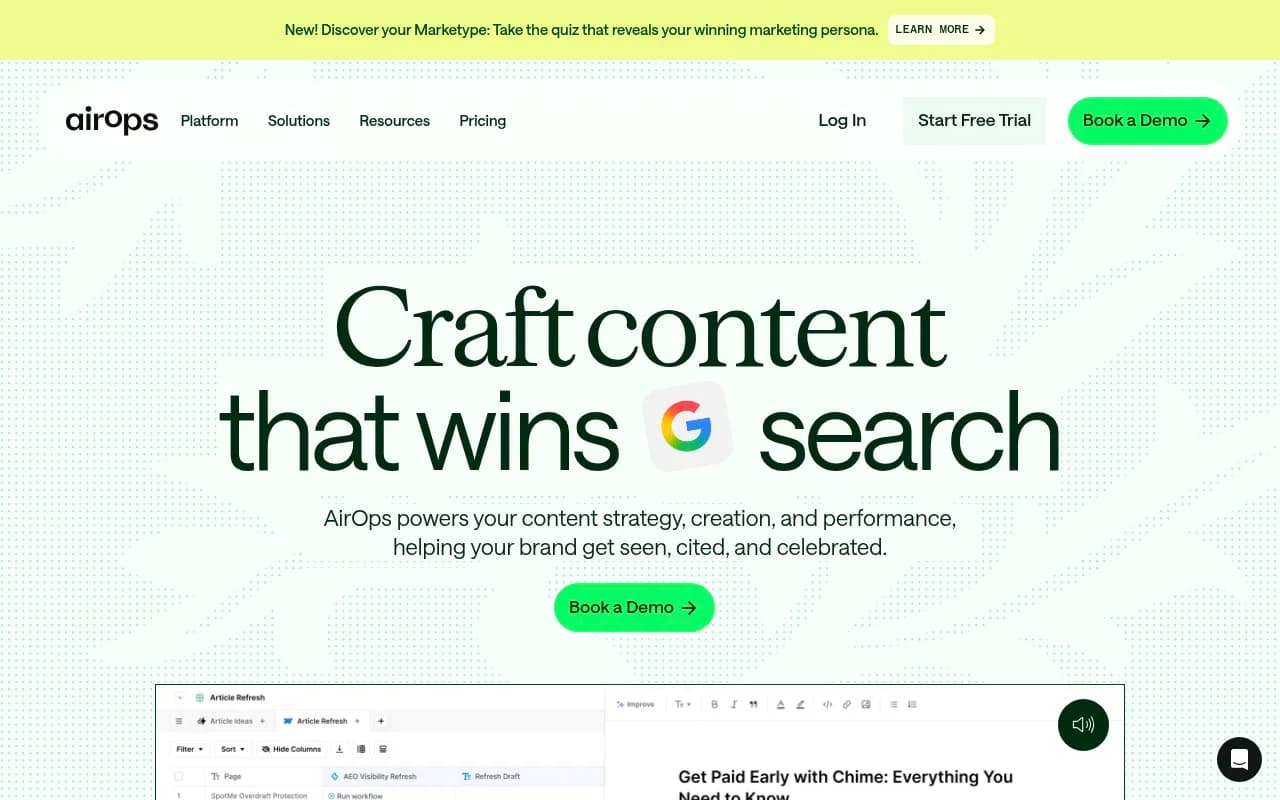
AirOps Review 2026
Combines workflow automation with GEO capabilities to help teams systematically improve their AI search visibility at scale.
Key Takeaways
- Monitoring-only approach: AirOps tracks AI search visibility across 10+ models (ChatGPT, Perplexity, Claude, Gemini, etc.) but lacks the content generation, crawler logs, and traffic attribution that Promptwatch offers for actually optimizing your presence
- Strong workflow automation: Excels at building custom content workflows with brand guardrails, knowledge bases, and human review steps -- useful for teams that want to maintain quality at scale
- Best for content teams with existing strategy: Works well for marketing teams at mid-to-large companies (Webflow, Chime, Ramp, Carta) who already know what content to create and need help executing faster
- Steep learning curve: The platform's power comes with complexity -- expect a ramp-up period to build effective workflows and integrate with your stack
- Premium pricing: Starts at $200/month for solo users, $2,000/month for teams -- significantly higher than competitors like Promptwatch ($99-$579/mo) that offer more complete GEO capabilities

AirOps positions itself as a "content engineering platform" -- a term the company uses to describe the intersection of content strategy, AI-powered creation, and workflow automation. Founded to help marketing teams adapt to the shift toward AI search, AirOps has attracted notable customers including Webflow, Chime, Ramp, Carta, Apollo, Docebo, and LegalZoom. The platform raised a Series B round and has built a reputation in the SEO and content marketing community through its Content Engineering Certification program and research reports on AI search behavior.
The core pitch: traditional content creation is too slow and AI search is reshaping how people discover brands. AirOps aims to help teams create more content, faster, while maintaining quality and brand voice. It does this through two main layers -- Insights (tracking where you should focus) and Action (workflows to create and optimize content).
Insights Layer: AI Search Visibility Tracking
AirOps monitors your brand's visibility across 10 AI models: ChatGPT, Perplexity, Google AI Overviews, Google AI Mode, Claude, Gemini, Meta/Llama, DeepSeek, Grok, Mistral, and Copilot. You can track which prompts your brand appears in, how often you're cited, and how you compare to competitors.
The platform surfaces opportunities through filters and dashboards -- showing you which topics, prompts, and domains are driving influence. Page360 is their unified view that combines SEO data, AI search visibility, and Google Analytics 4 metrics to give you a complete picture of content health.
What's missing here compared to Promptwatch: AirOps doesn't offer AI crawler logs (real-time tracking of which pages ChatGPT, Claude, and Perplexity are actually reading on your site), prompt volume estimates, difficulty scoring, query fan-outs, or Reddit/YouTube tracking. You also don't get traffic attribution to connect AI visibility to actual revenue. These gaps mean you're monitoring visibility but not understanding the full picture of how AI engines discover and use your content.
Action Layer: Content Workflows and Generation
This is where AirOps differentiates itself. The Action layer is a workflow builder that lets you create custom content pipelines. You can combine data sources (SEO tools, internal databases, competitor analysis), brand knowledge bases (tone, rules, references), AI generation steps, and human review checkpoints.
Grids are the project management interface -- think of them as a spreadsheet view where each row is a piece of content and each column is a workflow step. You can manage hundreds of articles, track their status, and collaborate with your team.
Workflows are the automation engine. You build multi-step processes that pull data, generate content, apply brand guardrails, and route drafts for human review. AirOps provides pre-built "Power Agents" (templates for common tasks like keyword research, content outlining, competitor analysis) that you can fork and customize.
Brand Kits & Knowledge Bases let you store your brand voice, style guides, product information, and reference materials. Workflows can pull from these knowledge bases to ensure generated content stays on-brand.
Integrations connect AirOps to your stack -- SEO tools (Ahrefs, Semrush), CMS platforms (Webflow, WordPress), analytics (Google Analytics 4, Amplitude), and collaboration tools (Slack). You can also connect your own LLMs (OpenAI, Anthropic, custom models) and push content directly into your CMS without manual handoffs.
The human-in-the-loop approach is central to AirOps' philosophy. The platform doesn't try to fully automate content creation -- instead, it handles the repetitive, time-consuming parts (research, outlining, first drafts) and routes work to humans for the parts that matter (strategy, editing, final polish).
Who Is It For
AirOps is built for mid-to-large marketing teams at B2B SaaS companies, agencies, and content-heavy brands. The ideal customer is a content or SEO team of 3-10 people managing 50-500+ articles, with a clear content strategy and the budget to invest in workflow automation.
Specific personas who benefit:
- SEO managers at SaaS companies (50-500 employees) who need to refresh hundreds of existing pages and create new content to compete in AI search. Example: Webflow's growth team used AirOps to 5x their content refresh velocity and increase AI-attributed signups from 2% to 10%.
- Content directors at fintech/enterprise brands who need to maintain brand quality while scaling output. Example: Chime dropped their agency and 10xed content output using AirOps workflows.
- Marketing agencies managing multiple client sites who need repeatable processes for content audits, keyword research, and content creation. Example: Graphite uses AirOps to deliver high-quality content for clients at scale.
- Growth marketers who want to experiment with AI search optimization but don't have the headcount to manually create and test content. Example: Ramp's growth team used AirOps to achieve 10x ROI on Reddit strategy.
Who should NOT use AirOps:
- Solo marketers or small teams (1-2 people) who need simple, affordable tools. The $200/month starting price and complexity of workflow building make AirOps overkill for small operations. Promptwatch at $99/month is a better fit for solo users who want AI search visibility tracking and content gap analysis without the workflow overhead.
- Teams without a clear content strategy. AirOps is an execution platform, not a strategy platform. If you don't already know what content to create, the workflows won't help.
- Companies that need deep AI search optimization. AirOps monitors visibility but doesn't provide the content gap analysis, prompt intelligence, or traffic attribution needed to systematically improve your AI search rankings. Promptwatch is purpose-built for GEO/AEO with features like Answer Gap Analysis (shows exactly which prompts competitors rank for but you don't), AI content generation grounded in 880M+ citations, and page-level tracking with traffic attribution.
Integrations & Ecosystem
AirOps connects to a wide range of tools:
- SEO platforms: Ahrefs, Semrush (for keyword data, backlink analysis, competitor research)
- CMS: Webflow, WordPress, Contentful (direct publishing, no manual copy-paste)
- Analytics: Google Analytics 4, Amplitude (traffic and conversion tracking)
- Collaboration: Slack (notifications, approvals), Google Sheets (data import/export)
- LLMs: OpenAI, Anthropic, custom models (bring your own API keys for cost control)
- Data sources: Custom APIs, databases, spreadsheets (pull in proprietary data for content personalization)
The platform has a REST API for custom integrations and supports webhooks for triggering workflows based on external events. Browser extensions and mobile apps are not available -- AirOps is a web-based platform designed for desktop use.
One notable gap: AirOps doesn't integrate with AI search monitoring tools like Promptwatch, which means you're limited to AirOps' own visibility tracking. If you want deeper AI search insights (crawler logs, prompt volumes, Reddit/YouTube tracking, ChatGPT Shopping), you'd need to use a separate tool.
Pricing & Value
AirOps uses a tiered pricing model:
- Solo Plan: $200/month for individual users. Includes basic workflows, limited tasks (pricing per 1000 tasks varies), and access to Power Agents.
- Pro Plan: $2,000/month for teams. Includes advanced workflows, more tasks ($9 per 1000 additional tasks), team collaboration features, and priority support.
- Custom/Enterprise: Contact sales for pricing. Includes dedicated account management, custom integrations, and SLA guarantees.
No free trial is advertised on the website, though they offer a "Start Free Trial" button that likely requires a demo call first. The pricing is significantly higher than competitors:
- Promptwatch: $99-$579/month for comprehensive GEO capabilities (AI search tracking, content gap analysis, AI content generation, crawler logs, traffic attribution)
- Otterly.AI, Peec.ai, AthenaHQ: $50-$300/month for monitoring-only tools
- Traditional SEO tools (Ahrefs, Semrush): $99-$400/month for keyword research and rank tracking
The value proposition depends on your use case. If you're a large team creating 100+ pieces of content per month and need workflow automation, the $2,000/month Pro plan could pay for itself by eliminating agency costs (Chime reported 50% cost reduction by dropping their agency). But if you're a smaller team focused on AI search optimization, Promptwatch offers better value with more complete GEO features at a fraction of the cost.
Strengths & Limitations
Strengths:
- Workflow flexibility: The ability to build custom, multi-step content workflows with brand guardrails and human review is powerful for teams that need repeatable processes.
- Human-in-the-loop philosophy: AirOps doesn't try to fully automate content -- it handles the grunt work and routes the important parts to humans. This results in higher-quality output than fully automated tools.
- Strong customer base: Webflow, Chime, Ramp, Carta, and other notable brands use AirOps, which signals product-market fit for mid-to-large content teams.
- Content Engineering Certification: The free training program (cohort-based, hands-on) helps users learn the platform and has built a community of practitioners. Several participants reported promotions after completing the program.
- Research and thought leadership: AirOps publishes detailed research reports on AI search behavior (e.g. "Fresh content earns 70% more citations", "Structured pages were surfaced 23% more across related queries") that provide actionable insights even if you don't use the platform.
Limitations:
- Monitoring-only AI search tracking: AirOps shows you where you're visible in AI search but doesn't help you understand why or how to improve. Missing features compared to Promptwatch: AI crawler logs, content gap analysis (Answer Gap Analysis), prompt volume and difficulty scoring, query fan-outs, Reddit/YouTube tracking, ChatGPT Shopping tracking, and traffic attribution. You're left guessing which content to create and whether it's actually driving results.
- No AI content generation: Unlike Promptwatch, which includes an AI writing agent that generates articles grounded in 880M+ citations and real prompt data, AirOps requires you to build your own workflows. This means more setup time and less out-of-the-box value.
- Steep learning curve: Building effective workflows requires understanding the platform's logic, data sources, and AI models. Expect a 2-4 week ramp-up period before you're productive. The Content Engineering Certification helps but is still a significant time investment.
- High pricing: At $200/month for solo users and $2,000/month for teams, AirOps is 2-4x more expensive than competitors like Promptwatch that offer more complete GEO capabilities. The pricing makes sense for large teams with big content budgets but is prohibitive for smaller operations.
- Limited AI search optimization features: AirOps focuses on content creation workflows, not AI search optimization. If your goal is to rank in ChatGPT, Perplexity, and Google AI Overviews, Promptwatch is purpose-built for that use case with features like Answer Gap Analysis, AI content generation, and page-level citation tracking.
Bottom Line
AirOps is a strong workflow automation platform for mid-to-large content teams that already have a clear strategy and need help executing faster. If you're managing 50-500+ articles, have a team of 3-10 people, and want to maintain brand quality while scaling output, AirOps can help you build repeatable processes and eliminate manual work.
However, if your goal is to optimize for AI search visibility -- to rank in ChatGPT, Perplexity, Claude, and Google AI Overviews -- AirOps falls short. It monitors where you're visible but doesn't provide the content gap analysis, prompt intelligence, AI content generation, or traffic attribution needed to systematically improve your rankings. Promptwatch is the stronger choice for GEO/AEO, offering a complete optimization platform (not just monitoring) at a fraction of the cost.
Best use case in one sentence: Large content teams at B2B SaaS companies who need workflow automation to scale content creation while maintaining brand quality, and who already have a separate tool or strategy for AI search optimization.
Tags:
Similar and alternative tools to AirOps