Key takeaways
- BabyLove Growth is roughly 2-20x cheaper than AirOps depending on plan, and it bundles content, backlinks, and basic AI-visibility tracking into one price. AirOps charges separately for volume and doesn't touch backlinks at all.
- AirOps is a workflow/content-engineering platform, not a monitoring tool. Profound's own review calls it out directly: built for content production, not AI visibility.
- BabyLove Growth's content quality is the weak point. Independent reviewers (Aboah Reviews, a YouTube "Honest Review") flag AI-detectable text, missing citations, and a self-graded 99/100 quality score that means nothing.
- AirOps has a real learning curve and its pricing only makes sense if you're publishing serious volume; Profound notes 10-20 articles/month won't justify the cost.
- BabyLove Growth's backlink model has generated real controversy in its Trustpilot reviews, including accusations of violating Google's link-scheme guidelines (which the company disputes) and inconsistent delivery of promised links.
- Neither tool is a dedicated AI-search-visibility platform. If tracking how your brand actually shows up in ChatGPT, Gemini, or AI Overviews matters more than churning out articles, you'll want something purpose-built for that alongside either tool.
Overview

AirOps positions itself as "the strategy that wins AI discovery," but in practice it's a content-engineering and workflow-automation platform. You build Playbooks and run them at scale through a spreadsheet-like feature called Grid, publishing directly to Webflow, WordPress, Contentful, Ghost, Sanity, Strapi, or ContentStack. It's used by companies like Ramp, Webflow, Gong, and monday.com, and the pricing reflects an enterprise-leaning buyer: $200/mo to start, $2,000/mo for real multi-engine coverage, and custom pricing above that.
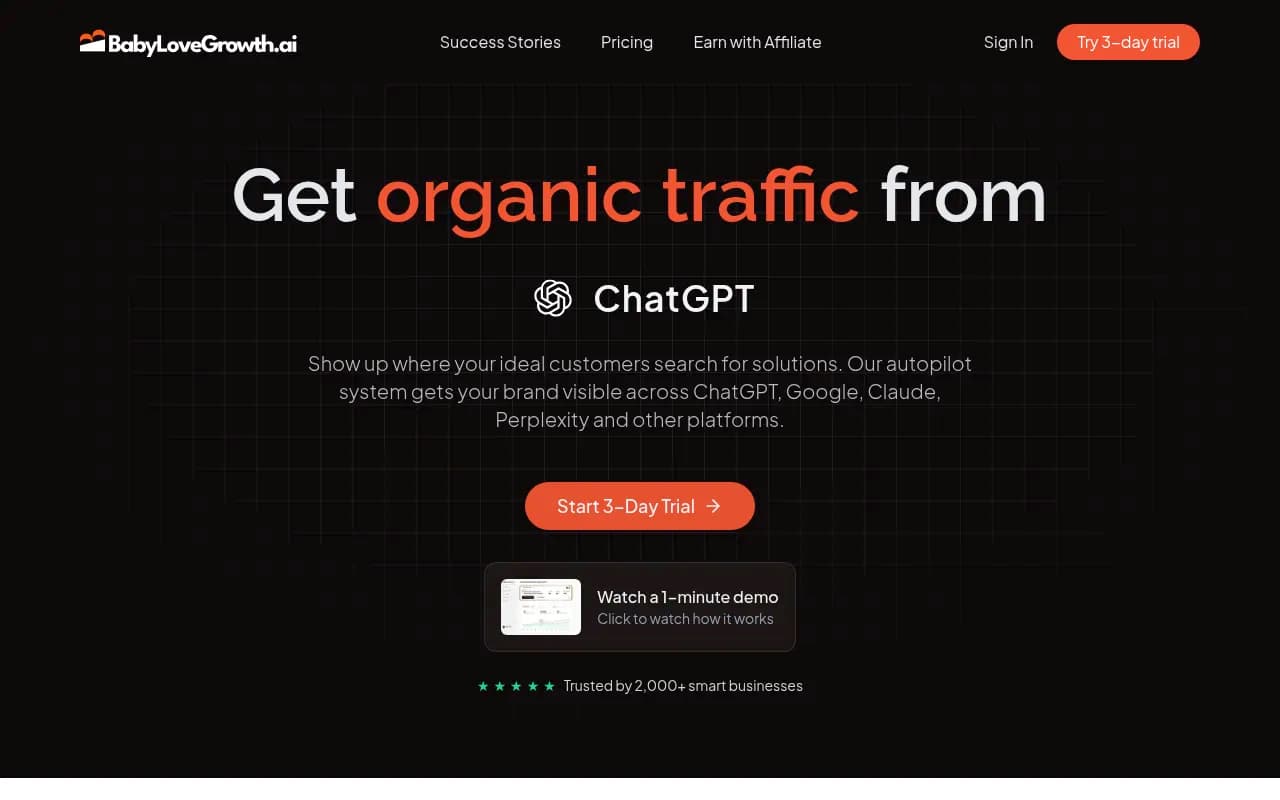
BabyLove Growth is the opposite bet: a fully automated bundle of content, backlinks, and light AI-visibility tracking aimed at founders, small teams, and agencies who don't want to manage a stack of separate tools. It's used by 4,000+ businesses, according to its own site, and its Trustpilot score sits at 4.5/5 across 205 reviews, though the negative reviews are pointed and specific: a punishing cancellation flow, inconsistent backlink delivery, and a 3-day trial that reviewers say isn't long enough to judge results before the card gets charged.
Side-by-side comparison
| Feature | AirOps | BabyLove Growth |
|---|---|---|
| Starting price | $200/mo (Solo) | $99/mo (Grow) |
| Top public tier | $2,000/mo (Pro) | $399/mo (Scale) |
| Free trial | None publicized | 3 days |
| Content volume (entry tier) | 35,000 tasks/mo | 30 articles/mo |
| Backlinks included | No | Yes, $800+/mo value (Grow), $1,600+/mo (Scale) |
| AI/LLM visibility tracking | ChatGPT only (Solo); 7+ engines (Pro) | 10 prompts across ChatGPT, Claude, Gemini (Grow); 50 (Scale) |
| CMS integrations | Webflow, WordPress, Contentful, ContentStack, Ghost, Sanity, Strapi | WordPress, Shopify, Webflow, Wix, Ghost, Duda, BigCommerce + more |
| Reddit/social targeting | No | Yes, Reddit and Quora agents |
| Learning curve | Steep, per G2 and Profound reviews | Low, largely automated |
| Agency/white-label program | Available on Enterprise | Dedicated white-label/reseller program |
| Content editorial control | High (Brand Kit, Writing Rules, Knowledge Bases) | Low (learns from a single sample URL) |
| Money-back guarantee | Not published | 90-day |
| Ideal monthly content volume to justify cost | High-volume publishers | Any volume, low-touch |
Content quality and customization
AirOps leans on what it calls Brand Kits and Knowledge Bases to keep output on-brand, plus a rules-based system reviewers on G2 specifically praise for voice consistency. The tradeoff is setup time. Multiple G2 reviews and Profound's independent review both describe a real learning curve before Playbooks and Grid start paying off.
BabyLove Growth skips almost all of that setup, which is the whole pitch, but the cost shows up in the output. Aboah Reviews' 45-day test across three sites found content quality inconsistent in technical or regulated niches, needing 25-35 minutes of editing per article versus 8 minutes for straightforward ecommerce copy. A YouTube review going by "BabyLoveGrowth Honest Review 2026" is blunter: it calls the articles 100% AI-detectable, notes they ship without cited sources, and points out that the platform's own 99/100 quality score is graded by the same system that wrote the article, which isn't a quality signal at all.
Verdict: AirOps produces more defensible content if you put in the setup work. BabyLove Growth is faster but you should plan to edit almost everything it produces before publishing.
Backlinks
This is the single biggest structural difference between the two. AirOps has no backlink component; it's a content and workflow tool, full stop. BabyLove Growth builds a backlink exchange into every plan, drawing from a network of 4,000+ partner sites, and quotes a dollar value for the links included ($800+/mo on Grow, $1,600+/mo on Scale).
The catch is in the Trustpilot reviews. Several customers report receiving far fewer backlinks than promised, sometimes zero or one link after 30-60 days. Others raise a more serious concern: that the reciprocal link-exchange model runs against Google's link-scheme guidelines. BabyLove Growth disputes this in its own review replies, describing the links as contextual placements in an A-B-C-D exchange network rather than direct reciprocal swaps. Whether that distinction holds up is between you and Google's Search Quality team, not something either vendor can promise.
Verdict: if backlinks are the deciding factor, BabyLove Growth includes them and AirOps doesn't. Just don't take the delivery numbers at face value.
AI visibility tracking
Both tools track some AI-visibility signal, but neither is built primarily for it. AirOps' Solo plan only covers ChatGPT; you need the $2,000/mo Pro tier to get insights across 7+ answer engines. Profound's independent review is direct about this gap, stating AirOps is built for content production, not AI visibility, and flags limited LLM and regional coverage as a real shortcoming.
BabyLove Growth tracks 10 prompts across ChatGPT, Claude, and Gemini on its entry tier, rising to 50 prompts on Scale. That's broader model coverage than AirOps' entry tier, but it's still a shallow slice of what dedicated AI-visibility platforms track, things like prompt volumes, difficulty scores, citation trends by content type, or AI crawler logs showing which pages ChatGPT and Perplexity actually read.
If AI search visibility is the actual goal rather than a side feature bolted onto a content tool, it's worth looking at a platform built specifically for that job. Promptwatch tracks citations, crawler activity (ChatGPTBot, ClaudeBot, PerplexityBot, and 400+ others), Reddit and YouTube citation share, and AI-driven traffic, then turns that data into prioritized actions rather than just a mention count. It complements either AirOps or BabyLove Growth rather than replacing them; you'd still need something producing content, this just tells you whether that content is actually getting cited.

Verdict: neither tool is a serious AI-visibility platform. Treat their tracking features as a bonus, not the reason to buy.
Integrations
| Integration type | AirOps | BabyLove Growth |
|---|---|---|
| CMS | Webflow, WordPress, Contentful, ContentStack, Ghost, Sanity, Strapi | WordPress, Shopify, Webflow, Wix, Ghost, Duda, BigCommerce, Snapps |
| Analytics | GA4, Google Search Console, Ahrefs, Semrush, Moz | Google Analytics, Google Search Console |
| AI/MCP | Claude MCP, G2 MCP | Not published |
| Broader connectors | 1,200+ apps via Integrately | API/Webhook |
| Languages | Not a stated strength | 50+ languages listed on pricing page |
AirOps wins on depth and breadth here, especially with its Claude MCP and G2 MCP connectors pulling review and buyer-intent data directly into its Playbooks. BabyLove Growth's integration list is more basic but covers the essentials most small teams need, and its multi-language claim (50+ languages, though one third-party review says 20+