Key takeaways
- Detecting decay is easy. Deciding what to do about each page (refresh, consolidate, redirect, prune) is the real work, and it needs a scoring model rather than a gut call.
- Decay now runs on two tracks: a page can lose Google rankings and drop out of AI answers independently of each other.
- Prune by content type and intent, not age. Promptwatch Data shows news-style pages lose citations fastest, while landing pages and docs last longest.
- Pages with backlinks, indexed history, or positions 5 to 20 are refresh candidates. Pages with no links, no traffic, and a dead keyword are prune or redirect candidates.
- At scale, the only workable setup is a pipeline: export, score, batch, act, then measure. Humans review the exceptions, not every page.
Why AI-generated libraries need a different maintenance plan
If you spun up 300 articles with an AI writer in 2024 or 2025, you probably have a specific problem now. A chunk of those pages are fine. A chunk are thin, overlapping, or built around keywords that never had demand. And a few are quietly your best performers. You can't tell which is which by looking at them, because AI drafts tend to look equally polished whether they work or not.
That uniform polish is the trap. Hand-written libraries decay unevenly and you remember which posts were weak. AI libraries have no such memory. Nobody feels attached to page 212, so nobody notices it has been cannibalizing page 97 for a year.
The good news is that the maintenance logic is the same as for any content library. It just has to be systematized, because you can't eyeball 2,000 URLs.
Understand the two kinds of decay
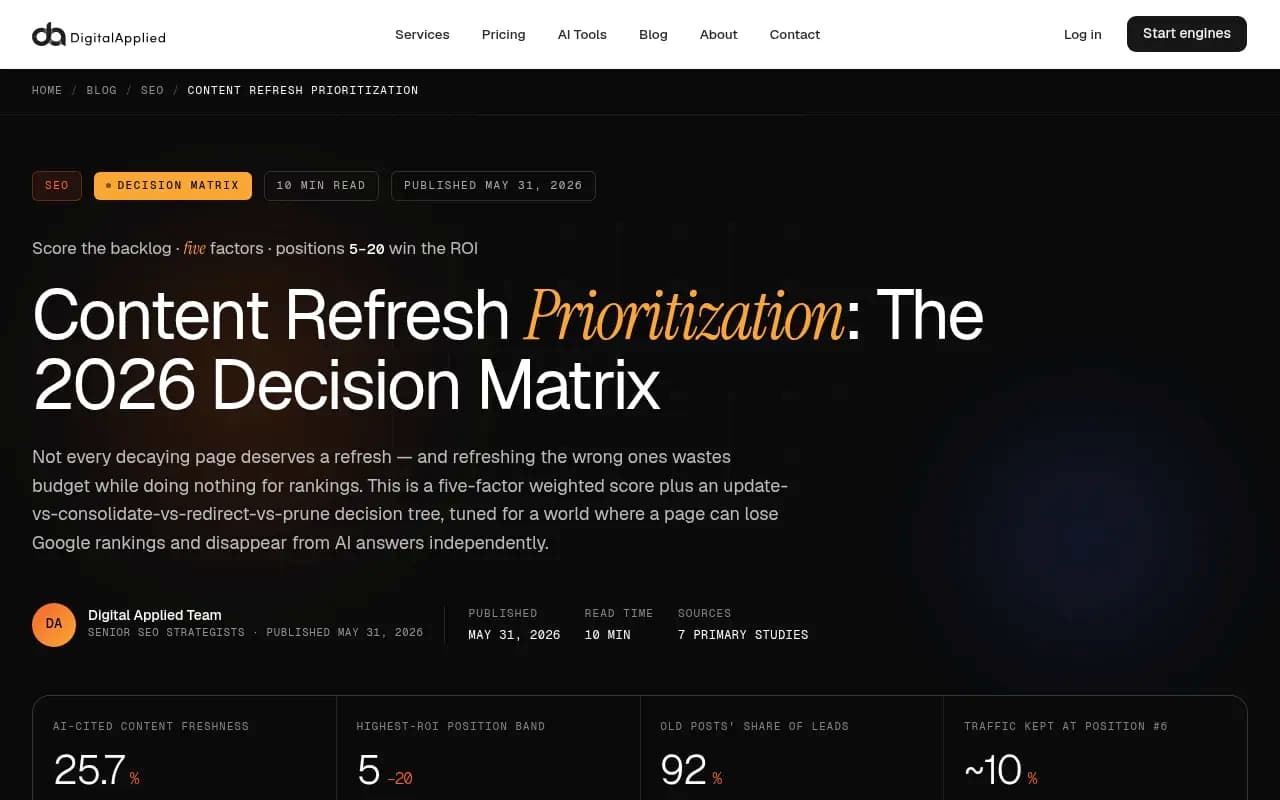
Older refresh advice only worried about Google rankings. In 2026 there is a second dimension. Digital Applied's 2026 decision matrix points to an Ahrefs analysis of roughly 17 million URLs finding that AI-cited content runs 25.7% fresher than organic SERP results. Treat that as one study's finding rather than a law, but the direction matches what most teams see: AI assistants lean toward recent pages.
So for every page you now have two questions:
- Is it still ranking and earning clicks in Google and Bing?
- Is it still being retrieved and cited in ChatGPT, Perplexity, and AI Overviews?
A page can fail one and pass the other. Retrieval is also not the same as citation. A study covered by MarketingProfs in March 2026 found only about 15% of the pages ChatGPT retrieves end up cited in the final answer. Getting fetched is not enough, which is a good reason to refresh for clarity and specificity, not just for dates.
Not all content types decay at the same speed
This is the most useful data point for deciding what to prune. Promptwatch tracked every classified page ChatGPT cited on July 6, 2026 for 90 days, and the half-life differs a lot by type (ChatGPT content half-life report).
| Content type | Still cited at day 30 | Still cited at day 60 | Notes |
|---|---|---|---|
| Landing pages | 78% | 69% | Real half-life likely beyond 90 days |
| Docs | 76% | 67% | 93% were cited again after day 0 |
| Comparisons | 72% | 63% | Durable |
| Listicles | n/a | 60% | Half-life likely close to or beyond 90 days |
| Product pages, reviews, how-tos | n/a | 55% | Half-life of 74 to 77 days |
| News | n/a | 41% | Half gone after 36 days |
A caveat from the report itself: landing pages, docs, comparisons and listicles only cross 50% in the final week of the window, so their true half-life is probably longer than what was measured. The window ended before they did.
Now pair that with what ChatGPT actually cites. In Promptwatch's citation share by content type data for Sep 28 to Oct 4, 2026, product pages took 22.4% of citations, landing pages 16.8%, listicles 13.6%, how-to guides 8.7%, docs 7.5%, and news 5.7%.
The practical takeaway for pruning:
- Do not delete product, landing, docs, or comparison pages just because they are old. They are the formats AI keeps citing.
- Review news-style and thin how-to content first. They lose citations fastest and add the least.
- Keep prices, specs, and positioning accurate on the durable formats, because stale facts there do the most damage.
Step 1: Build the inventory
Export every URL with the fields you need to decide. At minimum:
- URL, publish date, last modified date, content type, and word count
- Clicks, impressions, and average position for the last 12 months from Google Search Console, with a year-over-year comparison
- Referring domains and internal links
- Conversions or assisted conversions
- AI crawl and citation data, if you have it
For the crawl side, a desktop crawler gets you word counts, titles, canonicals, status codes, and internal link counts for the whole site.
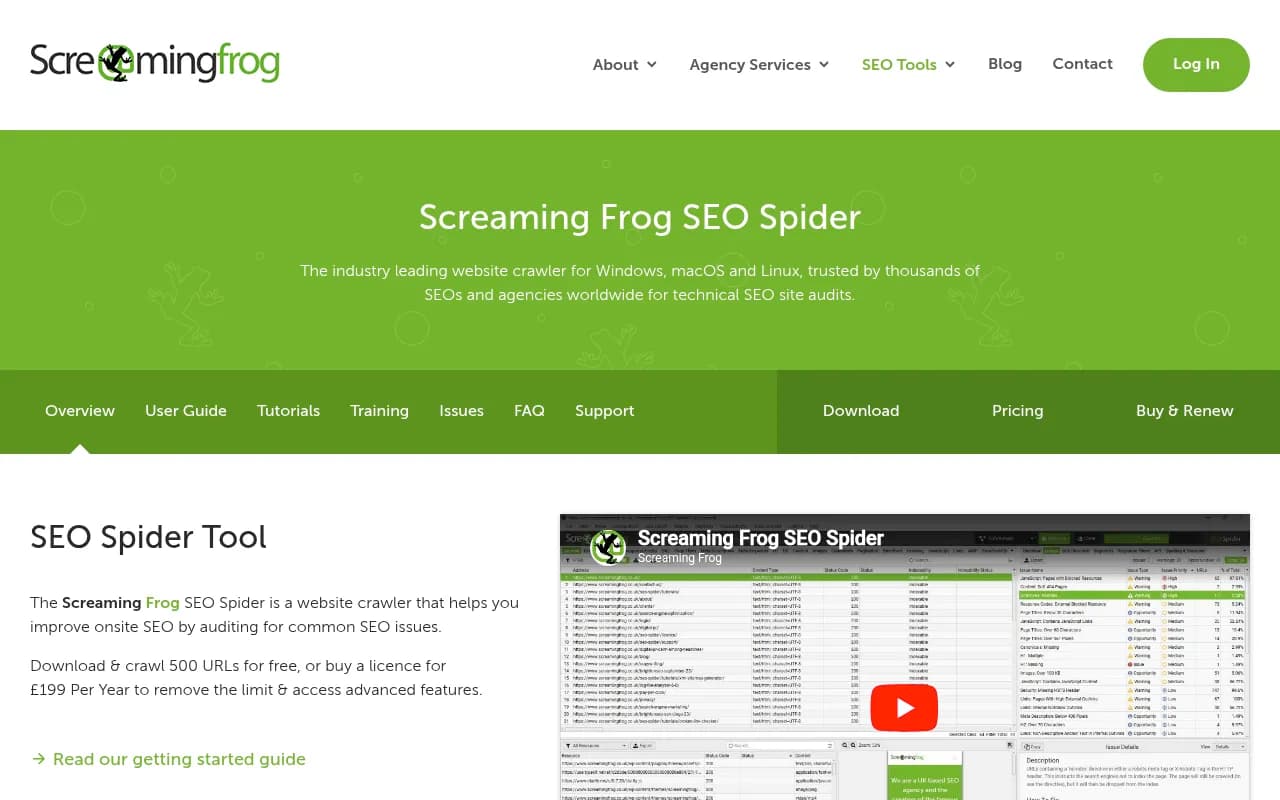
For sites past roughly 100,000 URLs, an enterprise crawler with log analysis is worth the money because it shows which pages search engines actually visit.
Tag each URL with its content type. This sounds tedious but it drives everything else, because the half-life numbers above only help if you know which pages are news, which are how-tos, and which are landing pages. An LLM can classify titles and URL patterns in bulk. Spot check 5% of the output by hand.
Step 2: Score the backlog
Digital Applied's matrix scores five factors: decay slope, position band, intent drift, conversion value, and refresh effort. Their own note matters here: the weights are adjustable starting points, not a validated formula, because no published study supplies empirically derived weights for this combination. Believe that. Do not treat any scoring model as science.
A simple version you can build in a spreadsheet:
| Factor | What to measure | Higher score when |
|---|---|---|
| Decay slope | Clicks, 12 months vs prior 12 | Steeper decline |
| Position band | Average position | Between 5 and 20 |
| Intent drift | Do current top results match your format? | Large mismatch |
| Conversion value | Revenue or leads attributed | Higher value |
| Refresh effort | Hours needed | Lower effort |
Positions 5 to 20 are the sweet spot. Those pages have banked authority and indexed history but aren't capturing first-page click volume yet. The traffic cliff is steep. Digital Applied cites Animalz saying a slip from #1 to #2 can roughly halve traffic, and position #6 keeps only around 10% of what #1 gets.
Add a sixth factor for AI-driven teams: AI citation status. If your audience leans on ChatGPT or Perplexity, weight freshness more heavily. If most of your AI traffic comes through Google AI Overviews, the freshness gap is smaller, per the same source.
Step 3: Triage into four actions
Every URL ends up in one of four buckets.
Update
The topic is still valuable and the page has some pull: links, impressions, or conversions. This is the default for anything in positions 5 to 20. Refresh targets usually include screenshots, internal links, external sources, product information, search intent coverage, formatting, and calls to action.
Consolidate
Two or more pages target the same intent. AI-generated libraries are full of these, because prompts like "write an article about X" and "write a guide to X" produce near-duplicates. Pick the strongest URL, fold the best material from the others into it, and 301 the rest.
Redirect
The page has no future but has backlinks or a close relative worth sending visitors to. Redirect it to the most relevant surviving page, not the homepage.
Prune
No traffic, no links, no conversions, a keyword with no demand, and content you wouldn't be proud of. Return a 410 or 404 and remove it from the sitemap and internal links.
The safeguard from the Digital Applied matrix is worth repeating: deleting a linked page throws away exactly the asset that makes refresh-first allocation pay off. Always check referring domains before you delete anything.
The goal of pruning isn't a smaller site. It's a content inventory where the pages worth finding are easy for search engines, AI systems, and people to understand.
A quick decision table
| Situation | Action |
|---|---|
| Position 5 to 20, some links, topic still relevant | Update |
| Overlaps another page on the same intent | Consolidate |
| Has backlinks, topic dead | Redirect |
| No traffic, no links, no impressions, 12+ months | Prune |
| News post older than a few months, no links | Prune or redirect |
| Docs, pricing, or landing page, even if old | Update, do not prune |
Step 4: Refresh at scale without making it worse
Here is where AI-generated content teams usually go wrong. They run the whole backlog through a model with the prompt "update this article for 2026" and publish the output. Dates change, nothing else does, and the page gets no better.
A refresh that moves the needle changes substance:
- Replace claims that lack a source with ones that have a named source and date.
- Add first-party facts the model could not have invented: your own data, screenshots, pricing, or customer detail.
- Rewrite the intro so the direct answer sits in the first two sentences.
- Fix intent mismatch. If the top results are comparison pages and yours is a how-to, change the format.
- Check internal links in both directions.
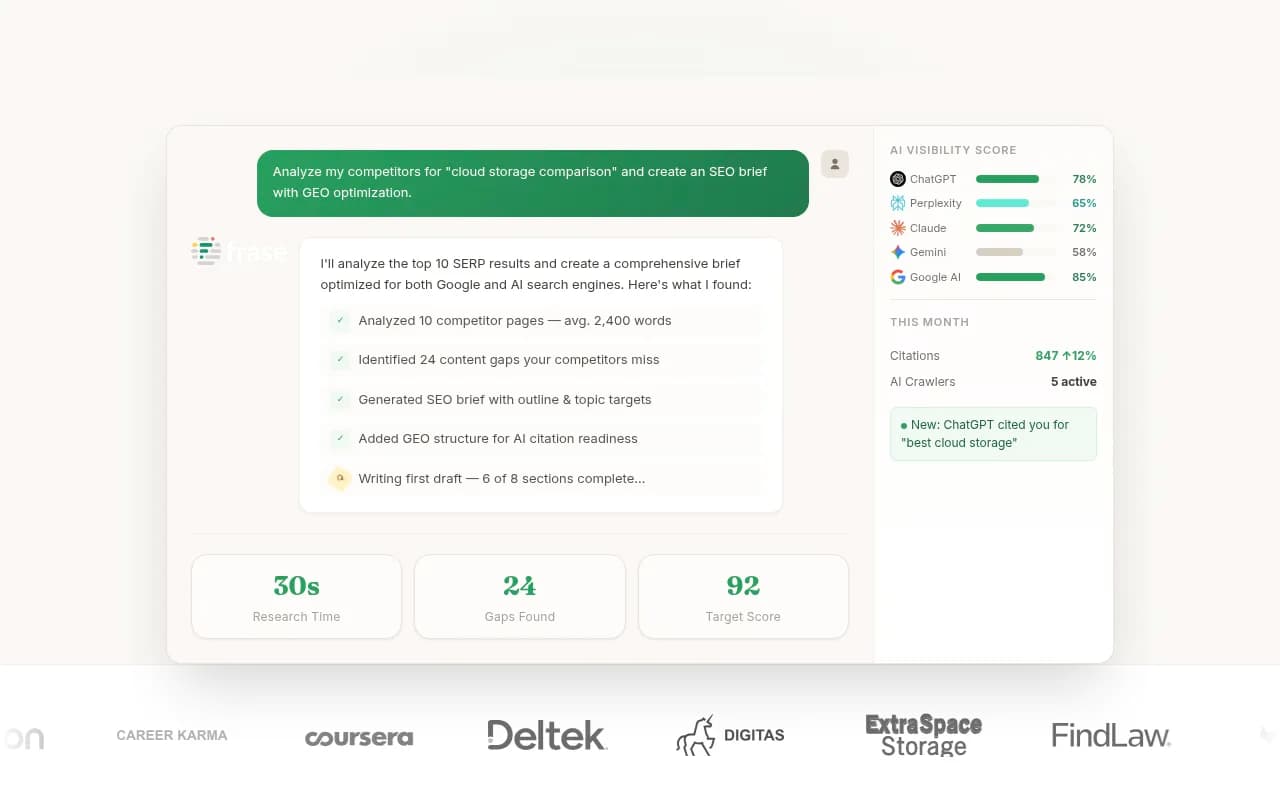
For on-page optimization against competing results, a few established tools do the comparison work and flag missing topics:

Keep a human in the loop for every page where the refresh touches facts, claims, or pricing. Batch the rest. One practical pattern is to refresh in tiers: the top 50 by score get an editor and a subject expert, the next 200 get an editor plus an AI-assisted draft, and the long tail gets automated fixes only (links, dates, broken references).
If you want a refresh pipeline that ties briefs, drafts, and publishing together, a few platforms in this space automate parts of it.

Automation is useful, but don't let it publish unreviewed on pages that already rank. Destabilizing a page that was performing is the most expensive mistake on this list.
Step 5: Measure whether AI systems noticed
Rankings tell you about Google. They don't tell you whether ChatGPT fetched the page, read it, or cited it. For that you need AI-side measurement. Tools like Promptwatch can show which of your pages get crawled by AI bots and cited, which makes it much easier to see whether a refresh changed anything after the fact, and to flag pages that rank in Google but never get cited.

Other trackers cover the monitoring side if you want to compare. Browse the GEO software directory at bestgeosoftware.com for a wider list.


A simple measurement routine after each batch:
- Wait 3 to 4 weeks, then compare clicks and average position against the pre-refresh baseline.
- Check whether the refreshed URLs were re-crawled by AI bots and whether they appear in citations for your tracked prompts.
- Tag each URL as improved, flat, or worse. Feed the flat and worse ones back into the backlog as actions, not as failures to ignore.
Step 6: Set cadences by content type
Given the half-life data, one refresh schedule for the whole site is wasteful. A starting point:
| Content type | Suggested review cadence | Why |
|---|---|---|
| Pricing, product, landing, docs | Quarterly, or on any product change | Most cited, and stale facts hurt most |
| Comparisons and listicles | Every 6 months | Durable, but the competitor set changes |
| How-to guides and reviews | Every 3 to 4 months | Half-life of about 75 days in citations |
| News and trend posts | Don't refresh. Prune or redirect after the burst | Half gone in about 36 days |
These are starting points based on the half-life data, not guarantees. Adjust them against your own results.
Common mistakes
- Pruning by age. Old and weak are different things.
- Deleting URLs with backlinks instead of redirecting them.
- Updating the publish date without changing the content. Search engines and AI systems can both tell.
- Refreshing everything at once, so you can't tell what worked.
- Ignoring cannibalization, which is the most common problem in AI-generated libraries.
- Redirecting hundreds of pruned URLs to the homepage, which usually gets treated like a soft 404.
A realistic first month
Week one: export and classify the inventory. Week two: score it, and mark the obvious prune and consolidate groups. Week three: ship the first redirect and prune batch, and start refreshing the top 20 by score. Week four: publish, request indexing, and set up the measurement baseline.
If you'd rather hand the whole thing to specialists, an agency that does technical SEO and AI search work can run the audit and triage for you. 1001 SEO Media does this kind of content audit as part of its SEO and GEO services.
Bottom line
Treat refresh as a prioritization problem, not a reflex. Score the backlog, triage into four actions, prune by content type instead of age, and measure on both the Google side and the AI side. For most AI-generated libraries, the biggest early win is consolidating near-duplicates, and the second biggest is leaving your durable landing and docs pages alone except to keep them accurate.