Key takeaways
- AirOps is a self-serve SaaS platform starting at $200/month. Search Party is a custom AI consultancy with no public pricing and likely six-figure engagement costs. These are fundamentally different buying decisions.
- AirOps is purpose-built for GEO (Generative Engine Optimization) -- tracking AI search visibility, finding content gaps, and publishing content that gets cited by ChatGPT, Perplexity, and similar models. Search Party doesn't focus on AI search visibility at all.
- Search Party embeds engineering teams into your business to build custom agentic workflows across sales, ops, and marketing. AirOps doesn't do custom implementation work -- you run it yourself.
- If you want to improve how your brand shows up in AI search results, AirOps is the more direct tool. If you want to automate internal business processes with custom-built AI systems, Search Party is the more relevant option.
- The two tools rarely compete for the same budget. AirOps is a marketing/SEO team purchase. Search Party is an operations or executive-level decision.
- Neither tool is a good fit for every company -- AirOps requires your team to actively use the platform, and Search Party requires a significant upfront investment with no guarantee of fit until after the validation session.
Overview
AirOps
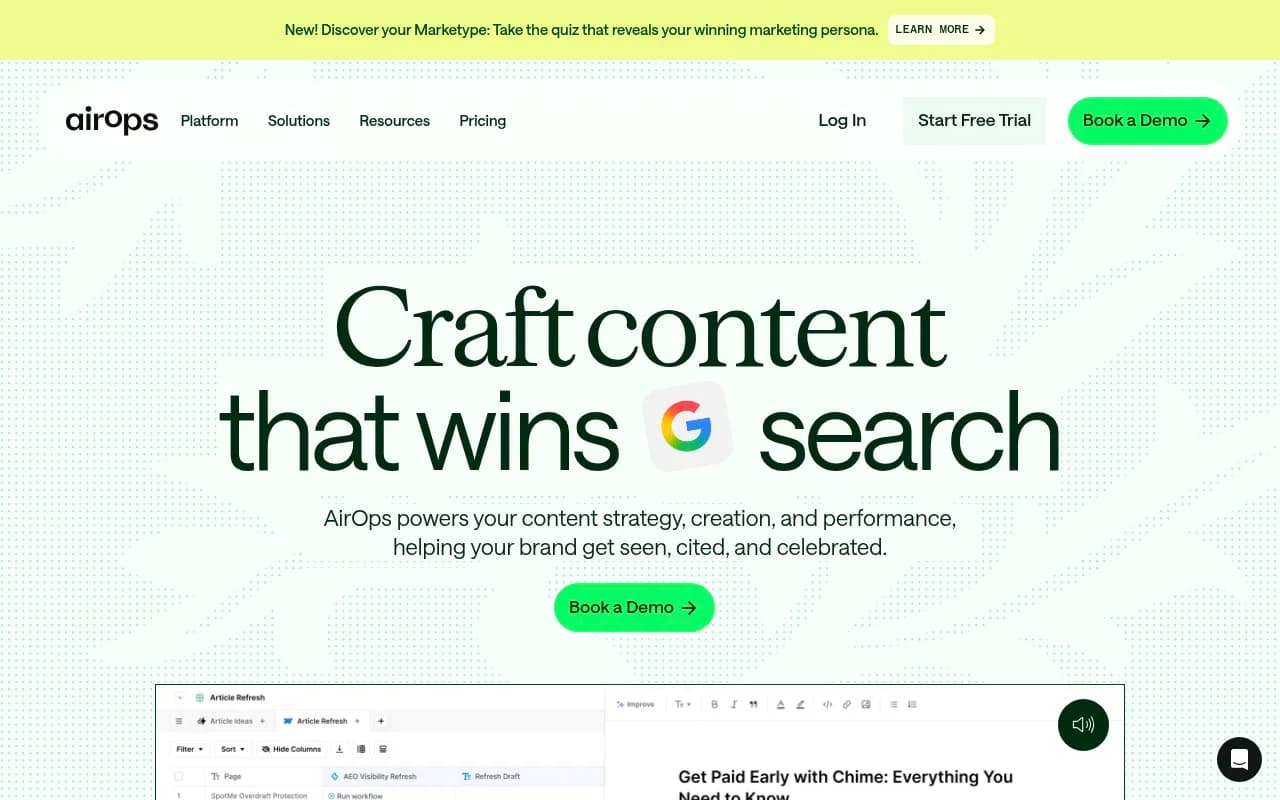
AirOps positions itself as a "content engineering platform" for AI search. The core idea: most brands are invisible in AI-generated answers, and the fix is creating content that AI models actually want to cite. AirOps combines GEO monitoring (tracking where your brand appears in ChatGPT, Perplexity, and other models) with workflow automation to produce that content at scale.
The platform covers the full loop -- from identifying which prompts your competitors rank for to generating and publishing content designed to close those gaps. It's aimed at marketing and SEO teams who want to own AI search visibility without hiring a consultant for every project.
Pricing runs from $200/month (Solo) to $2,000/month (Pro), with additional task costs of $6-$9 per 1,000 tasks depending on the plan.
Search Party
Search Party
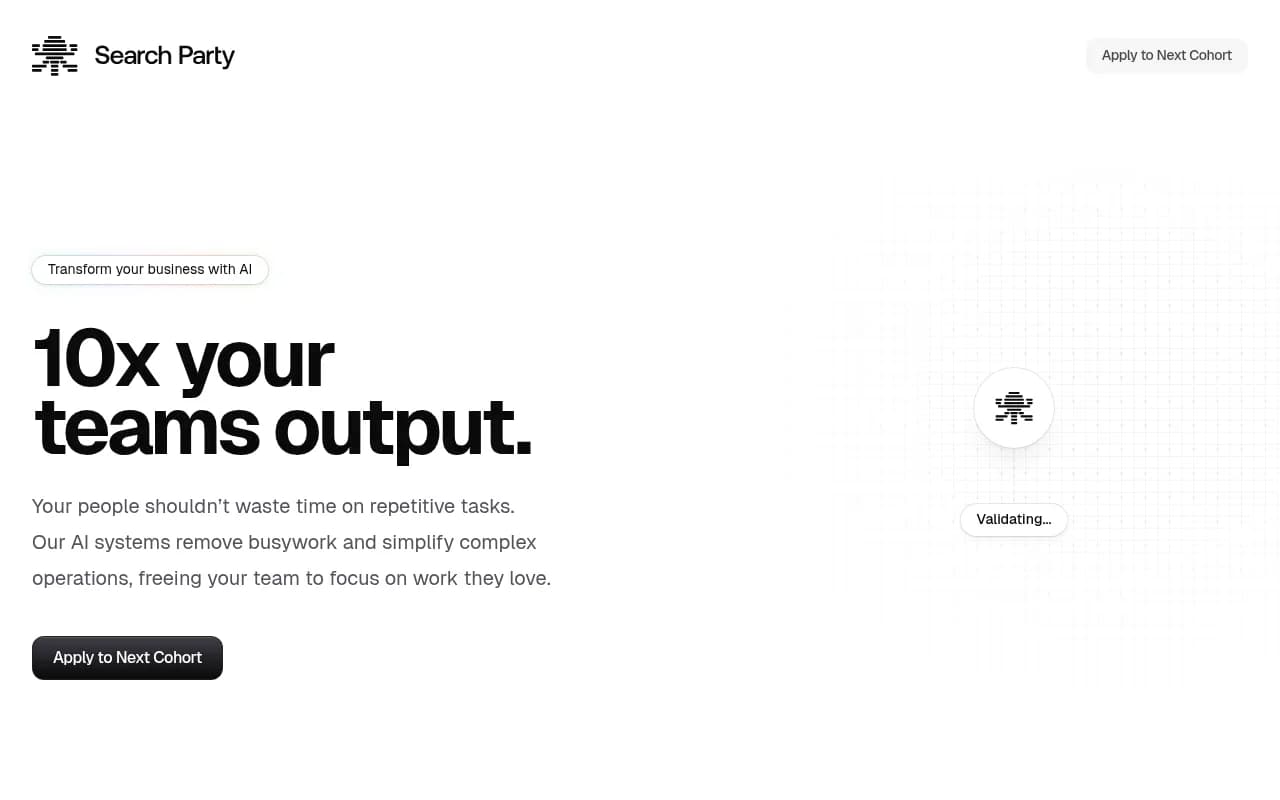
Search Party is an AI implementation consultancy. They don't sell software -- they sell outcomes. The model is cohort-based: you apply, go through a 90-minute validation session, and if the ROI math checks out, they embed an engineering team into your business to build custom AI systems.
Their DOE Framework (Directives, Orchestration, Execution) is the methodology they use to diagnose workflow bottlenecks and build production-grade automation across sales, marketing, operations, and R&D. The pitch is that off-the-shelf AI tools haven't moved the needle for most companies, and what's needed is custom orchestration -- not another SaaS subscription.
Pricing is entirely custom. Based on the engagement model and scope described, expect costs in the $100K-$500K+ range. There's no self-serve option.
Side-by-side comparison
| Feature | AirOps | Search Party |
|---|---|---|
| Product type | SaaS platform | AI consultancy / service |
| Primary focus | GEO / AI search content | Custom AI workflow automation |
| Self-serve | Yes | No (cohort application required) |
| Starting price | $200/month | Custom (est. $100K-$500K+) |
| Free tier | No | No |
| AI search monitoring | Yes | No |
| Content gap analysis | Yes | No |
| Content generation | Yes (AI-assisted) | No |
| Custom workflow builds | Limited (workflow automation within platform) | Yes (fully custom, production-grade) |
| Implementation support | Self-serve + docs | Embedded engineering team |
| Multi-model tracking | Yes (ChatGPT, Perplexity, etc.) | No |
| Target buyer | Marketing / SEO teams | Operations / executive leadership |
| Time to value | Days to weeks | Weeks to months |
| Scales across clients | Yes (agency-friendly) | No (single-business engagements) |
Head-to-head feature deep-dive
GEO and AI search visibility
AirOps was built specifically for this problem. It tracks where your brand appears (or doesn't) in AI-generated responses across ChatGPT, Perplexity, and other models, then helps you understand why competitors are getting cited instead of you. The content gap analysis is the core feature -- it surfaces specific topics and questions your site isn't answering, which is exactly the kind of signal you need to create content that AI models will reference.
Search Party doesn't touch this at all. Their work is internal -- automating how your team operates, not how your brand appears in external AI search results. If AI search visibility is your goal, Search Party isn't the right conversation.
Verdict: AirOps wins clearly. Search Party doesn't compete here.
Content creation and workflow automation
AirOps has built-in AI writing capabilities tied directly to its GEO data. You can generate articles, comparisons, and other content formats informed by real citation data and prompt volume -- not just generic AI output. The workflow automation layer lets teams scale this production without manually running every step.
Search Party builds custom automation systems, but these are internal business workflows -- think automated lead qualification, report generation, or operations pipelines. They're not building content production systems for AI search.
That said, Search Party's custom builds can be significantly more sophisticated than anything AirOps automates. If you need a complex multi-step agentic system that touches your CRM, data warehouse, and communication tools simultaneously, AirOps's workflow layer isn't designed for that.
Verdict: Depends entirely on what you mean by "workflow automation." For content and GEO workflows, AirOps. For internal business process automation, Search Party.
Pricing and accessibility
This is where the two tools diverge most sharply.
| Plan | AirOps | Search Party |
|---|---|---|
| Entry point | $200/month (Solo) | Custom (est. $100K-$500K+) |
| Mid-tier | $2,000/month (Pro) | N/A |
| Enterprise | Custom | Custom |
| Additional usage | $6-$9 per 1,000 tasks | N/A |
| Free trial | Not publicly listed | No |
| Self-serve signup | Yes | No (application required) |
AirOps is a predictable monthly subscription. You know what you're paying, and you can cancel. Search Party is a project-based engagement with no public pricing, no self-serve option, and a selection process that starts with a 90-minute validation call. You might not even get accepted.
For most marketing teams, AirOps is the obvious choice on accessibility alone. Search Party's model makes sense for companies with a specific operational problem and the budget to solve it properly.
Verdict: AirOps wins on accessibility and cost predictability. Search Party's pricing model is only appropriate for larger organizations with defined problems and executive buy-in.
Implementation and time to value
AirOps is self-serve. You sign up, connect your site, set up your prompts, and start seeing data. The learning curve exists -- you need to understand GEO concepts to use it well -- but you're not waiting on anyone else.
Search Party's process is deliberately slow at the front end. The validation session, bottleneck mining, and system design phases take time before anything gets built. Once the build starts, you have an engineering team working on your specific problems, which is a different kind of value. But the time-to-first-result is measured in weeks or months, not days.
Verdict: AirOps is faster to start. Search Party's slower process is intentional -- they're building something custom, not configuring a template.
Support and ongoing relationship
AirOps provides standard SaaS support -- documentation, likely a customer success team at higher tiers, and community resources. You're running the platform yourself.
Search Party's entire model is hands-on. Their team is embedded in your business during the engagement. That's a fundamentally different relationship -- closer to a fractional CTO or a specialist agency than a software vendor.
If you want someone to own the problem with you, Search Party's model is appealing. If you want control and don't want to depend on an external team, AirOps gives you that.
Verdict: Different models for different preferences. Neither is objectively better -- it depends on whether you want a tool or a partner.
Scalability and multi-client use
AirOps is built to scale. You can manage multiple sites, run parallel content workflows, and handle agency-style multi-client setups. The task-based pricing model means costs scale with usage, which is predictable.
Search Party works with one business at a time through their cohort model. It's not designed for agencies managing multiple clients, and there's no way to replicate their custom builds across different businesses without starting the engagement process from scratch each time.
Verdict: AirOps scales better for agencies and multi-brand teams. Search Party is a single-client engagement model.
Pros and cons
AirOps
Pros:
- Purpose-built for GEO and AI search visibility
- Self-serve with predictable monthly pricing
- Content gap analysis tied directly to AI citation data
- Scales for agencies and multi-site teams
- Faster time to value than a consultancy engagement
Cons:
- Requires your team to actively learn and operate the platform
- Workflow automation is limited to content and GEO use cases
- No embedded support -- you're on your own if you get stuck
- Additional task costs can add up at scale
- Less suited for complex internal business automation
Search Party
Pros:
- Fully custom solutions built for your specific business problems
- Embedded engineering team takes ownership of the outcome
- Covers a wide range of departments (sales, ops, marketing, R&D)
- Rigorous validation process means they only take on work they can deliver
- Production-grade systems, not toy pilots
Cons:
- No public pricing -- significant financial commitment with limited upfront transparency
- Not accessible to smaller teams or companies without large budgets
- Long lead time before anything is built
- No self-serve option -- you have to apply and be accepted
- Not focused on AI search visibility or GEO at all
- Cohort model limits availability
Who should pick which tool
Choose AirOps if:
- You want to improve how your brand appears in ChatGPT, Perplexity, Google AI Overviews, and other AI search results
- You have a marketing or SEO team that can operate a SaaS platform
- You need to scale content production for AI search without hiring a consultant for every project
- You're an agency managing AI search visibility for multiple clients
- You want predictable monthly costs and the ability to start quickly
Choose Search Party if:
- You have a specific, well-defined operational problem that off-the-shelf AI tools haven't solved
- You have the budget for a six-figure custom engagement
- You want an engineering team to own the build, not just advise
- Your problem spans multiple departments (sales, ops, marketing) and requires a custom orchestration layer
- You're not primarily focused on AI search visibility -- you're focused on internal efficiency
A note on AI search visibility
If your goal is specifically to track and improve how your brand shows up in AI-generated answers, neither AirOps nor Search Party is the most comprehensive option available. AirOps covers the content creation and GEO side well, but for deeper monitoring across 10+ AI models, crawler log analysis, Reddit and YouTube citation tracking, and traffic attribution, Promptwatch is worth looking at -- it's built end-to-end around that specific problem.

Final verdict
AirOps and Search Party are solving different problems for different buyers. Comparing them directly is a bit like comparing accounting software to hiring a CFO -- the question isn't which is better, it's which type of solution fits your situation.
If you're a marketing or SEO team trying to win visibility in AI search results, AirOps is the more relevant tool. It's accessible, purpose-built for GEO, and you can start in days rather than months.
If you're an executive trying to automate complex internal workflows and you have the budget for a custom engagement, Search Party's model makes sense -- but go in knowing it's a significant commitment with no self-serve fallback.
For most teams reading this comparison, AirOps is the practical starting point. Search Party is a different category of decision entirely.