Key takeaways
- ChatGPT and other retrieval systems pull passages, not whole pages, so every section has to make sense when read alone.
- Open each H2 with a short, direct answer (practitioners suggest roughly 40-75 words), then add evidence and nuance below it.
- Question-style headings, tables, numbered lists and FAQ blocks give models clean units to quote.
- Structure is only part of the story. Promptwatch's data shows page type and freshness shape citations too, and plain HTML beats markdown mirrors by about 2,000 to 1.
- Test your work by reading each section in isolation, then check whether the page actually gets crawled and cited.
Why structure matters for ChatGPT citations
ChatGPT doesn't read your article the way a person does. When it answers a question with web search, it breaks the question into sub-queries, retrieves matching passages from several sources, ranks them, and quotes or paraphrases the strongest ones. The unit of competition is the passage. Your intro, each H2 section, each FAQ answer and each table row are all competing separately.
That has a practical consequence. A page with good average writing but muddy sections loses to a page with clear, self-contained ones. I've seen well-researched long reads get ignored while a tidy comparison table from a smaller site gets quoted, and it usually comes down to this.
One caveat before we get into tactics. Most of the specific numbers floating around the web on this topic (40-75 word answers, headings under 10 words, 2-4x citation lifts) come from practitioner guides such as Kime, AirOps, LoudFace and 321 Web Marketing. They are useful rules of thumb, not measured findings from OpenAI. Treat them as sensible defaults you can test, not laws.

Check the page type before you obsess over formatting
Structure helps a page get quoted once it's in the candidate pool. Getting into the pool depends heavily on what kind of page you have. Promptwatch Data's report on ChatGPT citations by content type (Sep 28 to Oct 4, 2026) shows the split:
| Content type | Share of ChatGPT citations |
|---|---|
| Product pages | 22.4% |
| Landing pages | 16.8% |
| Listicles | 13.6% |
| How-to guides | 8.7% |
| Documentation | 7.5% |
| General articles | 6.1% |
| Comparisons | 5.9% |
| News | 5.7% |
| FAQ pages | 3.3% |
| Reviews | 1.7% |
Two things stand out. First, an FAQ page on its own is a small slice (3.3%), so don't expect a standalone FAQ to carry you. Put Q&A blocks inside pages that already deserve to be cited. Second, for informational prompts, how-tos (10.7%), docs (8.5%) and articles (7.7%) all earn a bigger share than they do overall. If your article answers a how-to question, formatting it as a step-by-step guide is a good match for what ChatGPT actually cites.
Write headings that match how people ask
A heading is the label a retrieval system uses to decide what a section is about. "Key considerations" tells it nothing. "How long does it take to see results from content marketing?" tells it exactly which question the section answers.
Headings that work
- Mirror real phrasing. Write the heading the way someone would type it into ChatGPT.
- Keep them short. Kime suggests under 10 words, because long headings dilute the match between heading and passage. That's a heuristic, but a short heading is easier to read anyway.
- Make each heading unique and specific. Three sections titled "Benefits" on one page are three identical labels.
- Keep the hierarchy clean: one H1 (your page title), H2 for main questions, H3 for sub-questions. Don't skip levels.
Before and after
| Vague heading | Extractable heading |
|---|---|
| Overview | What is an answer block? |
| Key considerations | How long should an answer paragraph be? |
| Tips | How do I make a section stand alone? |
| Pricing stuff | How much does the plan cost per month? |
Tools like AnswerThePublic and AlsoAsked are handy for finding the actual phrasing people use, and they're cheap ways to avoid inventing headings nobody searches for.
Lead every section with an answer block
The single most repeated piece of advice across the research is answer-first writing. The first paragraph under a heading should resolve the question the heading implies, in a form that can be lifted without context.
Practitioners put the sweet spot at roughly 40-75 words. Kime cites an analysis of 10,000 AI citations in which passages in that range were cited 3.1x more than longer ones; LoudFace argues for 40-60. I can't verify those figures independently, so read them as a range to aim for, not a threshold that flips a switch.
The anatomy of an answer block
- The first sentence answers the heading question directly.
- Two or three sentences add the essential qualifier, number or condition.
- Everything else (examples, nuance, edge cases) goes in the paragraphs after.
Here's a weak opener and a better one for the heading "How long should an answer paragraph be?"
Weak: "When thinking about content for AI search, there are a number of factors that people often consider, and length is one that many experts believe can matter in various ways."
Better: "Aim for 40 to 75 words. That is long enough to state the answer and one qualifying detail, and short enough that a model can quote it whole. Longer explanations belong in the paragraphs that follow."
The better version names its subject, makes a claim, and gives a number. Nothing in it depends on the previous section.
Make every section stand on its own
321 Web Marketing puts it well: every section should make full sense if a reader, or an AI system, lands on it without reading anything before it. This is the habit that changes the most in practice.
Rules for standalone passages
- Name the subject. Replace "it", "this" and "they" at the start of a section with the actual noun.
- Don't open with transitions that need the previous paragraph. "However," "Additionally" and "Furthermore" lean on context that may not travel with the passage.
- One idea per paragraph. Short paragraphs reduce the chance a quote gets cut mid-thought.
- Define terms where you first use them in each section, not once in the intro.
- Cut hedging. "It could be argued that" and "many experts believe" weaken the claim and give a model less to extract with confidence.
The isolation test
Before publishing, copy each section into a blank document and read it cold. Does it say what it's about? Does it contain a claim a reader could act on? If it needs the paragraph above to make sense, rewrite the first two sentences.
Use formats that models can reuse
Some formats are naturally modular. A model can lift a row, a step or a Q&A pair without dragging in half the article.
| Format | Use it for | Why it extracts well |
|---|---|---|
| Numbered lists | Processes and procedures | Steps are discrete and ordered |
| Bulleted lists | Features, criteria, options | Each item is a short, complete claim |
| Comparison tables | A vs B decisions, specs, pricing | Rows and columns carry labelled facts |
| FAQ blocks | Follow-up questions | Question and answer are explicitly paired |
| TL;DR or summary block | The whole article's conclusion | A ready-made quotable summary |
| Definition sentences | Terms and concepts | "X is Y that does Z" is a clean unit |
AirOps notes that models can lift TL;DR blocks directly into answers, which is why a Key Takeaways section at the top of the page is worth having. Again, that's a practitioner claim, but the logic holds: a tight summary is the most quotable thing you can write.
A practical note on tables: keep them simple. Short cell text, a clear header row, no merged cells. If a table needs a paragraph of explanation to be understood, it won't be quoted well.
Make passages worth citing, not just easy to lift
Structure gets a passage extracted. Substance gets it chosen. 321 Web Marketing's checklist asks whether a passage contains at least one verifiable detail: a specific number, a named source, a date or a referenced framework. That matches what I'd want as a reader too.
- Attribute claims. "According to Promptwatch Data, product pages were 22.4% of ChatGPT citations from Sep 28 to Oct 4, 2026" beats "studies show".
- Include first-hand observations. "In our testing, we found..." signals real experience and gives the model something nobody else has.
- Name entities explicitly. Say the product, company or standard by name rather than "the tool" or "the platform".
- Date your information. Add a visible last-updated date and refresh it when you actually change something.
Keep it in plain HTML
It's tempting to publish a markdown mirror of every article for AI. Don't. Promptwatch's markdown research (the 7 days before Feb 19, 2026, across ChatGPT, Claude, Perplexity and AI Overviews) found HTML pages took 99.94% of citations, .md files 0.05% and images 0.015%. That's roughly 2,000 to 1.
The takeaway is to invest in clear heading hierarchy, semantic markup and direct answers in HTML. If your page depends on client-side JavaScript to render its content, fix that first, because a passage that never reaches the crawler can't be extracted. Markdown endpoints are useful for developer docs, since coding agents fetch them heavily, but they're not an AI search tactic.
A couple of technical checks worth running with a crawler like Screaming Frog SEO Spider or Google's own Google Search Console:
- Headings are real H2 and H3 tags, not styled paragraphs.
- Lists use ul/ol and tables use real table markup.
- The core text is in the rendered HTML, not injected late by scripts.
- Each page has one clear H1 and a descriptive title.
Freshness and page type still matter
A beautifully structured article can still fade. In Promptwatch's content half-life study, every page ChatGPT cited on July 6, 2026 was tracked for 90 days. Landing pages (78% still cited after 30 days) and docs (76%) held up best. Comparisons kept 72% at 30 days. Product pages, reviews and how-tos reached their half-life after roughly 74-77 days. News was the weak spot: half its pages were gone after 36 days, and almost a quarter were never cited again after the first day.
So if you're writing news-style commentary, expect a short shelf life however well you structure it. If you're writing evergreen how-tos, comparisons or reference pages, structure pays off for much longer. Build in a refresh schedule for the pages you want to stay cited.
A practical template
Here's a skeleton you can copy for most informational articles:
Title (H1): The topic, phrased as users search it

Key takeaways: 3-5 bullets, each a complete claim

## Question-style H2
Answer block, 40-75 words, names the subject
Supporting detail, example, source

## Comparison H2
Short intro sentence
Table (clean header row, short cells)

## Process H2
Numbered steps, one action each

## FAQ
### Question 1
Direct answer, then one line of context
### Question 2
Direct answer, then one line of context
The extractable passage checklist
- Does the heading read like a real question or a specific topic label?
- Does the first paragraph answer it in 40-75 words?
- Does the section make sense with nothing before it?
- Is there at least one number, named source or date?
- Are subjects named instead of "it" and "this"?
- Is the content in rendered HTML with proper heading and list tags?
- Is there a visible last-updated date?
Tools that help you write and check this
You don't need software to write answer-first sections, but a few tools make the workflow easier.
| Job | Tools |
|---|---|
| Find question phrasing | AnswerThePublic, AlsoAsked |
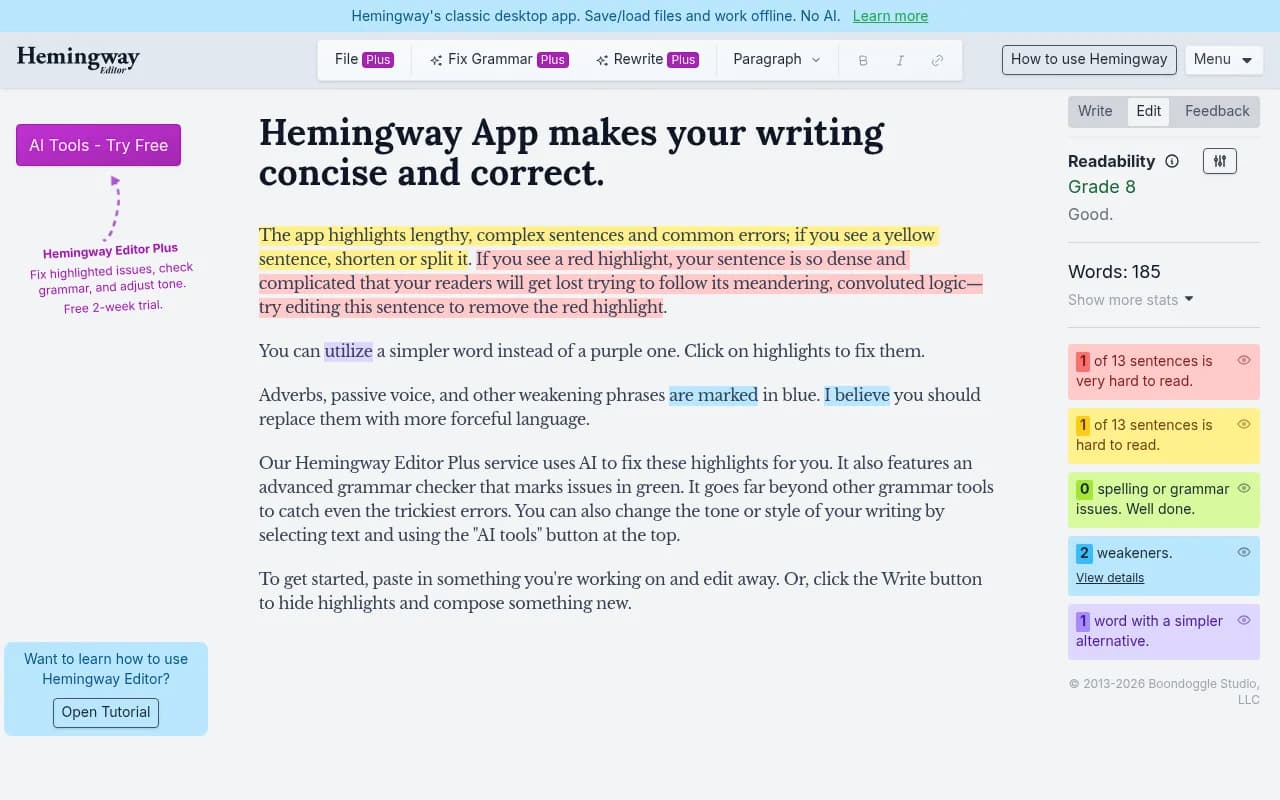
| Improve readability and clarity | Hemingway App, Grammarly |
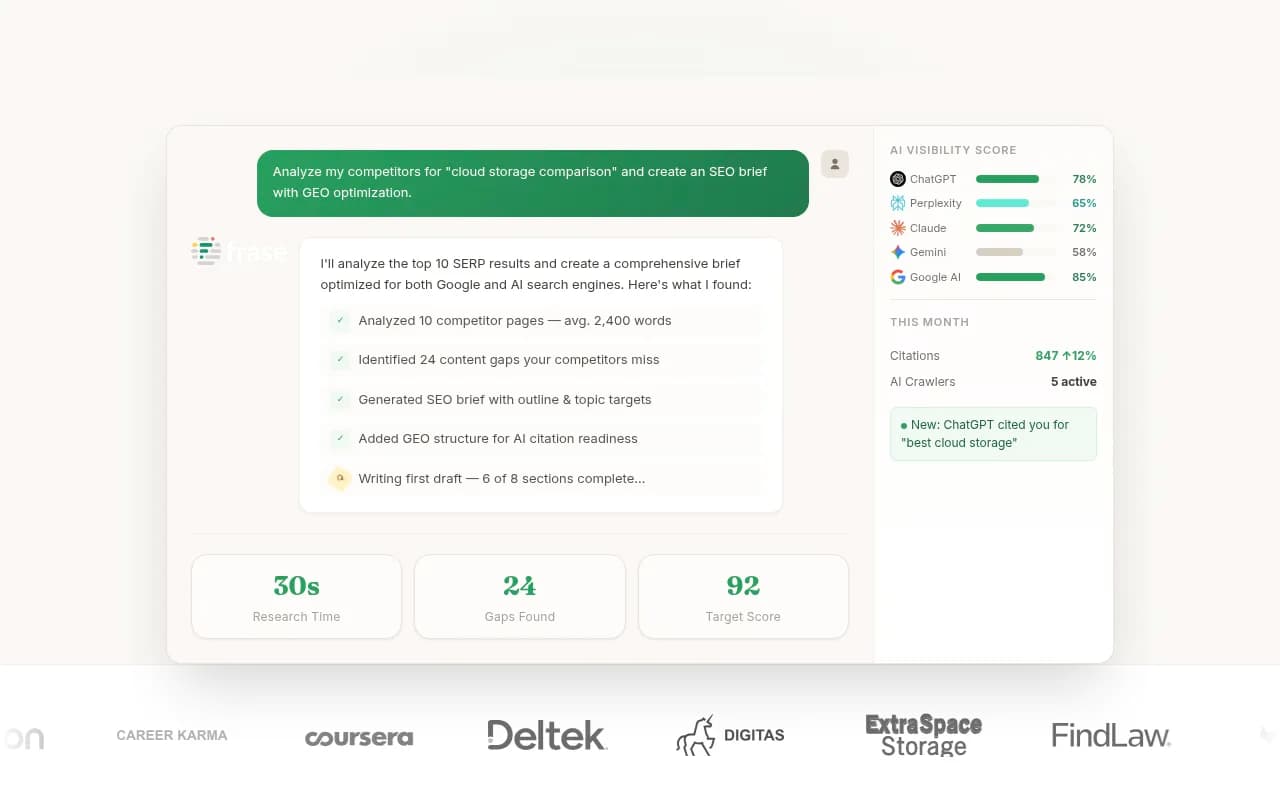
| Content briefs and optimization | Clearscope, Frase, MarketMuse |
| Check crawlability | Screaming Frog, Google Search Console |
| Track citations and AI traffic | Promptwatch and other AI visibility tools |

Once you've restructured a page, the real question is whether it works. Writing for extraction is a hypothesis until you see the page get crawled and cited. Tools like Promptwatch can show whether AI crawlers are reading the page, which prompts cite it, and what traffic follows, so you can tell a structure problem from a page-type or freshness problem.

If you want to compare other options for tracking, the GEO software directory at bestgeosoftware.com lists a wide range of them.
Common mistakes to avoid
- Burying the answer under a long intro. The extractable sentence ends up in paragraph four.
- Clever headings. "The elephant in the room" is fine for a human skim and useless for matching a query.
- Walls of text. Long paragraphs force a model to cut mid-thought or skip the passage entirely.
- Pronoun-heavy sections that fall apart out of context.
- Treating FAQ schema as a magic switch. FAQ pages are 3.3% of ChatGPT citations in Promptwatch's data, so use Q&A blocks to support good pages, not replace them.
- Publishing and forgetting. Evergreen pages hold citations longer, but only if you keep them accurate.
FAQ
How long should an answer block be?
Practitioners recommend roughly 40-75 words (LoudFace says 40-60). Treat it as a target, not a rule. The goal is a complete, standalone answer with one qualifying detail.
Do headings need to be questions?
No, but they should be specific and mirror how people phrase queries. A plain topic label like "ChatGPT citation share by content type" works as well as a question.
Does a TL;DR section help?
It costs little and gives models a clean summary to quote. AirOps says ChatGPT treats these blocks as extractable language. It also helps human readers, which is reason enough.
Should I publish a markdown version of my articles for AI?
Not for AI search. Markdown files were 0.05% of citations in Promptwatch's data. Put the effort into clean HTML instead.
Is structure more important than authority or page type?
Probably not. Structure raises the odds that a good page gets quoted cleanly, but page type, freshness and the strength of the source all affect whether it's cited at all. Fix them together.
The short version
Write each section as if it will be read alone. Put the answer first, name your subjects, back claims with something checkable, and keep it all in clean HTML. Then watch whether the page gets cited, and refresh it before it goes stale.