Key takeaways
- Qwairy is free to start (100 credits, no card needed); AirOps starts at $200/month with no free tier
- AirOps is built around content creation and workflow automation -- if you need to produce GEO-optimized content at scale, it's the stronger tool
- Qwairy covers 10 AI platforms; AirOps focuses on a narrower set (ChatGPT, Gemini, Perplexity)
- Qwairy has dedicated crawler analytics showing which AI bots hit your site and how often -- AirOps doesn't offer this
- Both have some form of content optimization, but AirOps treats it as the core product while Qwairy treats it as one module among many
- For pure monitoring depth and breadth, Qwairy has more coverage; for content execution at scale, AirOps has the edge
Overview
AirOps
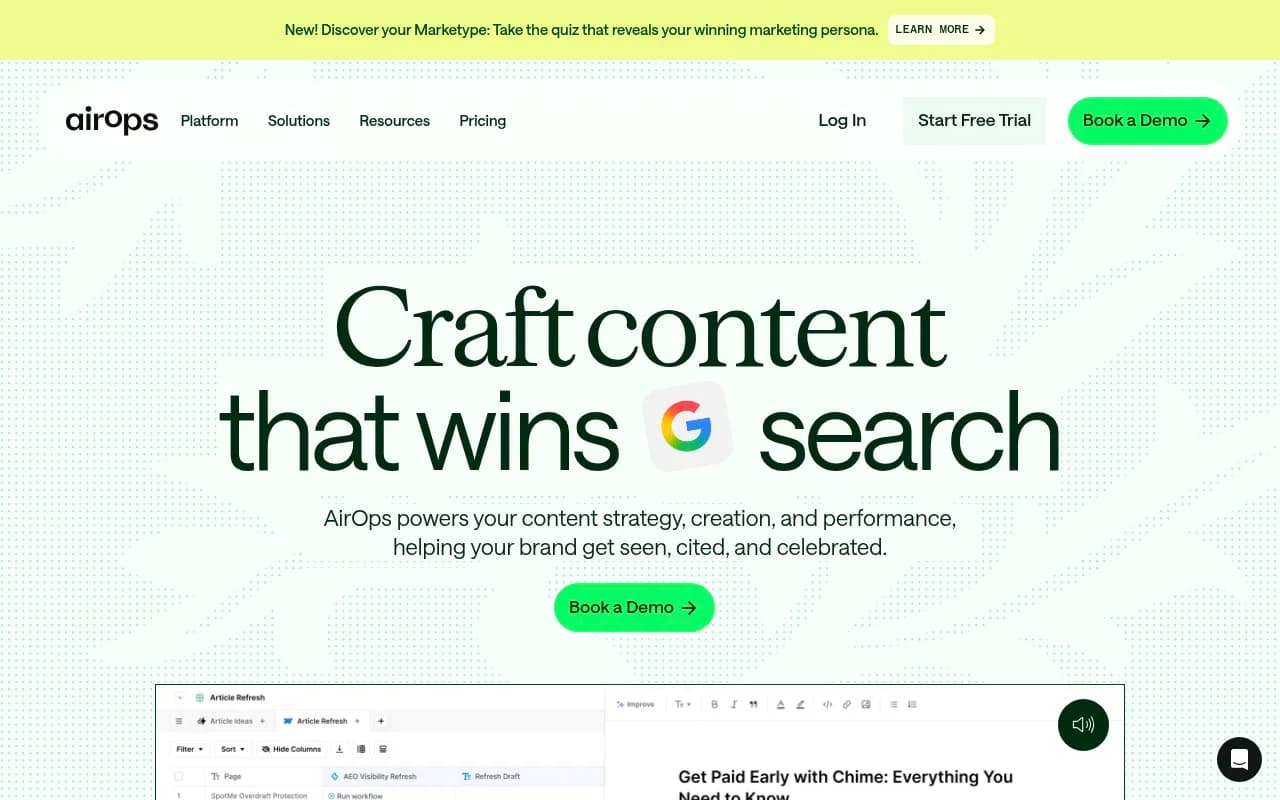
AirOps positions itself as a "content engineering platform" -- the idea being that getting cited in AI search isn't luck, it's a repeatable process you can engineer. The platform connects visibility tracking to content production, letting teams identify where they're missing in AI responses and then build the content to fill those gaps. It's workflow-heavy by design, with automation tools that let you run content operations at scale rather than one article at a time.
The pitch makes sense for content teams that already have a process and want to systematize it. AirOps isn't really a monitoring dashboard you check weekly -- it's more of an operational layer for teams that are actively publishing and optimizing.
Qwairy
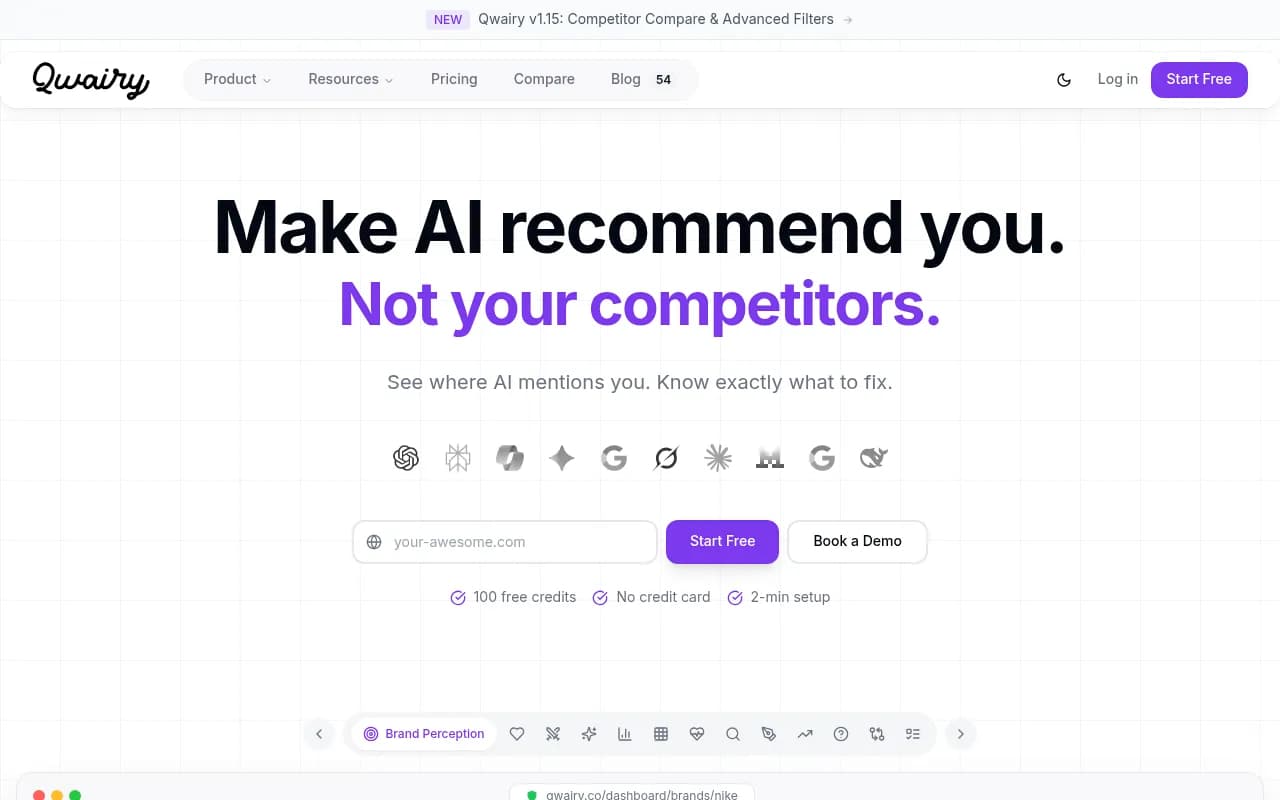
Qwairy takes a broader monitoring-first approach. It tracks your brand across 10 AI platforms, surfaces competitor mentions, analyzes sentiment, and shows you which pages AI crawlers are actually visiting. The platform is organized into six sections: Cockpit (overview), Monitor, Analyze, Act, Optimize, and Measure -- which gives you a sense of how it thinks about the workflow.
The free tier (100 credits, no card required) makes it genuinely easy to try. Qwairy has 2,000+ brands and agencies on the platform, including TotalEnergies, Air Transat, and Match Group, which suggests it's found traction beyond early adopters.
Side-by-side comparison
| Feature | AirOps | Qwairy |
|---|---|---|
| Free tier | No | Yes (100 credits) |
| Starting price | $200/month | Not publicly listed |
| AI models covered | ChatGPT, Gemini, Perplexity | 10 (ChatGPT, Claude, Perplexity, Gemini, Grok, Copilot, Mistral, DeepSeek, Google AI Overviews, Google AI Mode) |
| Content creation/generation | Core feature | Content Studio module |
| Workflow automation | Yes (core) | Limited |
| Crawler analytics | No | Yes (dedicated section) |
| Competitor tracking | Yes | Yes |
| Citation analysis | Yes | Yes |
| Sentiment analysis | No | Yes |
| Brand perception tracking | No | Yes |
| AI revenue tracking | No | Beta |
| G2 rating | Not listed | 4.8/5 |
| Setup time | Not specified | ~2 minutes |
| Target user | Content/SEO teams | Marketing teams, agencies |
Head-to-head feature deep-dive
AI model coverage
Qwairy monitors 10 platforms: ChatGPT (API + UI), Perplexity (API + UI), Copilot (UI), Gemini (API + UI), Google AI Overviews (API), Grok (API + UI), Claude (API), Mistral (API), Google AI Mode (UI), and DeepSeek (API). That's notably thorough, and the distinction between API and UI monitoring matters -- AI responses can differ between the two.
AirOps covers ChatGPT, Gemini, and Perplexity. That's the three biggest platforms by usage, so for most brands it covers the majority of AI search traffic. But if you care about Claude, Grok, or Mistral specifically, AirOps leaves gaps.
Verdict: Qwairy wins on coverage. Three platforms vs ten is a meaningful difference, especially as AI search fragments across more models.
Content creation and workflow automation
This is where AirOps has a real advantage. The platform is built around the idea that content engineering is a repeatable workflow -- you identify gaps, build templates, run automated pipelines, and produce content at scale. Teams can create structured workflows that go from "we're not showing up for this prompt" to "we published content targeting it" without manually managing each step.
Qwairy has a Content Studio module and an Action Center, but content generation isn't the platform's core identity. It's more of a "here's what to fix" tool than a "here's how to fix it at scale" tool.
Verdict: AirOps wins for content production. If your team's bottleneck is creating enough GEO-optimized content, AirOps is built for that problem.
Monitoring and analytics depth
Qwairy's monitoring section covers prompt tracking, response analysis, competitor mentions, citation sources, and insights. The Analyze section adds sentiment analysis and brand perception. The Measure section includes crawler analytics, referrer analytics, page performance, and an AI revenue tracker (in beta).
The crawler analytics feature is worth calling out specifically. Qwairy shows you which AI bots (GPTBot, ClaudeBot, PerplexityBot, Google-Extended, etc.) are crawling your site, how often, which pages they're hitting, and whether those pages return errors. That's genuinely useful for diagnosing why AI models might not be citing your content.
AirOps monitors visibility and connects it to content gaps, but doesn't appear to offer crawler-level data.
Verdict: Qwairy wins on monitoring depth. The crawler analytics alone give it an edge for teams that want to understand the technical side of AI indexing.
Pricing and accessibility
AirOps starts at $200/month for the Solo plan, scaling to $2,000/month for Pro. Additional tasks cost $6-$9 per 1,000 tasks depending on your plan. There's no free tier.
Qwairy starts with 100 free credits and no credit card required. Paid pricing isn't publicly listed, which is a bit frustrating -- you'd need to contact them or book a demo to understand what you'd actually pay beyond the free tier.
The lack of public pricing on Qwairy's paid plans makes direct comparison hard. But the free entry point is a genuine advantage for teams that want to validate the tool before committing budget.
Verdict: Qwairy wins on accessibility. AirOps's pricing is transparent but steep for smaller teams. Qwairy lets you start for free, though the opaque paid pricing is a mild annoyance.
Pricing table
| Plan | AirOps | Qwairy |
|---|---|---|
| Free | Not available | 100 credits (no card) |
| Solo/Starter | $200/month | Not publicly listed |
| Pro | $2,000/month | Not publicly listed |
| Enterprise | Custom | Custom |
| Additional usage | $6-$9 per 1,000 tasks | Credit-based |
Ease of use and setup
Qwairy claims a 2-minute setup, and the free tier makes it easy to just try it without a sales conversation. The dashboard is organized into clear sections (Cockpit, Monitor, Analyze, Act, Optimize, Measure) which gives new users a logical path through the product.
AirOps is workflow-oriented, which means there's more to configure upfront. That's not a criticism -- it's the nature of a platform built around automation pipelines. But it does mean the learning curve is steeper, and you'll get more value from it if you come in with a clear content strategy already in mind.
Verdict: Qwairy is easier to start with. AirOps rewards teams that invest time in setup.
Competitor analysis
Both platforms track competitor visibility in AI responses. Qwairy's Competitor Mentions feature shows where competitors appear in AI responses for your tracked prompts. AirOps similarly connects competitor visibility data to content gap analysis.
Neither platform has published detailed specs on how deep the competitor analysis goes, but Qwairy's GEO Matrix (a positioning tool that benchmarks you against competitors across AI platforms) is a notable feature for teams that want a visual overview of the competitive landscape.
Verdict: Roughly even, with Qwairy's GEO Matrix giving it a slight edge for competitive positioning views.
Pros and cons
AirOps
Pros:
- Content engineering is genuinely differentiated -- not just "here's your score", but a full pipeline for creating content that targets AI search
- Workflow automation lets teams scale content production without proportional headcount increases
- Transparent pricing (even if it's expensive)
- Connects visibility measurement directly to content execution in one platform
Cons:
- No free tier -- $200/month is a real commitment before you've validated the tool
- Narrower AI model coverage (3 platforms vs Qwairy's 10)
- No crawler analytics
- Steeper setup curve -- you need to invest time to get value from the automation features
- No sentiment or brand perception analysis
Qwairy
Pros:
- Free tier with no credit card required -- genuinely low barrier to entry
- 10 AI platforms covered, including Claude, Grok, Mistral, and DeepSeek
- Crawler analytics is a standout feature for technical teams
- Sentiment and brand perception tracking
- 4.8/5 on G2 with 2,000+ brands using it
- Clean, logical dashboard structure
Cons:
- Paid pricing isn't publicly listed -- you have to contact them
- Content generation is a secondary feature, not the core product
- Less workflow automation than AirOps
- Smaller brand recognition than AirOps in the content marketing space
Who should pick which tool
Pick AirOps if:
- Your main bottleneck is content production, not monitoring
- You have a content team that needs to systematize GEO at scale
- You're already tracking visibility somewhere and need a tool to help you act on it
- You're comfortable with a $200+/month commitment from day one
- Workflow automation is important to how your team operates
Pick Qwairy if:
- You want to start for free and validate the concept before spending budget
- You need coverage across 10 AI platforms, not just the big three
- Crawler analytics and technical AI indexing data matter to your team
- You want sentiment and brand perception tracking alongside visibility
- You're a brand or agency that needs a broad monitoring foundation first, content tools second
If you're also thinking about how your brand shows up across AI search engines more broadly, Promptwatch is worth a look -- it covers all 10 major AI platforms with crawler logs, content gap analysis, and a built-in AI writing agent, which overlaps with what both AirOps and Qwairy do but in a single integrated platform.

Final verdict
AirOps and Qwairy solve adjacent problems but aren't really competing for the same buyer. AirOps is for content teams that want to build a production pipeline around GEO -- it's an operational tool. Qwairy is for marketing and SEO teams that want comprehensive visibility monitoring across every major AI platform, with enough analytics to know what to fix.
If you're just getting started with GEO and want to understand where you stand before committing to a workflow, Qwairy's free tier makes it the obvious first step. If you already know you have a content gap problem and need to close it at scale, AirOps is built for that specific job.