Key takeaways
- "Citation checker" covers three different products: format checkers, existence checkers and metadata matchers. Most free tools only do the first or second.
- A reference can exist and still be wrong. In the 2023 Walters and Wilder study, 43% of GPT-3.5's citations to real papers contained substantive errors.
- Crossref's Simple Text Query, its REST API and the Retraction Watch data are free, uncapped as far as the docs state, and need no vendor.
- Free tiers from ProofreaderPro, AiCitationChecker, CiteMe, Sourcely and Scholar Sidekick are useful for a first pass. Most don't document their ceilings, so test before you rely on one.
- A pass from a formatting checker such as Scribbr says nothing about whether your sources are real.
Why this category is confusing
Search for a free citation checker and you get a pile of tools that look alike and do different jobs. One tells you your comma is in the wrong place. Another tells you whether the paper exists. A third tells you whether the paper you found is the paper you cited. Price is the least interesting difference between them.
A caveat on sourcing: much of the pricing and free-tier detail below comes from vendor pages and from competitors' roundups, including Citely and Scholar Sidekick, which both sell their own products. I flag that where it matters. Limits change often, so confirm on the tool's own page before you plan around a number.
The three checks hiding inside "citation checker"
Sort tools by the question they can answer, not by their pricing page.
Format checking
Does this reference follow APA 7? A format checker treats your reference list as a string-matching problem and never leaves your document. A fabricated reference written in perfect APA passes cleanly. That isn't a bug. It is the whole scope of the tool.
Existence checking
Is there a real publication behind this string? An existence checker queries scholarly databases such as Crossref, PubMed, arXiv and OpenAlex and reports found or not found. It catches invented journals and DOIs that resolve to nothing.
Metadata matching
Is the record it found the record you cited? Right title, right authors, right year. This is where most of the leftover damage lives, and free tiers skip it most often, because it means comparing several fields against a canonical record and deciding what counts as a mismatch.
Why existence checks alone fall short
Two pieces of evidence make the case.
The first is the 2023 Scientific Reports study by Walters and Wilder. Across 636 citations generated for 42 topics, 55% of GPT-3.5's citations and 18% of GPT-4's were fabricated. Among the citations that pointed to real papers, 43% of GPT-3.5's and 24% of GPT-4's still had substantive errors. An existence checker waves those through. So does a formatting checker.
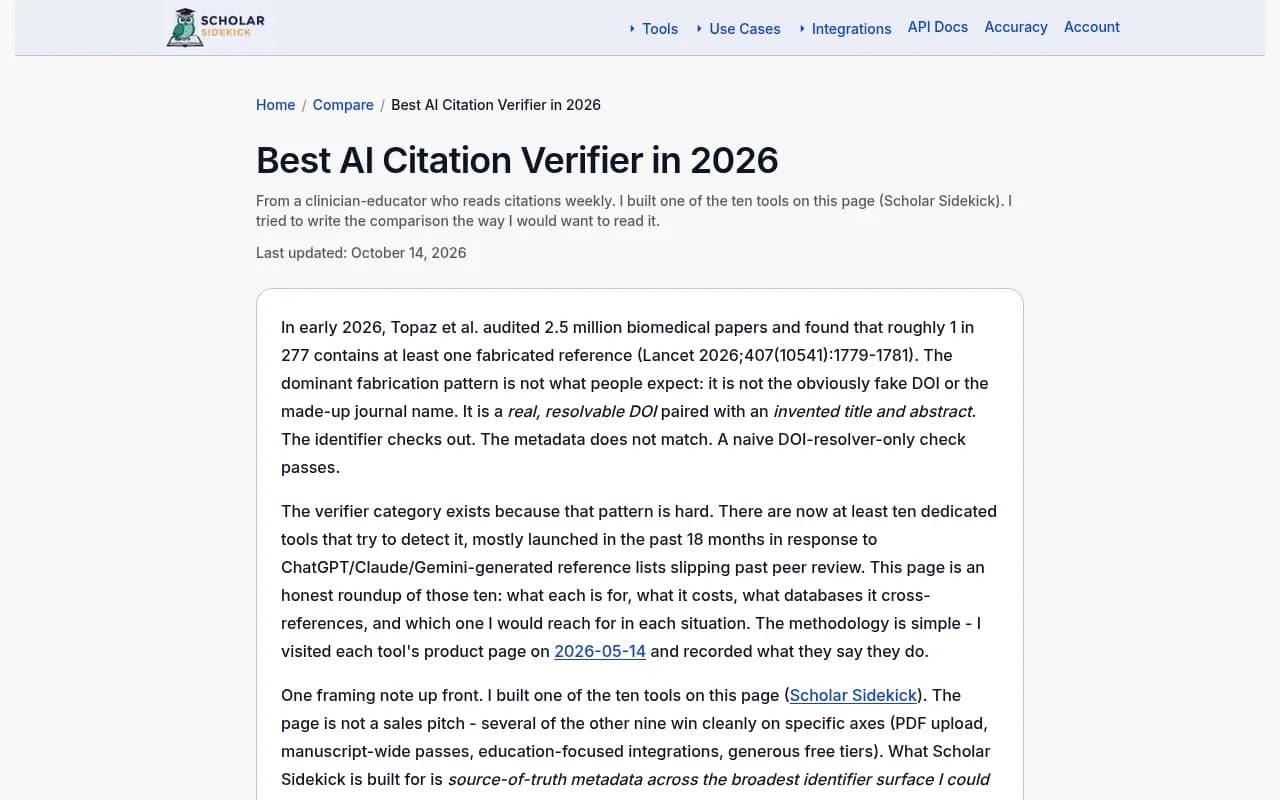
The second is a 2026 audit by Topaz et al. in The Lancet (2026;407(10541):1779-1781) of 2.5 million biomedical papers. It found roughly 1 in 277 contains at least one fabricated reference. The dominant pattern was a real, resolvable DOI paired with an invented title and abstract. A tool that only checks that the DOI resolves passes that reference. I found this figure on the Scholar Sidekick comparison page, so it is a secondhand citation to a paper I haven't read directly.
Practical consequence: whichever free tool you pick, look for one that compares title, authors and year, not just one that says "found."
The free infrastructure nobody markets to you
Before evaluating any freemium product, know what costs nothing. A good chunk of citation checking is a public good that Crossref maintains.
Crossref Simple Text Query
Paste a reference list into apps.crossref.org/SimpleTextQuery and it returns a DOI for each entry it can match. No account, no payment, and Crossref's documentation states there is no limit on use, with space for 1,000 references per submission. For a bibliography of DOI-bearing journal articles it is the fastest existence screen at any price.
The catch: an unmatched reference is not proof it is fake. Book chapters, older articles and conference papers often aren't registered with Crossref. Treat the output as a shortlist to investigate, not a verdict.
Crossref REST API
api.crossref.org/works/<DOI> is free and unauthenticated. It returns the authoritative metadata, so you can compare title, authors and year against what you cited. This is the metadata-matching step most free tools skip, and you can do it by hand for any reference that matters.
Retraction Watch data
Crossref acquired the Retraction Watch database in September 2023 and made it public. It is updated every working day, and you can pull it through the API with filter=update-type:retraction or as a CSV from Crossref's GitLab. Formatting tools never catch retractions, so this is worth doing separately.
Zotero and PubMed
Zotero flags retracted items for free without syncing, though only for items with a DOI or PMID, which covers roughly three-quarters of the Retraction Watch data. For biomedical references, PubMed is the right database. A Vancouver-style reference that fails a PubMed title search deserves a second look.
Free tiers, tool by tool
Here is what each option actually does, as far as the published pages say.
| Tool | Type of check | Free tier | Paid | Notes |
|---|---|---|---|---|
| Crossref Simple Text Query | Existence (DOI lookup) | Free, no account, up to 1,000 refs per submission | None | Misses books and older papers |
| ProofreaderPro | Existence plus matched record | Free, no sign-up, up to 100 refs per run | Not stated | Crossref and Semantic Scholar; corrected citation in seven styles |
| AiCitationChecker | Existence | 50 free credits per day (about 28-50 checks) | $9.99 (2,500 credits) to $99.99 (35,000) | Crossref, OpenAlex, Semantic Scholar; no retraction or OA check |
| CiteMe | Existence | Free, no signup | Not stated | Crossref, OpenAlex, PubMed, Google Books |
| CiteTrue | Existence | Reportedly 30 free checks per day | Not stated | Databases not enumerated |
| Sourcely | Existence with verdicts | Free paste-and-check widget, cap undocumented | $19/mo or $39/mo billed annually | Claims 200M+ papers; suggests replacement citations |
| Scholar Sidekick | Metadata plus retraction and OA | Free anonymous tier, rate-limited | RapidAPI, $0-$199/mo | Broad identifier support; bibliography audit up to 25 entries |
| Scribbr | Format only (APA 6 and 7) | Free preview | $9.95 per document | Does not verify sources exist |
| Grammarly citations | Citation generation | Free in browser extension | Paid Grammarly plans | Does not audit a pasted list |
ProofreaderPro
ProofreaderPro is the easiest starting point. Paste a reference list, one entry per line, up to 100 per run, with no sign-up. Each reference gets a verdict, the real record where one exists, and a corrected citation you can copy in seven styles. It matches against Crossref and Semantic Scholar plus other open databases.
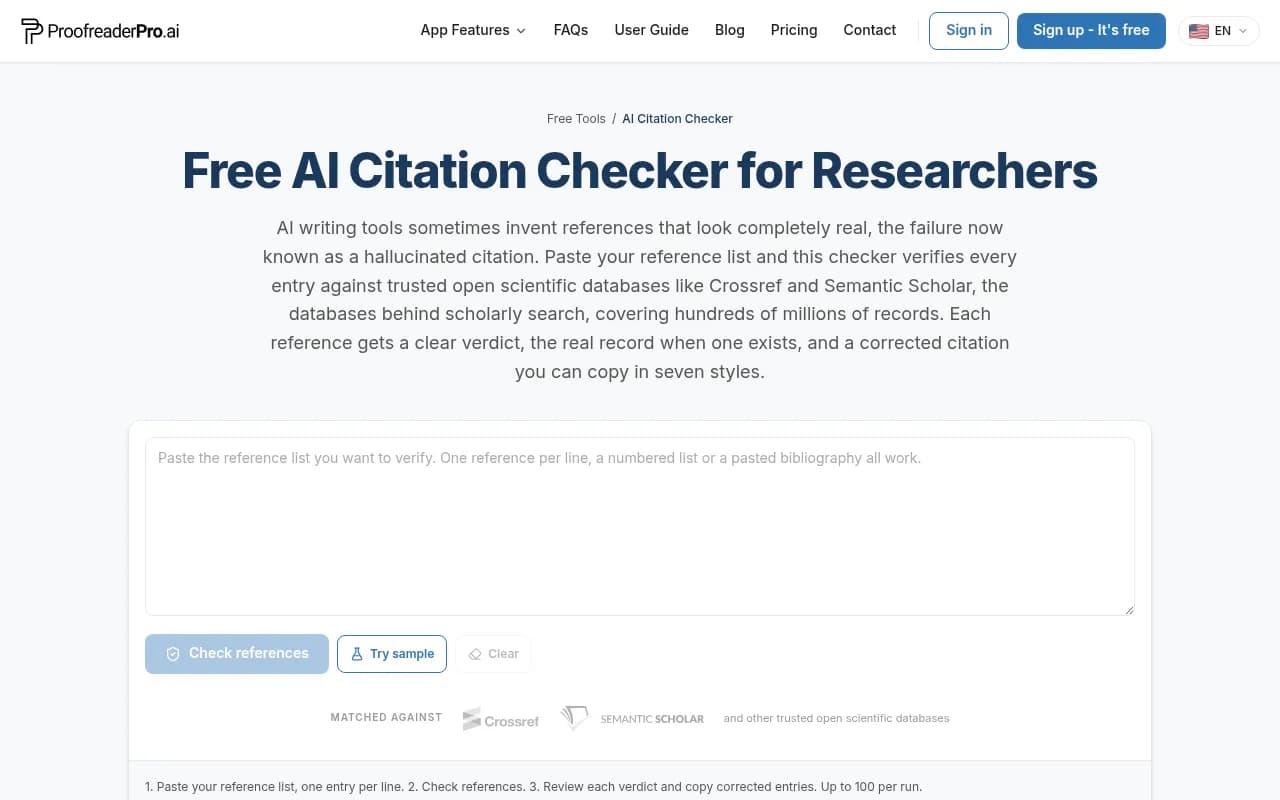
Returning the matched record is the useful part. It lets you eyeball title, authors and year yourself, which is a manual version of metadata matching.
AiCitationChecker
The most generous free allowance in the Scholar Sidekick roundup: 50 credits a day, which the site says covers about 28 to 50 reference checks. Paid packs run $9.99 for 2,500 credits up to $99.99 for 35,000. It queries Crossref, OpenAlex and Semantic Scholar and accepts citation strings in any format. It does not check retractions or open access. Whether the free tier needs an account is stated ambiguously on the current page, so check before relying on anonymous use.
CiteMe, CiteTrue and CiteSure
CiteMe's free checker needs no signup and cross-checks Crossref, OpenAlex, PubMed and Google Books. CiteTrue is reported to give 30 free checks a day in CiteMe's roundup, but Scholar Sidekick lists its paid tier and databases as not stated, and it also has a local MCP server that needs an API key. CiteSure publishes little about its databases or caps. Treat the last two as things to test, not trust. Note that CiteMe's own roundup is a competitor-adjacent source.
Sourcely
Sourcely has a free paste-and-check widget claiming coverage of more than 200M papers, with verdicts of real, fake or unverified. It returns ready-to-use replacement citations for flagged fakes, which saves time. The free usage cap is undocumented. Paid plans are Ultra at $19 a month and Max at $39 a month on annual billing, while the page advertises monthly billing from $37.
Scholar Sidekick
Scholar Sidekick is the broadest on identifiers: DOI, PMID, PMCID, ISBN, ISSN, arXiv, ADS bibcode and WHO IRIS URLs. It checks retractions through Retraction Watch and open-access status through Unpaywall. The anonymous tier needs no signup and is rate-limited. The bibliography audit takes .docx, .bib, .ris, CSL-JSON or a pasted list, up to 25 entries per run, but does not read PDFs. There is also a hosted MCP server with seven tools.
A bias note: the author of the comparison page built this tool and says so. Its pages were visited on 2026-05-14, so details may have shifted.
Scribbr
Scribbr's AI Citation Checker is APA-only (6th and 7th editions) and costs $9.95 per document, with unlimited re-uploads and a free preview. Its human Citation Editing service is $2.75 per source. Its own FAQ is blunt: "We cannot research each reference list and validate its content." Good for formatting, silent on fabrication.
Grammarly citations
Grammarly generates citations for free in the browser extension from the page you're on, across about ten source sites such as PubMed, arXiv, Springer, ScienceDirect and PLOS One. It does not audit a pasted reference list, so it solves a different problem.
Don't confuse these with AI detectors
Search results for this topic are full of AI text detectors, which are a different category. Tools like Pangram, Originality.ai, Winston AI and GPTZero estimate whether prose was machine-written. They don't tell you whether a reference exists. Their free tiers are tiny: Pangram gives 5 free scans a day with sign-up, Winston AI one check with a 1,800-character limit, and Detecting-AI.com 100 checks a day with a 5k character limit.
GPTZero's Source Finder is the exception. It targets education, with Canvas and Google Classroom integration, and does look at sources. If you're screening student essays for invented citations, that is the closer fit.
For a no-cost sanity check on a single claim, there is also the manual route: search a distinctive title in quotation marks on Google Scholar. It is slow but needs no account.
A workflow that costs nothing
This is the order I would run it in for a reference list of fewer than 100 entries.
- Run the list through Crossref Simple Text Query for a fast DOI screen.
- Paste the same list into ProofreaderPro or another checker that returns the matched record.
- For every flagged reference, search Google Scholar or PubMed by title. Remember that books, older articles and conference papers often legitimately fail.
- For every reference that passed, spot-check title, authors and year against
api.crossref.org/works/<DOI>. Real DOI plus wrong title is the failure that survives the other steps. - Check retractions with Zotero or the Retraction Watch data.
- Only then run a formatting tool such as Scribbr if your style guide demands it.
Formatting goes last on purpose. There is no point polishing a reference that shouldn't be in the list.
Pitfalls to watch for
- Undocumented caps. Many free tiers don't state their limit, so you usually find the ceiling by hitting it. Don't start a 90-entry check on a tool you haven't tried.
- Unnamed databases. If a checker won't say what it queries, test it first with one reference you know is real and one you know is fake.
- False comfort. A format pass is not an existence pass, and an existence pass is not a metadata pass.
- Stale numbers. Free-tier claims in roundups age fast. The Citely figures here were checked in September 2026 and the Scholar Sidekick ones in May 2026. Re-verify anything you plan to publish or budget around.
- Privacy. You're pasting unpublished manuscripts into a web form. Read the data policy before pasting anything sensitive.
When paying makes sense
I would pay if you hit one of three walls: you need to check whole manuscripts regularly and the per-run limits (25 entries on Scholar Sidekick, 100 on ProofreaderPro) slow you down; you need team workspaces, as with Citely at $14 to $19 a month; or you need retraction and open-access flags attached to every entry. Otherwise the free stack above covers most one-off checks. Citely claims 95% accuracy, but that is a vendor figure and I haven't seen an independent test.
And pair tools. A fabrication verifier and a structural tool like Scribbr, Paperpal or Recite cover different failures, and neither replaces a retraction check.
A side note on AI visibility
This guide is about academic references, but the same instinct applies if you publish content and want AI assistants to cite you accurately. For that, tools like Promptwatch track how your brand and pages show up in AI answers.

For a wider set of options in that space, the GEO software directory at bestgeosoftware.com is a good place to browse.
Bottom line
Start with Crossref, because it is free and uncapped. Add ProofreaderPro or AiCitationChecker for a readable verdict per entry. Spot-check metadata by hand for anything that passes, since a real DOI with the wrong title is the error these tools miss most. Save paid plans for volume, retractions or team use.