Key takeaways
- Of the four tools, Trakkr has the most explicit revenue method (GA4 channel grouping, CRM fields, labelled estimates). Promptwatch ties visibility to AI traffic, crawler logs and content actions. LLMclicks is mostly a visibility and audit tool. Passionfruit is a managed service, not a self-serve tracker.
- Pricing in roundups is stale. Promptwatch now lists paid plans from $95/mo (older posts say $99). Trakkr's Growth tier is reported at $100/mo, not $79. LLMclicks' official page currently shows lifetime-deal packages. Always confirm on the vendor page.
- No tool can see no-click influence. Referral-based revenue only captures people who actually click, and Google AI Overviews and AI Mode clicks land in Organic Search in GA4.
- I found no independent verification of how accurate any tool's revenue attribution is. Treat all of it as estimates and label it that way.
Why "mentions" stopped being enough
A mention count feels like progress. Your brand appeared in 34% of answers last month, up from 28%. Great. Now try telling a CFO what that is worth.
The pressure to answer that question is growing. According to figures Rework cites from Similarweb, AI platforms drove an average of 770.7M referral visits per month worldwide between June 2025 and May 2026, up 117.4% year on year. Adobe Analytics data, as cited by Digital Commerce 360, put AI-referred traffic to US retail sites up 138% year on year by May 2026. Those are third-party numbers I haven't verified myself, but the direction is hard to argue with.
There is also a competition problem that plain visibility trackers miss. Promptwatch Data found that ads appeared in an average of 20.1% of ChatGPT responses that ran a web search between May 20 and Aug 17, 2026, with a daily peak of 43.9%. Ads now sit beside organic citations. A tool that only counts whether you were named misses who paid to be next to you.
So the question for this comparison is narrow: which of these four tools gets you closest to revenue, and what does each one actually do to get there?
The four tools at a glance
| Tool | What it is | Revenue angle | Pricing (verify on vendor page) | Best for |
|---|---|---|---|---|
| Trakkr | Self-serve tracker, 8 models | GA4 and CRM attribution playbook, estimated revenue formulas | Growth about $100/mo, Scale about $500/mo, Enterprise from $1,000/mo | Teams that want a documented attribution method |
| Passionfruit | Managed SEO/GEO service | Service-led, custom audit, no confirmed self-serve revenue dashboard | Custom pricing | Brands that want someone else to do the work |
| LLMclicks | Visibility, audit and placement tool | No revenue or GA attribution found in sources | Lifetime-deal packages $159 to $399 on the official page; subscriptions reportedly $49 to $399 | Budget-conscious audits and citation work |
| Promptwatch | Visibility plus optimization platform | AI visitor analytics, crawler logs, page-level citations, content agent | From $95/mo, Professional $245, Business $579 | Teams that want to track and fix, then measure the result |
Trakkr: the most explicit revenue method
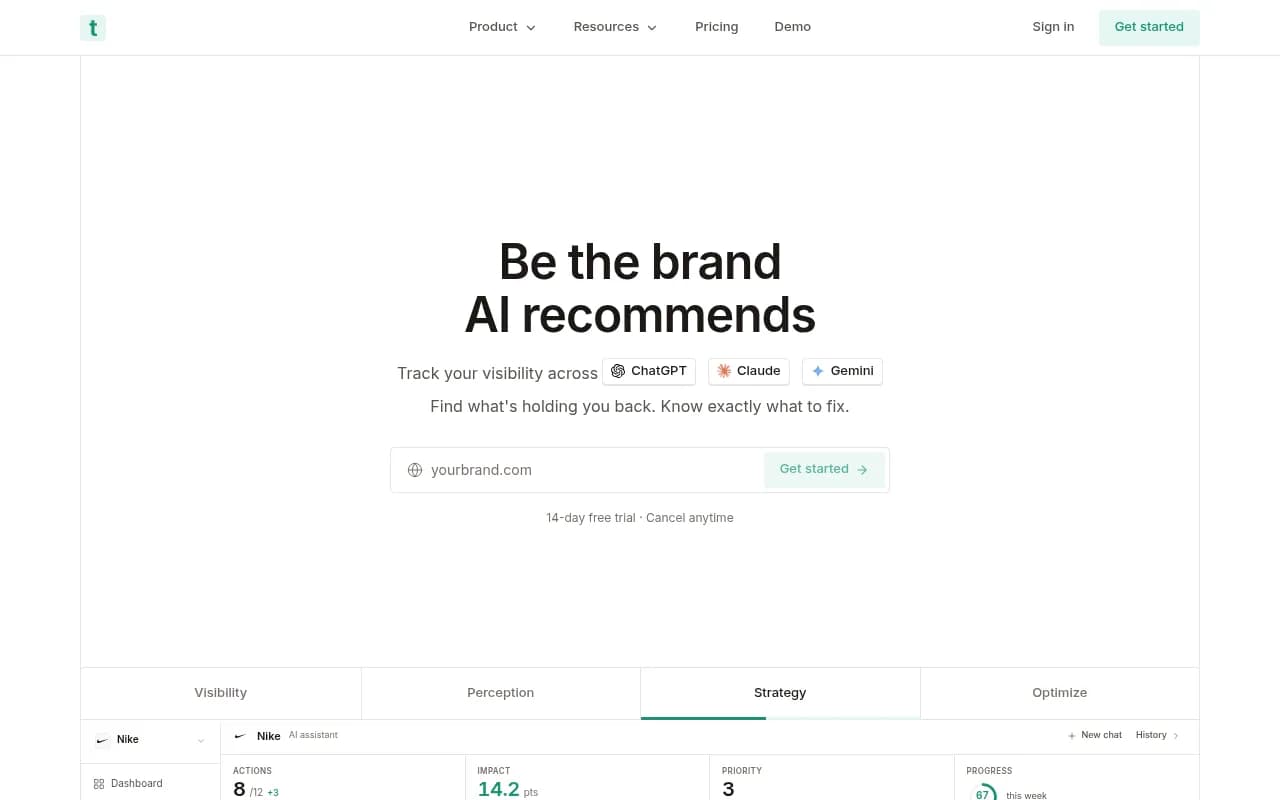
Trakkr tracks eight models: ChatGPT, Claude, Gemini, Perplexity, Google AI Overviews, Grok, DeepSeek and Meta AI. Its tagline is "Other tools give you a dashboard. Trakkr gives you a playbook," and the revenue guide on its site backs that up better than anything else in this comparison.
How its attribution approach works
Trakkr's measurement guide (kit updated Aug 18, 2026) splits AI revenue into three places: visible assistant referrals, later return visits after no-click exposure, and CRM or commerce outcomes influenced by AI answers. The practical steps are sensible:
- In GA4, start with Session default channel group = "AI Assistant", then audit source/medium and landing pages.
- Keep AI Overviews and AI Mode in Organic Search. Use Search Console generative-AI reports where available instead of calling them chatbot referrals.
- In your CRM, store first AI source, last AI source, first landing page, self-reported discovery source, research theme and confidence.
- Keep observed, assisted, estimated and directional values in separate ledger rows.
The formulas are simple. Estimated AI revenue is AI conversion count times value per conversion, and Trakkr says to label it "estimated". AI traffic value is AI revenue divided by AI sessions. Projected revenue is incremental AI sessions times AI conversion rate times average value.
What I like: it refuses to invent certainty. No-click influence stays "unknown" and shouldn't be inferred from Direct or branded search. That is the right call, and rarer than it should be.
Its own proof point
Trakkr's customer example, Futuro Corporation (May 1 to Aug 22, 2026), shows AI sessions at 2.1% of traffic but 11.9% of quote requests, converting at 30.4% against 5.3% for all sessions, a 5.7x ratio. It is one property, and Trakkr itself says it is not a benchmark. Useful illustration, not evidence.
Pricing and gaps
Rework checked trakkr.ai/pricing on Oct 2, 2026 and reported Growth at $100/mo ($1,000/yr) and Scale at $500/mo ($5,000/yr), with Enterprise from $1,000/mo. Older roundups, including AIWriteBook and Omnia, show $79 and $399, so they are out of date. Growth gives 1 brand, 3 seats and 25 article credits a month with no API. Scale gives 10 brands, unlimited seats, 100 article credits, a REST API and white-label portals. Both include 50 daily prompts per brand and all 8 models, and the 14-day trial needs a card.
The obvious catch: there is a gap in the middle if you track two or three brands. Also, Omnia's comparison lists Trakkr's action layer as "No", though the article credits suggest some content support. Check what is included for your case.
Passionfruit: a service, not a dashboard
Passionfruit is the odd one out here, and putting it in a tracker comparison needs a caveat. The official pricing page shows custom pricing only, starting with an exploratory call and a personalized audit. The service lines cover content and editorial SEO and GEO, technical, off-page, on-page and programmatic work, AI visibility tracking and Reddit engagement.
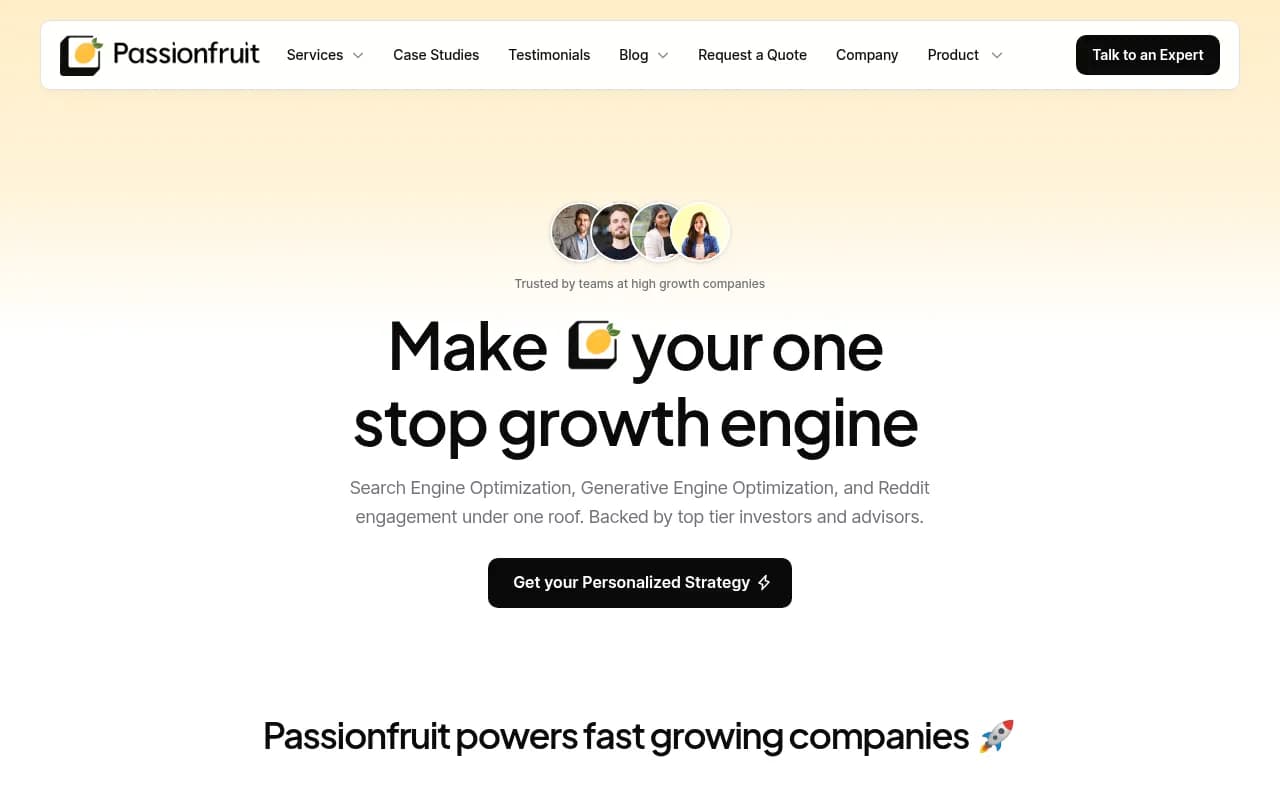
That is an agency-style engagement. Revenue is the result you buy, not a metric you log into. Third-party sources mention a self-serve "Passionfruit Labs" at $19 to $99/mo, and Bourd lists $99/mo, but I could not confirm any self-serve tier on the official pricing page. Ask directly before assuming it exists. There is also a separate product, Pip by Passionfruit, which says it will "prove what drove results", though I haven't seen enough detail to judge it.
Who should consider it? Teams with budget and no in-house capacity, who care about outcomes more than about owning the data. If you want to inspect attribution yourself, this isn't the shape of product you want. If you are weighing agencies generally, 1001 SEO Media is one of the options in that category, with technical SEO, content and GEO work and no long-term contracts.
LLMclicks: visibility, audits and placements
LLMclicks is described as AI visibility tracking with hallucination detection. According to AirOps and the pricing page, features include a 120-point AI Visibility Audit, hallucination detection, a Content Embedding Analyzer, an AI Listicle Marketplace (placement on domains AI engines reference), citation analysis, industry benchmarks and executive summary reports.
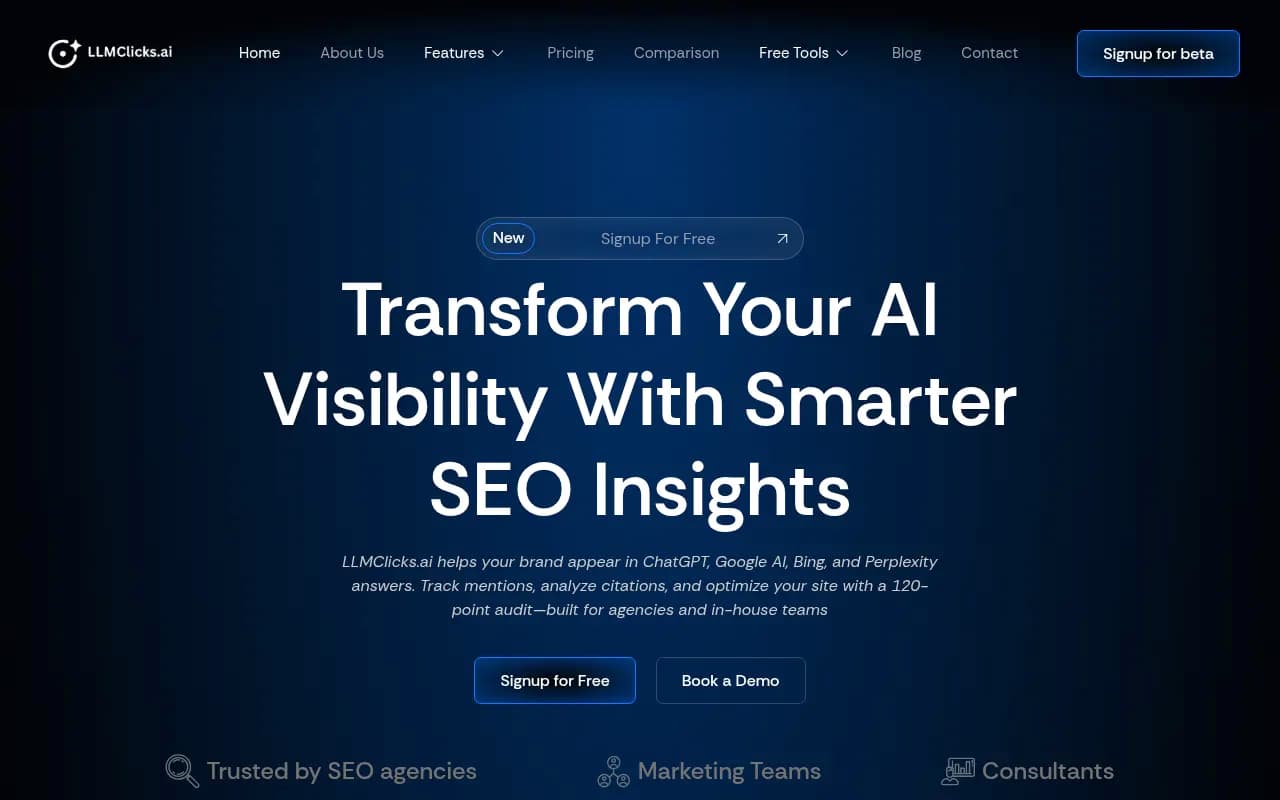
I found no revenue or GA attribution feature in any source I read. So despite the name, it looks like a visibility, audit and placement tool rather than a revenue tracker. That doesn't make it bad. Hallucination detection is useful if AI is saying wrong things about your pricing or product, and that is a real revenue risk. But it is a different job.
The pricing confusion
This one is messy. AirOps says plans run $49 to $399/mo with a 14-day trial, and notes pricing may change as the product exits beta. The official pricing page currently shows only lifetime-deal packages:
| Package | Price (list) | Checks per month | Projects |
|---|---|---|---|
| Starter | $159 ($199) | 300 | 1 |
| Professional | $239 ($299) | 700 | 10, custom branding |
| Agency | $399 ($499) | 1,500 | 30 |
The page also shows "0 / 500 spots claimed" counters, which may be placeholders. Verify the current tiers before you commit, especially if a lifetime deal is involved. Lifetime deals on fast-moving products carry their own risk.
Promptwatch: tracking connected to traffic and fixes
Promptwatch takes a different route to revenue. Rather than a documented spreadsheet method, it tries to connect each stage: why you are or aren't visible, where AI finds your content, what traffic it sends, and what to do about it.

In practice that means:
- Real-UI tracking of ChatGPT, Google AI Overviews, AI Mode, Gemini, Perplexity, Copilot, Alexa and more, with prompt volumes, difficulty and query fan-outs.
- IP-verified AI crawler logs, so you can see which pages GPTBot, ClaudeBot and others read, and where they hit errors.
- Visitor analytics that track actual traffic and conversions from AI platforms, not only mentions.
- 360 Insights that join crawls, citations, clicks and Search Console or Bing data per page, which answers questions like "which pages rank in Google but never get cited by AI?"
- A Content Agent, Action Board and Content Refresh that move from insight to published page, with CMS publishing to WordPress, Webflow and Framer. Published pages are then tracked for crawls, citations and clicks.
The pricing page says paid plans start from $95/month. Older roundups say $99, so the figure moves. Essential is $95/mo (1 project, 50 prompts, 6,000 responses). Professional is $245/mo (150 prompts, content writing and refresh, Agent Analytics). Business is $579/mo (350 prompts, state and city tracking, Shopping Insights, Ads Radar). Enterprise is custom. Self-serve tiers have a 7-day trial, and MCP and API access is on all plans. Confirm at promptwatch.com/pricing.
Customer results, with context
These are vendor-reported. Crisp saw 2x higher conversion rates from AI traffic than traditional channels. TreeHouse, the company behind Pararius, grew AI search to roughly 25% of organic conversions, with 99% of that from ChatGPT, after fixing crawler access and publishing proprietary rental data. Treat them as case studies, not guarantees.
Where it is weaker
Promptwatch's comparison grid lists conversion tracking, but it doesn't hand you Trakkr-style CRM ledger fields and formulas. If you want a rigorous revenue accounting framework, you will build that part yourself in GA4 and your CRM, whichever tool you use. Also, one third-party review (Lebesgue) called it strong on prompt monitoring but less focused on practical next steps. That contradicts the agent and Action Board features above, so test the workflow yourself during the trial and decide.
What no tool can fix
This is the part vendors skip, so I'll say it plainly.
- Much AI influence is no-click or dark. Someone reads your name in an answer, then types your URL a week later. That shows up as Direct. No tool reliably catches it.
- Google AI Overviews and AI Mode clicks appear as organic search, not AI referrals, so GA4 channel groups undercount.
- I found no independent test of any of these tools' attribution accuracy. Every revenue number is an estimate.
- Sampling matters. Responses vary run to run, so a mention rate is a range, not a point.
The workable answer is boring: add a self-reported "how did you hear about us" field, which Trakkr's own method recommends, keep estimates labelled, and compare trends instead of trusting a single figure.
A simple way to choose
| If this describes you | Start with |
|---|---|
| You want a documented GA4 and CRM method and a tracker to feed it | Trakkr |
| You want to track visibility, see crawler behavior, fix pages and measure AI traffic in one place | Promptwatch |
| You mainly need audits, hallucination checks and listicle placements at low cost | LLMclicks (verify current pricing) |
| You'd rather pay someone to run the program and report outcomes | Passionfruit |
One combination I'd seriously consider: use the Trakkr guide's measurement method (it is a published guide, so you can apply it to any tool's data) alongside a platform that shows crawler logs and page-level citations. The method tells you how to count. The platform tells you what to change.
A 30-day plan to prove it out
- Week 1: In GA4, build the AI Assistant channel group and audit source/medium and landing pages. Add a self-reported source field to your lead forms.
- Week 1: Pick 30 to 50 prompts that map to buying intent, not just broad topics. Run them in two tools using free trials.
- Week 2: Check crawler access. If AI bots can't read your key pages, nothing downstream matters.
- Week 3: Fix or publish five pages tied to your weakest high-intent prompts.
- Week 4: Compare AI sessions, conversion rate and CRM-tagged leads against the baseline. Label everything observed, assisted or estimated.
If you want more options before choosing, the GEO software directory at bestgeosoftware.com and the AI rank tracking directory at ai-rank-tools.com list dozens of alternatives. Other roundups, like the AIWriteBook comparison, are useful for a quick scan but carry the older pricing noted above.
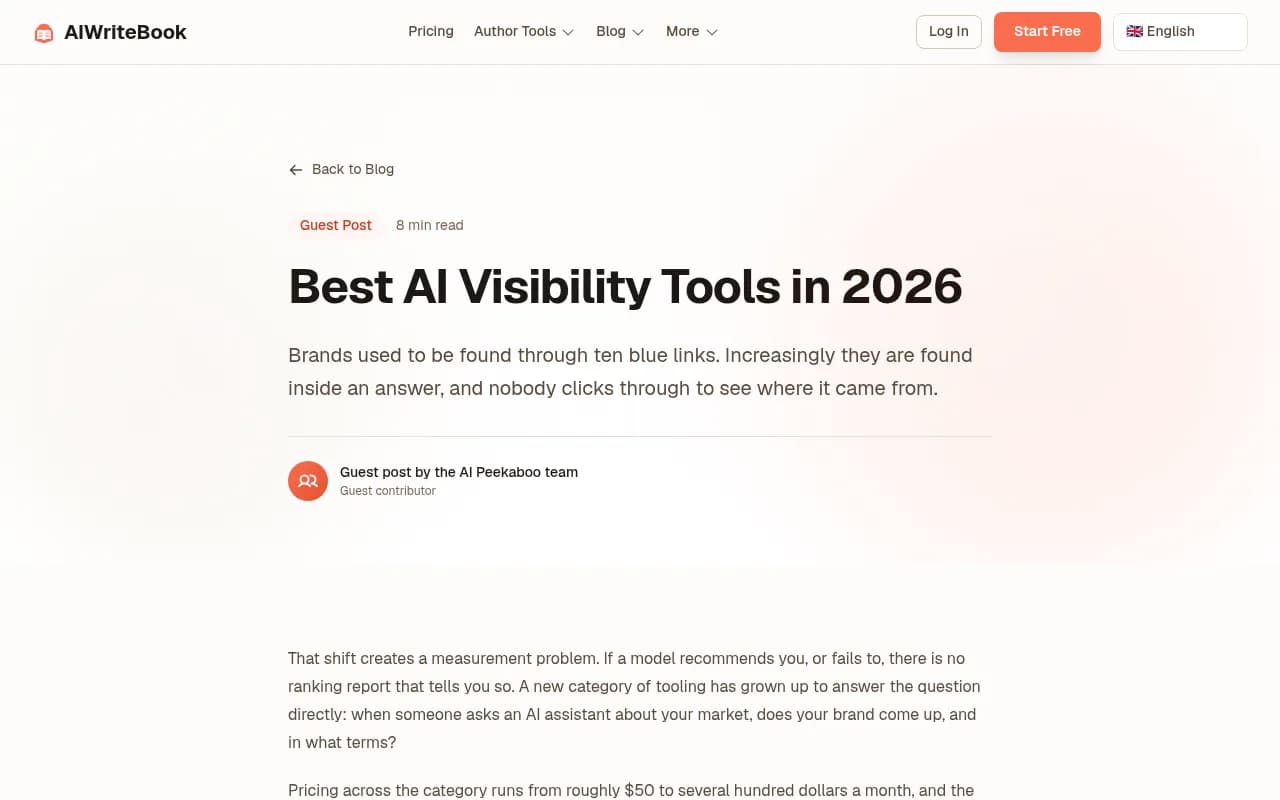
That screenshot is a good illustration of why you should check vendor pages: it lists Trakkr from $79/mo and Promptwatch from $99/mo, and both figures have since moved.
Bottom line
Trakkr gives you the clearest revenue-measurement method. Promptwatch gives you the broadest chain from crawler to citation to traffic to published fix. LLMclicks is a cheaper audit and placement tool whose pricing needs verifying. Passionfruit is a service you hire. Whichever you pick, run a trial against a GA4 baseline first, because the real test is whether the numbers still hold up when your finance team asks where they came from.