Key takeaways
- Small sites get cited all the time. In Promptwatch Data for August 2026, domains with a rank of 0-45 earned almost a third of ChatGPT citations, and Wellows found 47.9% of 20.5M scored citations went to domains under DA 40.
- Citation share in ChatGPT peaks in the middle. DR 46-75 sites earned about 46% of citations in August 2026, while DR 91-100 sites fell to about 4.4% for the month.
- Getting cited is easier than staying cited. Wellows found only 44.3% of sub-DA 40 domains were still cited two months later, versus 92% for DA 90+.
- Engines differ. Google AI Mode and AI Overviews lean toward stronger domains, while ChatGPT, Perplexity, and Gemini cite far more low-authority sites.
- The practical move is to build a mid-authority site, earn third-party mentions, and track each engine separately instead of chasing a DA 90 badge.
The short answer
Often, and more than most SEOs expect. If you run a small site and assume AI engines only quote Wikipedia, Forbes, and Reddit, the 2026 data says otherwise. There is no authority floor below which citation becomes impossible.
But "often" needs two qualifiers. First, it depends heavily on which engine you mean. Second, being cited once is different from being cited reliably. The data splits cleanly on both points, and that's where the useful decisions live.
This guide pulls together the domain rank numbers from four sources: Promptwatch Data (ChatGPT only, August 2026), the Wellows 20.5M citation study (five engines, March to July 2026), Ahrefs figures reported by Digital Applied (AI Overviews), and the Everything-PR index of the most-cited sites. They measure different things with different methods, so I'll flag where they agree and where they don't.
What ChatGPT's domain rank data shows
Promptwatch published ChatGPT citation share by domain rank for August 2026, covering every ChatGPT citation from Aug 1 to Aug 31. Only domains with a known rank are included, which is 89.65% of all citations. The report doesn't state which rank metric it uses, so treat "DR" as the report's own domain rank bucket rather than assuming a specific vendor's score.

Here is the average share by bucket for the month:
| Domain rank group | Average share of ChatGPT citations (Aug 2026) |
|---|---|
| DR 0-15 | 6.3% |
| DR 0-30 | about 14% |
| DR 0-45 | almost a third |
| DR 46-60 | 22.6% |
| DR 61-75 | 23.4% (highest group) |
| DR 76-90 | 18.9% |
| DR 91-100 | 4.4% |
Two things stand out. Citation share climbs with rank up to DR 61-75 and then falls. And the most authoritative tier, DR 91-100, earned less than the DR 0-15 tier over the month. That is not what the "you need a huge domain" folklore predicts.
A caveat I'd take seriously: the buckets are uneven. DR 0-15 spans 16 values and DR 91-100 spans only 10, and far fewer domains exist at the very top. So the headline isn't that low-rank sites are better. It's that the middle is where the volume is.
The August 14 wobble
DR 91-100 averaged about 7% in the first week of August, dropped to about 5% on Aug 8, and fell to roughly 3% on Aug 14, where it stayed. That date matters. It's the same day reddit.com's share of ChatGPT citations collapsed from about 4% to 0.5%, as documented in Promptwatch's Reddit citations report. Most of the lost share went to the middle tiers: DR 61-75 gained 1.6 points and DR 46-60 gained 0.9.
So the late-August picture is partly a Reddit effect. I'd call the August snapshot unstable rather than a permanent verdict on big domains. Also note ChatGPT started using the site: operator at scale on August 8, which Promptwatch Data on ChatGPT site: fanouts shows jumping from roughly 0.4% to 17% of fanout queries. Retrieval behaviour was shifting under everyone's feet that month.
What the five-engine data shows
The Wellows study analyzed 20.5 million scored citations across ChatGPT, Gemini, Perplexity, Google AI Overviews, and Google AI Mode, spanning 386,000 cited domains in 42 markets. It uses Domain Authority rather than a rank bucket, but the direction matches.
| Engine (Mar 8 to Jun 30, 2026) | Median cited DA | % of citations under DA 40 | % from DA 90+ |
|---|---|---|---|
| Google AI Mode | 48 | 40.4% | 24.6% |
| Google AI Overviews | 47 | 40.8% | 23.8% |
| Gemini | 39 | 51.3% | 9.1% |
| ChatGPT | 35 | 55.5% | 10.3% |
| Perplexity | 34 | 58.7% | 11.0% |
Overall, 346,348 domains under DA 40 earned citations in the window, together accounting for 47.9% of scored citation share. On a pure count basis, small sites are close to half the citation pool.
Google's two AI surfaces lean toward authority. ChatGPT and Perplexity, for most of that baseline period, leaned toward the long tail. If your audience asks Perplexity, a modest site has a real shot. If you're chasing AI Overviews, authority helps more.
ChatGPT moved in July
Here's the wrinkle. Wellows reports that between July 7 and July 14, 2026, ChatGPT's median cited DA rose from the mid-30s to the low 50s, and the share going to sub-DA 40 domains fell from 58% to 35%, with institutional and government sources gaining most. Gemini and Google's surfaces didn't change.
That sits awkwardly next to Promptwatch's August figures, where DR 0-45 still held almost a third. The two datasets use different authority metrics, different prompt mixes, and different bucket definitions, so I wouldn't force them into one number. Read them together as: ChatGPT's door for small sites narrowed in mid-2026 but didn't close. Wellows itself says the most open door in AI search is not guaranteed to stay open.
Getting cited versus keeping the citation
This is the most useful part of the Wellows data, and it's less comfortable for small sites.
| DA band | Avg engines citing | Cited by one engine only | Cited by all five |
|---|---|---|---|
| 1 to 39 | 1.65 | 66.5% | 4.5% |
| 40 to 69 | 2.53 | 37.8% | 17.6% |
| 70 to 89 | 3.43 | 19.9% | 39.0% |
| 90 to 100 | 3.87 | 12.0% | 52.8% |
Two thirds of sub-40 domains show up in only one engine's source pool. More than half of DA 90+ domains show up in all five. Small sites get visibility, but usually narrow visibility.
Persistence is worse. Measured on the pre-shift window (cited in April, checked again in June):
| DA band | Still cited two months later |
|---|---|
| 1 to 39 | 44.3% |
| 40 to 69 | 67.0% |
| 70 to 89 | 86.5% |
| 90 to 100 | 92.0% |
And authority compounds into volume: 301 domains at DA 90+ absorbed 17.0% of all citations, averaging 11,574 citations each. So the honest summary is that authority is a force multiplier, not a gate.
Promptwatch's own content-lifespan research points the same way for a different reason. In its ChatGPT content half-life report, landing pages and docs stayed cited longest among pages cited on July 6, 2026, while news lost half its pages within 36 days. Format affects staying power too, not just domain strength.
The big sites still dominate the head
None of this means the giants are irrelevant. The Everything-PR index, which synthesizes six studies covering 680M+ citations, claims the top 15 domains capture roughly 68% of consolidated citation share, with Reddit alone near 40% of the multi-engine aggregate. That is a synthesis of third-party studies, and the Reddit figure is volatile. As noted above, ChatGPT's own Reddit share dropped sharply in August.
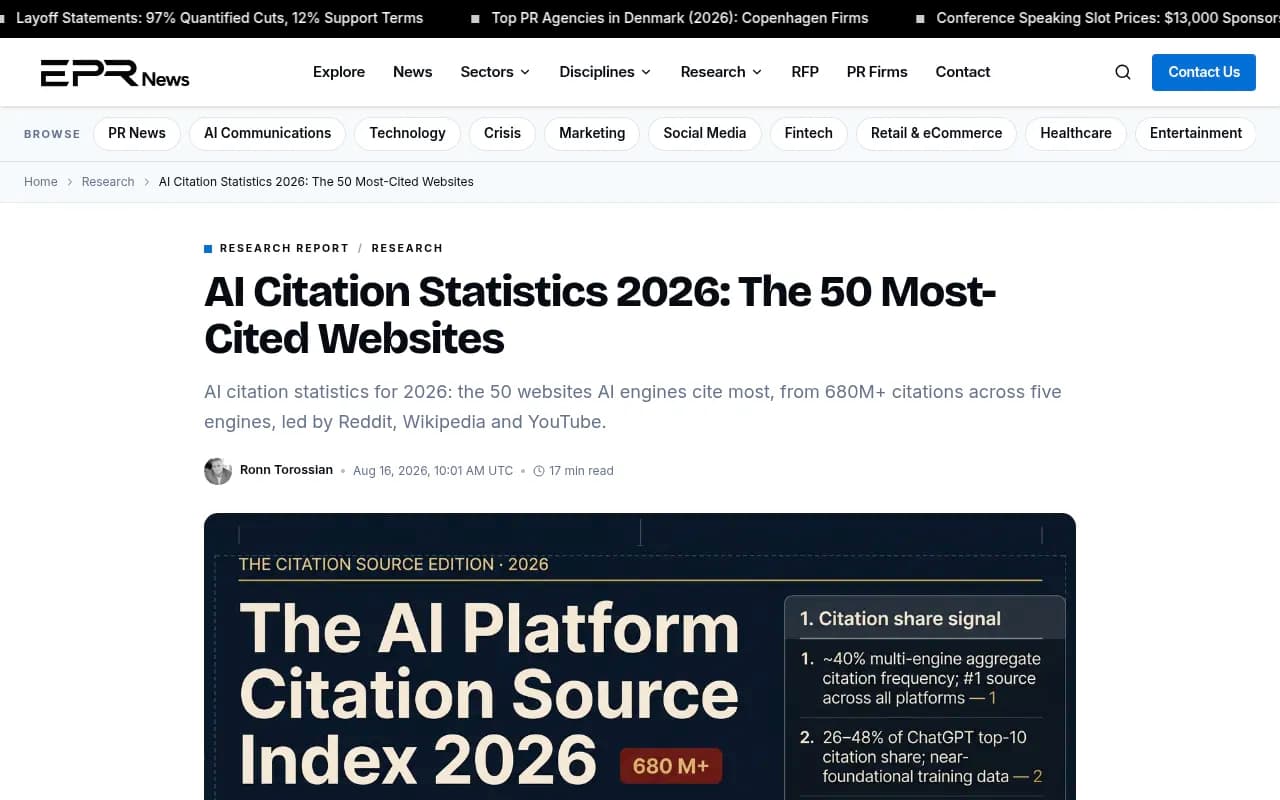
How do you square 68% concentrated in 15 domains with 47.9% going to sub-DA 40 sites? They measure different things. One counts share of citations across a consolidated index dominated by community and editorial giants. The other counts citations by authority band across a platform's tracked prompts. Both can be true: a handful of domains take an outsized slice, while a very long tail of small domains collectively takes nearly half of what's scored.
For niche prompts, which is where small sites actually compete, the head matters less. Promptwatch's industry reports show the pattern: for software prompts, GitHub, Microsoft's docs, and G2 lead; for automotive prompts, marketplaces like Autotrader and Cars.com outrank every car brand. Your competition is the category's source types, not the whole internet.
Rank in Google isn't the gate it used to be
The Ahrefs data reported by Digital Applied looked at 863,000 keywords and 4 million AI Overview URLs (March 2026). Only 38% of AI Overview citations came from pages in Google's top 10, down from 76% in mid-2025. Another 31.2% came from positions 11-100, and 31.0% from beyond rank 100.
The mechanism is query fan-out: engines expand a prompt into many sub-queries and pull from a much wider result set. That's good news for small sites with specific, well-targeted pages. A page that ranks 40th for a narrow sub-query can be cited where it would never earn a click in classic search.
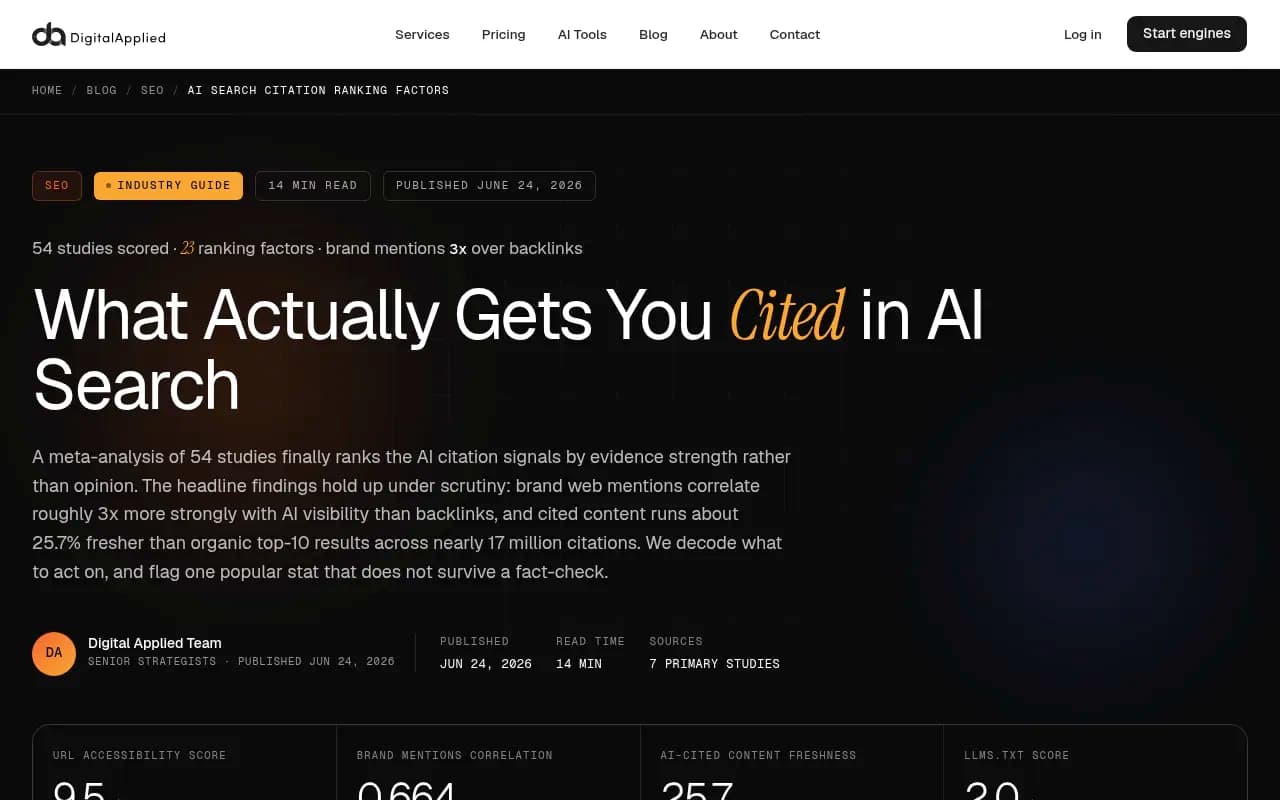
The same Digital Applied write-up, drawing on Cyrus Shepard's Zyppy meta-analysis of 54 studies, scores URL accessibility 9.5/10 and search rank 9.4/10 as the top factors. It also reports that branded web mentions correlate 0.664 with AI Overview visibility versus 0.218 for backlinks (Ahrefs, 75,000 brands). Those are correlations, not guaranteed levers, but they matter for small sites, because mentions are something you can earn without a high-DA domain.
Mentions matter as much as citations
Wellows found about half of all brand visibility in AI comes from other websites mentioning you rather than citing you. Those mentions spread across nearly 25,000 domains, versus just 293 domains where brands were cited directly, and the mentioning sites have a median DA of 41. Even on branded prompts, only 52.6% of the sources AI reads involve the brand.
For a small brand this is the opening. You don't need to out-authority Forbes. You need to be named on dozens of mid-tier sites that AI engines already read. OtterlyAI's study of 1M+ citations adds a warning on the access side: 73% of sites had technical barriers blocking AI crawlers. A small site that is blocked by robots.txt or a CDN rule can't win on any of the above.

What small sites should do
- Fix access first. Check robots.txt, CDN bot rules, and JavaScript rendering. A page AI can't reach can't be cited. AI crawler logs show whether bots actually arrive.
- Aim your benchmark at the middle. Promptwatch suggests comparing your site against DR 46-75, where most ChatGPT citation competition sits, rather than against DR 90+ giants.
- Target mid-authority placements. For PR and guest content, Promptwatch recommends DR 61-90 sites, and puts less weight on placements at the very top.
- Write for specific sub-queries. Fan-out rewards narrow, well-answered pages over a single head-term page.
- Pick formats that last. Landing pages, docs, and product pages hold citations longer than news. Product pages were the most cited content type in ChatGPT at 22.4% (Sep 28 to Oct 4, 2026), per Promptwatch Data.
- Track by engine, not in aggregate. A blended score hides that your wins may sit on one engine only.
- Re-measure monthly. Citations churn fast for low-authority domains, so a win in April says little about June.
Tools for tracking small-site citations
You need engine-level data to see any of this on your own site. A few options from the catalog:
| Tool | Good for |
|---|---|
| Promptwatch | Tracking citations per engine, crawler logs, and acting on content gaps |
| Wellows | AI citation analytics and authority-band views |
| Otterly.AI | Affordable prompt and citation tracking |
| Peec AI | Monitoring without the optimization layer |
| Google Search Console | Free baseline on which pages rank at all |

If you want to compare more platforms, the GEO software directory at bestgeosoftware.com is a decent place to start. I'd pick one that shows citations per engine and crawler activity, since those are the two things this data says matter most for a smaller site.
What the data can't tell you
- The Promptwatch domain rank report covers ChatGPT only, and one month. I found no equivalent figures for Perplexity or AI Mode from Promptwatch.
- Wellows' bands reflect the prompts tracked on its platform, and it states they describe observed behaviour, not causes.
- Authority metrics differ by vendor. DA and DR are not interchangeable, so cross-study comparisons are directional.
- ChatGPT changed behaviour in July and again around August 8 and 14. Any single month is a snapshot.
Bottom line
Small sites get cited constantly, roughly half the scored citation pool in the Wellows data and nearly a third of ChatGPT citations in Promptwatch's August 2026 numbers. The weakness isn't getting in. It's staying in, spreading across engines, and surviving shifts like ChatGPT's July move toward stronger domains. Build toward the DR 46-75 band, earn mentions on mid-tier sites, keep pages crawlable, and measure each engine separately.