Key takeaways
- AirOps is a content engineering platform first -- its core value is building automated workflows that produce AI-search-optimized content at scale. Profound is a monitoring and analytics platform first, with content generation as a secondary feature.
- Both tools start at the same price ($200/mo Solo, $2,000/mo Pro), but AirOps adds task-based overage fees that can make high-volume use significantly more expensive.
- Profound tracks 9+ AI engines with strong enterprise positioning and named clients (MongoDB, Ramp, Zapier). AirOps has historically tracked fewer engines, though its coverage has grown.
- Profound has dedicated solutions for AEO teams, content teams, and PR/brand teams -- it's built for cross-functional enterprise buying. AirOps is more of a power tool for content and SEO practitioners.
- Neither tool offers a free tier. Profound leans heavily on sales demos; AirOps offers a free trial on its entry plan.
- If your primary goal is understanding AI search performance across many engines with deep analytics, Profound has the edge. If you want to automate content production pipelines that feed AI search, AirOps is more purpose-built for that.
Overview
AirOps
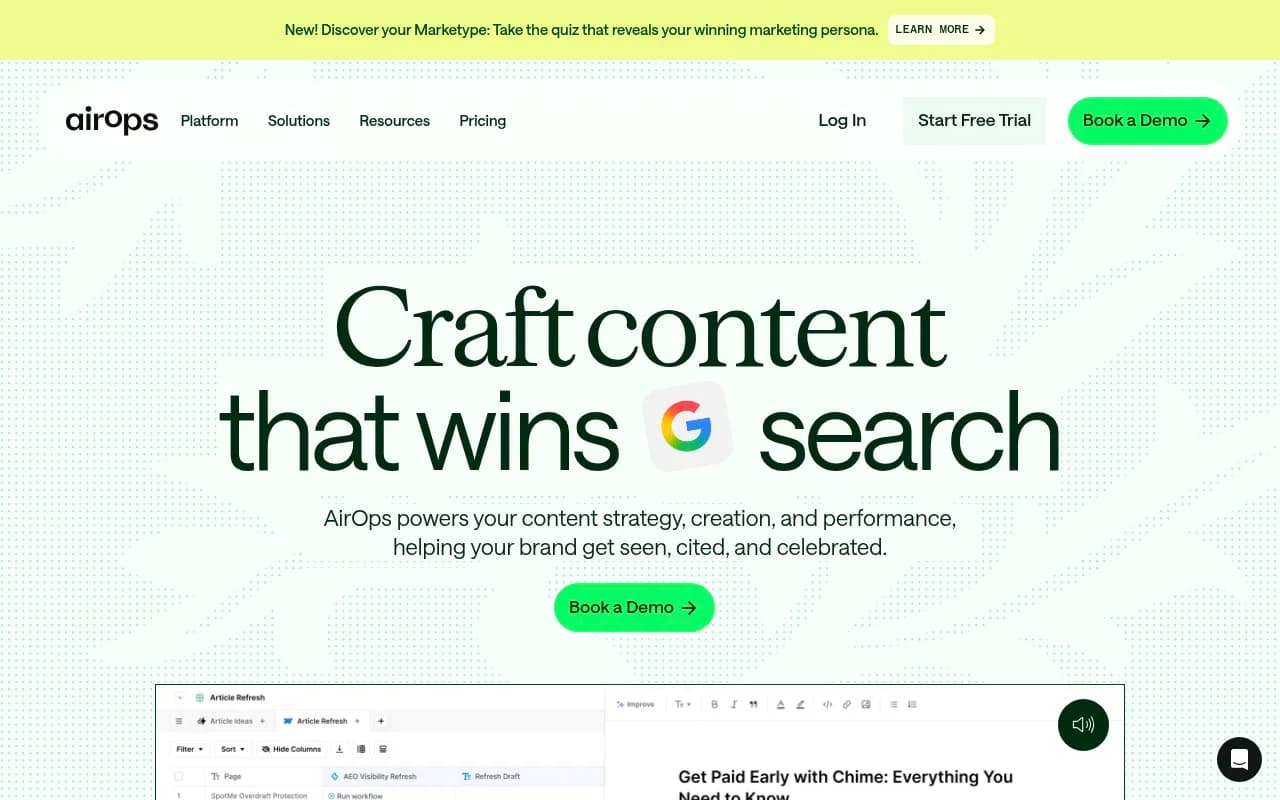
AirOps calls itself "the first end-to-end content engineering platform" -- and that framing tells you a lot about where it sits. The product is built around the idea that winning AI search isn't just about tracking your visibility; it's about systematically producing the right content at scale. You build workflows (they call them "apps") that chain together AI models, data sources, and publishing steps to generate content that's engineered to get cited by ChatGPT, Perplexity, and similar engines.
It's a genuinely different mental model from most GEO tools. Where others give you a dashboard and leave you to figure out what to do next, AirOps gives you an automation layer. That's powerful for teams that already know what content they need and want to produce it faster. It's less useful if you're still trying to figure out where your gaps are.
Profound AI
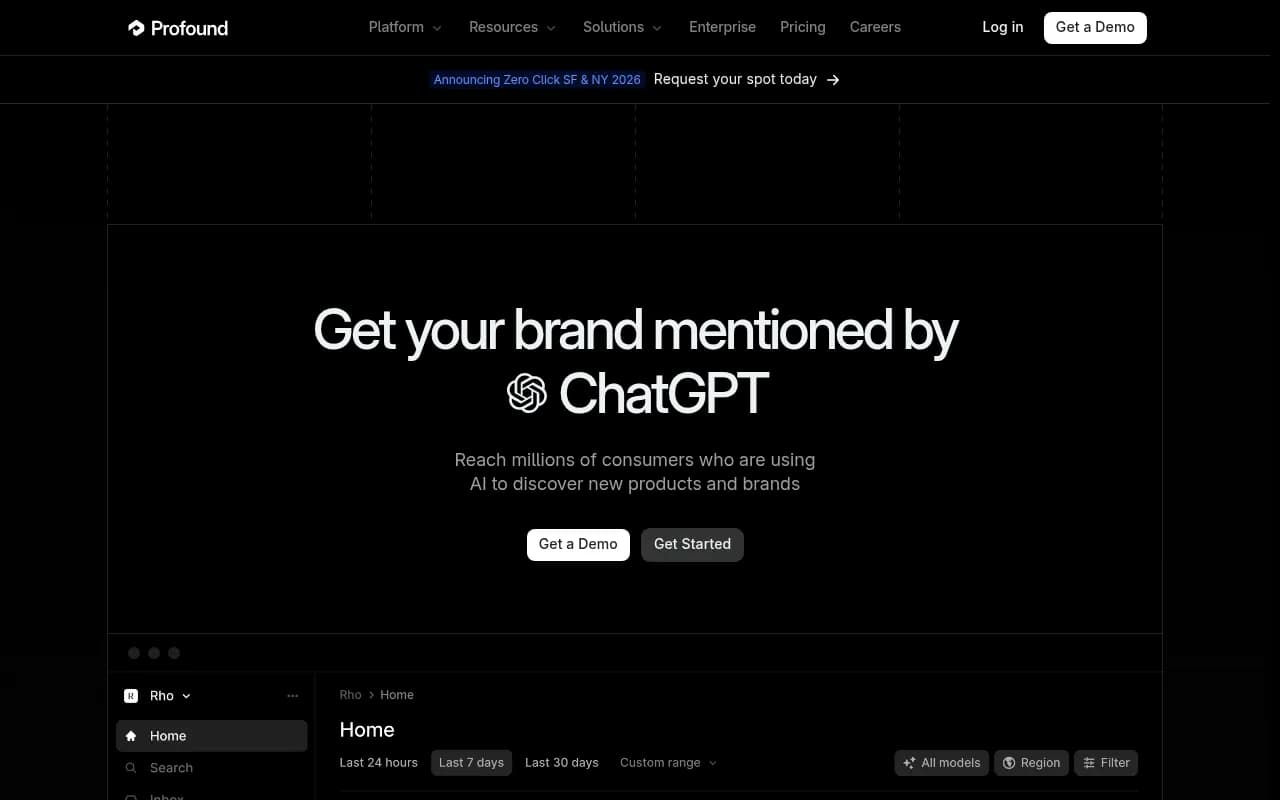
Profound positions itself as a "full stack marketing platform for the marketer of the future" -- which is ambitious language, but the product does cover a lot of ground. It monitors how your brand appears across 9+ AI engines, surfaces prompt volume data (what millions of people are actually asking AI), tracks citations, and has an Agents feature that generates AEO-optimized content like FAQ pages.
The enterprise angle is real. Profound has built dedicated solutions for AEO teams, content teams, and PR/brand teams, and its client list includes MongoDB, Ramp, and Zapier. The platform also publishes research (the Profound Index, AEO Report) and runs its own conference (Zero Click SF & NY 2026), which signals a company trying to own the AEO category narrative, not just sell software.
Side-by-side comparison
| Feature | AirOps | Profound AI |
|---|---|---|
| Primary focus | Content engineering & workflow automation | AI visibility monitoring & analytics |
| AI engines tracked | Growing coverage (historically 3-5) | 9+ (ChatGPT, Perplexity, Claude, Gemini, Grok, Copilot, Meta AI, DeepSeek, Google AI Overviews) |
| Content generation | Core feature -- flexible workflow automation | Agents feature -- template-driven (FAQ generator, etc.) |
| Prompt volume data | Yes | Yes -- "Prompt Volumes" feature |
| Citation tracking | Yes | Yes -- Answer Engine Insights |
| Shopping tracking | Not prominently featured | Yes -- dedicated Shopping feature |
| Agent analytics | No | Yes -- tracks AI agent interactions |
| Ease of setup | Moderate (workflow builder has a learning curve) | Easier (G2 reviewers give Profound a slight edge here) |
| Enterprise solutions | General enterprise tier | Dedicated solutions for AEO, content, PR/brand, and agency teams |
| Pricing model | Flat monthly + task-based overages | Flat monthly, no published task fees |
| Entry price | $200/mo | $200/mo (ChatGPT only) |
| Free trial | Yes (Solo plan) | Demo-first, no public free tier |
| API / integrations | Yes | Yes -- developer docs, integrations page |
| Research & education | Blog | Profound Index, AEO Report, Profound University, Research Hub |
Head-to-head feature deep-dive
Content generation
This is where the two tools diverge most sharply.
AirOps is built around workflow automation for content. You construct pipelines -- scrape a competitor page, run it through an LLM, generate a comparison article, publish it -- and those pipelines run at scale. The flexibility is real: you can chain together multiple AI models, pull in external data, and customize the output format. Teams that have invested time in building these workflows report significant velocity gains (one case study cited a 5x content refresh rate).
Profound's Agents feature takes a different approach. It's more template-driven: you give it a URL or a topic, it runs a research workflow (including pulling Perplexity FAQs), and outputs structured content like AEO-optimized FAQ pages. The demo on Profound's homepage shows a workflow that scrapes a web page, determines the core search query, and generates FAQ content. It's impressive, but it's narrower than AirOps's open-ended automation.
Verdict: AirOps wins for teams that need flexible, high-volume content automation. Profound wins for teams that want a guided, lower-setup content generation experience.
AI engine coverage and monitoring
| AI Engine | AirOps | Profound AI |
|---|---|---|
| ChatGPT / OpenAI | Yes | Yes |
| Perplexity | Yes | Yes |
| Claude | Yes | Yes |
| Gemini | Yes | Yes |
| Grok | Limited | Yes |
| Microsoft Copilot | Limited | Yes |
| Meta AI | Limited | Yes |
| DeepSeek | Limited | Yes |
| Google AI Overviews | Yes | Yes |
Profound has built out broader engine coverage, and it shows in the product. The Answer Engine Insights feature tracks how your brand appears across all these engines simultaneously, and the Agent Analytics feature specifically tracks interactions from AI agents (not just human-prompted queries). That's a meaningful distinction as agentic AI use grows.
AirOps has expanded its coverage over time, but the historical focus on a smaller set of engines means Profound has more data depth on the monitoring side.
Verdict: Profound has broader and deeper monitoring coverage. If you need to track how you appear across 9+ engines, Profound is the stronger choice.
Prompt intelligence
Both tools offer prompt volume data -- the ability to see what people are actually asking AI engines, not just what keywords they're searching on Google.
Profound's Prompt Volumes feature is prominently positioned and claims to surface insights from "millions" of real queries. It's designed to help teams align content strategy with actual AI search demand, which is the right problem to solve.
AirOps surfaces prompt data too, but it's more integrated into the workflow builder than presented as a standalone analytics feature. The framing is: here's what people are asking, now build a workflow to create content that answers it.
Verdict: Roughly even, but Profound presents prompt intelligence as a more polished standalone feature. AirOps integrates it more tightly into the content production loop.
Enterprise fit
Profound has clearly invested in enterprise go-to-market. The dedicated solutions pages (AEO Teams, Content Teams, PR & Brand Teams, Agencies), the named enterprise clients, the conference, the research hub -- this is a company that wants to be bought by a VP of Marketing at a Fortune 500, not just adopted bottom-up by an SEO manager.
AirOps has an enterprise tier too, but the product's workflow-builder DNA means it tends to get adopted by practitioners first. That's not a weakness -- bottom-up adoption often leads to stickier enterprise contracts -- but it does mean the buying process looks different.
Verdict: Profound is better positioned for top-down enterprise sales. AirOps is better for teams that want to start using it immediately and expand from there.
Ease of use
G2 reviewers give Profound a slight edge on ease of setup and use. That tracks with the product design: Profound's monitoring dashboards are relatively straightforward to configure, and the Agents feature has a guided workflow that doesn't require much technical knowledge.
AirOps's workflow builder is more powerful but has a steeper learning curve. Building a sophisticated content automation pipeline requires understanding how to chain steps, configure inputs and outputs, and manage task limits. Teams that invest in learning it report strong results, but the onboarding is heavier.
Verdict: Profound is easier to get started with. AirOps rewards teams willing to invest in setup.
Pricing and cost structure
Both tools share the same headline pricing, but the details matter.
| Plan | AirOps | Profound AI |
|---|---|---|
| Solo | $200/mo | $200/mo (ChatGPT only) |
| Pro | $2,000/mo | $2,000/mo |
| Enterprise | Custom | Custom |
| Task overages | $6-$9 per 1,000 tasks | Not published |
| Free trial | Yes | Demo only |
The task-based overage model on AirOps is worth paying attention to. If you're running high-volume content automation workflows, those $6-$9 per 1,000 task fees can compound quickly. A team running 100,000 tasks per month could add $600-$900 on top of the base plan cost. Profound's pricing appears to be flat (no published overage fees), which makes budgeting more predictable.
Profound's Solo plan is also more limited than it sounds -- at $200/mo, it only covers ChatGPT. To monitor across all 9+ engines, you need the Pro plan at $2,000/mo. That's a steep jump.
Verdict: Comparable at face value, but Profound's engine-gated Solo plan and AirOps's task overages both have gotchas. Get a detailed quote from both before committing.
Pros and cons
AirOps
Pros:
- Genuinely flexible workflow automation -- you can build almost any content pipeline you can imagine
- Strong content velocity for teams that invest in setup (5x refresh rates cited by users)
- Free trial available on Solo plan
- Adapts to various workflows (G2 reviewers consistently note this)
- Good for teams that want to own their content production process end-to-end
Cons:
- Steeper learning curve than Profound
- Task-based overage fees make costs harder to predict at scale
- Historically narrower AI engine coverage
- Less polished enterprise go-to-market compared to Profound
- Solo plan at $200/mo is the same price as Profound's but covers more engines
Profound AI
Pros:
- Broader AI engine coverage (9+ engines) out of the box
- Dedicated enterprise solutions for different team types (AEO, content, PR/brand)
- Agent Analytics tracks AI agent interactions, not just human queries
- Shopping tracking for brands selling products
- Strong research resources (Profound Index, AEO Report, Profound University)
- Easier to set up and use according to G2 reviewers
- Named enterprise clients add credibility
Cons:
- Solo plan ($200/mo) only covers ChatGPT -- full coverage requires the $2,000/mo Pro plan
- Content generation (Agents) is more template-driven and less flexible than AirOps
- Demo-first sales process creates friction for teams that want to try before buying
- Less suited for teams that want deep workflow automation
Who should pick which tool
Pick AirOps if:
- Your primary goal is producing AI-search-optimized content at scale through automated workflows
- You have a content or SEO team willing to invest time in building and maintaining automation pipelines
- You want flexibility to customize how content is generated, not just follow templates
- Cost predictability on overages isn't a major concern, or your task volume is relatively low
Pick Profound if:
- You need to monitor your brand's AI visibility across 9+ engines simultaneously
- You're buying for a cross-functional team (AEO, content, PR/brand) and need a platform that speaks to all of them
- You want enterprise-grade analytics with prompt volume data, citation tracking, and agent analytics
- Ease of setup matters more than workflow flexibility
- You're selling products and want ChatGPT Shopping tracking
A note on the broader landscape
Both AirOps and Profound are strong tools, but neither covers every angle of AI search visibility. If you're also looking to track how your brand appears in AI search results with traffic attribution, crawler logs, and content gap analysis in one place, Promptwatch is worth a look -- it's built specifically around the full cycle of finding gaps, creating content, and measuring the results.

Final verdict
AirOps and Profound are solving adjacent but different problems. Profound is the better choice if you want a comprehensive monitoring platform that tracks your AI visibility across many engines with strong analytics and enterprise support. AirOps is the better choice if you want to automate content production at scale and your team is willing to invest in building workflows.
The identical pricing at the Pro level ($2,000/mo) makes this a genuine feature-for-feature decision rather than a budget one. The real question is: do you need better visibility data, or better content production? If it's the former, go Profound. If it's the latter, go AirOps.