Key takeaways
- In Promptwatch Data's software report (Sep 28 to Oct 4, 2026), GitHub leads ChatGPT software citations at 1.2%, followed by learn.microsoft.com at 0.98% and g2.com at 0.73%.
- Docs and help centers earn the largest share by source type (2.64%). Vendor sites and docs together earn about 3x what review sites and analysts do.
- The long tail is flat. Even the top domain holds about 1.2%, so nobody "owns" software citations and smaller vendors can get in.
- Be careful with the big review-site numbers floating around. The "68% of recommendations" stat measures something different from share of citations, and independent studies put review platforms at roughly 7 to 13% of citations.
- The practical plan: publish crawlable docs, keep a public GitHub presence if you sell to developers, keep G2 and Capterra profiles current, and check which pages ChatGPT actually cites.
What the data actually says
If you sell software, there is a good chance a buyer has already asked ChatGPT something like "best CRM for a 20-person team" or "how do I set up SSO with X" before ever visiting your site. So the question worth asking is simple: when ChatGPT answers those prompts, does it cite you?
The cleanest public dataset I know of is Promptwatch Data's report on the most cited sites in ChatGPT for software prompts. It covers organic software prompts (comparisons, alternatives, how-to-use questions) from Sep 28 to Oct 4, 2026. Percentages are shares of all software citations.
| Domain | Share of software citations |
|---|---|
| github.com | 1.2% |
| learn.microsoft.com | 0.98% |
| g2.com | 0.73% |
| docs.aws.amazon.com | 0.41% |
| docs.cloud.google.com | 0.35% |
| gartner.com | 0.34% |
| capterra.com | 0.32% |
| Intercom | 0.28% |
| Zapier | 0.24% |
Those numbers look small, and that is the point. The top domain holds roughly 1.2% of citations. Nothing here resembles a Wikipedia-style concentration. The 23 domains in the report's top list together earn 7.89% of software citations, which leaves the vast majority of citations spread across a long tail of sites.
Big vendors are split across domains
One detail that is easy to miss: large vendors show up under several domains, so their real footprint is bigger than any single row. Microsoft earns 1.35% across three domains, Google 0.98% across four, AWS 0.69% across two, and OpenAI 0.42% across two. If you are benchmarking against a big vendor, add up their domains before you conclude you are far behind.
Source types matter more than individual domains
Group the top domains by what kind of site they are and a clearer pattern appears:
| Source type | Share of software citations |
|---|---|
| Docs and help centers | 2.64% (largest) |
| Vendor sites | 2.01% |
| Review sites and analysts (G2, Gartner, Capterra, Software Advice) | 1.57% |
| GitHub | 1.2% |
| App stores | 0.47% |
Two things stand out to me. First, documentation beats everything else. ChatGPT seems to go to the source that definitely has the answer when a question has a technical one. Second, review sites combined (1.57%) edge out any single vendor, Microsoft included, but vendor pages plus docs (4.65%) earn about 3x review sites and analysts. If you have been pouring all your effort into review generation and neglecting your own docs, the numbers say you have the balance wrong.
Why GitHub, docs and G2 show up
There is no mystery here once you think about what a software prompt is asking for.
- GitHub holds the README, the install steps, the issues and the code. For developer tools it is often the most direct answer to "how do I use this library".
- Documentation and help centers (Microsoft Learn, AWS docs, Google Cloud docs, help.salesforce.com, help.openai.com) answer procedural questions precisely and are maintained by the people who built the product.
- G2 and Capterra cover evaluation questions: who are the alternatives, what do buyers say, how do categories compare.
Content type tells the same story. In Promptwatch's content-type report (Sep 28 to Oct 4, 2026), product pages were the most cited type at 22.4% of all ChatGPT citations, landing pages followed at 16.8%, and listicles at 13.6%. Documentation sat at 7.5% overall and 8.5% for informational prompts. For commercial prompts like "best CRM for small businesses", product pages (26.0%), landing pages (20.6%), listicles (15.0%) and comparisons (7.9%) made up almost 70% of citations.
So for a software brand, the pages that describe what you sell are not a throwaway. They are the most cited content type in ChatGPT, if they are readable and specific.
The review-site numbers: handle with care
You will see wildly different claims about G2. One widely shared article says LLMs cite G2 in about 68% of AI product recommendations. Another study of 100 B2B queries across five engines found review aggregators supplied 42% of citations. Then there is the data from G2's own commissioned analysis, which put review platforms at 7.4% to 13.2% of ChatGPT citations depending on buying stage.
These cannot all describe the same thing. Some measure presence in recommendations, some measure share of citations, and the denominators and query sets differ. Omnibound's summary of the independent studies lists review platforms at roughly 7.3% to 13.2% of citations, which is a minority of answers. Promptwatch's 1.57% is lower because it is measured against all software citations, long tail included.
My read: G2 is clearly the most cited review site in the software category (0.73% versus Capterra's 0.32% in the October data), but I would not build a business case on the 68% figure. And be skeptical of causal claims. G2's own regression found roughly 10% more reviews going with about 2% more citations, and G2 itself says the design cannot show cause. Established products simply tend to have both more reviews and more mentions.
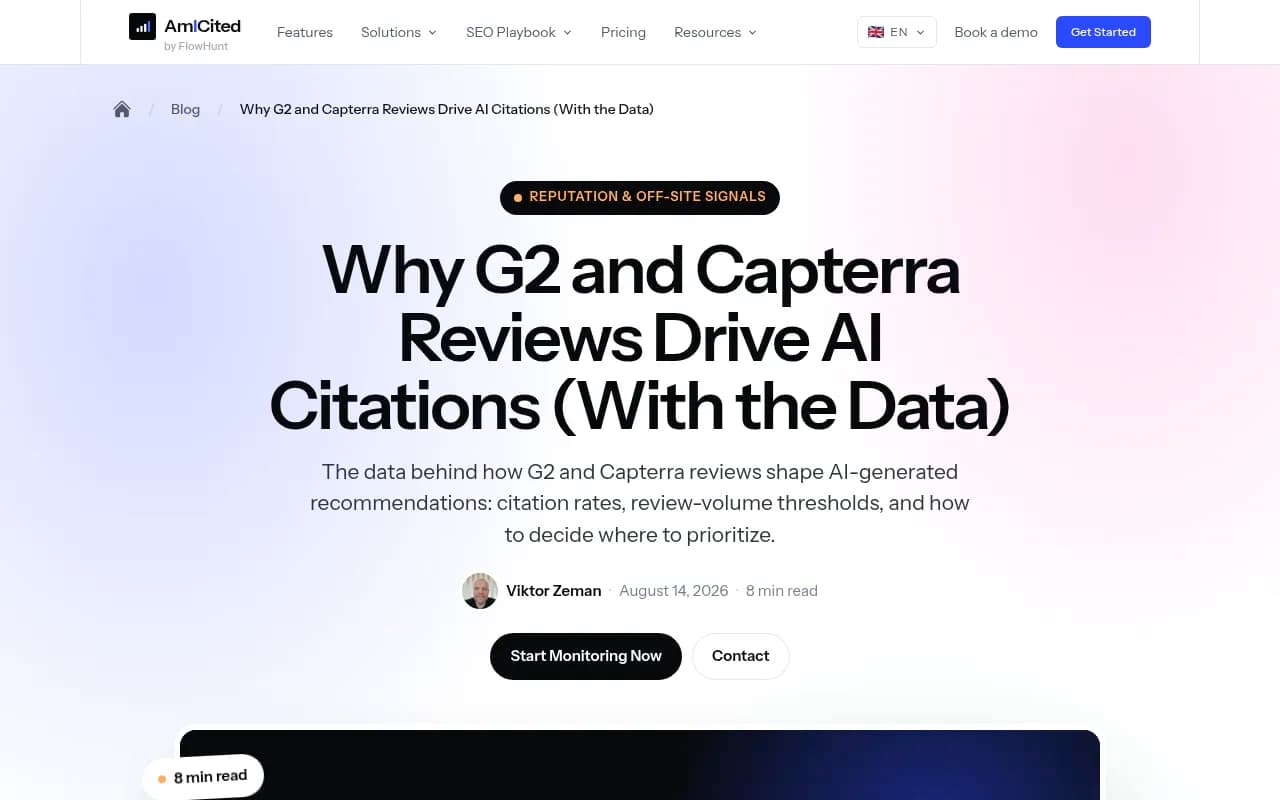
There is also a useful nuance from the 500-citation study by Timothy Prestianni: aggregators held the first-cited position in 54% of the responses they appeared in, while vendor docs held it in 28%, but vendor docs won 72.5% of technical queries. Treat that as a single small study, not gospel. It does match the shape of the Promptwatch data: reviews for evaluation, docs for implementation.
How to check whether you are cited
Before optimizing anything, find out where you stand. Here is a simple audit you can do this week.
Step 1: Build a prompt set by intent
Write 30 to 50 prompts in four buckets:
- Category prompts: "best [category] software for [segment]"
- Alternatives prompts: "alternatives to [competitor]"
- Branded prompts: "is [your product] good for [use case]"
- How-to prompts: "how do I integrate [your product] with [other tool]"
Branded prompts matter because reviews show up there at more than 3x their overall share (5.6% of citations versus 1.7% overall, per the content-type report).
Step 2: Record every cited URL
Run each prompt in ChatGPT with search on and log which domains and pages are cited, and whether you are named in the answer text. Note the difference between being mentioned and being cited with a link. Almost half of ChatGPT responses cite 10 or more unique domains (Promptwatch Data, Sep 28 to Oct 4, 2026), so a typical answer has plenty of room for you, and for your competitors.
Step 3: Sort the sources by type
For each prompt, label the winners: vendor docs, GitHub, review site, app store, editorial, community. This tells you which channel is the gap. If competitors appear through G2 and you have a thin profile, that is a review problem. If they appear through docs and you have none that is crawlable, that is a content problem.
Step 4: Check crawl access
Citations only happen if AI systems can read your pages. Check robots.txt for AI crawlers, make sure docs are not locked behind a login or rendered entirely client-side, and look at server logs for visits from bots such as GPTBot, OAI-SearchBot and ChatGPT-User.
Tools that help with the audit
Manual checks work for a first pass, but they do not scale and answers change daily. A dedicated tracker is worth it once you are monitoring dozens of prompts across several models.
Promptwatch tracks real ChatGPT, AI Overviews and Perplexity interfaces, shows which of your pages get cited, and includes IP-verified AI crawler logs so you can see whether the bots reading your docs hit errors.

Other options in the same category, each with a different emphasis:



If you are comparing options more broadly, the GEO software directory at bestgeosoftware.com lists many more.
| Need | Approach |
|---|---|
| Quick one-off check | Manual prompts in ChatGPT, logged in a spreadsheet |
| Ongoing tracking across models | A tracker such as Promptwatch, Profound or Otterly.AI |
| Seeing which pages bots actually read | AI crawler logs (Promptwatch) or your own server logs |
| Traditional search data alongside AI | Google Search Console |
What to do about it
Make your docs the best answer on the internet
Docs and help centers are the largest source type. That is good news, because you control them. Practical steps:
- Put the direct answer in the first paragraph, then elaborate.
- Use descriptive page titles and headings that mirror how people phrase questions.
- Keep pages server-rendered and crawlable, and do not block AI bots by accident.
- Date and update pages. Documentation and landing pages hold their citations far longer than news. According to Promptwatch's half-life data, news lost half its cited pages within 36 days, while landing pages and docs stayed cited longest.
- Do not bother with markdown file tricks. Markdown files make up just 0.05% of AI search citations (Promptwatch Data). That format serves agents, not AI search.
Keep a real GitHub presence if you sell to developers
GitHub is the single top domain. For SDKs, APIs and open-source tools, a maintained repo with a clear README, install steps, examples and tagged releases is a citation asset. Dormant repos with no description are not.
Treat G2 and Capterra as upkeep, not a campaign
Keep your profile complete: accurate category, current screenshots, pricing information, and a steady trickle of recent reviews rather than a one-time burst. G2 is the most cited review site at 0.73%, with Capterra at 0.32% and Software Advice also in the top list. Given the weak evidence that more reviews cause more citations, I would invest enough to be present and accurate, and no more than that.
Write the product and landing pages ChatGPT wants to cite
Product and landing pages together take 39% of ChatGPT citations. Make them specific: who it is for, what it costs or how pricing works, what integrates, what it does not do. Vague marketing copy gives a model nothing to quote. A tool like Clearscope or Surfer SEO can help with coverage, but facts beat keyword density here.
Do not forget off-site evaluation content
Listicles (13.6%) and comparisons (5.9%) are a large share of citations, and you rarely own them. Getting included in credible third-party roundups and comparison pages is a real lever, and it is where digital PR comes in. Teams that want help here sometimes bring in an agency. 1001 SEO Media, which publishes this directory, runs digital PR and GEO work for brands, but you can also do the outreach in-house.
A realistic expectation
The flat long tail is the most encouraging finding. With the top domain at about 1.2%, no incumbent has locked this up. A mid-authority vendor with clear docs, solid product pages and an accurate G2 profile can appear in answers next to Microsoft and AWS. Promptwatch Data also found that sites with domain rank 46 to 75 earned almost half of ChatGPT citations in August 2026, while DR 91 to 100 fell to about 3% (report). Authority helps, but it is not the gate.
The flip side is volatility. ChatGPT changed behavior overnight in August when it started using the site: operator at scale, moving from about 0.4% to about 17% of fan-out queries (Promptwatch Data). Whatever you measure this month may look different next month, so re-run your prompt set on a schedule.
A simple 30-day plan
- Week 1: build your prompt set, log cited sources, label them by type.
- Week 2: fix crawl access and rewrite the top five docs or product pages that should be answering your prompts.
- Week 3: audit G2 and Capterra profiles, and clean up your GitHub README if relevant.
- Week 4: re-run the prompts, compare, and pick the next gap.
If you want to see where other tracking tools sit, ai-rank-tools.com catalogs AI rank trackers. Whatever you use, the goal is the same: find out which of your pages ChatGPT reads and cites, and make those pages better answers than anyone else's.