Key takeaways
- Surfer SEO starts at $99/mo vs AirOps at $200/mo -- Surfer is the more accessible entry point for most content teams
- Surfer is built around Google SEO first; AirOps is built around GEO (AI search visibility) first -- this is the core philosophical split
- Surfer has 150,000+ users and a mature, proven workflow; AirOps is newer and more specialized, with a steeper learning curve
- AirOps positions itself as a "content engineering platform" with workflow automation at its core; Surfer is a content optimization tool with AI writing layered on
- For traditional SEO content at scale, Surfer wins on ease and price; for teams specifically targeting AI search citations, AirOps has the more purpose-built toolset
- Neither tool tracks your actual AI search visibility in real time -- that's a separate problem requiring a dedicated monitoring platform
Overview
AirOps

AirOps calls itself the first "end-to-end content engineering platform" for AI search. The pitch is that it helps brands build systematic, scalable workflows to produce content that gets cited by ChatGPT, Perplexity, Claude, and other AI models. It's not just an AI writer -- it's more of an automation layer that connects research, writing, and optimization steps into repeatable pipelines. The GEO angle is baked in from the start, not bolted on.
The trade-off is complexity. AirOps requires more setup and workflow thinking than a tool like Surfer. You're essentially building content production systems, not just opening a doc and hitting "generate."
Surfer SEO
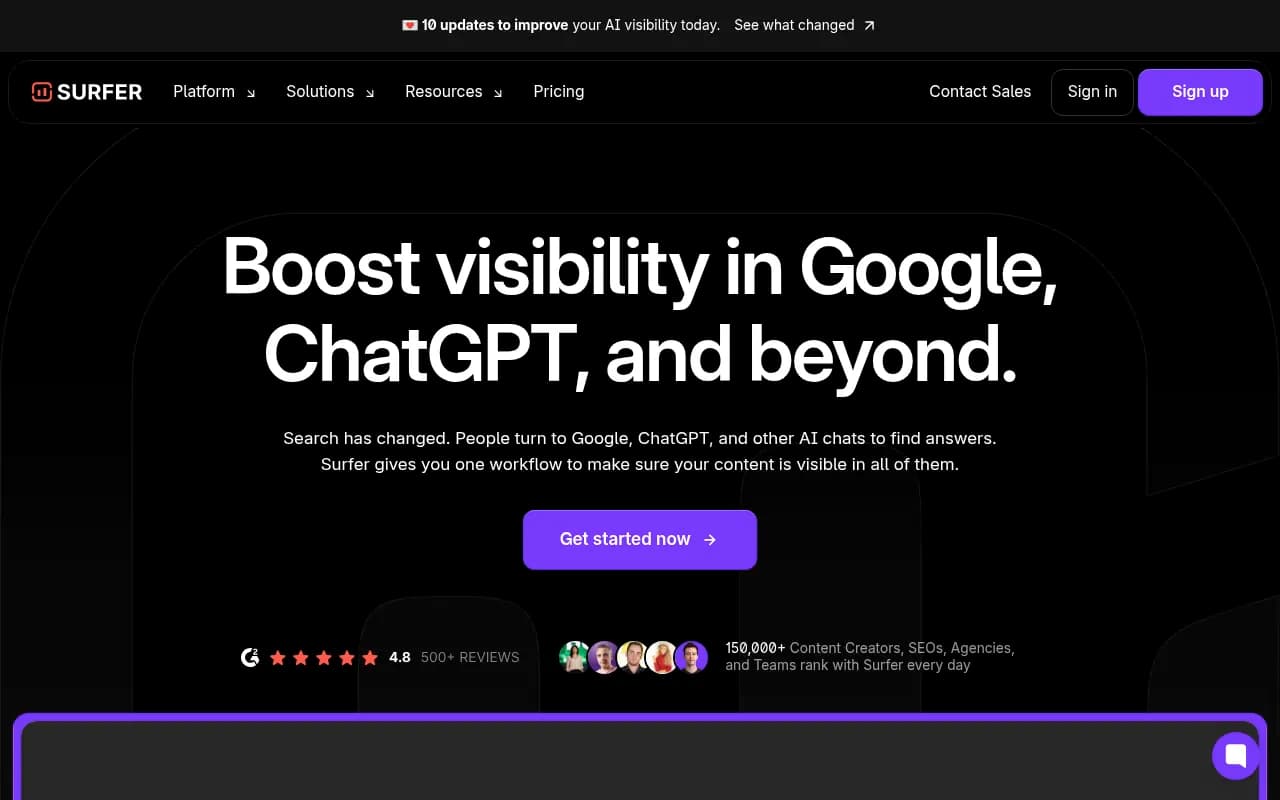
Surfer is one of the most established names in SEO content optimization. It analyzes the top-ranking pages for any keyword, then gives you a real-time content score based on word count, keyword usage, structure, and NLP terms. Its AI writer generates drafts that are already optimized for those signals. Over 150,000 content creators, SEOs, and agencies use it daily.
Surfer has recently expanded its positioning to cover AI search visibility alongside Google, but its DNA is traditional SEO. The interface is clean, the workflow is intuitive, and the learning curve is gentle compared to AirOps.
Side-by-side comparison
| Feature | AirOps | Surfer SEO |
|---|---|---|
| Starting price | $200/mo (Solo) | $99/mo (Essential) |
| Free tier | No | No (7-day money-back) |
| Primary focus | GEO / AI search content engineering | Google SEO content optimization |
| AI writing | Yes (workflow-based) | Yes (integrated AI writer) |
| Content scoring | GEO-oriented | Real-time SEO content score |
| SERP analysis | Limited | Core feature |
| Workflow automation | Yes (core feature) | No |
| AI search optimization | Purpose-built | Added feature |
| Team seats | Yes | Yes (varies by plan) |
| Integrations | API, custom workflows | Google Docs, WordPress, Jasper |
| Learning curve | Steep | Gentle |
| User base | Smaller, newer | 150,000+ users |
| Annual discount | Yes | Yes (20%) |
| Enterprise plan | Yes | Yes |
Head-to-head feature deep-dive
Core philosophy and approach
This is where the tools diverge most sharply, and it matters more than any individual feature.
Surfer's model is: here's a keyword, here's what the top-ranking pages look like, now write something better. It's a feedback loop between your draft and a content score. The score goes up, your chances of ranking on Google go up. Simple, proven, effective for traditional SEO.
AirOps's model is: here's a content gap in AI search, here's a workflow to systematically produce content that fills it, now run that workflow at scale. It's less about a single article and more about building a repeatable system. The output is content engineered to earn citations from AI models, not just rank in Google's blue links.
Neither approach is wrong -- they're solving different problems. The question is which problem your team has right now.
Verdict: If your primary goal is Google rankings, Surfer's approach is more direct. If you're specifically targeting AI search visibility, AirOps is more purpose-built.
Content creation workflow
Surfer's workflow is genuinely smooth. You enter a keyword, it pulls SERP data, you get a content brief with recommended headings, word count, and NLP terms. The AI writer generates a draft that already hits most of those targets. You edit, optimize, publish. Most users can produce a polished, optimized article in under an hour.
AirOps works differently. You're building or using pre-built "playbooks" -- automated workflows that chain together research, competitive analysis, writing, and optimization steps. This is powerful for teams running high-volume content operations, but it takes time to set up and understand. The payoff is repeatability: once a workflow is built, you can run it at scale without reinventing the process each time.
Verdict: Surfer wins for speed and simplicity on individual articles. AirOps wins for teams that need systematic, scalable content production pipelines.
GEO and AI search capabilities
AirOps was built specifically for GEO. Its workflows are designed to produce content that AI models will cite -- structured, authoritative, comprehensive content that answers the kinds of questions people ask ChatGPT and Perplexity. The platform's entire content engineering framework is oriented around this goal.
Surfer has added AI search optimization features and now markets itself as covering visibility "in Google, ChatGPT, and beyond." But the core product is still built around Google's ranking signals. The AI search features feel more like an expansion than a foundation.
Worth noting: neither tool actually monitors your AI search visibility in real time. They help you create content that should perform well in AI search, but tracking whether ChatGPT or Perplexity is actually citing your pages requires a dedicated platform. Promptwatch is built specifically for that -- tracking citations across 10+ AI models and showing you which pages are getting picked up and which aren't.

Verdict: AirOps has the more coherent GEO story. Surfer's AI search features are real but secondary to its Google SEO core.
Pricing and value
| Plan | AirOps | Surfer SEO |
|---|---|---|
| Entry | $200/mo (Solo) | $99/mo (Essential, 30 articles) |
| Mid-tier | $500/mo (Starter) | $219/mo (Scale, 100 articles) |
| Top tier | $2,000/mo (Pro) | $399/mo (Max, 300 articles, 10 users) |
| Enterprise | Custom | Custom |
| Extra tasks | $6-9 per 1,000 tasks | N/A |
| Annual discount | Yes | 20% |
| Money-back | N/A | 7-day |
Surfer is meaningfully cheaper at every tier. For a solo content creator or small team, the $100 price gap at entry level is significant. At the top end, Surfer's Max plan at $399/mo covers 300 articles and 10 users -- AirOps's $2,000/mo Pro plan is aimed at a very different scale of operation.
AirOps's pricing makes more sense when you factor in the workflow automation value. If a team is running hundreds of content pieces through automated pipelines, the per-task pricing model can be efficient. But for most teams, Surfer delivers more value per dollar.
Verdict: Surfer SEO wins on price at every tier for most use cases.
Integrations and ecosystem
Surfer integrates directly with Google Docs, WordPress, and Jasper, which covers the tools most content teams already use. The Google Docs integration in particular is popular -- you can optimize content without leaving your existing workflow.
AirOps is built around API-first workflow automation, which means it's more flexible but requires more technical setup. It connects to various data sources and can be integrated into custom content pipelines. For teams with engineering resources, this is a strength. For teams without, it's a barrier.
Verdict: Surfer wins for plug-and-play integrations. AirOps wins for custom workflow flexibility.
Ease of use and onboarding
Surfer has a clean, intuitive interface. Most users are productive within an hour. The content editor is familiar, the scoring is visual, and the AI writer is straightforward. There's a reason 150,000 people use it -- the product doesn't get in the way.
AirOps has a steeper learning curve. Understanding playbooks, configuring workflows, and getting the most out of the platform takes real time investment. The payoff is there for teams willing to put in the work, but it's not a tool you can pick up and run with immediately.
Verdict: Surfer wins on ease of use and onboarding speed.
Reporting and analytics
Surfer provides content scores, keyword tracking, and some performance data, but it's primarily a creation tool rather than an analytics platform. You'll still need separate tools for ranking tracking and traffic analysis.
AirOps focuses on workflow outputs and content performance within its GEO framework. Like Surfer, it's not a comprehensive analytics platform -- it's a production tool.
Verdict: Neither tool is strong on analytics. Both require supplementary tools for tracking actual search performance.
Pros and cons
AirOps
Pros:
- Purpose-built for GEO and AI search content from the ground up
- Workflow automation enables systematic, scalable content production
- Flexible, API-first architecture for custom pipelines
- Strong fit for teams running high-volume AI search content operations
Cons:
- Significantly more expensive than Surfer at every tier
- Steep learning curve -- not a tool you can pick up quickly
- Smaller user base and less community support than Surfer
- Requires more technical setup to get full value
- No real-time AI visibility monitoring (that's a separate problem)
Surfer SEO
Pros:
- Affordable entry point at $99/mo
- Clean, intuitive interface with a gentle learning curve
- Proven track record with 150,000+ users
- Strong Google Docs and WordPress integrations
- Fast workflow for individual article optimization
- 7-day money-back guarantee reduces risk
Cons:
- Core product is Google SEO first; AI search features are secondary
- No workflow automation -- each article is a manual process
- Less suited for teams building systematic GEO content pipelines
- Content score is Google-centric, not AI citation-centric
- No real-time AI visibility monitoring
Who should pick which tool
Choose AirOps if:
- Your primary goal is ranking in AI search (ChatGPT, Perplexity, Claude) rather than just Google
- You're building a systematic, scalable content operation and want workflow automation
- You have the budget ($200+/mo) and the technical appetite to set up and maintain workflows
- You're a larger team or agency running high-volume GEO content programs
- You want a platform that was designed for AI search from day one, not adapted to it
Choose Surfer SEO if:
- Google rankings are your primary focus, with AI search as a secondary consideration
- You want a tool that's fast to learn and easy to use from day one
- Budget is a real constraint -- $99/mo is a much lower barrier to entry
- You're a solo creator, small team, or agency that needs to produce optimized articles quickly
- You value a large community, extensive documentation, and a proven product
Final verdict
These two tools are less direct competitors than they appear. Surfer SEO is a mature, accessible content optimization platform that's excellent at what it was built for: helping content rank on Google, with AI search features added as the market has shifted. AirOps is a newer, more specialized platform built specifically for the GEO era, with workflow automation at its core.
If you're a content team that primarily cares about Google and wants a reliable, affordable tool that works out of the box, Surfer is the safer, smarter choice. If you're specifically investing in AI search visibility and want to build systematic content pipelines for it, AirOps is worth the higher price and steeper learning curve.
The honest answer for most teams in 2026: start with Surfer for Google SEO, and evaluate AirOps when AI search becomes a dedicated priority with dedicated budget to match.