Key takeaways
- AirOps is a workflow automation platform built for teams that need to go from "we're not showing up in AI search" to "here's the published, fixed page" without leaving the tool. Clearscope is a content scoring and editorial guidance tool that tells you what a draft needs, then hands execution back to your stack.
- Clearscope is meaningfully cheaper to start: Essentials runs $129/mo versus AirOps' Solo plan, which starts around $200/mo but has moved to a usage-based task slider, so your real bill depends on monthly task volume.
- Clearscope is the easier tool to onboard. Reviewers report being productive on day one, while AirOps has a real setup curve, often described as "the first two weeks were hard" before Brand Kits and Playbooks start paying off.
- Both tools have added AI-search tracking recently, but the depth differs. AirOps monitors visibility across 7+ answer engines on its Pro tier and pipes that data into production workflows; Clearscope tracks ChatGPT and Gemini mentions on every plan but stops at monitoring.
- AirOps has the deeper integration bench: 7 native CMS connectors (Webflow, WordPress, Contentful, Sanity, ContentStack, Ghost, Strapi), project tools like Asana and ClickUp, plus Zapier access to 9,000+ apps. Clearscope's integrations are narrower and editor-embedded (Google Docs, Word, a WordPress plugin), and at least one reviewer flagged the Google Docs add-on as unreliable.
- These tools aren't really competing for the same budget line. Most comparisons, including third-party ones from Slate and Rankability, conclude that AirOps and Clearscope solve different problems and can be run together rather than as an either/or choice.
Overview
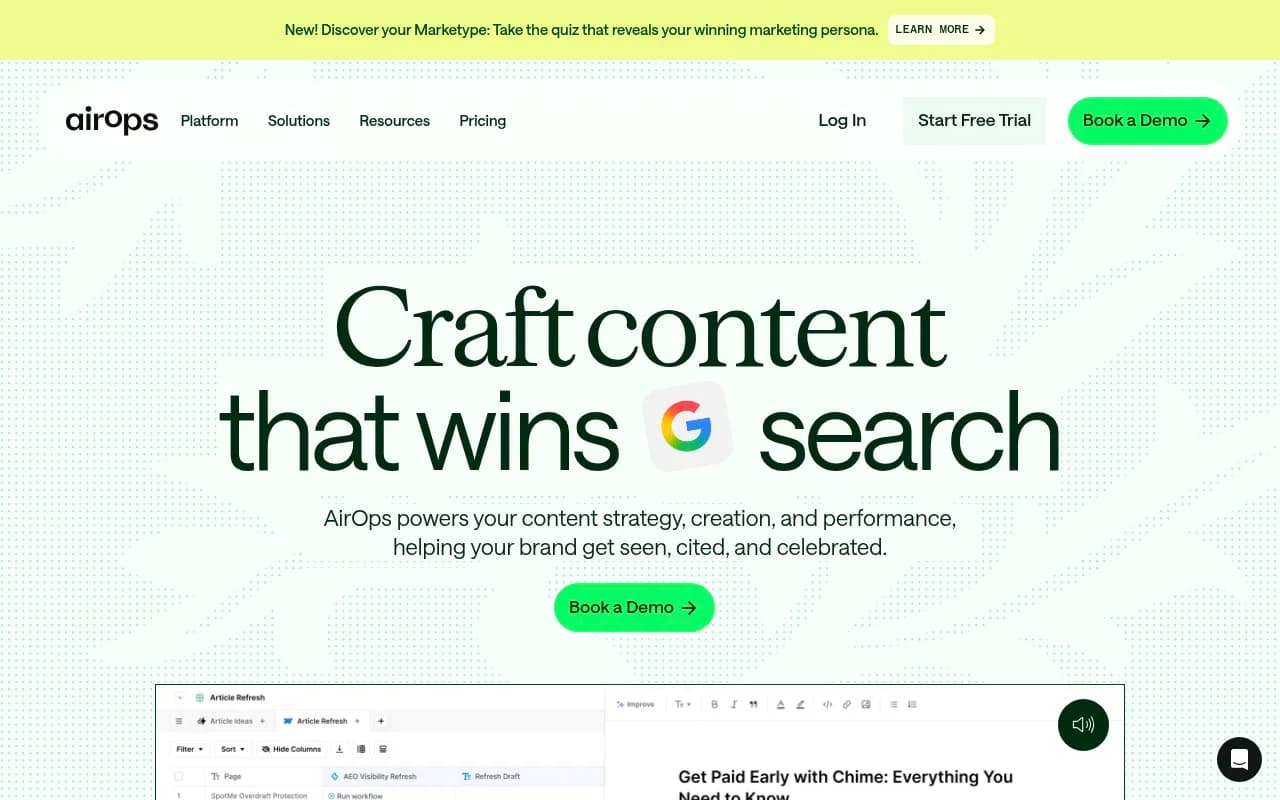
AirOps positions itself as the system that runs your "AI discovery strategy" end to end. It combines visibility monitoring across answer engines with an agent/workflow builder (Playbooks) that takes an identified content gap and turns it into a published, CMS-ready page. The pitch is less "here's a score" and more "here's the finished asset." AirOps leans technical: its own research shows pages not refreshed within three months are over three times more likely to lose AI citations, and the product is built around acting on that signal automatically rather than just reporting it.
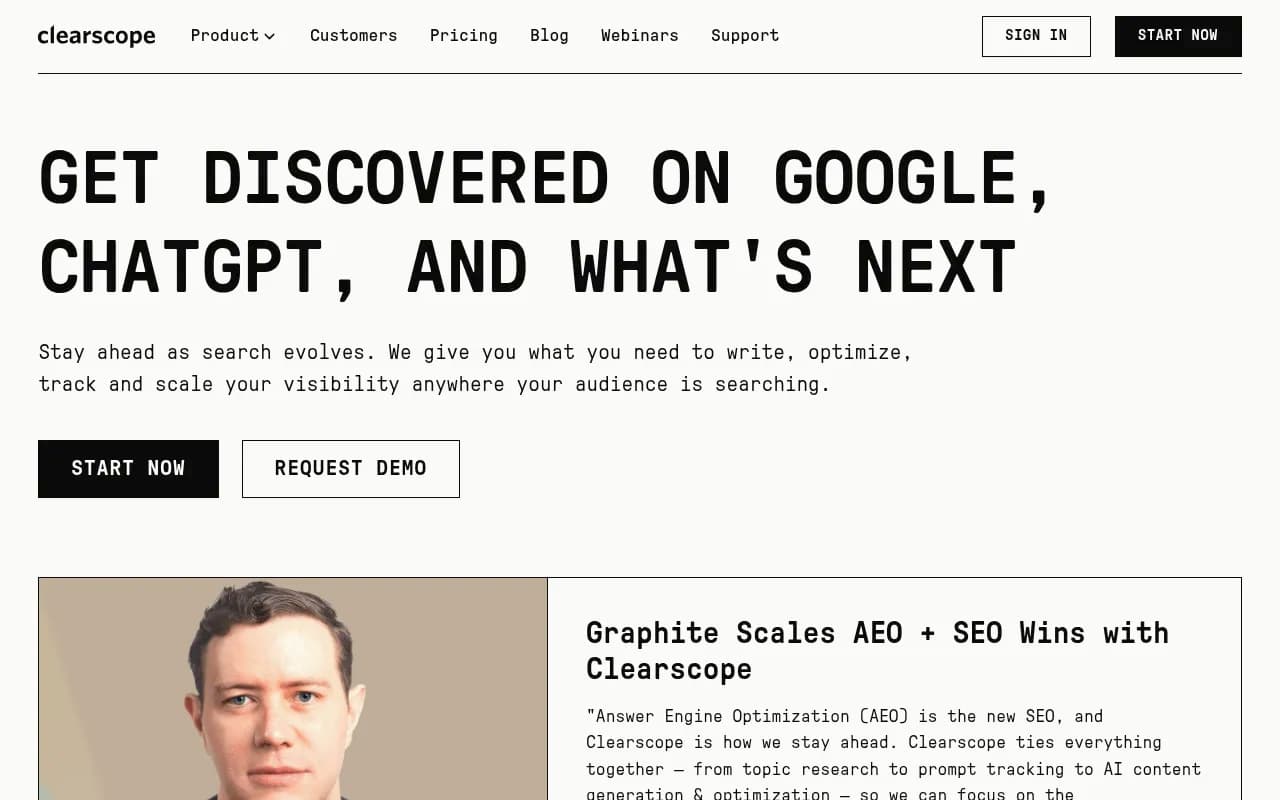
Clearscope started as an on-page content optimization tool built around keyword and topic coverage grading, and it's still best known for that. In 2026 it repositioned as a "discoverability platform," adding Prompt Tracking (brand mentions across ChatGPT and Gemini) and Query Discovery to surface high-value topics across Google and AI engines. But the core workflow is still editor-led: you write or generate a draft, Clearscope grades it against competitor content, you revise, you publish somewhere else.
Side-by-side comparison
| Feature | AirOps | Clearscope |
|---|---|---|
| Starting price | ~$200/mo (Solo), now usage-based via task slider | $129/mo (Essentials) |
| Top published tier | Enterprise, custom quote | $399/mo (Business) |
| Free trial/tier | Free tier exists, real usage lands on paid plans | 14-day free trial |
| Core model | Workflow/agent automation across production | Editorial scoring and grading |
| AI search visibility tracking | 7+ answer engines (Pro tier) | ChatGPT and Gemini (all plans) |
| Content production | Automated drafting, refresh, and CMS publishing via Playbooks | AI-assisted drafts, but publishing happens elsewhere |
| Native CMS integrations | Webflow, WordPress, Contentful, Sanity, ContentStack, Ghost, Strapi | WordPress plugin only |
| Project management integrations | Asana, ClickUp, Monday.com, Airtable | None |
| Editor-embedded tools | Limited | Google Docs add-on, Word/OneDrive |
| Zapier/broad app access | Yes, 9,000+ apps | No |
| Users/seats included | Unlimited on Pro+ | Unlimited on every plan |
| Onboarding time | Steeper, multi-week setup for Brand Kits/Playbooks | Fast, usable within a day |
| G2 rating | 4.6-ish across ~133 reviews | 4.9/5 across 92 reviews |
Head-to-head deep dive
Pricing
Clearscope is the more transparent and predictable buy. Essentials is $129/mo with 50 tracked queries, 50 pages, 20 monthly Topic Explorations, and 20 Drafts. Business jumps to $399/mo for 300 tracked queries and pages, plus a dedicated account manager. Extra Pages and Drafts are sold in blocks if you outgrow your tier.
AirOps used to publish flat tier pricing ($200 Solo up to $2,000 Pro), but the current pricing page has moved to an interactive task-volume slider instead of fixed numbers, which means your actual cost depends on how many tasks (content generations, refreshes, workflow runs) you burn through each month. Budget for "starting around $200/mo" and expect a quote conversation once your volume grows past entry-level usage.
Verdict: Clearscope wins on price predictability. AirOps can get expensive fast at scale, but that scale is also the point of buying it.
Pricing comparison table
| Plan | AirOps | Clearscope |
|---|---|---|
| Entry | Solo, ~$200/mo (now slider-based) | Essentials, $129/mo |
| Mid | Pro, up to ~$2,000/mo depending on task volume | Business, $399/mo |
| Top | Enterprise, custom | Enterprise, custom |
| Extra usage | Additional tasks: $6-$9 per 1,000 | Extra Pages from $15-$25/mo per 100; extra Drafts from $20-$50 per 10 |
Content quality and editorial guidance
Clearscope's grading model is the reason it's still recommended by editors specifically. It analyzes top-ranking and top-cited competitor content, then scores your draft on topic coverage and term usage, with a clear number to chase. It's built for someone tuning a single piece of content and wanting a clean answer on whether it's comprehensive enough.
AirOps includes content guidance too, but it lives inside broader Playbooks rather than as a standalone scoring interface. If your team's bottleneck is "we don't know if this draft is good enough," Clearscope answers that faster. If your bottleneck is "we know what's wrong across 400 pages and need to fix it without hiring five more writers," that's AirOps' actual use case.
Verdict: Clearscope wins for pure content scoring. AirOps wins when content guidance needs to be one step inside a bigger production pipeline.
Workflow automation and scale
This is the real dividing line between the two tools. AirOps is workflow-led: Playbooks chain together research, drafting, brand voice application, and CMS publishing into repeatable pipelines. It's designed for teams managing large content libraries who need refresh and production to happen continuously, not manually, page by page.
Clearscope is editor-led. There's no equivalent to a Playbook. Each piece of content moves through Clearscope as a discrete task: research the topic, draft or paste your draft, grade it, revise, then take it somewhere else to publish.
Verdict: No contest here. AirOps is built for scale and automation; Clearscope is built for one article at a time.
AI search visibility tracking
Both tools have leaned into GEO/AEO positioning over the past year, which tells you where the market is headed. Clearscope's Prompt Tracking covers ChatGPT and Gemini mentions on every plan, paired with Query Discovery for surfacing high-value AI-driven topics. AirOps tracks visibility across 7+ answer engines on its Pro tier and connects that data to G2 review pulls (a nod to research showing AI engines cite G2 more than vendor sites) and refresh workflows.
Neither tool goes especially deep here compared to a dedicated AI visibility platform. If your primary need is understanding why you're or aren't being cited, tracking AI crawler behavior, or measuring actual traffic from AI platforms, tools like Promptwatch cover that ground with crawler logs, citation trend analysis by content type, Reddit and YouTube citation tracking, and visitor analytics tied to real conversions, not just mention counts.

Verdict: AirOps covers more answer engines and acts on the data; Clearscope tracks fewer engines but keeps it simple. Neither replaces a purpose-built AI visibility platform.
Integrations
AirOps has the clear edge on breadth. Its native connector list covers seven CMS platforms plus four project management tools, and Zapier opens up 9,000+ additional apps. It also supports MCP access across Claude, ChatGPT, and Cursor, letting you query AirOps data from inside those AI environments.
Clearscope keeps integrations close to the writing surface: a Google Docs add-on, Word/OneDrive support, and a WordPress plugin. That's fine if your workflow is "write in Docs, check the score, publish through WordPress," but at least one hands-on reviewer flagged the Google Docs integration as unreliable.
Verdict: AirOps, by a wide margin, if you need the tool to actually touch your CMS and project management stack.
Ease of use and onboarding
Clearscope reviewers on G2 report average implementation under a month and describe the product as straightforward, sometimes calling out fair pricing and ease of use as standout strengths. One recurring critique: it can feel overwhelming to someone unfamiliar with SEO terminology.
AirOps reviewers consistently mention a real ramp-up period. Multiple G2 reviews describe the first two weeks as the hardest part, spent configuring Brand Kits and Playbooks before the tool starts saving real time. It's also not fully automated by design: a human-in-the-loop review step is built into workflows, which preserves brand voice but adds friction some reviewers didn't expect.
Verdict: Clearscope is faster to get value from. AirOps asks for patience upfront in exchange for more leverage later.
Support and community
AirOps invests in hands-on implementation support and a growing Content Engineering community, useful given the setup curve. Clearscope keeps support lighter for lower tiers but adds a dedicated account manager on Business and above.
Verdict: Roughly a wash, weighted toward what tier you're on for each tool.
Pros and cons
AirOps
Pros:
- Turns visibility data into published, CMS-ready content without switching tools
- Deep native integrations across CMS and project management platforms
- Tracks AI search visibility across 7+ answer engines
- MCP access for querying data from Claude, ChatGPT, or Cursor
- Built for scale: refresh and production run as repeatable workflows
Cons:
- Real setup curve; first two weeks are commonly described as difficult
- Pricing has moved to a usage-based slider, making budgeting less predictable
- Human-in-the-loop review step adds time even though it protects quality
- Overkill for teams only producing a handful of articles a month
Clearscope
Pros:
- Fast to onboard, usable within a day per most reviews
- Clear, well-regarded grading model for topic coverage
- Prompt Tracking for ChatGPT and Gemini included on every plan
- Predictable, published pricing with no custom quotes needed below Enterprise
- Strong G2 rating (4.9/5) and consistent praise for fair pricing
Cons:
- No production or publishing automation; you still need other tools to ship
- Integrations are narrow and editor-embedded; Google Docs add-on has reliability complaints
- Cost is a recurring complaint even among happy reviewers, especially for freelancers and small teams
- Can feel overwhelming for people without existing SEO knowledge
Who should pick which tool
Pick Clearscope if you're an editor or a small content team that produces articles one at a time and wants a reliable, fast answer on whether a draft is comprehensive enough. It's also the better fit if you want predictable monthly pricing and don't need CMS-level automation.
Pick AirOps if your content team is managing a large inventory of pages, your bottleneck is execution rather than diagnosis, and you need refresh cycles, drafting, and publishing to happen through repeatable workflows rather than manual effort. Expect a real onboarding investment and budget flexibility since pricing scales with task volume.
Many teams, especially agencies, end up running both: AirOps as the production engine, Clearscope as the quality gate for individual drafts. That combination shows up repeatedly in third-party comparisons, and it's a reasonable way to avoid forcing a choice between two tools that aren't really solving the same problem.
Final verdict
AirOps and Clearscope get compared constantly, but they're not really rivals: Clearscope is a content grading tool with some AI-tracking layered on, and AirOps is a production and automation platform with some grading layered on. If you need to know whether a draft is good, buy Clearscope. If you need to turn a backlog of content gaps into published pages without hiring more writers, buy AirOps. If your actual problem is understanding your AI search visibility itself, crawler behavior, citation sources, and real AI-driven traffic, neither tool goes deep enough, and that's a separate purchase entirely.