Key takeaways
- AirOps is a content production platform first. Its core job is helping you create and scale content engineered to rank in AI search. Scrunch is a monitoring and optimization platform that tracks how AI models perceive your brand right now.
- Scrunch has deeper LLM monitoring: real-time AI crawler logs, citation tracking, competitor comparisons, and a unique "Agent Experience Platform" that serves AI-optimized content directly to crawlers. AirOps doesn't do this.
- AirOps has deeper content workflows: multi-step automation, bulk content generation, and integrations with your existing CMS or data sources. Scrunch doesn't generate content.
- Pricing is closer than it looks. AirOps starts at $200/mo but charges per-task fees on top, which can add up fast. Scrunch's $250/mo (annual) is more predictable for teams running steady monitoring.
- If you need to understand your current AI visibility, start with Scrunch. If you need to produce content to improve it, AirOps is the better tool. Many teams end up using both.
- Neither tool is a complete end-to-end GEO solution on its own -- each covers roughly half the picture.
Overview
AirOps
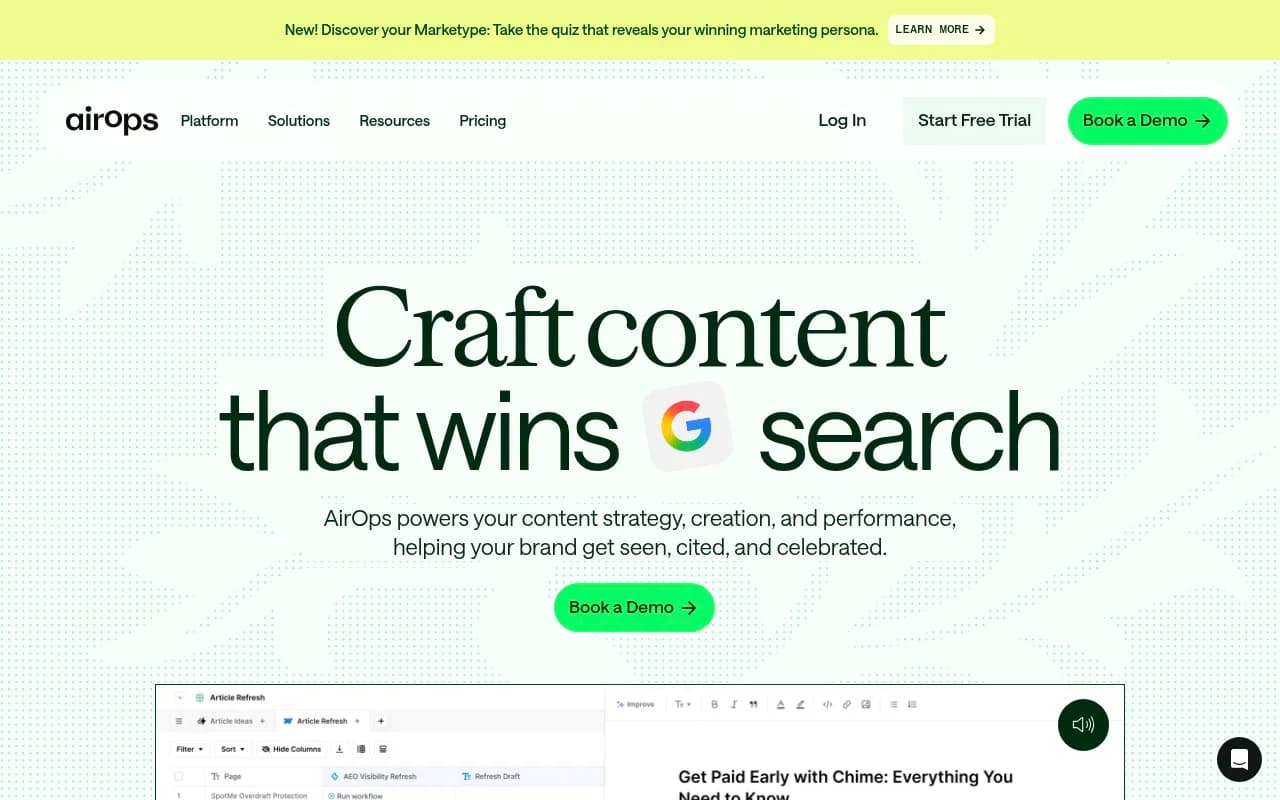
AirOps bills itself as "the first end-to-end content engineering platform" for AI search. The pitch is straightforward: most brands know they need to show up in ChatGPT and Perplexity, but producing enough quality content to actually get cited is a bottleneck. AirOps solves the production problem. It lets you build automated workflows that pull in your data, run it through AI models, and output structured content -- articles, comparisons, FAQs, product descriptions -- at scale. The platform has a workflow builder, prompt management, integrations with tools like Google Sheets, Airtable, and various CMSs, and a growing set of GEO-specific templates.
The learning curve is real. AirOps is not a "log in and get a result in 30 seconds" tool. You're building workflows, which takes setup time. But once those workflows are running, you can produce content at a volume that would be impossible manually.
Scrunch
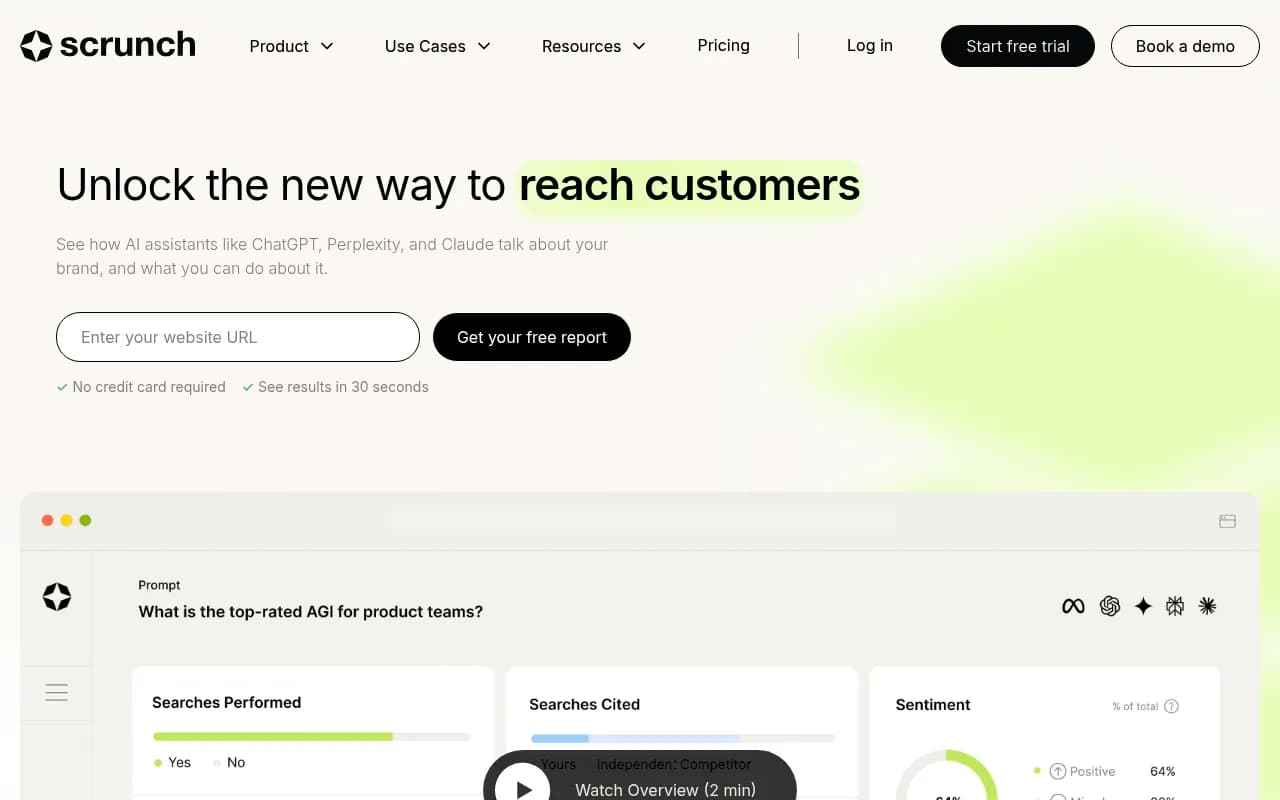
Scrunch positions itself as an "AI Customer Experience Platform" -- a broader framing than pure GEO monitoring, though monitoring is clearly its strongest suit. You connect your brand, set up prompts, and Scrunch starts tracking how ChatGPT, Claude, Perplexity, and other LLMs talk about you. It shows citations, rankings, competitor comparisons, and AI crawler activity on your site.
The standout feature is the Agent Experience Platform (AXP), which lets you serve AI-optimized versions of your pages directly to AI crawlers without changing anything for human visitors. That's a genuinely different approach to the problem -- instead of just telling you what to fix, it helps you serve better content to AI bots in real time.
Scrunch is trusted by 500+ companies including Lenovo, Crunchbase, and Penn State University.
Side-by-side comparison
| Feature | AirOps | Scrunch |
|---|---|---|
| Primary function | Content engineering & production | LLM monitoring & optimization |
| LLM monitoring | Limited | Yes (ChatGPT, Claude, Perplexity, Gemini, etc.) |
| AI crawler logs | No | Yes (real-time feed) |
| Content generation | Yes (core feature) | No |
| Workflow automation | Yes (multi-step, visual builder) | No |
| Citation tracking | No | Yes |
| Competitor analysis | Limited | Yes (by prompt, persona, geo) |
| Agent Experience Platform (AXP) | No | Yes |
| GEO-specific templates | Yes | No |
| CMS integrations | Yes (Webflow, WordPress, etc.) | No |
| Free trial | Not listed | 7-day free trial |
| Starting price | $200/mo | $250/mo (annual) |
| Per-task fees | Yes ($6-$9 per 1,000 tasks) | No |
| Target user | Content teams, SEO agencies | Marketing teams, SEO managers |
| Ease of use | Steeper learning curve | Intuitive dashboard |
Head-to-head feature deep-dive
LLM monitoring and brand tracking
This is where the gap between the two tools is most obvious.
Scrunch was built for monitoring. You get a real-time dashboard showing how AI models mention your brand, which prompts trigger citations, how you rank against competitors, and how AI bots are crawling your site. You can filter by persona, geography, topic, and competitor. The AI crawler feed is particularly useful -- it shows you exactly which pages AI bots are visiting, how often, and whether they're hitting errors.
AirOps doesn't really do this. Its focus is on the content production side, not the monitoring side. You won't get a dashboard showing your brand's citation frequency across LLMs or a breakdown of which competitors are outranking you for specific prompts.
Verdict: Scrunch wins this category clearly.
Content generation and workflow automation
AirOps is the clear winner here, and it's not close.
The platform lets you build multi-step workflows that can ingest data from spreadsheets, APIs, or databases, process it through AI models with custom prompts, and output structured content at scale. You can generate hundreds of articles, comparison pages, or FAQs in a single workflow run. The GEO-specific templates are designed to produce content that AI models are more likely to cite -- structured, factual, well-sourced.
Scrunch provides optimization recommendations (tips on what to fix, which topics to cover), but it doesn't generate content. You still have to write it yourself or use another tool.
Verdict: AirOps wins this category clearly.
Technical AI optimization
Scrunch has a feature that AirOps simply doesn't: the Agent Experience Platform. The idea is that AI crawlers often struggle to parse modern JavaScript-heavy websites. AXP lets you serve a clean, AI-readable version of your pages directly to AI bots, without touching the human-facing version. This is a meaningful technical lever that can improve how AI models understand and cite your content.
Scrunch also surfaces crawl errors -- cases where AI bots tried to visit your site and failed. That's actionable data most teams don't have visibility into.
AirOps doesn't address this layer at all.
Verdict: Scrunch wins on technical optimization.
Ease of use
Scrunch is the more accessible tool. The dashboard is clean, and you can get a meaningful read on your AI visibility within minutes of signing up. The 7-day free trial means you can test it without a sales call.
AirOps requires more upfront investment. Building workflows takes time, and the platform assumes you're comfortable with concepts like prompt chaining, data mapping, and API connections. It's not unusable, but it's not a "log in and get value immediately" experience. The payoff is real once workflows are set up, but the ramp is steeper.
Verdict: Scrunch is easier to get started with. AirOps rewards the investment but requires it.
Pricing and cost predictability
| Plan | AirOps | Scrunch |
|---|---|---|
| Entry-level | $200/mo (Solo) | $250/mo (Starter, annual) |
| Mid-tier | Not clearly listed | $417/mo (Growth, annual) |
| Pro/Scale | $2,000/mo (Pro) | Enterprise (custom) |
| Free trial | Not listed | 7-day free trial |
| Per-task fees | $6-$9 per 1,000 tasks | None |
| Enterprise | Custom | Custom |
The per-task pricing on AirOps is worth paying attention to. At $200/mo base, it looks cheaper than Scrunch's $250/mo -- but if you're running large content workflows, those task fees accumulate. A team generating 50,000 tasks/month at $8 per 1,000 is paying an extra $400 on top of the base plan. Scrunch's pricing is flat, which makes budgeting simpler.
Verdict: Scrunch is more predictable. AirOps can be cheaper at low volumes but more expensive at scale.
Integrations and ecosystem
AirOps has stronger integration support for content workflows: Google Sheets, Airtable, Webflow, WordPress, and various APIs. If your content team already works in these tools, AirOps slots in reasonably well.
Scrunch's integrations are less documented publicly, though it connects to your website for crawler monitoring and provides traffic data. It's more self-contained.
Verdict: AirOps has more integrations relevant to content production teams.
Competitor and market intelligence
Scrunch lets you compare your AI visibility against specific competitors across prompts, personas, and geographies. You can see which brands are being cited alongside yours (or instead of yours) and track how that changes over time.
AirOps doesn't offer this kind of competitive intelligence. Its competitor awareness is limited to informing content strategy rather than direct monitoring.
Verdict: Scrunch wins on competitive intelligence.
Pricing comparison
| Plan | AirOps | Scrunch |
|---|---|---|
| Free tier | No | No (7-day trial) |
| Entry plan | $200/mo (Solo) | $250/mo (Starter, annual) |
| Growth/Mid plan | Not clearly listed | $417/mo (Growth, annual) |
| Pro plan | $2,000/mo | Enterprise (custom) |
| Enterprise | Custom | Custom |
| Task/usage fees | $6-$9 per 1,000 tasks | None |
Pros and cons
AirOps
Pros:
- Best-in-class content production workflows for GEO
- Scales to high content volumes once workflows are set up
- Strong integrations with content and data tools
- GEO-specific templates reduce guesswork
- Flexible automation for teams with complex content pipelines
Cons:
- No real LLM monitoring or brand tracking
- Steeper learning curve than most GEO tools
- Per-task fees make costs unpredictable at scale
- No free trial clearly advertised
- Requires significant setup before delivering value
Scrunch
Pros:
- Clean, intuitive monitoring dashboard
- Real-time AI crawler logs are genuinely useful
- Agent Experience Platform is a unique technical differentiator
- Predictable flat-rate pricing
- 7-day free trial, no credit card required
- Competitor tracking by prompt, persona, and geo
Cons:
- No content generation -- you still need another tool to act on insights
- Workflow automation is not part of the platform
- Fewer integrations with content production tools
- Starts at $250/mo (annual), which is a commitment for smaller teams
- Monitoring-first approach means you need to bring your own content strategy
Who should pick which tool
Pick AirOps if:
- Your main bottleneck is content production, not visibility data
- You need to generate large volumes of AI-optimized content across multiple topics or pages
- You're an agency or content team that already has visibility data and needs to act on it
- You're comfortable with workflow automation and willing to invest setup time
- You have a clear content strategy and just need execution at scale
Pick Scrunch if:
- You want to understand your current AI search visibility before investing in content
- You need real-time monitoring of how ChatGPT, Claude, and Perplexity talk about your brand
- Technical AI optimization (crawler errors, AXP) is a priority
- You want competitive intelligence -- who's getting cited instead of you, and why
- You prefer a tool you can get value from on day one without a long setup process
Use both if:
- You're serious about GEO as a channel and want to close the full loop: monitor gaps with Scrunch, produce content to fill them with AirOps
- You're an agency managing multiple brands that need both reporting and content delivery
If you're also tracking how your brand appears in AI search results across models like ChatGPT, Perplexity, and Google AI Overviews, Promptwatch is worth looking at -- it combines monitoring, content gap analysis, and AI-native content generation in a single platform, which is a different take on the same problem both tools are trying to solve.

Final verdict
AirOps and Scrunch are solving adjacent problems, not the same one. Scrunch tells you where you stand in AI search and gives you the technical tools to improve how AI bots read your site. AirOps gives you the production machinery to create content that can actually get cited. Neither is a complete GEO solution on its own.
If you're starting from zero and want to understand the problem before throwing content at it, start with Scrunch. If you already know your gaps and need to produce content at scale to close them, AirOps is the better tool. The teams getting the most out of GEO right now are typically using something in both categories -- the question is just which half you're missing.