Key takeaways
- AirOps is a workflow automation platform built for teams that want to run bulk content operations (its Grids feature) across thousands of pages, with AI visibility monitoring bolted on as a secondary feature, not the core product.
- Averi AI is a simpler, all-in-one content engine aimed at startups and lean teams: strategy, drafting, publishing, and analytics in one flow, without a visual workflow builder or bulk-row operations.
- Price gap is significant. AirOps starts at $200/mo and its Pro plan runs $2,000/mo plus $6-$9 per 1,000 extra tasks. Averi AI's current pricing page shows $99/mo (Solo) and $199/mo (Team), though older sources still list a $45/mo tier, so confirm current pricing before you commit.
- AirOps has real third-party validation: 4.6/5 on G2 from 130+ reviews. Averi AI has no independent G2 product page at the time of writing; its 4.8-4.9/5 ratings and "1,000+ teams" claims are self-reported.
- Neither tool is a serious AI visibility platform. AirOps' own reviewers (including a competitor's independent review) call its AI monitoring "surface-level" with limited LLM coverage and no prompt-popularity data. Averi's discoverability audit is a lighter feature still, not a monitoring product.
- If your core need is publishing content at scale with governance (brand kits, review steps, CMS automation across a dozen platforms), AirOps wins. If you're a small team that wants one dashboard to go from brand research to published post without a learning curve, Averi AI wins.
Overview
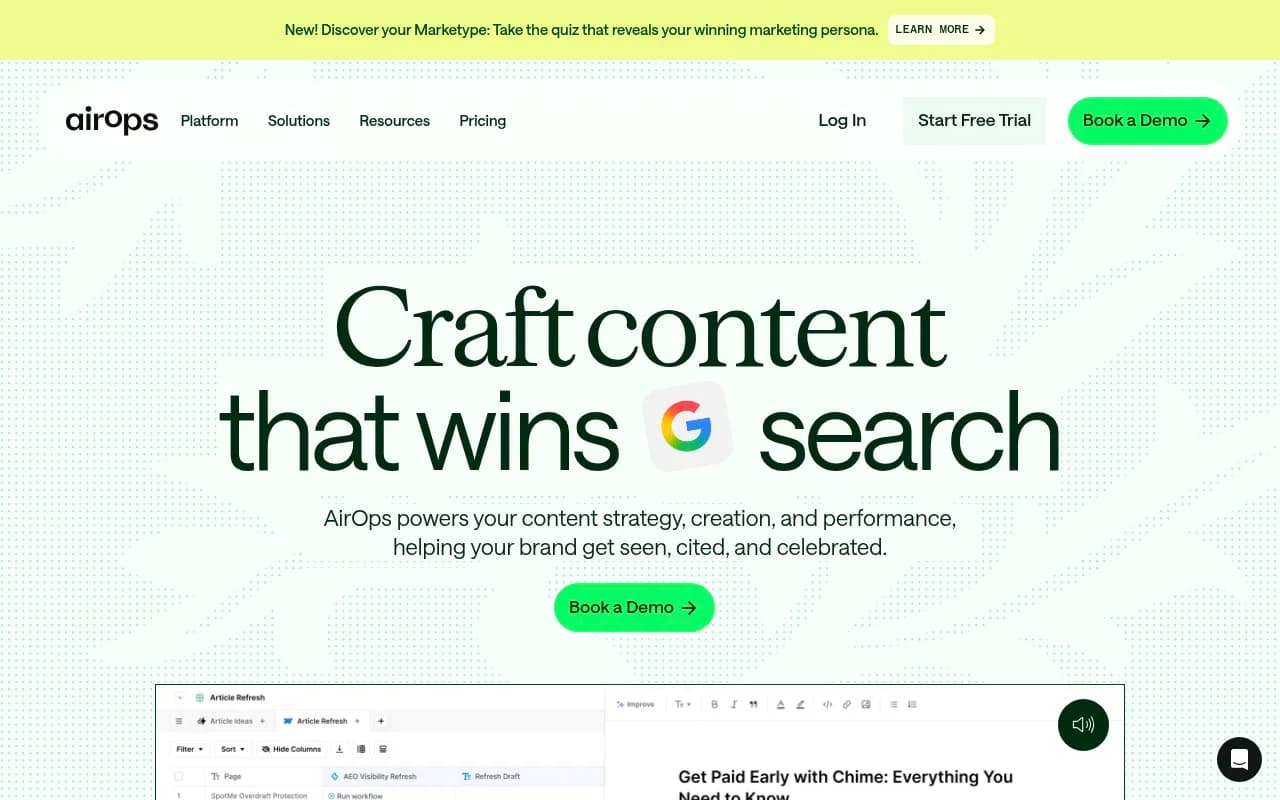
AirOps calls itself "AI workflow automation for GEO." In practice it's a visual workflow builder (Workflow Studio) plus a bulk-operations tool called Grids that lets you run the same AI task across thousands of rows of content or data at once. It ships with an AI execution agent named Quill that helps adjust playbooks and catch gaps, Brand Kits for voice consistency, and native publishing integrations across a list of CMS platforms that AirOps' own marketing pages describe inconsistently (7, 9, or 12+ depending on which page you read; a LinkedIn post from the company lists 12 specifically, including Webflow, WordPress, HubSpot CMS, Contentful, and Asana). It also tracks AI answer engine visibility, though that piece is thinner than the content-production side.
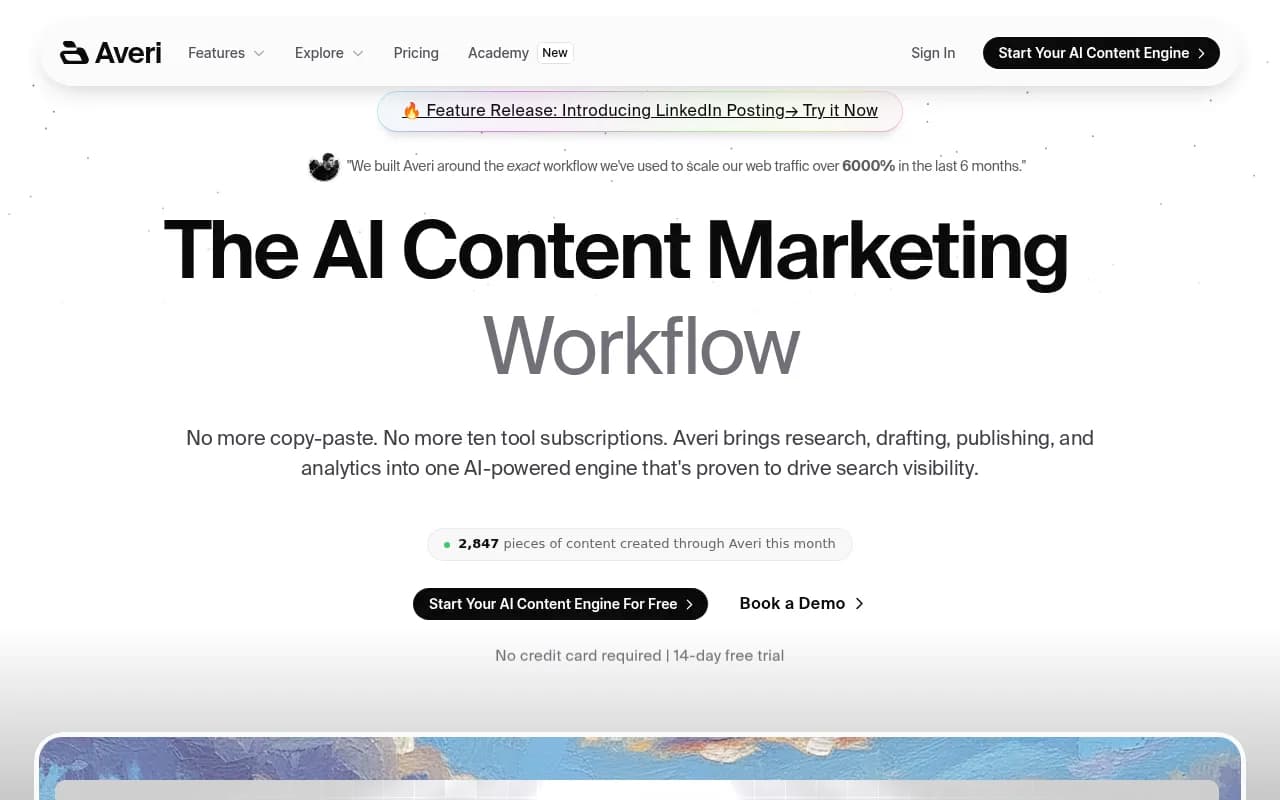
Averi AI positions itself as the "AI Content Engine for startups." It's a single guided workflow: teach it your brand and ICP once (Brand Core), let it map a content strategy against competitor gaps (Strategy Map), draft posts in your voice, then publish natively to Webflow, Framer, or WordPress and track results through built-in site analytics. There's no drag-and-drop workflow canvas and no bulk-row tooling like Grids; the trade-off is a much shorter path from signup to a published article.
Side-by-side comparison
| Feature | AirOps | Averi AI |
|---|---|---|
| Starting price | $200/mo (Solo) | $99/mo (Solo), per current pricing page |
| Top-tier public price | $2,000/mo (Pro) + task fees | $199/mo (Team) |
| Free tier | No (14-day trial mentioned in some materials) | 14-day free trial on paid plans; an older free 200-token plan may be deprecated |
| Visual workflow builder | Yes (Workflow Studio) | No |
| Bulk content operations | Yes (Grids, thousands of rows) | No equivalent |
| Brand voice training | Yes (Brand Kits) | Yes (Brand Core) |
| AI drafting engine | Quill (AI execution agent) | Proprietary "Synapse/AGM-2" model (unverified marketing claim) |
| Native CMS publishing | Webflow, WordPress, Contentful, Ghost, Shopify, Sanity, Contentstack, Strapi, HubSpot CMS (varies by source) | Webflow, Framer, WordPress |
| AI answer engine monitoring | Yes, but described as surface-level with limited LLM/regional coverage | Lighter "AI discoverability audit" add-on |
| Team seats | Single-user on Solo, unlimited on Pro/Enterprise | Solo is single-user, Team adds up to 3 teammates |
| Third-party review score | 4.6/5 on G2 (130+ reviews) | No independent G2 listing found; self-reported 4.8-4.9/5 |
| Learning curve | Real setup cost, reviewers cite "first two weeks were hard" | Marketed as faster to onboard, less independently verified |
| Task-based overage billing | Yes, $6-$9 per 1,000 tasks on top of plan | Not applicable; flat monthly pricing |
Head-to-head feature deep-dive
Content production at scale
AirOps' Grids feature is the real differentiator here. It lets a team run one AI operation, say, rewriting meta descriptions or generating FAQ blocks, across thousands of URLs or rows simultaneously, then review and push the results to a CMS. That's a genuinely different capability from what Averi offers. Averi drafts content one post or campaign at a time inside its guided workflow; there's no equivalent to bulk row processing.
Verdict: AirOps wins for teams with large content libraries needing systematic refreshes. Averi wins for teams publishing a handful of pieces a week who don't need that machinery.
Ease of use and onboarding
Multiple G2 and Profound reviewers describe AirOps as having a genuine learning curve, one reviewer's exact words were that the first two weeks were hard before the reuse and duplication benefits of Grids and Playbooks started to pay off. Averi's own marketing (a biased source, worth noting) claims its workflow gets a team from signup to a live content plan inside a coffee break, and third-party sources like SoftwareAdvice and TheresAnAIForThat back the idea that Averi is the more self-serve, less technical tool. I'd treat Averi's specific claims skeptically, but the general shape, AirOps requires more setup investment, Averi is built for faster time-to-value, holds up across sources.
Verdict: Averi AI for solo founders and small teams who want speed. AirOps for teams willing to invest setup time for more powerful long-term automation.
AI visibility and GEO monitoring
Both tools market themselves partly on AI search visibility, and both fall short of being dedicated monitoring platforms. Profound's independent review of AirOps (a competitor, so read with a grain of salt, but specific and detailed) says AirOps' AI monitoring is "surface-level at best," with limited LLM coverage and no prompt-popularity or intent data, meaning you can't see how often a given prompt gets asked or how competitive it is. Averi's equivalent is a lighter "AI discoverability audit" bundled into its plans rather than a standalone tracking product.
If tracking how your brand actually shows up across ChatGPT, Gemini, Perplexity, AI Overviews, and AI Mode is the point of the exercise rather than a bonus feature, neither of these tools is built for it. Promptwatch tracks prompt volumes and difficulty, citation trends across 22 content types, AI crawler logs (who's actually reading your pages and how often that turns into a citation), Reddit and YouTube citation data, and real visitor analytics from AI traffic, then turns that into Content Agents that write and publish GEO-optimized articles for you. It's a genuinely different category from either AirOps or Averi.

Verdict: Neither AirOps nor Averi is a serious AI visibility tool. If that's your priority, look elsewhere first, then decide whether you also need a content-production layer.
Integrations and CMS publishing
Both publish natively to Webflow and WordPress. AirOps adds Contentful, Ghost, Shopify, Sanity, Contentstack, Strapi, and HubSpot CMS across its various product pages (the company's own marketing copy is inconsistent about the exact count, ranging from 7 to 12+ depending on the page), plus Google Search Console, Google Analytics, and a Claude MCP connection per one G2 reviewer. Averi adds Framer instead of the longer CMS list, plus webhooks and an analytics layer it calls Averi Pixel (currently in beta).
Verdict: AirOps has the broader integration footprint if your stack includes anything beyond Webflow, WordPress, or Framer.
Pricing structure and predictability
AirOps mixes a fixed monthly plan with task-based overage billing, and Profound's review specifically flags that this gets confusing because "some steps in the workflow count toward your usage while others don't." Averi's current pricing page (as of this writing) is flat: $99/mo for Solo, $199/mo for Team, no usage-based surprises. Worth flagging that Averi's pricing has clearly moved around, older guides cite $45/mo and $100/mo Plus tiers, and third-party listings like SoftwareAdvice still show the old $45/mo number, so confirm the live price before signing up.
Verdict: Averi is cheaper and its pricing is easier to predict. AirOps costs more and its task-based add-on fees require more careful budgeting.
Team collaboration and governance
AirOps' Pro and Enterprise plans include unlimited seats, multiple Brand Kits, and multiple Knowledge Bases, built for agencies or larger content teams managing several client brands or product lines at once. Averi's Team plan tops out at 3 teammates with basic role permissions (Admin, Editor, View-only), which fits a small in-house team but not an agency managing many accounts.
Verdict: AirOps for agencies and multi-brand teams. Averi for a single in-house team of two or three.
Pricing comparison
| Plan | AirOps | Averi AI |
|---|---|---|
| Entry paid plan | Solo, $200/mo (ChatGPT insights only, 35,000 tasks/mo) | Solo, $99/mo (per current pricing page; some third-party listings still show $45/mo) |
| Mid-tier | Pro, up to $2,000/mo (7+ answer engines, 100,000 tasks/mo) | Team, $199/mo (up to 3 teammates) |
| Top tier | Enterprise, custom pricing | No published enterprise/agency tier currently live, despite marketing copy mentioning one |
| Overage fees | $6-$9 per 1,000 extra tasks | None published |
| Free trial | Not consistently advertised | 14-day free trial on paid plans |
Pros and cons
AirOps pros
- Grids enables genuine bulk content operations across thousands of rows
- Strong CMS and integration footprint (Search Console, Analytics, Claude MCP, multiple CMS platforms)
- 4.6/5 on G2 from 130+ independently verified reviews
- Built for teams and agencies managing multiple brands or client accounts
AirOps cons
- Real learning curve; reviewers consistently describe a rough first couple of weeks
- Confusing hybrid pricing (fixed plan + task-based overage) that reviewers flag directly
- AI visibility monitoring is thin, limited LLM coverage, no prompt-popularity data
- Starting price of $200/mo is steep for a solo operator or very small team
Averi AI pros
- Much lower entry price ($99/mo Solo vs AirOps' $200/mo)
- Single guided workflow from brand research to published post, less setup overhead
- Flat, predictable pricing with no task-based overage fees
- 14-day free trial on paid plans
Averi AI cons
- No visual workflow builder or bulk operations equivalent to Grids
- No independent G2 reviews found; most performance claims (4.8-4.9/5 rating, "1,000+ teams," "6000% traffic growth") are self-reported and unverified
- Team plan caps out at 3 seats, not built for agencies
- Pricing has visibly shifted over time (from $45/mo to $99-199/mo), with old numbers still floating around on third-party sites
Who should pick which tool
Pick AirOps if you run a content or SEO team (or agency) managing large volumes of pages across multiple brands, need bulk refresh operations, and have the budget and patience to get through a real onboarding curve.
Pick Averi AI if you're a startup or lean team of one to three people who wants a single workflow covering strategy, drafting, and publishing without building a custom automation, and you want to keep monthly costs under $200.
Skip both, at least as your primary tool, if AI search visibility monitoring is the actual job to be done. Neither is a substitute for a dedicated GEO platform; you'll want to check a directory like the one at bestgeosoftware.com or look directly at Promptwatch, which builds prompt tracking, citation analytics, and AI crawler logs into the same platform that also automates content creation.
Final verdict
AirOps is the more powerful, more expensive tool for teams that need to operate at real content scale and can absorb a learning curve. Averi AI is the faster, cheaper option for small teams who want simplicity over horsepower. Neither one should be your AI visibility tool of record, that job belongs to something built specifically for it.