Insightly CRM Review 2026
CRM software for managing customer relationships, tracking communications, and automating business processes across your organization.
Summary
Insightly is a CRM platform that's been quietly winning over mid-market companies tired of overpaying for Salesforce or outgrowing HubSpot's free tier. It's not the flashiest name in the space, but it's built a loyal base of 6,000+ customers by offering a genuinely unified platform -- CRM, marketing automation, support ticketing, and workflow automation all under one roof. The pitch is simple: one system, one price, faster time to value. An independent ROI study found Insightly users hit positive ROI in 6 months vs 12-18 months for Salesforce and HubSpot, mostly because implementation is faster and total cost of ownership is lower. That's the kind of stat that gets CFOs to pay attention.
The target audience is clear: companies with 10-500 employees that need more than a basic CRM but don't want to hire a Salesforce admin or pay enterprise prices. Think SaaS startups scaling from 20 to 100 employees, professional services firms managing complex client relationships, manufacturers tracking long sales cycles, and digital agencies juggling multiple client accounts. Insightly is particularly strong in industries like consulting, education, manufacturing, and B2B services where sales cycles are measured in weeks or months, not hours.
Insightly launched in 2009 and has been bootstrapped and profitable for most of its history, which explains the focus on delivering actual value instead of chasing unicorn valuations. The company is privately held and doesn't disclose revenue, but customer testimonials mention 242% revenue growth, 40% cost savings vs competitors, and 20% efficiency gains -- the kind of numbers that suggest the product actually works.
Core CRM capabilities
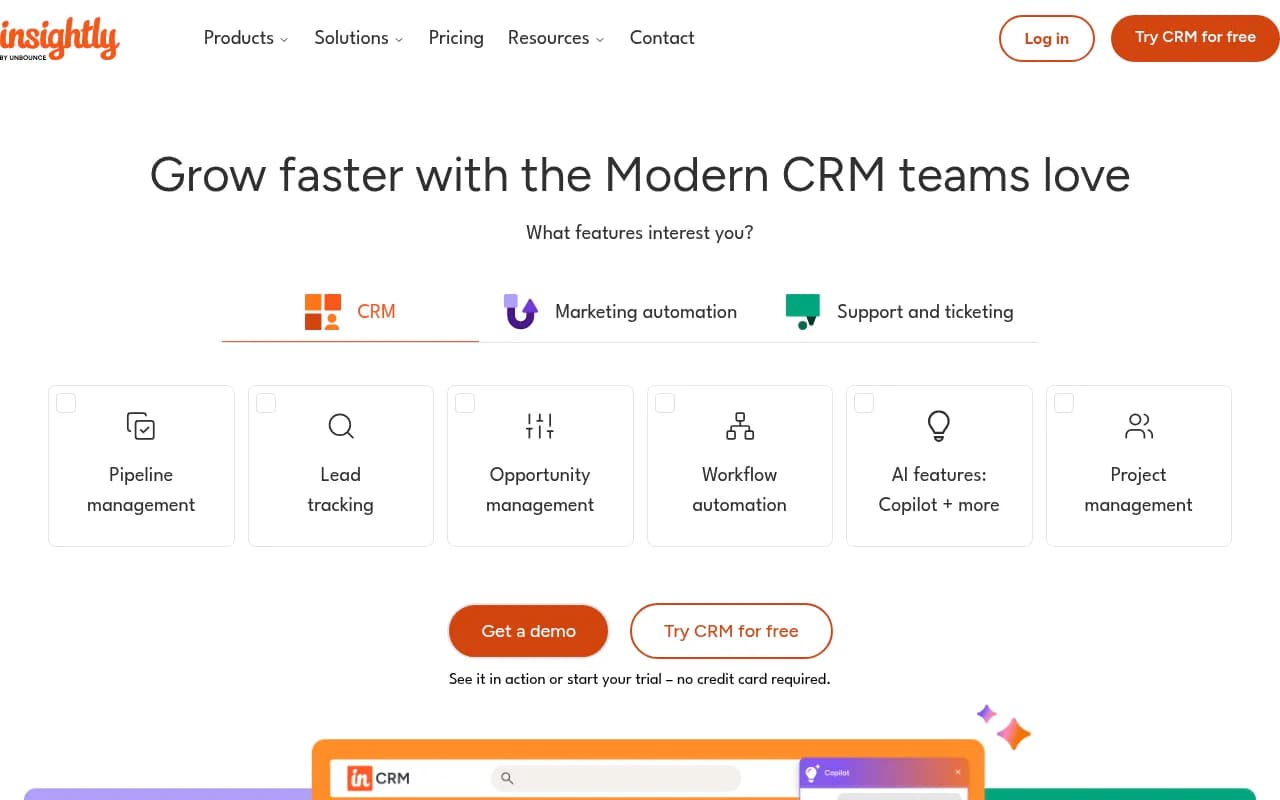
The CRM module is the foundation. You get contact management, lead tracking, opportunity pipelines, task automation, email integration (Gmail and Outlook), and mobile apps. The interface is clean and modern -- not as slick as Pipedrive but miles ahead of Salesforce's cluttered UI. Custom fields, custom objects, and custom pipelines let you model your actual sales process instead of forcing your team into a vendor's idea of how sales should work. Lead scoring is built in and can be automated based on email opens, website visits, form submissions, and other engagement signals. The pipeline view is visual and drag-and-drop, making it easy to see where deals are stuck.
One standout feature: relationship linking. You can connect contacts to organizations, link organizations to other organizations (useful for tracking parent companies and subsidiaries), and map out complex relationship networks. Most CRMs treat contacts and companies as separate silos -- Insightly lets you model the actual web of relationships that exist in B2B sales.
Email tracking and templates are solid. Compose emails directly in Insightly or sync with Gmail/Outlook, and the system logs every interaction automatically. Templates support merge fields and can be shared across the team. The mobile app (iOS and Android) is full-featured -- you can update deals, log calls, and check tasks from your phone without feeling like you're using a stripped-down version.
Marketing automation that actually connects to sales
Insightly Marketing is where the platform starts to differentiate itself. Most CRMs bolt on marketing automation as an afterthought or charge extra for a separate product. Insightly includes it in the platform and makes it talk to the CRM natively. You can build email campaigns, create landing pages, run A/B tests, segment audiences dynamically, and track campaign performance all the way to closed deals.
The journey builder is visual and lets you create multi-step campaigns triggered by specific actions -- form submission, email open, page visit, deal stage change, etc. You can set up drip campaigns that automatically nurture leads based on their behavior, then hand them off to sales when they hit a certain score. Lead scoring is customizable and can factor in demographic data (job title, company size) and behavioral data (email opens, website visits, content downloads).
Landing pages are drag-and-drop with templates for common use cases (webinar registration, ebook download, demo request). Forms can be embedded on your website or hosted on Insightly's domain. Dynamic content lets you personalize emails and landing pages based on contact attributes -- show different messaging to prospects vs customers, or tailor content by industry.
The A/B testing feature lets you test subject lines, email content, send times, and landing page variations. Results are tracked automatically and you can set the system to automatically send the winning variant to the rest of your list.
What makes this powerful: the marketing data flows directly into the CRM. Sales reps can see which emails a prospect opened, which pages they visited, and which campaigns they engaged with -- all in the contact record. No more "marketing says the lead is qualified but sales says it's garbage" disconnect.
Support and ticketing for post-sale relationships
Insightly Service is the support ticketing module, and it's more robust than you'd expect from a CRM vendor. Customers can submit tickets via email, web forms, or a branded customer portal. Tickets are automatically linked to contact and organization records, so your support team has full context on the customer's history, open deals, and past issues.
The knowledge base feature lets you create a self-service portal with articles, FAQs, and product documentation. Articles can be organized by category and tagged for search. You can track which articles are most viewed and which searches return no results, helping you identify gaps in your documentation.
SLA tracking is built in -- set response time and resolution time targets by ticket priority, and the system will alert your team when SLAs are at risk. Ticket routing rules can automatically assign tickets to specific agents based on criteria like product, issue type, or customer tier.
The customer portal is white-labeled and gives customers a place to view their open tickets, browse the knowledge base, and submit new requests. It's basic but functional -- don't expect the polish of Zendesk or Intercom, but it covers the essentials.
AppConnect: the integration layer that matters
AppConnect is Insightly's workflow automation and integration platform, and it's a bigger deal than it sounds. It's essentially a built-in Zapier that connects Insightly to 2,000+ third-party apps -- QuickBooks, Xero, Shopify, Slack, Jira, DocuSign, PandaDoc, Gong, ZoomInfo, and hundreds more. The drag-and-drop workflow builder lets you create multi-step automations without writing code.
Example workflows: when a deal closes in Insightly, automatically create an invoice in QuickBooks, send a Slack notification to the team, and generate a contract in PandaDoc. Or when a new contact is added, enrich it with data from ZoomInfo, add them to a marketing campaign, and create a task for the sales rep to follow up.
The workflow builder supports conditional logic, loops, and error handling. You can trigger workflows based on record creation, field updates, scheduled times, or webhook events. Data mapping is visual -- you select fields from the source app and map them to fields in the destination app.
What's notable: AppConnect is included in Professional and higher plans, not sold as a separate add-on. Most CRM vendors charge extra for this level of integration capability or force you to use a third-party tool like Zapier (which adds another monthly cost).
AI features: Copilot and automation
Insightly recently added AI capabilities, and they're focused on practical use cases rather than flashy demos. Copilot (currently in beta) is a conversational AI assistant that lives in the CRM. You can ask it to create records, update fields, link contacts to deals, and pull up summaries -- all via natural language chat. "Show me all open deals over $50k" or "Create a task to follow up with John next Tuesday" or "Summarize the last 5 interactions with Acme Corp."
The AI can also generate email replies based on context from the contact record and previous conversations. It's not trying to write your emails for you -- it drafts a response that you can edit before sending. Email summaries condense long threads into bullet points so you can quickly catch up on a conversation without reading 20 messages.
Lead scoring uses machine learning to predict which leads are most likely to convert based on historical data. The system analyzes past won and lost deals, identifies patterns, and assigns scores to new leads automatically. You can override the AI's scoring if needed, and the model improves over time as it learns from your team's behavior.
These AI features aren't revolutionary, but they're useful. The focus is on reducing data entry and helping reps find information faster, which is where AI actually delivers value in a CRM.
Who is Insightly for?
Insightly is built for companies in the 10-500 employee range that need a full-featured CRM but don't have the budget or IT resources for Salesforce. Specific personas:
-
SaaS companies scaling from seed to Series B: You've outgrown spreadsheets and need real pipeline visibility, but you're not ready to spend $150/user/month on Salesforce. Insightly gives you CRM, marketing automation, and integrations with your tech stack (Slack, Jira, Stripe, etc.) for a fraction of the cost.
-
Professional services firms (consulting, legal, accounting): You need to track complex client relationships, manage projects, and coordinate across teams. Insightly's relationship linking and project management features (yes, there's a project module) fit this use case well.
-
Manufacturers and distributors with long sales cycles: You're tracking deals that take 6-12 months to close, involve multiple stakeholders, and require detailed notes and document management. Insightly handles this complexity without the bloat of enterprise software.
-
Digital agencies managing multiple clients: You need to track leads, manage client relationships, coordinate campaigns, and report on results -- all while keeping client data separate. Insightly's custom objects and relationship linking make it easy to model agency-client relationships.
Who should NOT use Insightly: Enterprise companies with 1,000+ employees and complex compliance requirements will outgrow it. E-commerce businesses that need deep Shopify integration and abandoned cart workflows are better off with Klaviyo or ActiveCampaign. Sales teams that live in LinkedIn and need heavy social selling features should look at Sales Navigator or Outreach.
Integrations and ecosystem
Insightly integrates natively with Gmail, Outlook, Google Workspace, Microsoft 365, Mailchimp, QuickBooks, Xero, Slack, Zapier, and dozens more. The AppConnect platform extends this to 2,000+ apps via pre-built connectors. API access is available on all paid plans, and the API is RESTful and well-documented. Developers can build custom integrations or extend Insightly's functionality.
Browser extensions for Chrome and Firefox let you add contacts and log emails without leaving your inbox. The mobile apps (iOS and Android) support offline mode, so you can update records and log activities even without an internet connection -- changes sync when you're back online.
Data import is straightforward -- CSV upload with field mapping and duplicate detection. Export is available in CSV, Excel, and via API. No vendor lock-in.
Pricing and value
Insightly's pricing is transparent and significantly lower than Salesforce or HubSpot:
-
Plus: $29/user/month (billed annually) -- basic CRM with contact management, pipeline tracking, email integration, and mobile apps. Good for small teams just getting started.
-
Professional: $49/user/month -- adds workflow automation, custom objects, advanced reporting, and AppConnect integrations. This is the sweet spot for most growing companies.
-
Enterprise: $99/user/month -- adds advanced permissions, custom branding, dedicated support, and higher limits on records and storage.
Marketing automation is sold separately: $299/month for up to 2,500 contacts, $599/month for up to 10,000 contacts. Service (support ticketing) is also separate: $29/user/month for basic, $49/user/month for advanced.
Free trial available (14 days, no credit card required). Annual billing gets you 2 months free.
How this compares: Salesforce Sales Cloud starts at $25/user/month but you need Professional ($80/user/month) or Enterprise ($165/user/month) to get useful features. HubSpot CRM is free but marketing automation starts at $800/month and sales automation starts at $450/month. Pipedrive is cheaper ($14-$99/user/month) but lacks marketing automation and support ticketing entirely.
Insightly's value proposition is clear: you get CRM, marketing, and support in one platform for less than you'd pay for just the CRM from Salesforce or HubSpot. The ROI study backs this up -- customers report 40% cost savings vs competitors and 6-month payback periods.
Strengths
-
Unified platform: CRM, marketing automation, support ticketing, and workflow automation all in one system with native integration. No need to stitch together multiple tools or pay for separate subscriptions.
-
AppConnect included: 2,000+ integrations and a visual workflow builder included in Professional and higher plans. Most competitors charge extra for this or force you to use Zapier.
-
Faster time to value: Independent study found 6-month ROI vs 12-18 months for Salesforce and HubSpot. Implementation is faster because the platform is simpler and doesn't require an army of consultants.
-
Relationship linking: Model complex B2B relationships with contact-to-organization and organization-to-organization linking. Useful for tracking parent companies, subsidiaries, and multi-stakeholder deals.
-
Transparent pricing: No hidden fees, no surprise charges for "premium" features. What you see is what you pay.
Limitations
-
Marketing automation is basic: If you're running sophisticated multi-touch attribution or need advanced personalization, you'll outgrow Insightly Marketing. Tools like Marketo, Pardot, or ActiveCampaign are more powerful (and more expensive).
-
Reporting is functional but not fancy: You can build custom reports and dashboards, but the visualization options are limited. If you need Tableau-level analytics, you'll want to export data or use the Looker Studio integration.
-
No built-in calling or SMS: Insightly doesn't include a dialer or texting feature. You'll need to integrate with a third-party tool like RingCentral, Aircall, or Twilio.
-
Support ticketing is basic: Insightly Service covers the essentials but lacks advanced features like live chat, chatbots, or omnichannel support. If customer support is your primary use case, Zendesk or Freshdesk are stronger.
Bottom line
Insightly is the CRM for companies that want a complete platform without the complexity or cost of Salesforce. If you're a 50-person SaaS company, a consulting firm with 20 employees, or a manufacturer managing a 100-person sales and marketing team, Insightly gives you everything you need to manage customers, run campaigns, and automate workflows -- all in one system for a predictable monthly cost. The ROI is real, the learning curve is manageable, and you won't need to hire a full-time admin to keep it running. Best use case: B2B companies with 10-500 employees that need CRM, marketing automation, and support ticketing but don't want to pay enterprise prices or deal with enterprise complexity.
Tags:
Similar and alternative tools to Insightly CRM