Key takeaways
- Promptmonitor is a monitoring tool first. It tracks brand mentions, visibility scores, and source citations across AI models. AirOps is a content production platform first. It automates the creation of GEO-optimized content at scale.
- Promptmonitor starts at $29/mo. AirOps starts at $200/mo. The price gap is real and reflects the difference in scope.
- If you want to know where you stand in AI search, Promptmonitor answers that question faster and cheaper. If you want to do something about it through content workflows, AirOps is the heavier machinery.
- AirOps has no meaningful brand monitoring. Promptmonitor has no content generation or workflow automation. They're genuinely complementary tools, not direct replacements.
- Promptmonitor covers ChatGPT, Gemini, Perplexity, and Grok. AirOps focuses on content engineering rather than model-by-model tracking.
- Neither tool is a complete GEO solution on its own -- which is worth keeping in mind before committing to either.
Overview
AirOps

AirOps describes itself as "the first end-to-end content engineering platform" for AI search. The pitch is that winning in AI search is a content problem, and AirOps gives teams the workflows, agents, and automation to produce that content at scale. Its core features include AI writing workflows, a "Grid" for bulk content operations, and Power Agents that can handle complex, multi-step content tasks. It's built for teams that are already bought into GEO and need to execute -- fast and at volume.
The platform leans heavily on workflow automation. You can build repeatable processes for things like creating comparison pages, FAQ content, or product descriptions optimized for AI citation. It integrates with various data sources and has an API for custom setups. The pricing reflects this -- it's not a tool you pick up casually.
Promptmonitor
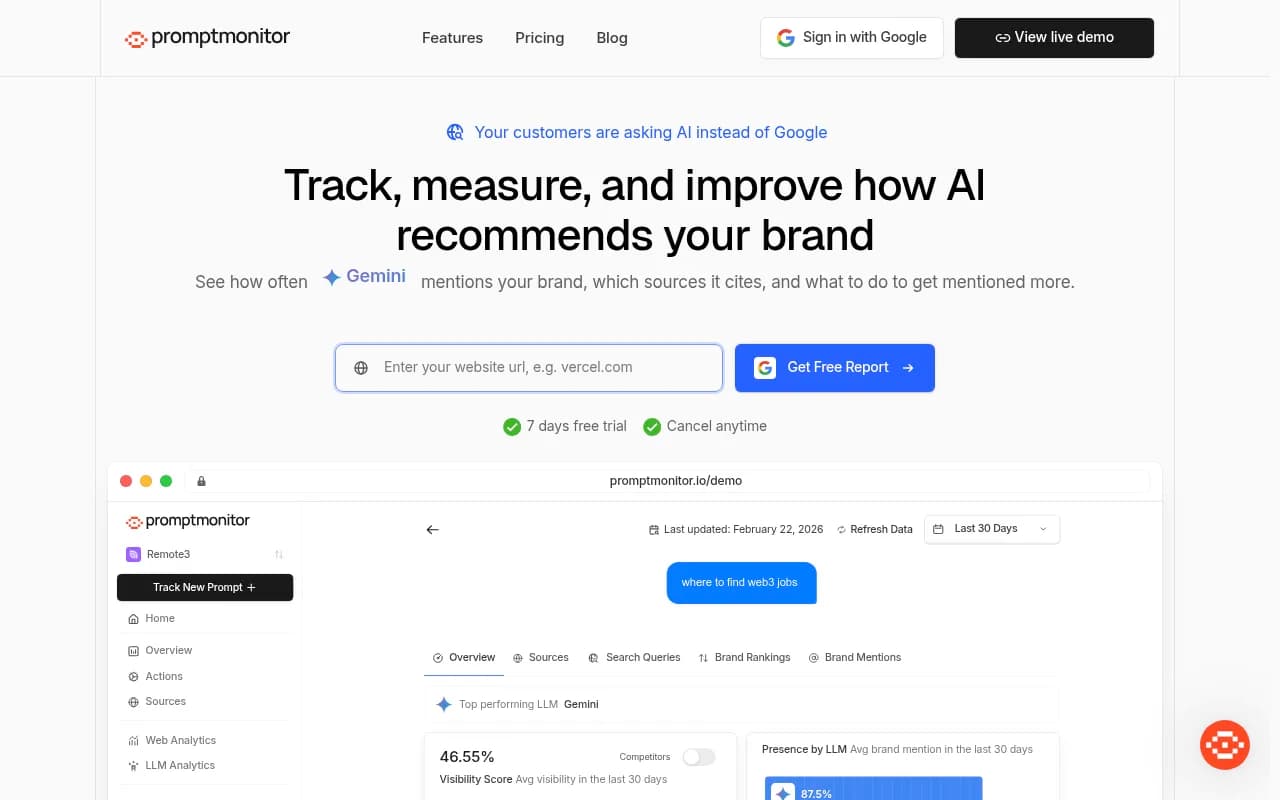
Promptmonitor sits on the other end of the spectrum. It's a tracking and monitoring tool that answers a simpler but important question: is your brand showing up when people ask AI about your category? It tracks presence across ChatGPT, Gemini, Perplexity, and Grok, shows you which sources AI models cite, and gives you a visibility score that changes over time.
The live demo on their site shows a clean interface -- visibility scores by LLM, brand mention timelines, and source breakdowns. It's genuinely easy to read. The pricing is accessible, starting at $29/mo, which puts it in reach for solo marketers and small teams. There's also a 7-day free trial, so you can see your actual data before paying anything.
Side-by-side comparison
| Feature | AirOps | Promptmonitor |
|---|---|---|
| Primary use case | Content engineering & GEO content production | AI brand monitoring & visibility tracking |
| Starting price | $200/mo (Solo) | $29/mo (Starter) |
| Free trial | Not publicly listed | 7-day free trial |
| AI models tracked | Not a core feature | ChatGPT, Gemini, Perplexity, Grok |
| Content generation | Yes -- workflows, agents, bulk Grid | No |
| Workflow automation | Yes -- core feature | No |
| Brand mention tracking | Limited | Yes -- core feature |
| Visibility score | No | Yes -- per LLM and overall |
| Source/citation analysis | No | Yes |
| Competitor tracking | Yes (content gap focus) | Yes (brand mention comparison) |
| Agency plan | Yes (custom) | Yes (custom) |
| API access | Yes | Not confirmed |
| Ease of setup | Moderate -- workflow setup required | Fast -- connect brand, start tracking |
| Best for | Content teams, SEO agencies doing GEO execution | Marketers, brand managers tracking AI presence |
Head-to-head feature deep-dive
Core purpose and philosophy
This is where the two tools diverge most sharply, and it's worth being direct about it.
AirOps is built on the belief that AI search is won through content quality and volume. Its platform helps you build the content machine -- structured workflows that produce articles, comparisons, FAQs, and landing pages designed to get cited by AI models. The "engineering" framing is intentional. It's not a one-click tool; it's a system you build and run.
Promptmonitor is built on the belief that you first need to see the problem clearly. It shows you your current AI visibility -- which models mention you, how often, and what sources they cite when they do. The "actions" tab in their demo suggests some optimization guidance, but the platform's real value is the data layer.
Neither philosophy is wrong. They just answer different questions.
Verdict: These tools aren't really competing. AirOps is for execution; Promptmonitor is for measurement. If you're comparing them head-to-head, you're probably trying to figure out which problem to solve first.
AI model coverage
| AI model | AirOps | Promptmonitor |
|---|---|---|
| ChatGPT / OpenAI | Content optimization target | Tracked (31.58% presence in demo) |
| Gemini | Content optimization target | Tracked (78.95% presence in demo) |
| Perplexity | Content optimization target | Tracked (65.79% presence in demo) |
| Grok | Content optimization target | Tracked |
| Claude | Content optimization target | Not confirmed |
| Google AI Overviews | Content optimization target | Not confirmed |
AirOps doesn't track AI models directly -- it creates content designed to be cited by them. Promptmonitor actually queries these models and records whether your brand appears.
Verdict: Promptmonitor wins here by design. If you need to know your visibility score across specific LLMs, Promptmonitor gives you that data. AirOps doesn't.
Content creation and workflow automation
AirOps is the clear winner in this category because Promptmonitor doesn't really play here. AirOps offers:
- AI writing workflows for articles, comparisons, and structured content
- A Grid feature for bulk content operations (think: generating 50 comparison pages at once)
- Power Agents for multi-step, complex content tasks
- Integrations with data sources to feed content workflows
- API access for custom automation
Promptmonitor has an "Actions" section in its interface, which appears to surface optimization recommendations, but it's not a content creation tool.
Verdict: AirOps wins, no contest. If content production is the job, Promptmonitor isn't the tool.
Monitoring and analytics
Promptmonitor's dashboard shows:
- Overall visibility score (updated regularly)
- Presence by LLM with percentage breakdowns
- Brand mention timeline across models
- Source and citation analysis
- Competitor visibility comparison
AirOps does have some monitoring capabilities -- it can track how content performs in AI search -- but this isn't its primary function, and the depth of tracking doesn't match a dedicated monitoring tool.
Verdict: Promptmonitor wins. The visibility score, LLM-by-LLM breakdown, and source analysis are genuinely useful for anyone who needs to report on AI brand presence.
Pricing
This is one of the starkest differences between the two tools.
| Plan | AirOps | Promptmonitor |
|---|---|---|
| Free / Trial | Not publicly listed | 7-day free trial |
| Entry-level | $200/mo (Solo) | $29/mo (Starter) |
| Mid-tier | Not specified | $39/mo (Growth) |
| Pro | $2,000/mo | $129/mo (Pro) |
| Enterprise | Custom | Custom (Agency plan) |
| Task-based costs | $6-$9 per 1,000 tasks | Not applicable |
AirOps is 7x more expensive at entry level and roughly 15x more expensive at the Pro tier. That gap makes sense given the scope difference -- AirOps is running AI workflows and generating content at scale, which has real compute costs. But if you're a small team just trying to understand your AI visibility, paying $200/mo before you've even confirmed the problem exists is a tough sell.
Verdict: Promptmonitor wins on price, especially for teams starting out or with limited budgets.
Ease of use and time to value
Promptmonitor is faster to get value from. You connect your brand, set up a few prompts, and within days you're seeing visibility scores and mention data. The 7-day trial means you can validate the tool before spending anything.
AirOps requires more upfront investment. You need to design workflows, configure agents, and build the content processes before you see output. That's not a flaw -- it's the nature of a workflow automation platform -- but it means the time-to-value curve is longer.
Verdict: Promptmonitor wins on ease of setup. AirOps rewards teams willing to invest in configuration.
Competitor analysis
Both tools offer some form of competitor analysis, but from different angles.
AirOps approaches competitor analysis through content gaps -- what topics are competitors covering that you're not, and how do you build content to close those gaps?
Promptmonitor shows competitor visibility scores alongside yours, so you can see which brands are getting mentioned more often in AI responses for the same prompts.
Verdict: Depends on what you need. Promptmonitor's competitor tracking is more immediate and visual. AirOps' approach is more actionable for content strategy.
Pros and cons
AirOps
Pros:
- Genuinely powerful workflow automation for content at scale
- Grid feature handles bulk content operations that would take days manually
- Built specifically for GEO content engineering, not repurposed from SEO
- API access enables custom integrations and automation pipelines
- Strong fit for agencies delivering GEO content execution to clients
Cons:
- Expensive -- $200/mo minimum is a real barrier for smaller teams
- No meaningful AI brand monitoring or visibility tracking
- Requires significant setup time before seeing results
- Task-based pricing adds unpredictability to monthly costs
- Not useful if you just want to understand your current AI visibility
Promptmonitor
Pros:
- Affordable entry point at $29/mo
- 7-day free trial with real data
- Clean, readable dashboard with visibility scores and LLM breakdowns
- Source and citation analysis shows why AI models mention (or don't mention) you
- Fast to set up -- value within days, not weeks
Cons:
- No content creation or workflow automation
- Monitoring without execution means you still need another tool to act on the data
- Model coverage (ChatGPT, Gemini, Perplexity, Grok) is good but not exhaustive
- Smaller platform with less established track record than some competitors
- The "Actions" feature appears limited compared to full optimization platforms
Who should pick which tool
Pick AirOps if:
- You're an agency or content team that needs to produce GEO-optimized content at scale
- You've already validated the AI visibility problem and need to execute
- You have a budget of $200/mo or more and a team to manage workflows
- Bulk content operations (dozens or hundreds of pages) are part of your strategy
- You want workflow automation that connects to your existing data sources
Pick Promptmonitor if:
- You're starting out with GEO and need to understand your current AI visibility first
- Budget is a constraint -- $29/mo is a reasonable starting point
- You need to report on AI brand presence to stakeholders or clients
- You want to track competitor visibility alongside your own
- You want to see real data quickly without a long setup process
Consider both if:
- You're an agency that needs to both report on AI visibility (Promptmonitor) and deliver content execution (AirOps)
- You want to use Promptmonitor to identify gaps and AirOps to fill them
If you're also thinking about how your brand shows up across a wider range of AI models -- including Claude, DeepSeek, Mistral, and Google AI Overviews -- Promptwatch covers that monitoring layer with additional features like AI crawler logs, prompt volume data, and a built-in content generation tool that connects visibility gaps directly to content creation.

Final verdict
AirOps and Promptmonitor are solving adjacent problems, not the same one. AirOps is the tool you reach for when you need to build and publish GEO content at scale -- it's a content machine with real workflow depth. Promptmonitor is the tool you reach for when you need to see where you stand in AI search right now, without a lot of setup or budget.
For most teams, the honest answer is: start with monitoring (Promptmonitor or similar), understand the gaps, then decide whether a content workflow platform like AirOps is worth the investment. Jumping straight to $200/mo in content automation before you know what you're optimizing for is a common and expensive mistake in GEO.
If you're a content agency already executing GEO strategies for clients, AirOps makes sense. If you're a brand marketer trying to get a handle on AI visibility, Promptmonitor is the faster, cheaper starting point.