Key takeaways
- Structured data (schema markup) is one of the strongest signals AI search engines use to understand and cite your content -- it's not optional anymore.
- Most traditional SEO tools offer schema support, but few connect it to AI citation tracking, which means you're flying blind on whether your markup is actually working.
- The tools that matter most in 2026 combine schema implementation, content optimization, and AI visibility monitoring in one workflow.
- Enterprise crawlers like Botify and Screaming Frog are still the gold standard for technical schema auditing at scale.
- Platforms built specifically for Generative Engine Optimization (GEO) -- like Promptwatch -- go further by connecting structured data gaps to actual citation outcomes across ChatGPT, Perplexity, Gemini, and others.
Why structured data suddenly matters more than ever
For years, structured data was mostly about rich snippets -- the star ratings, FAQ dropdowns, and recipe cards you'd see in Google's search results. Useful, sure, but not exactly mission-critical for most brands.
That calculus has shifted. AI search engines don't browse your site the way a human does. They read it. They parse it. They try to understand what your page is about and whether it's a credible, authoritative source worth citing. Structured data -- specifically schema.org markup -- gives them a machine-readable layer that makes that job easier.
When ChatGPT or Perplexity pulls together an answer about "the best project management tools for remote teams," it's not just scanning your homepage copy. It's reading your entity relationships, your product attributes, your FAQ schema, your author markup. Pages that speak the language AI crawlers prefer get cited more often. Pages that don't, don't.
Google's own structured data documentation has been explicit about this for a while, but the urgency has compounded now that AI Overviews, Perplexity, and ChatGPT search collectively handle hundreds of millions of queries per day.
So which tools actually help? Let's break it down by what you're trying to accomplish.
What "structured data features" actually means in 2026
Before diving into tool recommendations, it's worth being precise about what we're evaluating. "Structured data features" in an SEO tool can mean several different things:
- Schema markup generation (creating JSON-LD or microdata)
- Schema validation and error detection
- Schema auditing across a full site crawl
- Recommendations for which schema types to add
- Monitoring whether your schema is being read by AI crawlers
- Connecting schema implementation to AI citation outcomes
Most tools do one or two of these. Very few do all of them. The ones that do all of them are, not surprisingly, the most valuable right now.
The best tools for schema generation and validation
Yoast SEO
If you're on WordPress, Yoast remains one of the most practical schema tools available. It automatically generates structured data for articles, breadcrumbs, author profiles, and organization entities without requiring you to touch a line of code. The schema graph it builds is reasonably sophisticated -- it connects your site's entities in a way that helps AI models understand the relationships between your content, your authors, and your brand.
The limitation is that Yoast is reactive, not diagnostic. It generates schema based on what you've already published, but it won't tell you which schema types you're missing or how your markup compares to what competitors are using.
AIOSEO
AIOSEO is a strong alternative to Yoast, particularly for teams that want more granular control over their schema output. It supports a wider range of schema types out of the box -- including LocalBusiness, Product, Event, and HowTo -- and its schema generator has a cleaner interface for custom configurations.
Like Yoast, it's WordPress-specific. If you're on a different CMS, you'll need to look elsewhere.
Screaming Frog SEO Spider
For technical SEO teams doing site-wide schema audits, Screaming Frog is still the tool most professionals reach for first. It crawls your entire site, extracts all structured data, validates it against schema.org specifications, and flags errors or missing required fields. The structured data report is genuinely detailed -- you can filter by schema type, see which pages have markup and which don't, and export everything for further analysis.
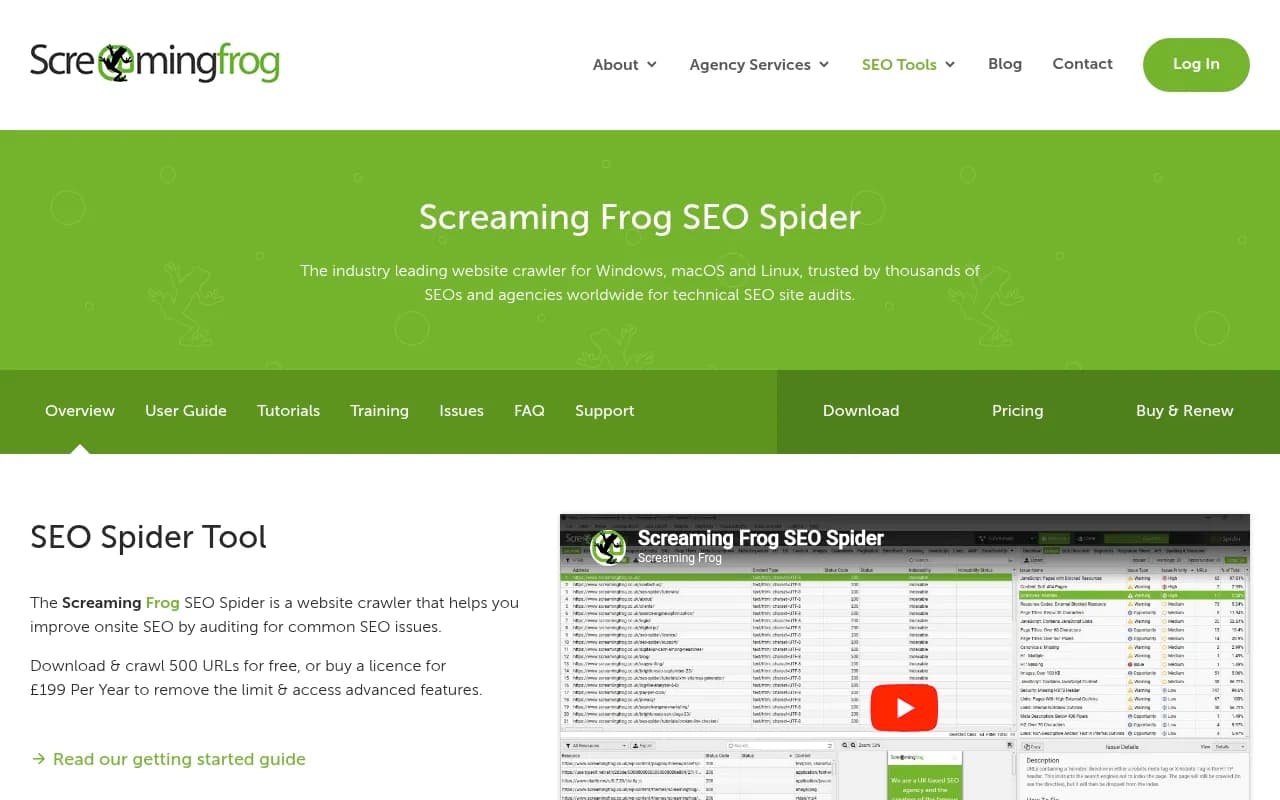
It's a desktop tool, which some teams find clunky, but the depth of the crawl data is hard to match. For large sites with thousands of pages, it's essentially irreplaceable for the audit phase.
The best tools for connecting schema to AI visibility
This is where things get more interesting -- and where the gap between traditional SEO tools and newer GEO platforms becomes obvious.
Botify
Botify sits at the intersection of enterprise technical SEO and AI search readiness. Its crawl data includes structured data analysis, and its newer features specifically address how AI crawlers interact with your site -- which pages they visit, how often, and what they read. If you're running a large site and want to understand whether your schema is actually being consumed by AI agents, Botify's crawler log analysis is one of the few places you can get that data.
It's expensive and built for enterprise teams, but for brands with complex site architectures, it's worth the investment.
Semrush
Semrush's site audit tool includes structured data checks as part of its broader technical SEO audit. It flags missing schema, validates existing markup, and surfaces recommendations. It's not the deepest schema tool available, but it's good enough for most teams -- and the advantage is that it sits inside a platform you're probably already using for keyword research and competitor analysis.
The honest caveat: Semrush's AI search features use fixed prompts rather than dynamic real-world query tracking, which limits how useful it is for understanding AI citation patterns specifically.
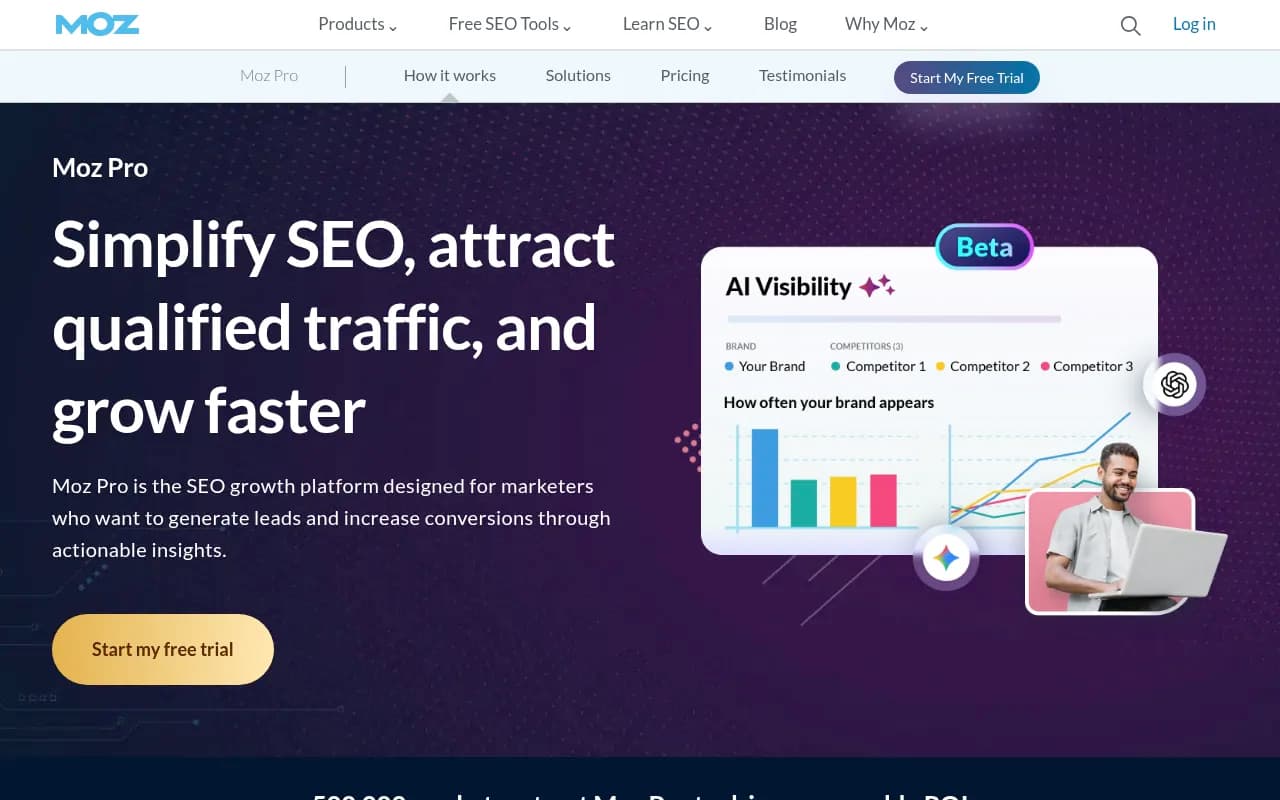
Moz Pro
Moz Pro's site crawl includes structured data detection, and its on-page optimization recommendations will flag missing schema types. It's solid for teams that want a single platform covering keyword research, rank tracking, and basic technical SEO -- including schema validation.
The best tools for AI citation tracking tied to structured data
Here's the honest truth: most schema tools will tell you whether your markup is technically valid. Very few will tell you whether it's actually helping you get cited by AI search engines. That second question is the one that matters most in 2026.
Promptwatch
Promptwatch approaches this differently from most platforms. Rather than just auditing your schema in isolation, it tracks how AI models are actually responding to prompts in your category -- which pages they cite, which competitors they mention, and what content gaps are causing you to be invisible.

The AI Crawler Logs feature is particularly relevant here: it shows you in real time which AI crawlers (ChatGPT, Claude, Perplexity, and others) are hitting your pages, which pages they're reading, and whether those pages are moving from crawl to citation. If your structured data is well-implemented but AI crawlers are still ignoring certain pages, that's a signal you can act on. If a competitor's FAQ schema is getting them cited for prompts you should be winning, you can see that too.
The Content Gap Analysis then helps you figure out what to create or fix to close those gaps -- not just from a schema perspective, but from a content and entity coverage perspective. It's the difference between knowing your markup is valid and knowing whether it's working.
Lumar (formerly Deepcrawl)
Lumar is another enterprise-grade option that combines deep technical SEO crawling with emerging AI search visibility features. Its structured data analysis is thorough, and it's been building out features specifically for GEO -- understanding how AI engines interact with your site's technical layer.
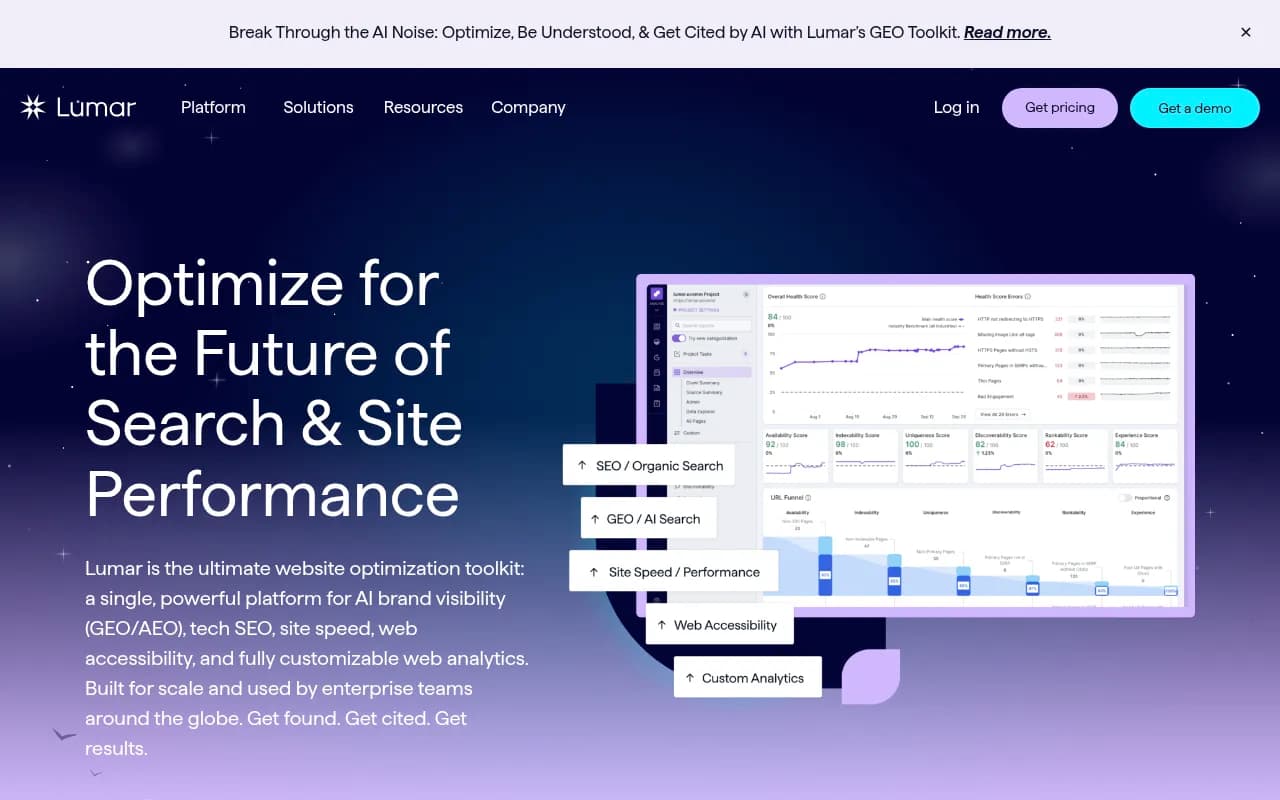
For enterprise teams that need both traditional technical SEO depth and AI search readiness in one platform, Lumar is worth evaluating.
Prerender.io
Prerender.io takes a different angle -- it's focused on making your JavaScript-rendered content visible to crawlers, including AI crawlers. If your site relies heavily on client-side rendering, your structured data might not be visible to AI engines at all, even if it's technically present in your codebase. Prerender solves that by serving pre-rendered HTML to crawlers.
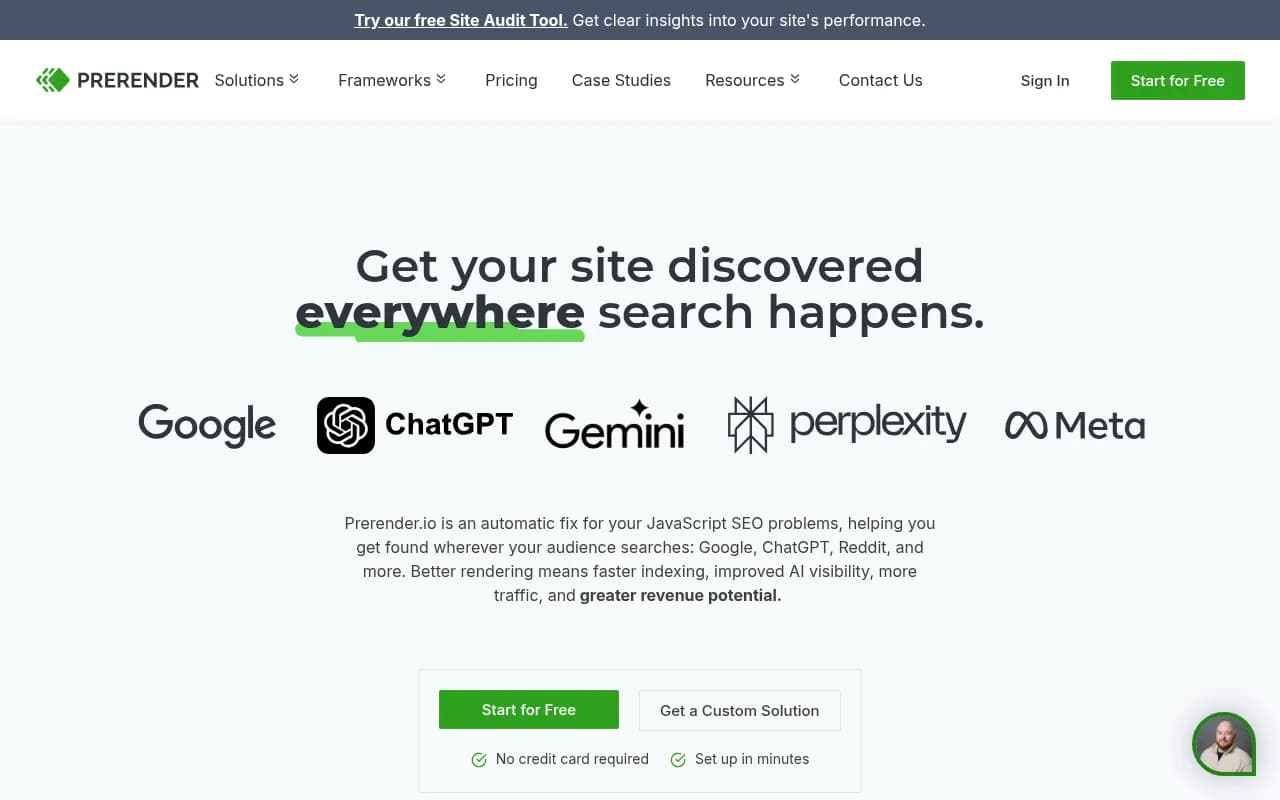
It's a technical fix rather than an analytics platform, but it's an important one. Broken rendering is one of the most common reasons schema markup gets ignored.
Tools for content-level structured data optimization
Schema markup is one part of the equation. The other part is making sure your content itself is structured in ways that AI models can parse and cite -- clear headings, FAQ sections, entity definitions, comparison tables, and so on.
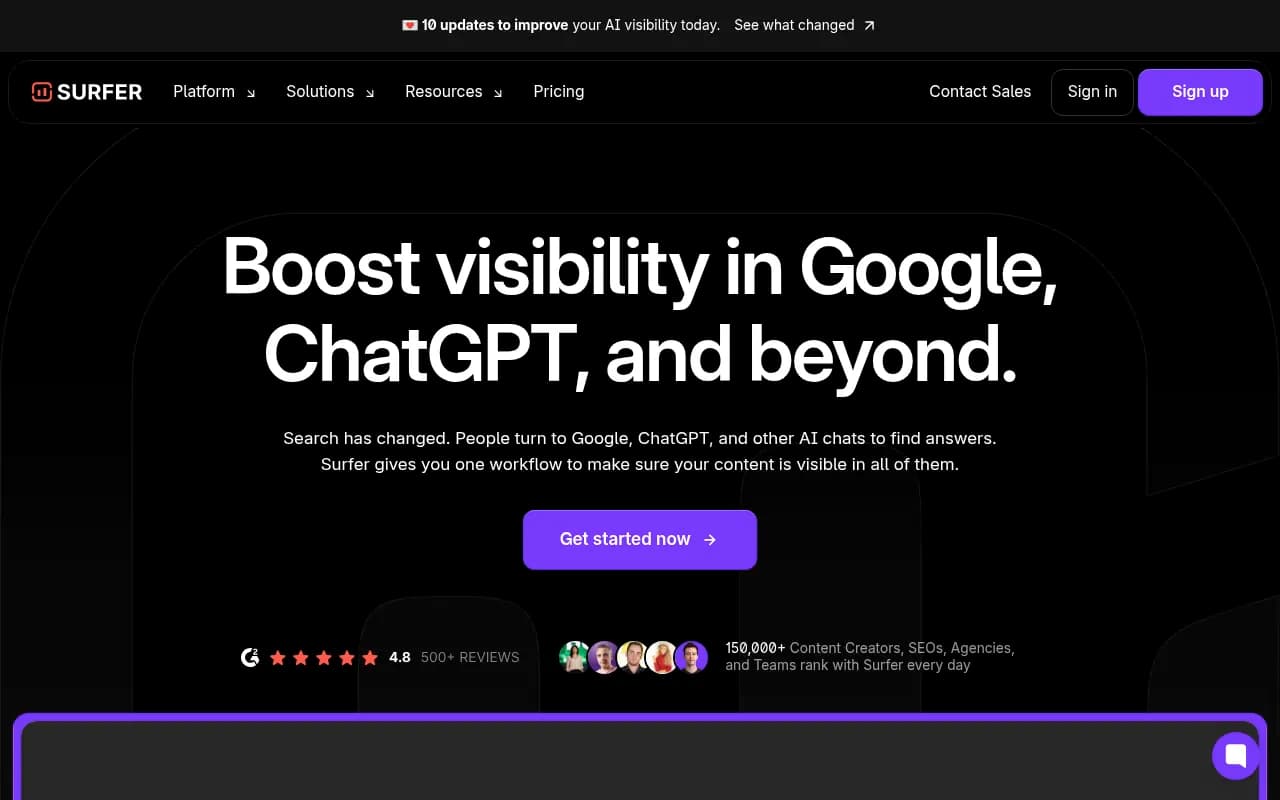
Surfer SEO
Surfer SEO's content editor analyzes top-ranking pages and gives you recommendations for content structure, heading usage, and semantic coverage. While it doesn't generate schema markup directly, it helps you structure your content in ways that make it more machine-readable -- which is effectively the human-readable complement to schema.
Clearscope
Clearscope does something similar -- it analyzes the semantic landscape around your target topic and tells you which concepts, entities, and questions your content needs to address. Content that covers a topic comprehensively tends to get cited more often by AI models, because AI models are trying to give complete answers.
Frase
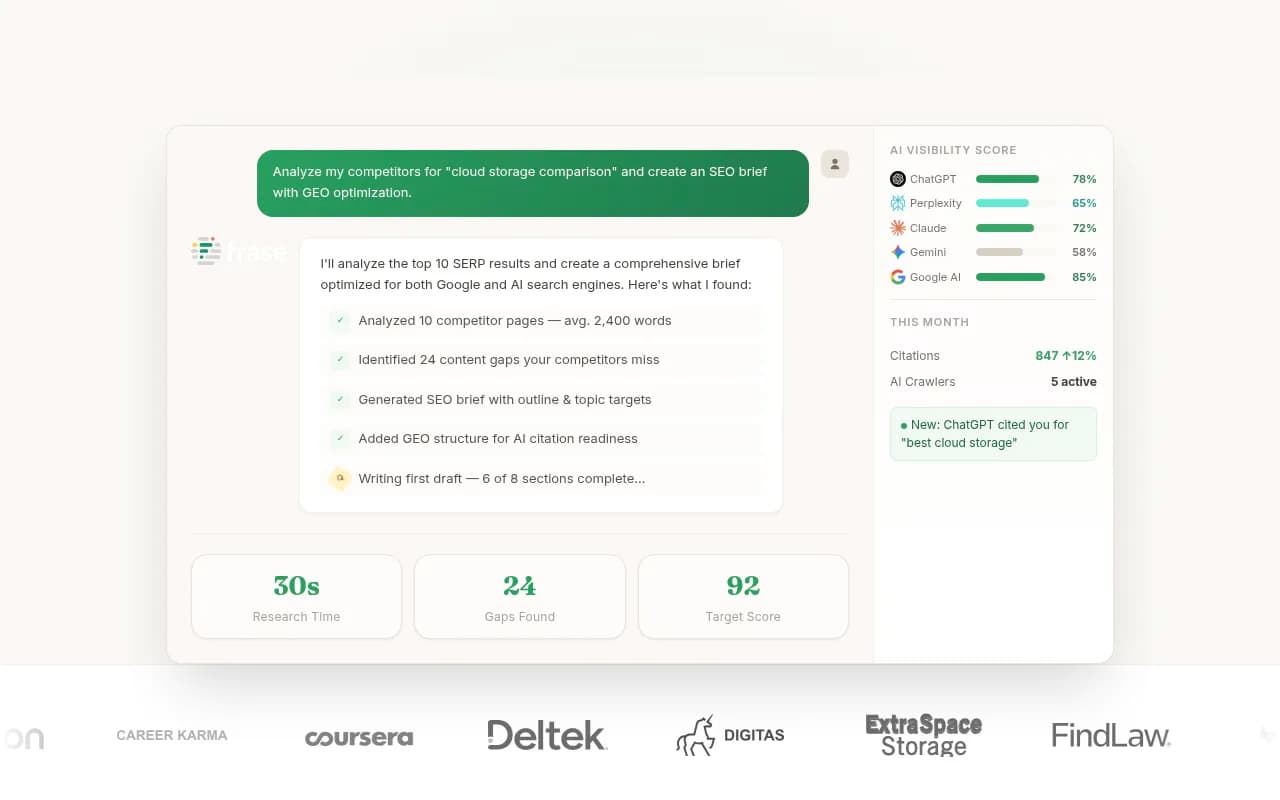
Frase combines content research with optimization, and its brief generation is particularly good for identifying the questions and subtopics that AI models are likely to surface. If you're building FAQ schema, Frase's "People Also Ask" analysis gives you a solid starting point for which questions to include.
How these tools compare
| Tool | Schema generation | Schema auditing | AI crawler visibility | Content optimization | AI citation tracking |
|---|---|---|---|---|---|
| Yoast SEO | Yes (WordPress) | Basic | No | No | No |
| AIOSEO | Yes (WordPress) | Basic | No | No | No |
| Screaming Frog | No | Deep | No | No | No |
| Botify | No | Deep | Yes | No | Partial |
| Semrush | No | Moderate | No | Yes | Limited |
| Moz Pro | No | Moderate | No | No | No |
| Lumar | No | Deep | Partial | No | Partial |
| Prerender.io | No | No | Yes (rendering) | No | No |
| Surfer SEO | No | No | No | Yes | No |
| Clearscope | No | No | No | Yes | No |
| Frase | No | No | No | Yes | No |
| Promptwatch | No | No | Yes | Yes (via agents) | Yes |
The table makes the gap visible. Most tools are strong in one column. The platforms built specifically for AI search visibility -- Promptwatch, Botify, Lumar -- are the ones starting to cover multiple columns simultaneously.
A practical workflow for 2026
Rather than picking one tool and hoping it covers everything, most serious teams are running a stack. Here's what a reasonable workflow looks like:
-
Use Screaming Frog or Lumar to audit your existing schema across the full site. Fix validation errors, identify missing schema types for your key page templates.
-
Use Yoast or AIOSEO (if you're on WordPress) to automate schema generation for new content going forward.
-
Use Surfer SEO, Clearscope, or Frase to make sure your content is semantically complete -- covering the entities, questions, and subtopics that AI models expect to find.
-
Use Promptwatch or Botify to monitor whether AI crawlers are actually reading your pages, and whether your content is translating into citations across ChatGPT, Perplexity, Gemini, and others.
-
Close the loop: when you see citation gaps, use that data to inform your next round of content creation and schema additions.
The fifth step is the one most teams skip. They implement schema, publish content, and then... wait. The teams that are winning AI search visibility in 2026 are the ones treating it as an ongoing optimization cycle rather than a one-time technical fix.
What schema types matter most for AI citations
Not all schema is equally useful for AI search visibility. Based on what AI models tend to cite, these types consistently show up as high-value:
- FAQPage -- AI models love structured Q&A. If you have FAQ schema on pages that answer questions in your category, you're giving AI engines a pre-packaged citation.
- Article / BlogPosting -- Author markup, publication dates, and organization attribution all help AI models assess credibility.
- Product -- For e-commerce and SaaS, product schema with clear attributes (name, description, offers, reviews) helps AI shopping features surface your brand.
- HowTo -- Step-by-step content with HowTo schema is frequently cited in instructional AI responses.
- Organization / LocalBusiness -- Entity-level markup that establishes who you are, what you do, and where you operate. This is foundational for brand recognition in AI models.
- BreadcrumbList -- Helps AI models understand your site structure and content hierarchy.
The underlying principle: schema that helps AI models answer a specific question or understand a specific entity is more valuable than schema that's purely decorative.
The bottom line
Structured data in 2026 is not a nice-to-have. It's one of the clearest ways to communicate with AI search engines in a language they're designed to understand. The tools that help you implement it correctly, audit it thoroughly, and connect it to actual citation outcomes are the ones worth investing in.
The honest reality is that no single tool does all of this perfectly yet. Screaming Frog is still the best for deep schema auditing. Yoast and AIOSEO are the most practical for WordPress teams generating schema at scale. And for the piece that matters most -- understanding whether any of it is actually driving AI citations -- platforms like Promptwatch are the ones closing that loop with real data.
Start with the audit. Fix what's broken. Then track whether it's working.