Key takeaways
- ChatGPT generates anywhere from 1 to 50+ sub-queries per user prompt depending on the mode (standard chat vs. deep research vs. agentic tasks)
- Standard ChatGPT responses typically involve 3-7 internal sub-queries; deep research mode can fan out into 20-50+ web searches per prompt
- At 2.5 billion prompts per day, the total sub-query volume hitting the web is orders of magnitude larger than most people realize
- For brands and marketers, understanding query fan-outs is now a core part of AI visibility strategy -- you need to know which sub-queries your competitors are winning
- Tools that track prompt-level behavior (not just keyword rankings) give you a real picture of where you're visible and where you're not
The question nobody was asking (but should be)
When you type a question into ChatGPT, you see one response. What you don't see is everything that happened before that response arrived.
Depending on what you asked and which mode you're using, ChatGPT may have quietly broken your single prompt into a handful of sub-queries, searched the web multiple times, synthesized sources from different angles, and then assembled an answer that looks seamless. The whole thing takes a few seconds. The complexity underneath is significant.
This matters a lot more than it sounds. If you're a brand trying to appear in AI search results, you're not just competing on one query -- you're competing on every sub-query ChatGPT generates from that prompt. Miss one, and a competitor fills the gap.
So let's look at what the data actually shows.
ChatGPT's scale in 2026: the baseline numbers
Before getting into sub-queries, it helps to understand the raw volume we're dealing with.
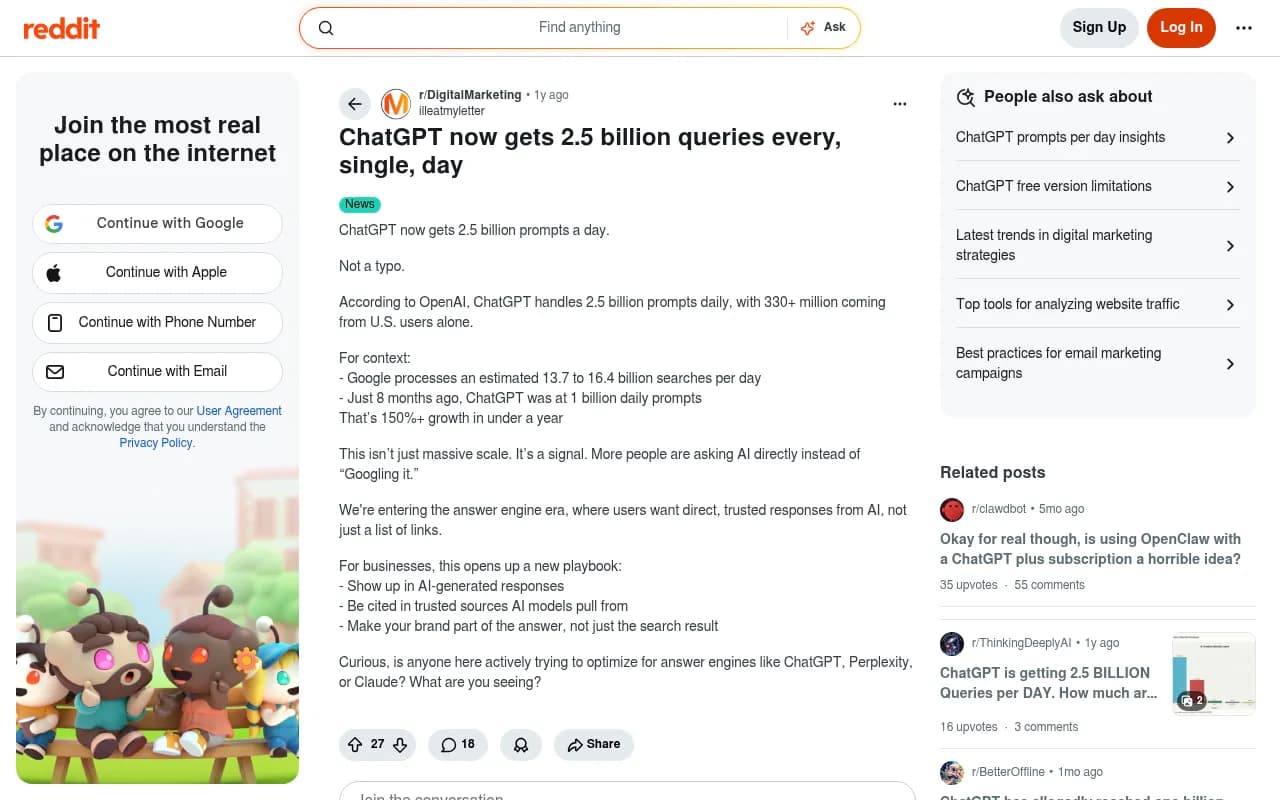
OpenAI confirmed that ChatGPT now handles 2.5 billion prompts per day, with over 330 million of those coming from U.S. users alone. For context, Google processes roughly 8.5 billion searches daily -- so ChatGPT is sitting at about 30% of Google's query volume, which is remarkable for a platform that didn't exist four years ago.
A typical office worker, according to Earth Day's February 2026 analysis, uses ChatGPT about 20 times a day -- summarizing meetings, drafting emails, brainstorming, outlining reports. Each of those prompts consumes roughly 0.34 watt-hours of electricity. The energy math is striking, but the query math is even more interesting for our purposes.
If 2.5 billion prompts per day each generate even 3 sub-queries on average, the actual number of information-retrieval operations happening inside ChatGPT's infrastructure is closer to 7-8 billion per day. That's more than Google's total search volume.
Standard ChatGPT: how many sub-queries per prompt?
For a regular ChatGPT conversation without web browsing enabled, sub-queries are internal -- they don't hit the web, but they do happen within the model's reasoning process.
When you ask something like "What's the best project management software for a remote team of 10?", the model doesn't treat that as a single lookup. It's effectively decomposing the question into:
- What are the leading project management tools?
- What features matter for remote teams specifically?
- What's the typical team size consideration for pricing tiers?
- What are common complaints about each tool?
- How do these compare on collaboration features?
This decomposition happens in the model's latent reasoning, not as visible web searches. You won't see it. But the answer you get reflects it.
For most standard prompts, this internal fan-out is somewhere between 3 and 7 sub-dimensions the model considers before generating a response. Complex, multi-part questions push that higher. Simple factual questions stay lower.
Deep research mode: where sub-queries get serious
Deep research is where the numbers get genuinely surprising.
OpenAI introduced deep research as an agentic mode where ChatGPT independently finds, analyzes, and synthesizes information before responding. It doesn't just answer -- it researches. And the sub-query behavior in this mode is fundamentally different.
According to Coursera's breakdown of the feature, free users get 5 deep research queries per month, Plus/Team users get around 25, and Pro users get up to 250. The reason for these limits isn't arbitrary -- deep research is computationally expensive because each single user prompt can trigger 20 to 50+ web searches before the model even starts writing its response.
Here's a rough breakdown by prompt type in deep research mode:
| Prompt type | Estimated sub-queries | Typical response time |
|---|---|---|
| Simple factual question | 3-8 | 30-60 seconds |
| Product comparison | 10-20 | 1-3 minutes |
| Market research question | 20-35 | 3-5 minutes |
| Competitive analysis | 30-50+ | 5-10 minutes |
| Multi-step research task | 50+ | 10-20 minutes |
The model is essentially acting as a research analyst, not a search engine. It reads pages, follows links, cross-references sources, and iterates. Each iteration is another sub-query.
Why this matters for AI visibility
Here's where this stops being a technical curiosity and becomes a strategic problem.
If ChatGPT generates 15 sub-queries when a user asks "What's the best CRM for a B2B SaaS company?", your brand needs to be a credible answer for several of those sub-queries -- not just the top-level one. You might be perfectly visible for "best CRM for SaaS" but completely absent from "CRM tools with strong reporting for B2B" or "CRM pricing for small SaaS teams."
That gap is what competitors exploit. And until recently, most brands had no way to see it.
This is the core idea behind what's called query fan-out analysis -- mapping how a single user prompt branches into sub-queries, then checking your visibility across each branch. It's a more granular version of keyword research, applied to AI search behavior.
Promptwatch tracks this directly. Its Prompt Intelligence feature shows volume estimates and difficulty scores for individual prompts, plus the query fan-outs that show how one prompt branches into sub-queries. That lets you prioritize the high-value, winnable branches instead of guessing which sub-queries matter.

The agentic layer: sub-queries you can't see at all
Standard chat and deep research are just two modes. The third -- and fastest-growing -- is agentic use.
When ChatGPT operates as an agent (using tools, browsing autonomously, executing multi-step tasks), the sub-query behavior becomes even harder to track from the outside. An agent asked to "research our top 5 competitors and summarize their pricing pages" might generate 40-80 discrete web requests, read dozens of pages, and synthesize information across multiple sessions.
From a brand perspective, this is both an opportunity and a blind spot. If AI agents are crawling your website as part of research tasks, you want to know:
- Which pages are they reading?
- Are they encountering errors that stop them from getting your content?
- How often are they returning?
- Is a crawl actually leading to a citation?
Most analytics tools don't capture this at all. Traditional web analytics logs bot traffic but doesn't distinguish between a Googlebot crawl and a ChatGPT research agent. The behavior is different, the intent is different, and the outcome (whether you get cited) is different.
What the data tells us about citation patterns
Sub-queries don't all lead to citations. The model generates many sub-queries, reads many sources, and then cites a small subset. Understanding the ratio matters.
Based on patterns from AI visibility platforms tracking citation behavior across billions of prompts, a few things are consistent:
- Sources cited in AI responses tend to appear in the top results for multiple sub-queries, not just one. Breadth of coverage matters.
- Structured, specific content (comparison tables, numbered lists, clear definitions) gets cited more often than long-form prose that buries the answer.
- Reddit threads, YouTube videos, and third-party review sites appear in citations far more often than most brands expect -- often more than the brand's own website.
- The model tends to cite sources that directly answer the sub-query, not sources that are generally authoritative. A highly-ranked homepage doesn't help if it doesn't answer the specific sub-question.
This last point is worth sitting with. Your domain authority doesn't transfer cleanly to AI search. What matters is whether a specific page on your site answers a specific sub-query that ChatGPT is generating.
A framework for thinking about sub-query coverage
If you want to improve your AI visibility, the sub-query lens gives you a more actionable framework than traditional SEO thinking.
Start with a prompt your target customer would actually use. Something like "What's the best email marketing tool for e-commerce brands?" Then work through the sub-queries that prompt likely generates:
- What are the top email marketing platforms?
- Which email tools have strong e-commerce integrations?
- How do these tools handle abandoned cart sequences?
- What's the pricing like for e-commerce brands at different scales?
- What do users say about deliverability for each tool?
- Are there any tools specifically built for e-commerce vs. general email marketing?
Now check: does your website have content that clearly answers each of these? Not just mentions them -- actually answers them, in a way that a model could extract and cite.
Most brands find they cover sub-query #1 reasonably well (they appear in general "best of" lists) but have thin or no coverage for sub-queries #4, #5, and #6. Those are the gaps competitors fill.
How to actually track this
Knowing sub-queries exist is one thing. Tracking them systematically is another.
A few approaches, depending on your resources:
Manual testing works for small-scale research. Run your target prompts through ChatGPT's deep research mode and watch which sources it cites. Do this across 10-20 prompts and you'll start to see patterns -- which competitors appear repeatedly, which sub-angles you're missing, which content formats get cited.
AI crawler log analysis is more technical but more complete. If you can see which pages ChatGPT's crawlers are hitting on your site, you can reverse-engineer which sub-queries are driving that traffic. Errors in those logs (404s, slow load times, blocked pages) tell you where you're losing visibility before it even becomes a citation opportunity.
Dedicated AI visibility platforms automate all of this. They track prompt behavior across models, map citation patterns, identify gaps, and in some cases generate the content needed to fill those gaps.
Perplexity
For brands serious about AI search visibility, the combination of prompt tracking, crawler log analysis, and content gap identification is what separates monitoring from optimization. Monitoring tells you where you're invisible. Optimization does something about it.
The environmental footnote worth knowing
One thing that doesn't get discussed enough in the sub-query conversation: the environmental cost scales with query volume.
Earth Day's February 2026 analysis put the energy cost of a single ChatGPT prompt at roughly 0.34 watt-hours. A deep research query that generates 40 sub-queries and reads 30 web pages is consuming significantly more -- potentially 10-15x a standard prompt.
At 2.5 billion prompts per day, even a conservative estimate puts ChatGPT's daily electricity consumption in a range comparable to a small country's residential power use. That number grows as deep research and agentic use become more common.

This isn't an argument against using AI search -- it's context for why the infrastructure investment in AI is so large, and why the competitive stakes around AI visibility are real. Companies are spending billions on this infrastructure. Brands that don't show up in the results are leaving that investment on the table.
What this means for your strategy in 2026
The sub-query reality changes a few things about how you should think about AI search:
One prompt is many opportunities. A single user query generates multiple sub-queries, each of which is a chance to be cited. Covering more sub-angles of a topic gives you more surface area for citations.
Depth beats breadth for sub-query coverage. A single, thorough page that answers five related sub-questions is more valuable than five thin pages that each answer one. The model can extract multiple answers from one well-structured source.
Third-party presence matters as much as your own site. If Reddit threads, review sites, and YouTube videos are driving a large share of citations (and they are), your off-site content strategy is as important as your on-site content strategy.
Crawler behavior is a signal. If AI crawlers are hitting your site but you're not getting cited, something is breaking in the chain -- content quality, page structure, load time, or something else. That's fixable, but only if you can see it.
The brands winning in AI search in 2026 aren't the ones with the highest domain authority. They're the ones who understand how AI models decompose questions, and who've built content that answers those decomposed questions clearly and specifically.
That's the real game. Sub-queries are where it's played.