Frase Review 2026
Research, write, and optimize SEO content in one platform. Generates content briefs, answers questions, and provides optimization suggestions based on SERPs.
Key Takeaways
- Dual optimization engine: Frase scores content for both traditional SEO and GEO (Generative Engine Optimization) in real-time, making it one of the few tools that optimize for AI search engines like ChatGPT and Perplexity alongside Google
- Agentic workflow: The AI Agent handles 80+ tasks from competitive research to content creation to publishing, replacing the typical 5-tool stack (SEMrush, Jasper, Surfer, Canva, WordPress) with a single platform
- Monitoring-only limitation: While Frase tracks AI visibility across 8 platforms, it lacks the content gap analysis, AI crawler logs, and traffic attribution that Promptwatch offers for deeper GEO optimization
- Best for: Content teams and SEO agencies managing 10-50 articles per month who want to consolidate their toolchain and optimize for both traditional and AI search in one editor
- Pricing: Plans start at $39/mo with a 7-day free trial, making it accessible for small teams while scaling to enterprise needs

Frase launched as an SEO content optimization tool but has evolved into what the company calls an "agentic SEO and GEO platform" -- a single AI agent that handles the full content workflow from research to publishing to performance tracking. The platform is used by teams at ActiveCampaign, Microsoft, GitLab, Oracle, and thousands of other companies. The core pitch: replace your fragmented stack of research tools, writing assistants, optimization checkers, and social schedulers with one AI that does the work for you.
The target audience is content marketing teams, SEO agencies, and in-house marketers who produce 10-50+ articles per month and are tired of juggling logins across SEMrush, Jasper, Surfer SEO, Canva, and WordPress. Frase positions itself as the consolidation play -- one platform, one login, one invoice. The company has also made a notable bet on GEO (Generative Engine Optimization), adding features specifically designed to help content rank in ChatGPT, Perplexity, Claude, and other AI search engines that are eating into Google's traffic.
The AI Agent and 80+ Skills
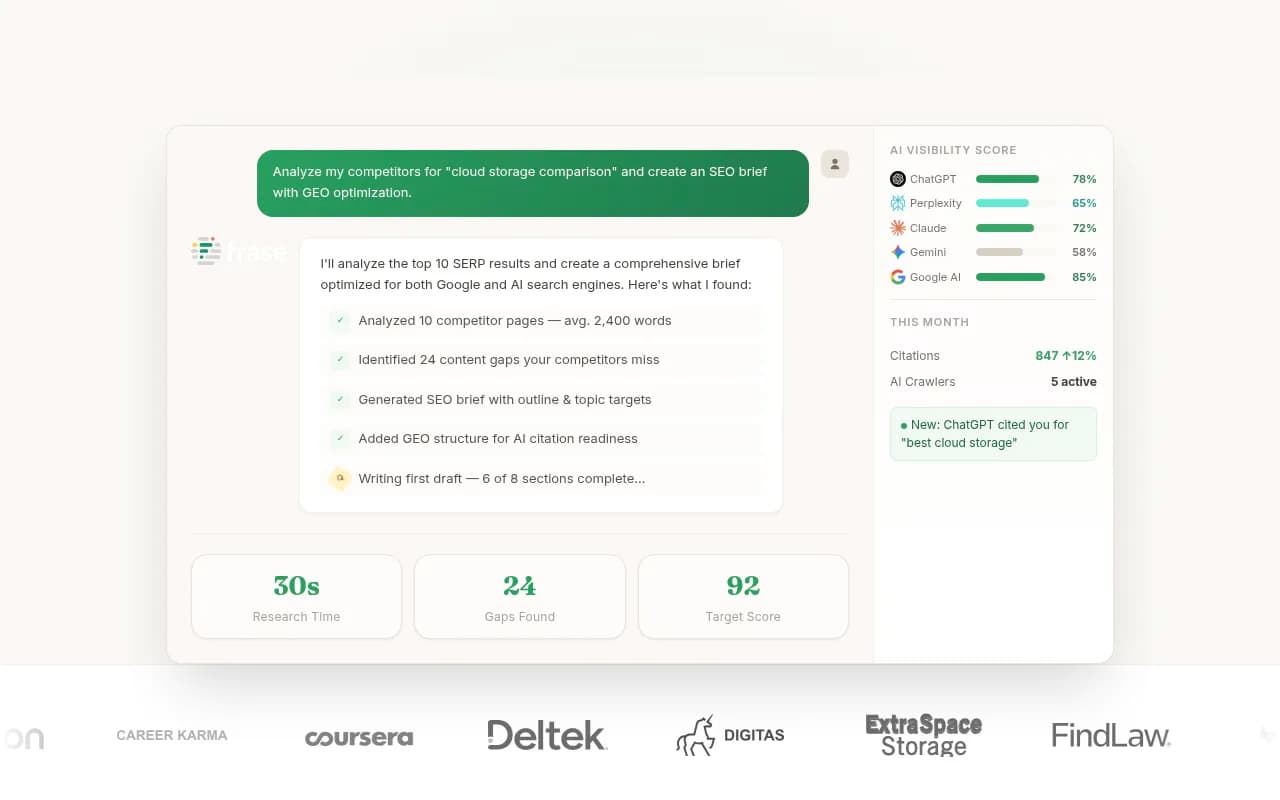
Frase's headline feature is the AI Agent, which the company describes as having "80+ specialized skills." In practice, this means you can ask the agent questions like "What should we publish next for cloud storage comparison?" and it will analyze the top 10 SERP results, identify content gaps, generate an SEO brief with an outline, and start drafting the article -- all in about 30 seconds. The agent pulls from multiple skill sets: SERP analysis, keyword research, topic clustering, content generation, optimization scoring, social media atomization, and publishing workflows. It's not a chatbot that answers questions -- it's a task executor that completes multi-step workflows.
The agent interface feels like a conversation, but the output is structured work product: briefs, outlines, drafts, optimization reports, and publishing-ready assets. You can interrupt mid-task to refine instructions ("make it more technical" or "focus on enterprise buyers"), and the agent adjusts without starting over. This is where Frase differentiates from tools like Jasper or Copy.ai, which generate text but don't handle the research, optimization, and distribution steps.
SERP Research and Competitive Analysis
Frase's SERP research tool analyzes the top 10 Google results for your target keyword and extracts topics, questions, headings, and patterns. It shows you what competitors are covering, how long their articles are, what keywords they're targeting, and where the gaps are. The output is a visual breakdown of topic overlap -- you can see that Backlinko covers 22 topics, HubSpot covers 18, and PCMag covers 15, with a Venn diagram showing what's unique to each and what's shared.
This data feeds directly into the content brief generator, which creates an outline that fills the gaps competitors miss. The brief includes target word count, recommended headings, questions to answer, and keywords to include. It's similar to what Surfer SEO or Clearscope provide, but Frase bundles it with the writing and optimization steps instead of stopping at the research phase.
One limitation: Frase's SERP analysis is Google-only. It doesn't analyze Reddit threads, YouTube videos, or other content types that influence AI search results -- a gap that tools like Promptwatch address with Reddit and YouTube tracking.
Real-Time SEO and GEO Optimization Scoring
As you write in Frase's editor, two scores update in real-time: an SEO score (out of 100) and a GEO score (out of 100). The SEO score measures traditional ranking factors -- keyword usage, topic coverage, content length, heading structure, and how well you match the SERP benchmarks. The GEO score measures factors that help AI models cite your content -- clear structure, authoritative citations, direct answers to questions, and formatting that LLMs can parse.
The editor highlights missing topics in the sidebar, shows keyword density, and suggests where to add more depth. If your SEO score is 60, you can click on the missing topics and Frase will draft paragraphs to fill them. If your GEO score is low, it will suggest adding citations, restructuring for Q&A format, or clarifying definitions. The dual scoring system is unique -- most tools optimize for Google or AI, not both simultaneously.
The optimization suggestions are specific. Instead of "add more keywords," Frase tells you "mention 'cloud backup encryption' in the security section" or "add a comparison table for Dropbox vs Google Drive." It's prescriptive, which helps junior writers produce expert-level content but can feel restrictive if you're an experienced writer who doesn't want to follow a formula.
AI Search Visibility Tracking
Frase tracks your brand's appearance across 8 AI platforms: ChatGPT, Perplexity, Claude, Gemini, Google AI Overviews, Copilot, Meta AI, and Grok. The dashboard shows share of voice (how often you're cited vs competitors), appearance rate (percentage of relevant prompts where you show up), authority rate (how often you're cited as a primary source), and momentum (whether your visibility is trending up or down).
You can drill into specific prompts to see the full AI-generated response and where your brand appears. Frase sends alerts when your appearance rate drops or when a competitor starts outranking you in AI results. The tracking is prompt-based -- you define the queries you care about ("best project management software," "cloud storage comparison," etc.) and Frase monitors them over time.
However, Frase's AI tracking is monitoring-only. It shows you where you stand but doesn't tell you why you're invisible or what content to create to fix it. There's no content gap analysis that maps which prompts competitors rank for but you don't, no AI crawler logs showing how ChatGPT or Perplexity are reading your site, and no traffic attribution connecting AI visibility to actual revenue. For teams that want to optimize for AI search, not just monitor it, Promptwatch offers deeper capabilities -- Answer Gap Analysis that shows exactly what content you're missing, an AI writing agent grounded in 880M+ citations, AI crawler logs, and traffic attribution that connects visibility to conversions.
Content Atomization and Multi-Channel Distribution
Frase's atomization feature takes one blog post and automatically generates LinkedIn carousels, Twitter threads, email newsletters, and Instagram posts. You write the article once, and Frase extracts key points, reformats them for each platform, and generates platform-specific copy. The output isn't perfect -- you'll need to edit for tone and add platform-specific hooks -- but it saves 4+ hours of manual repurposing work.
The atomization templates are customizable. You can define your brand voice, set character limits, specify hashtag usage, and choose which sections of the article to emphasize for each channel. Frase also generates image suggestions for each social post, though you'll need to create the actual visuals in Canva or another design tool.
This feature is particularly valuable for small teams that don't have dedicated social media managers. Instead of publishing a blog post and hoping people find it, you can distribute it across five channels in 10 minutes. The downside: the social copy can feel formulaic if you don't customize it, and the feature doesn't handle scheduling or posting -- you'll still need Buffer, Hootsuite, or a similar tool for that.
Programmatic SEO and Content Clusters
Frase's programmatic SEO feature generates hundreds or thousands of pages from structured data. If you have a database of locations, products, or directory listings, you can create a template once and Frase will generate unique pages for each entry. Teams have used this to build 10,000+ location pages, product comparison grids, and directory sites at enterprise scale.
The content cluster tool maps your content strategy with AI-powered topic clusters. It identifies pillar pages, supporting content, and internal linking opportunities, then tracks how your domain authority improves as you build out the cluster. This is similar to what HubSpot's content strategy tool or MarketMuse's topic modeling provide, but Frase integrates it with the writing and optimization workflow instead of treating it as a separate planning step.
Both features are aimed at larger teams or agencies managing multiple sites. If you're publishing 5-10 articles per month, you won't need programmatic SEO. If you're managing 50+ articles per month across multiple clients, these features become essential.
Brand Governance and Voice Consistency
Frase's brand governance feature enforces terminology, tone, and style across all AI-generated content. You upload reference docs (style guides, product descriptions, competitor positioning), and Frase applies them automatically to every draft. Your 20th article sounds as on-brand as your first, without manual review.
This is particularly valuable for agencies managing multiple clients or enterprises with strict brand guidelines. You can set up separate brand profiles for each client, and Frase will switch contexts automatically when you start a new project. The feature also flags off-brand language in real-time -- if you write "utilize" instead of "use," or if you mention a competitor in a way that violates your positioning guidelines, Frase will highlight it and suggest alternatives.
The limitation: brand governance only applies to AI-generated content. If you're writing from scratch without using Frase's drafting features, the governance checks won't run unless you manually trigger them.
Content Opportunities and Performance Tracking
Frase's content opportunities dashboard surfaces three types of recommendations: Fix (declining pages that need updates), Boost (pages with potential to rank higher), and Fill (content gaps where competitors rank but you don't). Each recommendation includes estimated traffic impact, so you can prioritize based on ROI.
The Fix recommendations identify pages that have dropped in rankings over the past 30-90 days and suggest specific updates -- add missing topics, refresh outdated statistics, improve keyword targeting. The Boost recommendations find pages ranking on page 2 or 3 that could reach page 1 with targeted optimization. The Fill recommendations show keywords where competitors rank but you have no content, along with a brief outline of what to create.
This is similar to what Ahrefs' Content Gap or SEMrush's Position Tracking provide, but Frase integrates it with the content creation workflow. You can click "Create Content" on a Fill recommendation and Frase will generate a brief, outline, and first draft in one step. The downside: the traffic estimates are based on Google search volume, not actual click-through rates, so they can be optimistic.
Integrations and Publishing Workflow
Frase integrates with WordPress, Webflow, Shopify, and HubSpot for one-click publishing. You can write in Frase's editor, optimize the content, and push it directly to your CMS without copy-pasting. The integration syncs metadata (title tags, meta descriptions, featured images) and preserves formatting.
Frase also integrates with Google Search Console for keyword tracking, Google Analytics for traffic attribution, and Zapier for custom workflows. The API is available on higher-tier plans, allowing developers to build custom integrations or automate content workflows.
One notable gap: Frase doesn't integrate with Google Docs or Microsoft Word, which many teams use for collaborative editing. You have to work in Frase's editor or copy-paste content back and forth.
Who Is Frase For
Frase is best for content marketing teams and SEO agencies producing 10-50+ articles per month who want to consolidate their toolchain. If you're currently paying for SEMrush (research), Jasper (writing), Surfer SEO (optimization), Canva (social), and WordPress (publishing), Frase can replace most of that stack at a lower total cost.
It's particularly strong for teams that want to optimize for both traditional SEO and AI search in one workflow. The dual scoring system and AI visibility tracking make it easy to ensure your content ranks in Google and gets cited by ChatGPT without doubling your workload.
Frase is less suited for solo bloggers or small businesses publishing 1-5 articles per month. The platform is overkill if you're not producing content at scale, and the learning curve (understanding SEO scores, GEO optimization, content clusters) takes time to master. For occasional content creation, simpler tools like Jasper or Copy.ai are easier to pick up.
Agencies managing multiple clients will appreciate the brand governance features, client-specific voice profiles, and white-label reporting. The programmatic SEO and content cluster tools are also valuable for agencies building large-scale content strategies.
Pricing and Value
Frase offers three main plans: Solo ($39/mo for 1 user, 10 articles/mo, basic features), Basic ($114/mo for 3 users, 30 articles/mo, full platform access), and Team ($214/mo for unlimited users, 100 articles/mo, API access, white-label reporting). All plans include the AI Agent, SERP research, optimization scoring, AI visibility tracking, and publishing integrations. Annual billing saves 20%.
There's a 7-day free trial with no credit card required, so you can test the full platform before committing. The trial includes all features, not a limited demo.
Compared to competitors, Frase is mid-priced. Surfer SEO starts at $89/mo but doesn't include AI writing or visibility tracking. Clearscope starts at $170/mo but is optimization-only. Jasper starts at $49/mo but doesn't handle research or optimization. If you're replacing multiple tools, Frase's pricing is competitive. If you only need one piece of the workflow (just writing or just optimization), standalone tools may be cheaper.
For teams serious about GEO and AI search visibility, Promptwatch offers more depth at $99-579/mo -- content gap analysis, AI crawler logs, traffic attribution, and an AI writing agent grounded in 880M+ citations. Frase's AI tracking is monitoring-only, while Promptwatch helps you optimize and fix visibility gaps.
Strengths
- Dual optimization: Real-time scoring for both SEO and GEO in one editor is unique and valuable as AI search grows
- Workflow consolidation: Replaces 5+ tools with one platform, reducing logins, invoices, and context-switching
- Agentic execution: The AI Agent completes multi-step workflows (research, brief, draft, optimize, atomize, publish) instead of just generating text
- Content atomization: Automatically repurposes blog posts into social content for 5 channels, saving hours of manual work
- Programmatic SEO: Generates thousands of pages from structured data, valuable for large-scale content operations
- Brand governance: Enforces voice and terminology across all AI-generated content, ensuring consistency at scale
Limitations
- Monitoring-only AI tracking: Shows where you rank in AI search but doesn't explain why or what to create to fix it -- lacks the content gap analysis, AI crawler logs, and traffic attribution that Promptwatch provides
- Google-centric research: SERP analysis only covers Google results, missing Reddit threads, YouTube videos, and other content types that influence AI search
- No collaborative editing: Doesn't integrate with Google Docs or Word, forcing teams to work in Frase's editor or copy-paste
- Formulaic output: AI-generated content can feel templated if you don't customize it, especially for social atomization
- Learning curve: Understanding SEO vs GEO scores, content clusters, and programmatic SEO takes time -- not a pick-up-and-go tool
Bottom Line
Frase is the right choice for content teams and agencies producing 10-50+ articles per month who want to consolidate their toolchain and optimize for both Google and AI search in one workflow. The agentic approach (research, write, optimize, atomize, publish) saves hours per article and reduces tool sprawl. The dual SEO/GEO scoring is forward-thinking as AI search grows.
However, if you're serious about AI search visibility and want to optimize, not just monitor, Promptwatch offers deeper capabilities -- content gap analysis that shows exactly what you're missing, AI crawler logs, traffic attribution, and an AI writing agent grounded in real citation data. Frase tracks where you stand in AI search; Promptwatch helps you improve it.
Tags:
Similar and alternative tools to Frase