Key takeaways
- A single user prompt triggers 8-10 parallel sub-queries (fan-out branches) before an AI model returns an answer. Ranking for the obvious query doesn't mean you rank for all of them.
- Brands typically go missing on specific branch types: pricing, comparisons, complaints/limitations, recency signals, and third-party validation (Reddit, reviews, forums).
- The fix isn't "more content" -- it's mapping which branches exist, auditing which ones you're absent from, and creating content that directly answers those specific angles.
- Tools like Promptwatch can surface the exact fan-out branches where competitors are cited but you aren't, so you know precisely what to build.
- This is a structural problem, not a keyword problem. Solving it requires thinking in branches, not in rankings.
What query fan-out actually means (and why it matters more than keywords)
When someone types "best project management software for remote teams" into ChatGPT or Perplexity, they get back a confident, synthesized answer. What they don't see is everything that happened before that answer appeared.
The AI didn't just look up one thing. According to data from a study of 72,000+ AI-generated queries across 8,700+ prompts, a single user question routinely triggers 8 to 10 parallel, hyper-specific sub-queries before the model commits to a response. These sub-queries -- the "fan-out" -- are invisible to the user but are the actual mechanism determining which brands make the final answer.
Think of it like a journalist doing background research before writing a story. They don't just accept the first source they find. They check reviews, look for recent news, compare alternatives, search for complaints, and verify pricing. AI models do the same thing, just in milliseconds and at scale.
The uncomfortable truth for most brands: you might rank perfectly for the surface-level query and still get filtered out of the final answer because you're missing from three or four of the branches the AI checked along the way.
The anatomy of a fan-out: what branches actually look like
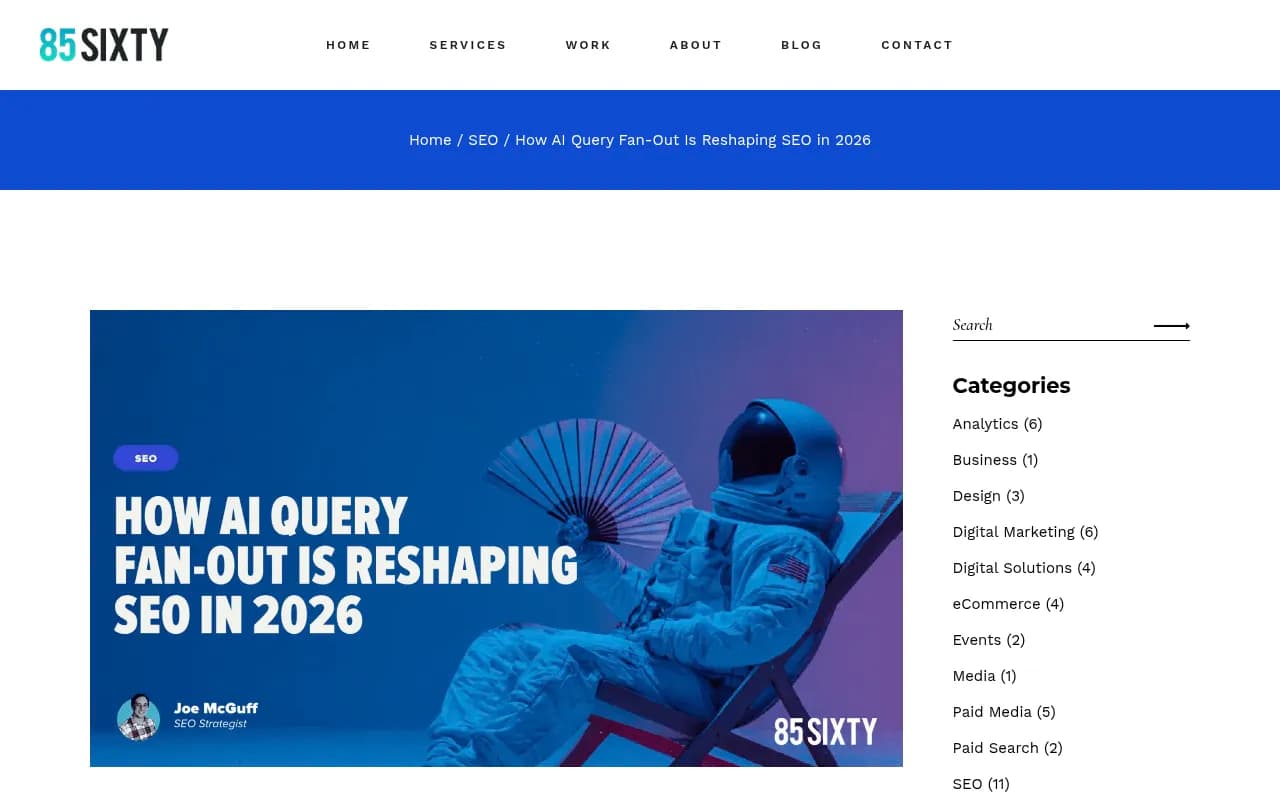
Fan-out branches aren't random. They follow predictable patterns based on what AI models need to feel confident about an answer. Research from 85sixty's analysis of fan-out behavior shows these branch types appear consistently:
Recency branches -- The model checks whether information is current. Timestamps like "2024" or "2025" appear in roughly 6% of all fan-out queries. If your content hasn't been updated recently, you're invisible on this branch.
Price and cost branches -- Terms like "free," "pricing," and "cost" are among the most common fan-out qualifiers. If you don't have a clear, crawlable pricing page or content that addresses cost, you'll lose this branch to competitors who do.
Comparison branches -- "vs" queries are extremely common. The model wants to understand how options stack up against each other. If you've never written a comparison page or addressed how you differ from alternatives, you're absent here.
Risk and limitation branches -- "Pros and cons," "complaints," "limitations," and "alternatives" are all branch types the model uses to balance its answer. Brands that only publish promotional content get filtered out on these branches because the model can't find a balanced picture.
Social proof and consensus branches -- Reddit threads, review sites, professional forums. The model looks for third-party validation. If your brand only exists on your own website, you're missing the branches that check for external consensus.
Use-case branches -- "Best for small teams," "best for enterprise," "best for [specific industry]" -- the model tries to match recommendations to context. Generic positioning loses here.
The reason a brand ranks for some branches and not others usually comes down to which of these content types they've actually published. Most brands have a homepage, a few product pages, and maybe a blog. That covers maybe two or three branch types. The rest are gaps.
Why this creates uneven visibility (and why it's so hard to spot)
Here's what makes fan-out gaps particularly frustrating: traditional SEO metrics won't show them to you.
Your keyword rankings might look fine. Your organic traffic might be stable. But in AI search, you're getting mentioned for "best project management tool" and completely absent when the model checks "project management software complaints" or "project management tool vs Asana." The final AI answer reflects all of those branches, not just the one you rank for.
95% of fan-out phrases show zero monthly search volume in traditional keyword tools. They're invisible to conventional tracking. You can't find them by looking at your Google Search Console data. They don't show up in a standard keyword research report. The model is checking them anyway.
This is why brands are often surprised when they see their AI visibility data. They're ranking well in traditional search but barely appearing in AI answers -- or appearing for some topics but not others in ways that feel arbitrary. It's not arbitrary. It's branch coverage.
The six most common branch gaps (and what causes each one)
1. The pricing/cost branch
Most SaaS and B2B brands either hide their pricing or make it hard to find. AI models can't cite what they can't crawl. If your pricing page is behind a form, gated, or simply doesn't exist, you'll lose every pricing branch -- and pricing branches are some of the most common in commercial queries.
The fix: publish a clear pricing page with actual numbers (or at least ranges). Write content that addresses cost comparisons, "is [your tool] worth it," and "how much does [your tool] cost" directly.
2. The comparison branch
If you've never written "X vs Y" content, you're leaving comparison branches entirely to your competitors. The model will find their comparison pages and cite them -- often in a way that doesn't favor you.
The fix: write comparison content from your own perspective. "How we compare to [Competitor]" pages, honest feature comparisons, and "alternatives to [Competitor]" content all feed this branch.
3. The recency branch
An AI model checking for fresh information will deprioritize content that looks stale. A blog post from 2022 with no updates signals that your information might be outdated.
The fix: add "last updated" dates to your content, refresh older posts with current data, and publish content that references the current year. Even small updates signal recency.
4. The complaints/limitations branch
This one is counterintuitive. Brands that only publish positive content actually hurt themselves in AI search because the model can't find a balanced picture. When it checks "limitations of [your product]" and finds nothing from you, it fills that gap from competitor content or review sites -- which may not be flattering.
The fix: write honest content about your product's limitations, who it's not right for, and what you're working to improve. This builds trust with the model and lets you control the narrative on that branch.
5. The third-party validation branch
Reddit, G2, Capterra, Trustpilot, industry forums -- AI models weight these heavily because they represent external consensus rather than brand-controlled messaging. If your brand has no presence in these channels, you're missing an entire category of branches.
The fix: encourage genuine reviews on third-party platforms, participate in relevant Reddit communities, and create content that earns citations from industry publications.
6. The use-case specificity branch
"Best for [specific context]" branches require content that speaks directly to that context. A generic "who is this for" section on your homepage won't cut it. The model needs content that specifically addresses each use case.
The fix: create dedicated landing pages or articles for each major use case. "Best project management tool for marketing agencies," "best project management tool for remote engineering teams" -- these need to exist as separate, substantive pieces.
How to audit your fan-out branch coverage
Before you can fix the gaps, you need to know where they are. Here's a practical approach:
Step 1: Map the branches for your core topics
Take your 5-10 most important topics and manually think through what branches an AI model would check. For each topic, ask: what would a thorough researcher check before recommending something in this category? Pricing, comparisons, reviews, limitations, use cases, recency -- list them all.
Step 2: Check what the AI actually cites
Run your core queries through ChatGPT, Perplexity, and Google AI Mode. Look at what sources they cite. Are you there? If not, who is? What content type is being cited -- a review site, a comparison article, a Reddit thread? That tells you which branch type you're missing.
Step 3: Use a GEO platform to systematize this
Doing this manually for 50+ prompts across multiple AI models isn't realistic. Promptwatch has an Answer Gap Analysis feature that shows exactly which prompts competitors are visible for but you aren't -- including the specific content types and angles driving those citations.

This turns a manual audit into something systematic. Instead of guessing which branches you're missing, you see them directly, along with which competitors are filling those gaps.
Step 4: Prioritize by impact
Not all branches are equal. A pricing branch on a high-volume commercial query matters more than a use-case branch on a niche topic. Prioritize gaps where the prompt volume is high and the branch type is one you can realistically address.
Building content that covers branches, not just keywords
The mental model shift here is important. Traditional SEO thinks in terms of target keywords and rankings. Fan-out coverage thinks in terms of branch types and content completeness.
For any given topic, you need content that covers:
- The primary query (what you're probably already ranking for)
- The comparison angle (vs competitors, alternatives)
- The pricing/value angle (cost, ROI, worth it)
- The limitation/risk angle (cons, complaints, not right for)
- The use-case angle (best for specific contexts)
- The recency angle (updated content with current data)
That's six content pieces per topic, minimum. Most brands have one.
Practical content types that fill branch gaps
Comparison pages cover the "vs" branches. Write them honestly -- the model will find dishonest comparisons and they won't build trust.
Transparent pricing content covers the cost branches. If you can't publish exact pricing, at least publish ranges and what factors affect pricing.
"Who this is (and isn't) for" content covers both use-case and limitation branches simultaneously.
Regular content updates cover recency branches. A quarterly refresh of your most important pages goes a long way.
Third-party review cultivation covers the social proof branches. This isn't something you can fake -- it requires genuine customer satisfaction and a systematic ask.
Tools that help you track and fix fan-out gaps
A few platforms are worth knowing about in this space, depending on what you need:
For tracking which AI models cite you and for which prompts, Promptwatch gives you the most complete picture -- including page-level citation tracking and crawler logs that show when AI agents visit your site and which pages they actually read. The Answer Gap Analysis is particularly useful for fan-out work because it surfaces the specific content gaps driving your missing citations.
For mapping topical coverage and building content architecture that addresses multiple branch types, tools like Topical Map AI can help you visualize where your content has gaps.
For the actual content creation once you know what branches to target, platforms like MarketMuse help you understand what a comprehensive piece on a given topic needs to cover.
For monitoring third-party mentions and reviews that feed the social proof branches, Brand24 tracks mentions across the sources AI models frequently cite.
A comparison of approaches to fan-out gap analysis
| Approach | What it finds | What it misses | Best for |
|---|---|---|---|
| Manual AI query testing | Real citations, real branch behavior | Doesn't scale beyond a few prompts | Initial audit, spot-checking |
| Traditional keyword research | Keyword gaps on your own site | Fan-out branches with zero search volume | Traditional SEO, not AI visibility |
| GEO platform (e.g. Promptwatch) | Competitor citations, content gaps, branch patterns at scale | Requires setup and ongoing monitoring | Systematic, ongoing optimization |
| Topical mapping tools | Content architecture gaps | Doesn't show AI citation behavior directly | Content planning and site structure |
| Third-party review monitoring | External citation sources | Doesn't connect to specific AI prompt behavior | Offsite presence and reputation |
The honest answer is that manual testing is the best starting point to understand what fan-out actually looks like for your category. Then a GEO platform takes over for systematic tracking and gap identification at scale.
What "fixing" fan-out gaps actually looks like in practice
A concrete example: imagine a B2B SaaS company that sells HR software. They rank well for "HR software for small business" in traditional search. But in AI answers, they're getting cited inconsistently.
An audit reveals:
- They have no comparison content ("HR software vs Rippling," "BambooHR alternatives")
- Their pricing page is gated behind a demo request form
- Their blog hasn't been updated in eight months
- They have 12 reviews on G2, all from 2023
- They have no content addressing "HR software limitations" or "who HR software is not right for"
That's five branch types with zero coverage. The fix isn't a redesign or a new campaign -- it's five targeted content pieces and a review cultivation push. That's a few weeks of work, not a quarter-long project.
After publishing:
- A transparent pricing page with tier ranges
- Three comparison articles targeting their main competitors
- A "who this is not right for" page
- Updated blog posts with 2026 data
- A G2 review campaign targeting recent customers
Within 60-90 days, AI models have new content to cite on those branches. The visibility improves not because the algorithm changed, but because the content gaps were actually filled.
The broader point about AI visibility in 2026
Fan-out is the mechanism. The underlying principle is that AI models are doing due diligence before they answer, and they need to find your brand across multiple angles to feel confident recommending you.
Brands that understand this stop thinking about "ranking" as a single outcome and start thinking about "coverage" as a multi-dimensional problem. You need to be findable when the model checks pricing, when it checks comparisons, when it checks limitations, when it checks recent news, and when it checks what real users think.
That's a different content strategy than traditional SEO. It requires more content types, more honest content, and more attention to where your brand exists outside your own website.
The brands winning in AI search right now aren't necessarily the ones with the best product or the most backlinks. They're the ones who've built content that survives the cross-examination.