Botify Review 2026
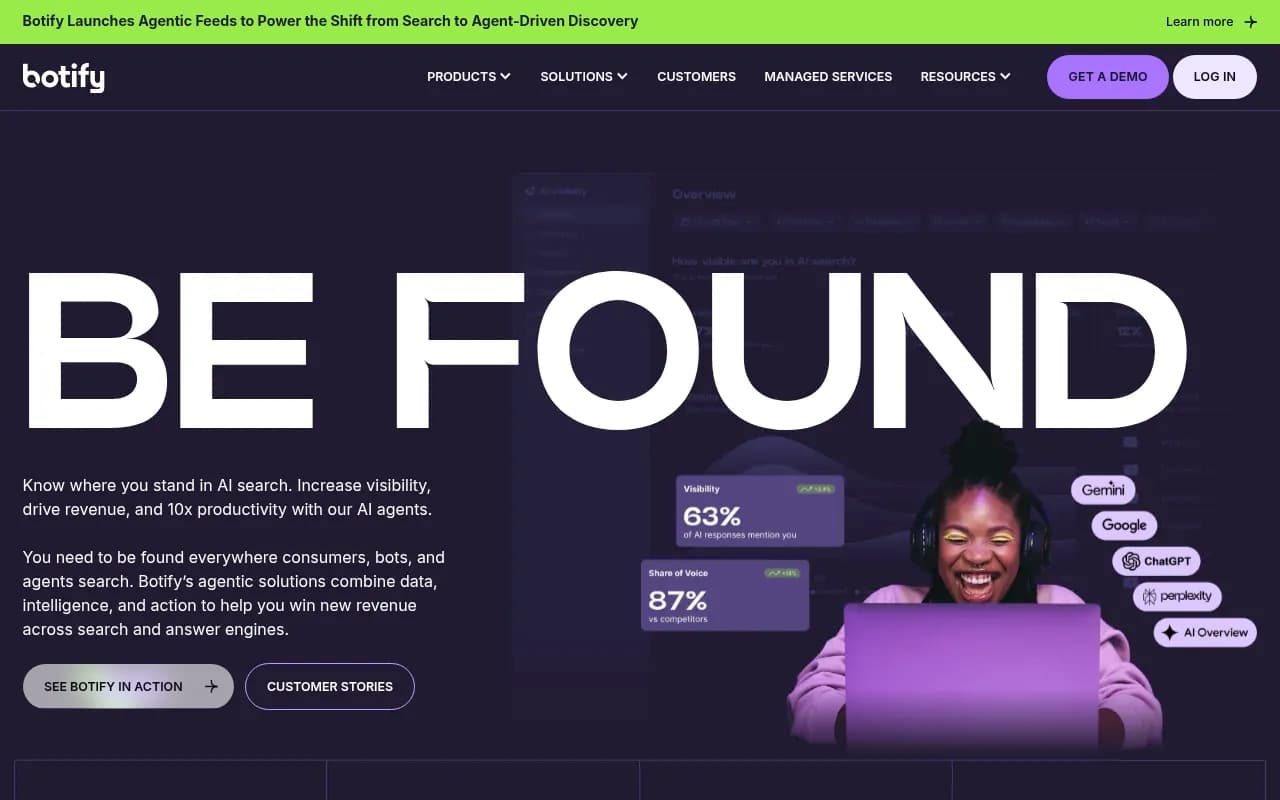
Botify is an enterprise AI search optimization platform combining technical SEO, GEO monitoring, and agentic automation. It helps large brands with complex websites get found in traditional and AI search engines through crawl analytics, log file analysis, and no-code deployment tools like PageWorker
Key takeaways
- Botify is a full-stack enterprise SEO and AI search visibility platform, covering everything from technical crawl analysis to GEO (Generative Engine Optimization) and automated page deployment
- Recognized as a Strong Performer in the Forrester Wave for SEO Solutions, Q3 2025, with the highest possible score in 11 criteria
- Built for large, complex websites -- enterprise e-commerce, media, travel, and retail brands with hundreds of thousands to millions of pages
- Lacks the dedicated AI citation tracking depth, prompt volume scoring, query fan-out analysis, Reddit/YouTube tracking, and AI traffic attribution that Promptwatch provides for GEO-focused teams
- Pricing is enterprise-only with no public tiers -- expect significant investment; not suitable for SMBs or solo practitioners
Botify has been around since 2012, founded in Paris by Adrien Niaulin, Thomas Grange, and Stan Chauvin. It started as a technical SEO crawling tool for large websites and has steadily expanded into a broader search optimization platform. Over the years it raised over $55 million in funding, including a $55M Series C in 2021, and built a customer base that includes Ralph Lauren, Carolina Herrera, EssilorLuxottica, Singtel, and Post Office UK. That's not a coincidence -- Botify's architecture was designed from the start to handle the kind of site complexity that breaks simpler tools.
The platform has recently repositioned itself around what it calls "agentic search optimization," which is a reasonable description of where it's heading. The core idea is that search now includes not just Google and Bing but AI answer engines like ChatGPT, Perplexity, and Google AI Overviews -- and that optimizing for all of them requires automation, not just analysis. Botify's pitch is that it handles both the traditional SEO infrastructure and the newer GEO layer in one platform, with AI agents doing a lot of the heavy lifting.
The target audience is unambiguously enterprise. If you're running a site with fewer than 100,000 pages, Botify is probably overkill. If you're managing a global e-commerce site with millions of product pages, a media property with decades of content, or a multi-brand portfolio across multiple markets, Botify starts to make a lot of sense. The platform's strength is in scale -- crawling, analyzing, and deploying changes across massive sites without requiring a developer for every fix.
Key features
Botify Analytics is the data foundation of the platform. It combines log file analysis, crawl data, and search performance metrics (via Google Search Console and Bing Webmaster Tools integration) into a unified view. The log file analysis is genuinely impressive -- it shows you exactly which pages search engine bots are crawling, how often, and whether those crawls are wasted on low-value pages. For large sites where crawl budget is a real constraint, this is valuable. The platform also pulls in AI bot traffic data, so you can see how often ChatGPT, Perplexity, and other AI crawlers are hitting your pages -- a capability that's increasingly relevant as AI search grows.
Botify Intelligence is the recommendations and alerting layer. It monitors your site for issues that could affect visibility -- crawl errors, indexation drops, content quality signals -- and surfaces them with prioritized recommendations. The early-warning alerts are designed to catch problems before they become traffic losses, which matters a lot for enterprise sites where a 1% traffic drop can mean millions in lost revenue. Intelligence also includes competitive benchmarking, though the depth of competitor analysis is more focused on traditional search signals than on AI citation tracking.
Botify Assist is the AI copilot feature, launched more recently as part of the platform's agentic push. It lets users ask natural language questions about their site data, get content recommendations, and interact with the platform without needing deep technical expertise. In practice, it functions as a chat interface over your site's data -- useful for SEO managers who want quick answers without building custom reports. It can also generate intent-optimized content suggestions, though this is more of a supporting feature than a full content generation engine.
Botify Activation is where the platform gets genuinely differentiated from most SEO tools. It's a suite of automation tools that let you deploy changes to your site without developer involvement:
- PageWorkers lets you create, test, and deploy on-page optimizations (title tags, meta descriptions, structured data, internal links) at scale using JavaScript-based rules. Singtel reported going from 4 optimizations per quarter to 50+ per quarter using this feature.
- SmartIndex automates the process of getting your most important pages crawled and indexed faster -- particularly useful for large sites where new content can take weeks to get indexed.
- SpeedWorkers handles page speed optimizations, including rendering improvements that affect both traditional search rankings and AI crawler accessibility.
- SmartContent generates and deploys content optimizations at scale.
- SmartLink manages internal linking at scale, which is one of the more underrated levers for large site SEO.
Agentic Feeds is Botify's newest capability, announced in 2025. The idea is to push structured content directly to AI search engines and agents so they can surface your pages in response to real-time queries. This is Botify's answer to the question of how to get AI models to recommend your content -- rather than waiting for AI crawlers to find your pages organically, you're proactively feeding them structured data. It's an interesting approach, though the full scope of which AI engines support this kind of direct feed is still evolving.
GEO visibility monitoring has been added to the platform as AI search has grown. Botify now tracks how your brand and pages appear in AI-generated answers across major AI engines. This is a newer addition and, compared to dedicated GEO platforms, it's less granular -- you won't get the prompt-level volume scoring, query fan-out analysis, or Reddit/YouTube citation tracking that purpose-built AI visibility tools offer. But for teams that want a single platform for both traditional SEO and basic AI visibility, it covers the fundamentals.
Professional services and consulting are a significant part of Botify's offering. The platform comes with access to Botify's search experts, and there's a separate consulting tier for teams that want managed services or GenAI readiness assessments. For enterprise customers, this kind of hands-on support often matters as much as the software itself.
Who is it for
Botify's sweet spot is enterprise SEO teams at large consumer brands -- think global e-commerce retailers, media companies, travel platforms, and financial services firms with complex, high-volume websites. The customer list tells the story: Ralph Lauren, EssilorLuxottica, LuisaViaRoma, Singtel, Post Office UK. These are organizations with dedicated SEO teams (often 3-10 people), significant engineering resources, and sites where crawl budget, indexation, and page speed are genuine constraints rather than theoretical concerns.
For these teams, Botify solves a real problem: the gap between knowing what needs to be fixed and actually deploying fixes at scale. Most enterprise SEO tools are good at identifying issues; Botify's PageWorkers and SmartIndex features are specifically designed to close that gap without requiring a developer ticket for every change. If your SEO team is constantly blocked by engineering backlogs, that's the core value proposition.
Growth-stage companies with rapidly scaling content operations -- say, a Series B SaaS company with a large blog and documentation site, or a marketplace with hundreds of thousands of listings -- might also find value here, though the pricing and complexity may be more than they need. Botify has a "Growth Companies" solution tier, but the platform's DNA is enterprise.
Who should not use Botify: small businesses, solo SEO practitioners, or teams primarily focused on AI search visibility and GEO optimization. The platform's GEO features are real but secondary to its core SEO infrastructure. If your primary goal is tracking and improving how your brand appears in ChatGPT, Perplexity, or Google AI Overviews -- with prompt-level analytics, citation tracking, and content gap analysis -- a dedicated GEO platform will serve you better. Botify is an SEO platform that has added AI search features, not an AI search platform with SEO features.
Integrations and ecosystem
Botify integrates with Google Search Console and Bing Webmaster Tools natively, pulling in click and impression data to combine with crawl and log file analysis. This GSC integration is central to how the Analytics module works -- without it, you're missing half the picture.
The platform also connects to Google Analytics and Adobe Analytics for traffic attribution, which matters for tying SEO performance to business outcomes. Log file analysis requires you to provide server logs or connect via CDN integrations (Cloudflare, Fastly, and similar providers are supported).
For deployment, PageWorkers works via a JavaScript snippet added to your site -- similar to how tag managers work -- which means you can deploy optimizations without touching your CMS or requiring a code deploy. This is a meaningful architectural choice that reduces the engineering dependency for SEO changes.
Botify has an API that allows custom data exports and integration with BI tools like Tableau and Looker. There's also a Looker Studio connector for teams that want to build custom dashboards.
The Botify Academy (academy.botify.com) and Knowledge Base (support.botify.com) are solid resources for onboarding and ongoing learning. The Academy includes structured courses for different roles and experience levels.
No public Discord or community forum was found. Support appears to be primarily through dedicated customer success managers for enterprise accounts.
Pricing and value
Botify does not publish pricing on its website. All plans require a demo and custom quote. Based on publicly available information and industry knowledge, Botify's contracts typically start in the range of $30,000-$50,000 per year for smaller enterprise accounts and scale significantly from there based on site size, crawl volume, and features required.
This pricing model is standard for enterprise SEO platforms -- Conductor, BrightEdge, and Searchmetrics operate similarly. It's not designed for teams with limited budgets, and the sales process (demo, discovery, proposal) reflects that.
For the right customer -- an enterprise SEO team managing a site with millions of pages, significant crawl budget constraints, and a need for deployment automation -- the ROI case is real. Botify's own data cites 5x ROI within three years and a 10x decrease in development costs for some customers. Singtel's 227% increase in impressions and 19% organic traffic uplift are the kind of results that justify enterprise-level investment.
For teams primarily interested in AI search visibility and GEO, the value equation is less clear. You'd be paying for a full enterprise SEO platform to access GEO features that are less comprehensive than what dedicated tools offer.
Strengths and limitations
What Botify does well:
- Scale and crawl infrastructure: Few tools can match Botify's ability to crawl, analyze, and act on data from sites with millions of pages. The log file analysis combined with crawl data is genuinely best-in-class for enterprise use cases.
- Deployment automation: PageWorkers is a real differentiator. The ability to deploy on-page optimizations at scale without developer involvement is something most SEO platforms don't offer, and it directly addresses one of the biggest bottlenecks in enterprise SEO.
- Integrated platform: Having analytics, intelligence, and activation in one platform reduces the tool sprawl that plagues enterprise SEO teams. The data flows between modules in ways that make the whole more useful than the parts.
- Enterprise support and services: The combination of software and expert services is well-suited to large organizations that need both technology and strategic guidance.
- AI bot traffic visibility: The ability to see AI crawler activity in your log data is a useful and increasingly relevant feature.
Where it falls short:
- GEO depth is limited: Botify's AI search features cover the basics -- AI visibility monitoring, some content optimization -- but lack the granularity that dedicated GEO platforms provide. There's no prompt volume scoring, no query fan-out analysis, no Reddit or YouTube citation tracking, no ChatGPT Shopping monitoring, and no AI traffic attribution at the level that Promptwatch offers. For teams where GEO is a primary concern, Botify's AI search layer will feel thin.
- Pricing excludes most teams: The enterprise-only pricing model means Botify is simply not accessible to the vast majority of companies that could benefit from better SEO tooling. There's no self-serve option, no freemium tier, no way to try the platform without going through a sales process.
- Complexity and onboarding: Botify is a powerful platform, but it takes time to get value from it. The onboarding process is substantial, and teams without dedicated SEO expertise may struggle to use it effectively even with professional services support.
Bottom line
Botify is the right choice for enterprise SEO teams managing large, complex websites who need both deep technical analysis and the ability to deploy optimizations at scale without constant developer support. The combination of log file analysis, crawl intelligence, and PageWorkers automation is genuinely hard to replicate with other tools, and the platform's track record with brands like EssilorLuxottica and Singtel is credible.
For teams whose primary goal is AI search visibility -- tracking how their brand appears in ChatGPT, Perplexity, or Google AI Overviews, identifying content gaps, and optimizing for AI citations -- Botify's GEO features are a secondary addition to an SEO platform, not a purpose-built solution. In that case, a dedicated GEO platform like Promptwatch will provide significantly more depth: prompt-level analytics, citation tracking across 10+ AI models, content gap analysis, AI content generation, and traffic attribution that connects AI visibility to actual revenue.
Best use case in one sentence: Botify is the platform for enterprise SEO teams at large consumer brands who need to crawl, analyze, and deploy optimizations across millions of pages -- and want AI search visibility included in the same platform.
Frequently asked questions
What is Botify?
Who is Botify designed for?
How much does Botify cost?
Does Botify track AI search visibility?
What makes Botify different from other SEO tools?
Is there a free trial for Botify?
Similar and alternative tools to Botify