Lumar (formerly Deepcrawl) Review 2026
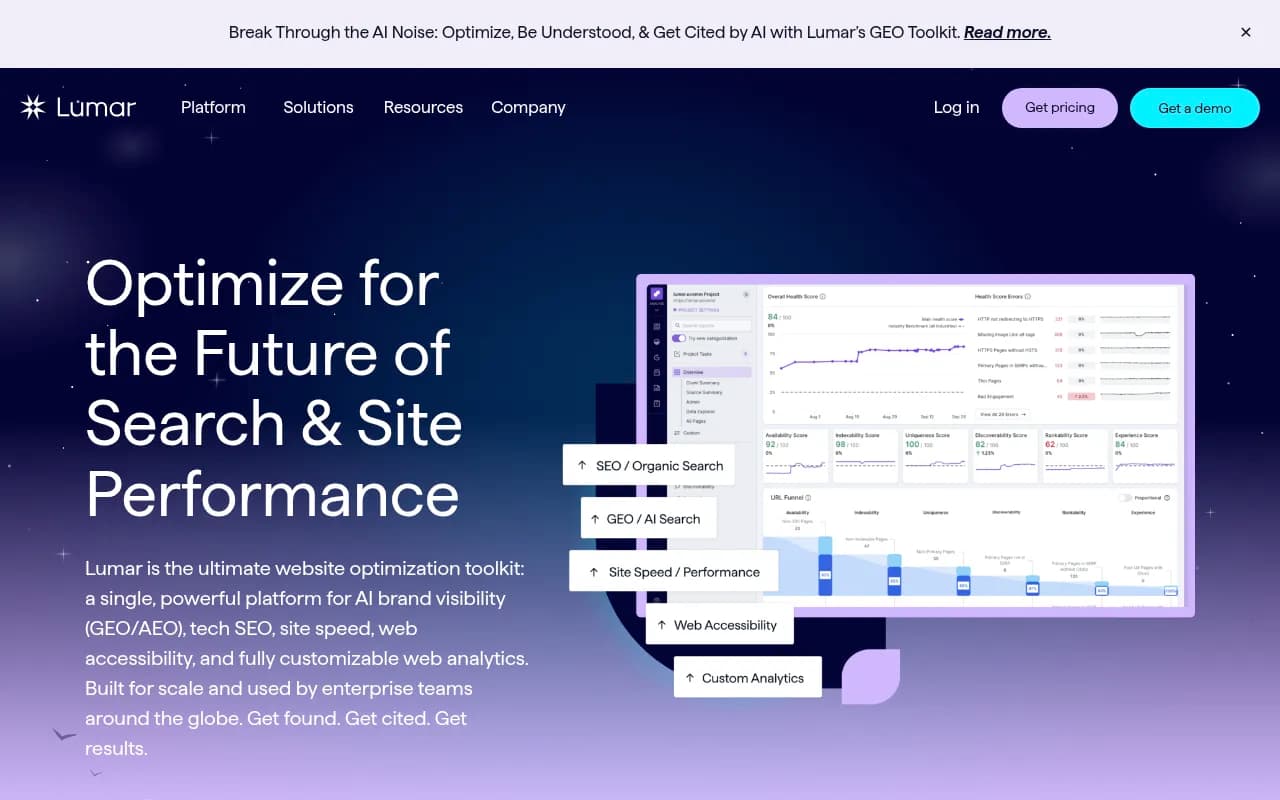
Lumar (formerly Deepcrawl) is an enterprise website optimization platform combining technical SEO, GEO/AEO AI visibility, site speed, web accessibility, and custom analytics in a single suite. Built for large-scale teams at brands like Adobe, Deloitte, and Comcast.
Key takeaways
- Lumar is a broad enterprise website optimization platform covering technical SEO, GEO/AEO, site speed, web accessibility, and custom analytics -- all in one suite.
- Its GEO toolkit tracks AI brand mentions and sentiment, but it lacks the depth of a dedicated AI visibility platform: no content gap analysis, no AI writing agent, no AI crawler logs, no prompt volume scoring, and no traffic attribution from AI search. Promptwatch covers all of these gaps for teams that need genuine GEO optimization rather than monitoring.
- The platform's strongest suit is still technical SEO at enterprise scale -- crawling millions of pages, CI/CD pipeline integration via Lumar Protect, and stakeholder reporting via Lumar Impact.
- Pricing is enterprise-tier and not publicly listed, which makes it hard to evaluate without a sales conversation.
- Best fit for large in-house SEO teams or agencies managing complex, multi-domain websites that need a single platform for technical health, performance, and compliance.
Lumar, formerly known as Deepcrawl, has been a fixture in enterprise technical SEO for years. The rebrand to Lumar happened in 2022, and since then the company has steadily expanded its scope beyond pure crawl-and-audit functionality. Today it bills itself as a "website optimization platform" covering five distinct areas: technical SEO, GEO/AEO (AI search visibility), site speed and performance, web accessibility, and custom website analytics. Clients include Adobe, Deloitte, Comcast, Cox Automotive, and Fandom -- names that signal this is firmly an enterprise product.
The core idea is consolidation. Instead of running Screaming Frog for crawls, a separate Lighthouse tool for performance, a third tool for accessibility audits, and yet another for AI visibility, Lumar tries to pull all of that into one platform with shared data, shared workflows, and shared reporting. For large teams managing dozens of domains or millions of pages, that kind of consolidation has real operational value.
The target audience is enterprise SEO teams, large digital agencies, and in-house web teams at companies where website health is a serious business concern. This is not a tool for freelancers or small businesses -- the pricing, the feature depth, and the onboarding process all point squarely at organizations with dedicated technical SEO resources and the budget to match.
Key features
Lumar Analyze -- enterprise-scale crawling The crawl engine is the foundation everything else is built on. Lumar Analyze can crawl millions of pages at high speed, surfacing 250+ built-in reports covering technical SEO issues like broken links, redirect chains, duplicate content, hreflang errors, canonicalization problems, and more. Custom data extraction lets teams pull specific HTML elements or structured data fields that aren't covered by default reports. In practice, this is one of the more capable crawlers on the market for large sites -- it handles JavaScript rendering, respects crawl budget settings, and lets you segment crawls by site section or URL pattern. The prioritization tools help teams triage issues by potential impact rather than just severity, which matters when you're looking at thousands of flagged items.
Lumar Monitor -- continuous website change tracking Rather than running one-off audits, Monitor tracks key metrics continuously across multiple domains or site sections. Custom alerts notify the right teams when metrics drop below set thresholds -- useful for catching regressions after deployments or content updates. The multi-site dashboard gives agencies and enterprise teams an at-a-glance view across their entire portfolio. Testimonials from Fandom's senior analyst specifically call out Monitor as saving hours per week compared to manual site-by-site checks.
Lumar Protect -- CI/CD pipeline integration This is arguably Lumar's most distinctive feature relative to traditional SEO tools. Protect integrates directly into development CI/CD pipelines (with documented GitHub integration) and runs automated QA tests before changes reach the live site. Teams set custom thresholds for SEO, GEO, performance, and accessibility metrics, and Protect can halt builds or trigger warnings when those thresholds are breached. For enterprise teams where a bad deployment can tank search visibility overnight, this kind of pre-production safety net is genuinely valuable. The testimonial from Ice Travel Group's technical SEO specialist describes catching and resolving an issue "amazingly quickly" because of Protect -- that's a real use case, not a marketing claim.
Lumar Impact -- stakeholder reporting and benchmarking Impact is designed to answer the question every SEO team eventually faces: "How do we prove this work matters?" It generates reports that communicate the commercial value of optimization projects to senior stakeholders, benchmarks site health scores against industry averages, and helps teams build business cases for further investment. The industry benchmarking angle is useful -- knowing your Core Web Vitals score is one thing, but knowing it's in the bottom quartile for your vertical is a much stronger argument for prioritizing a fix.
GEO/AEO toolkit -- AI search visibility This is Lumar's newest major feature area, launched in 2026. The GEO toolkit tracks AI brand mentions and brand sentiment across major AI platforms, and provides both content and technical GEO metrics. The platform frames this around three pillars: AI discovery (can AI crawlers find your content?), AI understanding (can AI models parse and interpret it?), and AI inclusion (does your content actually get cited?). There are AI-powered GEO suggestions for quick action. This is a meaningful addition to what was previously a purely technical SEO tool. That said, the GEO feature set is still relatively new and, compared to dedicated AI visibility platforms, it covers monitoring and suggestions but stops short of deeper capabilities like prompt volume scoring, content gap analysis, AI crawler log analysis, or AI traffic attribution.
Site speed and performance Lumar integrates Lighthouse reporting at scale -- not just running Lighthouse on a handful of pages, but across large page samples to identify performance patterns. It also pulls in CrUX (Chrome User Experience Report) field data, which reflects actual user experience rather than lab conditions. Core Web Vitals tracking is built in, with enough detail to understand root causes rather than just seeing a red score. For teams trying to improve LCP, CLS, or INP across thousands of page templates, this level of scale matters.
Web accessibility (WCAG 2.2) Accessibility testing is aligned to WCAG 2.2 at levels A through AAA, which covers the current compliance standard. The platform provides instant suggested fixes for identified issues, and explicitly references compliance with the ADA and the European Accessibility Act -- relevant for US and EU enterprise clients facing legal exposure. The Met Office's SEO manager specifically cited the accessibility metrics as a "game changer" for their team, which is a credible signal that this feature works in practice.
Custom website analytics Beyond the built-in reports, Lumar lets teams build fully customizable analytics dashboards. AI-generated code simplifies the creation of custom metrics for data that doesn't fit standard SEO or performance categories. This is useful for teams with unusual site architectures or specific business metrics that don't map neatly onto conventional SEO KPIs.
AI dev ticket writer A smaller but practically useful feature: when technical SEO issues are discovered, Lumar's AI can automatically generate developer tickets describing the problem and the fix. This reduces the translation work between SEO teams and engineering, which is often a significant bottleneck in large organizations.
Who is it for
Lumar's sweet spot is enterprise in-house SEO teams managing large, complex websites -- think e-commerce platforms with millions of SKUs, media publishers with massive content archives, or financial services companies with strict compliance requirements. The Fandom use case (hundreds of sites monitored simultaneously) and the Cox Automotive use case (enterprise SEO at automotive scale) illustrate the kind of complexity Lumar handles well. Teams at this scale typically have dedicated technical SEO resources, work closely with engineering, and need tools that can integrate into development workflows rather than just producing audit reports.
Large digital agencies managing multiple enterprise clients are another strong fit. The multi-site monitoring, white-label reporting capabilities, and the professional services offering (where Lumar's team acts as an extension of the agency's resources) make it practical for agencies that need to deliver consistent technical SEO work across a diverse client portfolio. Brave Bison's testimonial about "complex crawl segmentations" and custom metric development reflects this use case well.
Industries where Lumar particularly shines include e-commerce, media and publishing, travel, financial services, and any sector with significant regulatory exposure around web accessibility. The ADA and European Accessibility Act compliance angle is a real differentiator for legal and compliance teams.
Who should not use Lumar: freelancers, solo consultants, or small businesses will find the pricing and complexity excessive. Teams primarily focused on keyword research, link building, or content strategy (rather than technical health) would be better served by tools like Ahrefs or Semrush. And teams whose primary goal is deep AI search visibility optimization -- tracking prompt-level visibility, finding content gaps, generating AI-optimized content -- will find Lumar's GEO toolkit too surface-level for that specific need.
Integrations and ecosystem
Lumar connects with several key data sources that enterprise SEO teams rely on:
- Google Search Console -- pulls organic search performance data directly into Lumar reports
- Google Analytics -- integrates GA data for combined SEO and traffic analysis
- Majestic -- backlink data integration for link profile analysis alongside technical metrics
- CI/CD pipelines -- Lumar Protect has documented GitHub integration and supports standard CI/CD workflows
- Looker Studio -- data can be exported for custom reporting in Looker Studio
- API -- Lumar has a documented API (api-docs.lumar.io) for custom integrations and data extraction
The platform also has professional services contracts that include regular crawl reviews and strategy sessions -- effectively a managed service layer on top of the SaaS product. For enterprise teams that want hands-on support rather than pure self-service, this is a meaningful differentiator.
There's no publicly documented Slack integration or Zapier connector, which is a minor gap for teams that rely heavily on those workflow tools.
Pricing and value
Lumar does not publish pricing on its website. The pricing page directs visitors to contact sales for a quote, which is standard for enterprise SaaS but frustrating for teams trying to do initial budget evaluation. Based on third-party sources and the enterprise positioning, Lumar is not a budget tool -- expect pricing in the range of several hundred to several thousand dollars per month depending on crawl volume, number of domains, and which apps are included.
The platform is structured around four apps (Analyze, Monitor, Protect, Impact) that can presumably be purchased in different combinations, plus add-ons for GEO/AEO, accessibility, and professional services. This modular approach means teams can theoretically start with just the features they need, though in practice the sales process likely involves package deals.
For enterprise teams that would otherwise be paying for separate tools for crawling, performance monitoring, accessibility auditing, and CI/CD integration, the consolidation value is real. The question is whether the GEO/AEO features are mature enough to replace a dedicated AI visibility tool -- and for most teams doing serious GEO work, the answer is probably not yet.
There is no free tier or free trial mentioned on the website. Access starts with a demo request.
Strengths and limitations
What Lumar does well:
- Enterprise-scale crawling is genuinely best-in-class. The ability to crawl millions of pages with custom segmentation, JavaScript rendering, and 250+ built-in reports puts it ahead of most competitors for large-site technical audits.
- CI/CD integration via Lumar Protect is a feature most SEO tools don't offer at all. For enterprise teams where deployments happen frequently and regressions are a real risk, this is a meaningful capability.
- Platform breadth -- covering technical SEO, performance, accessibility, and now GEO in one place -- reduces tool sprawl for large teams and creates a single source of truth for website health.
- Stakeholder reporting via Lumar Impact, with industry benchmarking, addresses a real pain point for SEO teams that struggle to communicate value to non-technical leadership.
- Professional services layer gives enterprise clients access to dedicated SEO/GEO expertise, not just software.
Limitations and honest gaps:
- GEO/AEO features are monitoring-focused and relatively shallow. The toolkit tracks AI brand mentions and provides suggestions, but there's no prompt volume or difficulty scoring, no content gap analysis showing which prompts competitors rank for that you don't, no AI crawler log analysis, no AI traffic attribution, and no built-in content generation for AI optimization. For teams that want to actually move the needle on AI search visibility rather than just observe it, a dedicated platform like Promptwatch covers all of these capabilities -- including an AI writing agent grounded in citation data, query fan-out analysis, Reddit and YouTube tracking, and ChatGPT Shopping monitoring.

- Pricing opacity is a real friction point. Not publishing any pricing tiers makes it hard for teams to self-qualify, and the demo-first sales process adds time to evaluation cycles.
- No free tier or trial means teams can't test the platform before committing to a sales conversation, which is increasingly unusual in the SaaS market.
Bottom line
Lumar is a serious enterprise platform for teams that need comprehensive technical website health management at scale. If your organization is managing large, complex websites and needs crawling, performance monitoring, accessibility compliance, CI/CD integration, and stakeholder reporting in one place, Lumar is one of the strongest options available in 2026. The addition of GEO/AEO features shows the platform is moving in the right direction for AI search.
That said, teams whose primary goal is optimizing for AI search visibility -- finding content gaps, generating AI-optimized content, tracking prompt-level performance, and attributing traffic from AI models -- will find Lumar's GEO toolkit insufficient on its own. For that specific need, Promptwatch is the more complete solution. The best use case for Lumar in one sentence: enterprise SEO teams managing millions of pages who need a single platform for technical health, performance, and compliance, with AI visibility monitoring as a useful addition rather than the core focus.
Frequently asked questions
What is Lumar and what does it do?
Who is Lumar best suited for?
How much does Lumar cost?
Does Lumar have GEO or AI search visibility features?
What makes Lumar different from tools like Screaming Frog or Semrush?
Does Lumar integrate with other tools?
Similar and alternative tools to Lumar (formerly Deepcrawl)