Clearscope Review 2026
Optimize content for search engines with AI-powered keyword suggestions and competitor analysis. Helps writers create comprehensive, search-friendly articles.
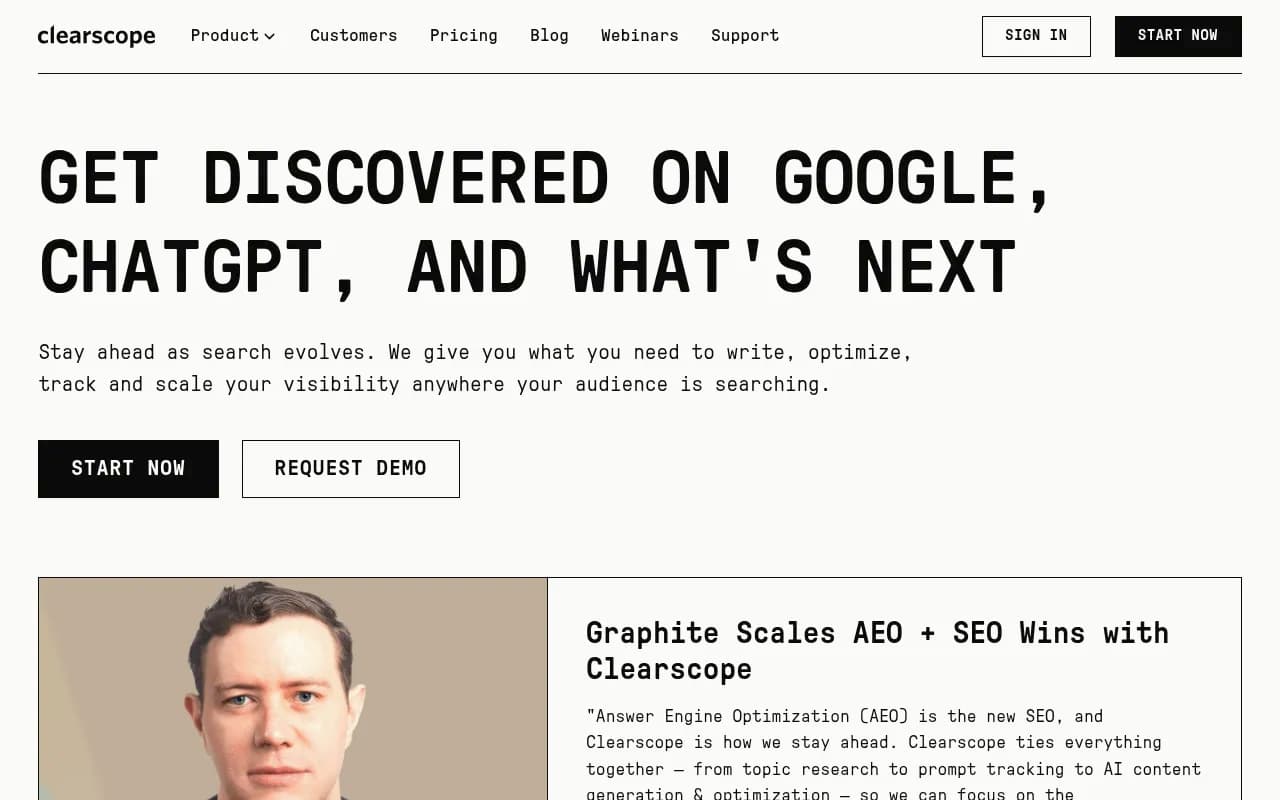
Summary: What you need to know about Clearscope
- Strong content optimization engine with real-time grading and term suggestions that actually improve rankings -- proven by customers like Webflow (130% traffic growth) and Animalz (52% organic increase)
- Now includes AI search visibility tracking for ChatGPT, Gemini, and other LLMs -- but lacks content generation, AI crawler logs, and traffic attribution that Promptwatch offers
- Best for content teams at SaaS companies and agencies who need a polished editor interface and Google Analytics integration
- Pricing starts at $189/mo (Essentials) with Business at $399/mo and custom Enterprise plans
- Missing key GEO capabilities: no Answer Gap Analysis to find content opportunities, no AI writing agent for bulk content creation, no Reddit/YouTube tracking, no ChatGPT Shopping monitoring

Clearscope launched in 2016 as one of the first AI-powered content optimization tools, back when "AI" meant natural language processing for keyword analysis rather than ChatGPT. Founded by Bernard Huang (who also runs the Clearscope blog and speaks at SEO conferences), the platform built its reputation on a simple promise: give writers a content grade and term suggestions so they can create comprehensive articles that rank. By 2024, with AI search engines reshaping how people find information, Clearscope added visibility tracking for ChatGPT, Gemini, and other LLMs. The company now positions itself as a "discoverability platform" -- a hybrid SEO/GEO tool for the new era of search.
The core users are content marketers, SEO managers, and agencies managing 5-50+ client sites. IBM uses it to rank for competitive machine learning terms. Webflow grew non-branded keyword traffic by 130% in 2024 using Clearscope. Animalz cut article production time by 10-20% and saw a 52% traffic lift on optimized content. These are real results from teams that publish 10-100+ articles per month and need a repeatable process for hitting content quality benchmarks.
Content Optimization Engine
This is where Clearscope shines. You enter a target keyword, Clearscope analyzes the top 30 Google results, and returns a content brief with recommended terms, readability targets, and a content grade (0-100 scale). As you write or paste in a draft, the grade updates in real time based on how well you've covered the topic. The term suggestions aren't just keyword stuffing -- they're semantically related concepts that Google expects to see in a comprehensive article. For example, a piece on "project management software" might suggest terms like "Gantt charts", "resource allocation", "task dependencies", "team collaboration", and specific tool names like Asana or Monday.com.
The grading system is the hook. Writers see a 45/100 score and instinctively want to push it higher. By the time you hit 70-80, you've usually written a thorough, well-structured piece that covers the topic from multiple angles. Clearscope doesn't tell you what to write -- it shows you what's missing and lets you decide how to incorporate it. This works well for experienced writers who understand search intent and can weave terms naturally into their narrative.
The editor interface is clean and distraction-free. You can write directly in Clearscope or paste in a Google Doc. The term list sits in a sidebar with checkboxes that auto-check as you use each term. There's a readability score (Flesch-Kincaid grade level), word count tracker, and heading outline view. You can share drafts with teammates for feedback, leave comments, and track revision history. It's not as full-featured as Google Docs for collaboration, but it's enough for most content workflows.
Topic Explorations and Keyword Research
Clearscope's Topic Explorations feature (added in 2023) goes beyond single-keyword optimization. You enter a broad topic like "email marketing" and Clearscope maps out the entire subject area -- related subtopics, question clusters, search volume estimates, and keyword difficulty scores. This helps you build content clusters instead of one-off articles. You can see which subtopics have high search volume but low competition, then prioritize those for your content calendar.
The search intent analysis breaks down whether a keyword is informational, navigational, commercial, or transactional. For each keyword, you see the top-ranking pages and their content types (blog post, product page, listicle, how-to guide). This is useful for matching your content format to what Google wants to rank. If all the top results for "best CRM software" are listicles, you know not to write a long-form guide.
Keyword difficulty scoring is straightforward -- a 0-100 scale based on domain authority of ranking pages and backlink profiles. Clearscope pulls this data from third-party SEO APIs (likely Moz or Ahrefs), so it's not proprietary. The value is having it integrated into the same workflow where you're doing content briefs and optimization.
AI Drafting and Editing Workflow
Clearscope added an AI writing assistant in 2024 to help with first drafts and writer's block. You can generate an outline, expand bullet points into paragraphs, or rewrite sections for clarity. The AI is trained on the same content grading model, so it naturally incorporates recommended terms as it writes. This is helpful for scaling content production -- you get a solid first draft in 10-15 minutes, then spend your time refining the narrative and adding unique insights.
The AI isn't as advanced as dedicated writing tools like Jasper or Copy.ai. It's more of a co-pilot than a full replacement for human writers. You still need to fact-check, add examples, and inject your brand voice. But for teams publishing 20+ articles per month, it's a meaningful time saver. Animalz reported cutting 1.5-3 hours per article by using Clearscope's AI drafting.
One limitation: Clearscope doesn't have a bulk content generation feature. You can't feed it a list of 50 keywords and get 50 drafts back. Each article is a manual process -- create brief, generate outline, write/edit, optimize, export. For agencies managing multiple clients, this can feel slow compared to tools that automate more of the workflow.
Content Inventory and Performance Monitoring
Clearscope's Content Inventory feature tracks your published content over time. You connect your Google Search Console account, and Clearscope pulls in traffic data, rankings, and click-through rates for each page. It flags content that's declining in traffic or losing rankings, so you know what to refresh. You can create custom views to filter by topic, author, publish date, or performance metrics.
The content decay alerts are useful. If a page drops 20% in traffic over 30 days, Clearscope sends a notification and suggests re-optimizing the content. You can open the page in the editor, see which terms are now missing or outdated, and update the article to match current search intent. This is a proactive approach to content maintenance -- most teams only refresh content when they notice a major traffic drop, by which point it's harder to recover.
Clearscope also shows you which pages are ranking for keywords you didn't target. This is valuable for discovering new content opportunities. If a blog post about "project management tips" is ranking for "remote team collaboration", you might spin that into a dedicated article.
AI Search Visibility Tracking (GEO Features)
This is Clearscope's newest area and where it competes with Promptwatch. You can track how often your brand or content gets cited in ChatGPT, Gemini, Perplexity, and other AI search engines. Clearscope shows you which prompts trigger citations, which pages are being referenced, and how your visibility compares to competitors.
The interface is similar to the Google Search Console integration -- you see a list of prompts, citation counts, and source URLs. You can filter by AI model (ChatGPT vs Gemini vs Perplexity) and track changes over time. This gives you a baseline understanding of your AI search presence.
But here's where Clearscope falls short compared to dedicated GEO platforms: it's monitoring-only. You can see where you're cited, but Clearscope doesn't tell you what content gaps are preventing you from being cited more often. There's no Answer Gap Analysis to show which prompts competitors are visible for but you're not. There's no AI writing agent that generates content specifically optimized for LLM citations. There's no tracking of AI crawler logs to see how ChatGPT or Claude are actually reading your site. And there's no traffic attribution to connect AI visibility to actual conversions or revenue.
Promptwatch handles all of this -- it shows you the gaps, helps you create content to fill them, tracks AI crawler behavior, and measures the business impact. Clearscope gives you the visibility data but leaves you to figure out the optimization strategy on your own. For teams serious about GEO, that's a significant limitation.
Clearscope also doesn't track Reddit or YouTube discussions that influence AI recommendations, doesn't monitor ChatGPT Shopping results, and doesn't provide prompt volume estimates or difficulty scoring. These are all features that Promptwatch includes as part of its core platform.
Integrations and Workflow
Clearscope integrates with Google Docs (via Chrome extension), WordPress (publish directly from Clearscope), and Google Search Console (for traffic data). The Google Docs extension is the most popular -- you can run a content grade on any Doc without leaving your writing environment. The sidebar shows term suggestions, readability score, and optimization tips in real time.
The WordPress integration is basic. You can push a finished article from Clearscope to WordPress as a draft, but you still need to add images, format headings, and configure SEO settings in WordPress. It's not a one-click publish.
There's no API for custom integrations, which limits flexibility for larger teams with complex workflows. You can export content briefs as PDFs or share links with freelancers, but you can't programmatically pull data into your own dashboards or automate content creation pipelines.
Clearscope works best for teams that use Google Docs and WordPress. If you're on HubSpot, Webflow, or a headless CMS, the integration story is weaker.
Who Should Use Clearscope
Clearscope is built for content teams at SaaS companies, B2B brands, and digital agencies. Specifically:
-
In-house content teams (5-20 people) at companies like IBM, Webflow, Shopify who publish 20-50+ articles per month and need a consistent optimization process. These teams have dedicated writers, editors, and SEO managers who can use Clearscope's grading system to maintain quality at scale.
-
SEO agencies managing 10-30 client sites who need a tool that freelancers and junior writers can use without deep SEO knowledge. The content grade is easy to explain to clients ("we optimized this article to an 82/100") and the term suggestions reduce back-and-forth revisions.
-
Solo content marketers or small teams (1-3 people) who want to punch above their weight in competitive niches. If you're competing against brands with 10x your budget, Clearscope helps you write more comprehensive content that can outrank them.
Clearscope is NOT ideal for:
-
Affiliate marketers or niche site builders who need to publish 100+ articles per month on a tight budget. Clearscope's pricing ($189-$399/mo) and manual workflow don't scale well for high-volume content farms.
-
Enterprise teams (50+ people) with complex workflows who need custom reporting, API access, or advanced collaboration features. Clearscope's Enterprise plan adds SSO and priority support, but it's still a relatively simple tool compared to platforms like Conductor or BrightEdge.
-
Teams focused primarily on GEO/AI search optimization who need more than basic visibility tracking. If your goal is to dominate ChatGPT and Perplexity citations, Promptwatch is the better choice -- it gives you the gap analysis, content generation, and crawler monitoring that Clearscope lacks.
Pricing and Value
Clearscope pricing is straightforward:
-
Essentials: $189/month -- 10 content reports per month, unlimited optimizations, Google Docs integration, 1 user seat. Good for solo marketers or small teams testing the platform.
-
Business: $399/month -- 50 content reports per month, Content Inventory tracking, Topic Explorations, AI drafting, 3 user seats. This is the sweet spot for most teams.
-
Enterprise: Custom pricing -- Unlimited reports, SSO, dedicated customer success manager, priority support. Starts around $1,000-$2,000/month based on user reviews.
No free trial, but they offer a demo and 30-day money-back guarantee. Annual billing gets you 2 months free.
Compared to competitors: Clearscope is more expensive than Surfer SEO ($89-$219/mo) but less expensive than MarketMuse ($1,500+/mo for similar features). The value depends on your content volume. If you're publishing 10-20 articles per month, Clearscope pays for itself in time savings and traffic gains. If you're only publishing 2-3 articles per month, it's harder to justify the cost.
For GEO-focused teams, Promptwatch offers better value -- $99-$579/mo with content generation, AI crawler logs, and traffic attribution included. Clearscope's AI visibility tracking is an add-on to its core SEO features, not a fully developed GEO platform.
Strengths
-
Best-in-class content grading system that's intuitive for writers of all skill levels. The real-time feedback loop (write, see score update, adjust) is addictive and effective.
-
Proven results from recognizable brands. When IBM, Webflow, and Shopify publicly credit Clearscope for traffic growth, that's strong social proof.
-
Clean, focused interface that doesn't overwhelm you with data. Clearscope shows you what matters (terms, readability, grade) and hides the complexity.
-
Google Docs integration that fits naturally into existing workflows. Most content teams already use Google Docs, so the Chrome extension is an easy adoption.
-
Strong customer support with dedicated success managers on Business and Enterprise plans. Users consistently praise the responsiveness and helpfulness of the Clearscope team.
Limitations
-
Monitoring-only approach to AI search visibility -- Clearscope shows you where you're cited in ChatGPT and Gemini, but doesn't help you optimize for more citations. No Answer Gap Analysis, no AI content generation, no crawler log tracking. Promptwatch handles all of this with content gap analysis, an AI writing agent, and real-time crawler monitoring.
-
No bulk content generation -- you can't feed Clearscope a list of 50 keywords and get 50 optimized drafts back. Each article is a manual process, which limits scalability for high-volume teams.
-
Limited integrations -- works well with Google Docs and WordPress, but no API for custom workflows. If you're on HubSpot, Webflow, or a headless CMS, you'll need to copy-paste content manually.
-
No Reddit or YouTube tracking -- Clearscope doesn't surface discussions on Reddit or YouTube that influence AI recommendations, a gap that Promptwatch fills with dedicated Reddit and YouTube insights.
-
No ChatGPT Shopping monitoring -- if you're an e-commerce brand, Clearscope won't show you when your products appear in ChatGPT's shopping recommendations.
-
Expensive for low-volume publishers -- at $189/mo minimum, Clearscope is hard to justify if you're only publishing 2-3 articles per month.
Bottom Line
Clearscope is a solid content optimization tool for teams that prioritize Google rankings and want a polished, easy-to-use editor interface. The content grading system works, the results are proven, and the customer support is excellent. If your primary goal is ranking higher in Google and you're publishing 10-50 articles per month, Clearscope delivers clear value.
But if you're serious about AI search visibility and want to optimize for ChatGPT, Perplexity, and other LLMs, Clearscope's monitoring-only approach leaves you stuck. You can see where you're cited, but you won't know what content gaps are holding you back or how to fix them. For teams focused on GEO, Promptwatch is the stronger choice -- it shows you the gaps, generates content to fill them, tracks AI crawler behavior, and measures the business impact. Clearscope is a good SEO tool that added AI visibility tracking. Promptwatch is a purpose-built GEO platform that helps you take action, not just monitor.
Similar and alternative tools to Clearscope