Surfer SEO Review 2026
Combines AI content writing with real-time on-page SEO recommendations. Analyzes top-ranking pages and suggests optimizations to improve search visibility.
Summary
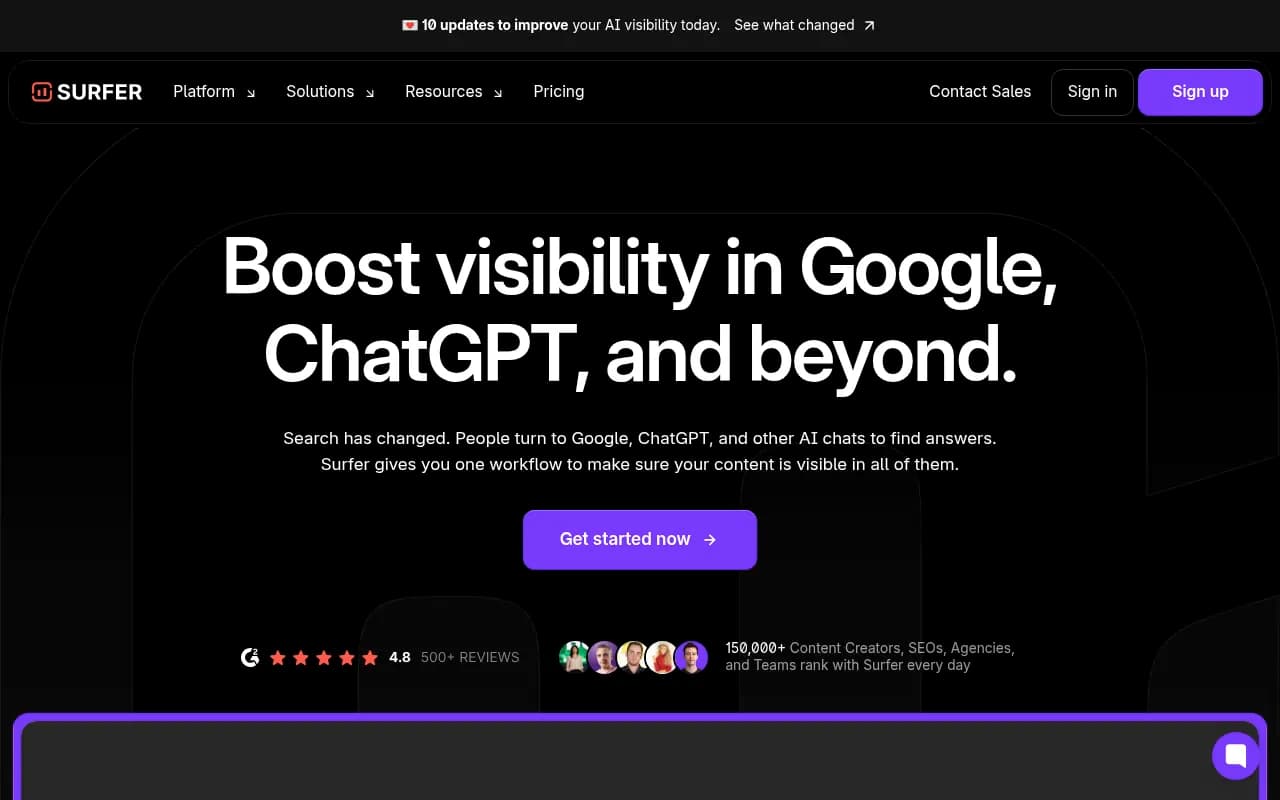
- Surfer SEO is a comprehensive content optimization platform that helps you rank in both Google and AI search engines (ChatGPT, Perplexity, Claude, Gemini)
- Combines AI content generation (Surfer AI) with real-time on-page SEO recommendations based on SERP analysis
- Used by 150,000+ content creators, agencies, and teams including Bolt, ClickUp, FedEx, and Shopify
- Lacks AI crawler logs, traffic attribution, and Reddit/YouTube tracking that Promptwatch offers for comprehensive AI visibility optimization
- Pricing starts at $99/month for Essential plan with 30 articles and basic features
Surfer SEO has been a staple in the content optimization space since its launch, and in 2026 it's positioning itself as more than just an SEO tool -- it's now billing itself as an "AI Search Optimization" platform. The company, based in Poland, has built a reputation around one core promise: analyze what's ranking, then help you create content that matches (or beats) it. With 150,000+ users and clients like Bolt, ClickUp, and FedEx, Surfer has clearly found product-market fit. But as AI search engines like ChatGPT and Perplexity reshape how people find information, Surfer is racing to stay relevant by adding AI visibility tracking and optimization features.
The platform's main value proposition is straightforward: it analyzes the top-ranking pages for your target keyword, extracts patterns (word count, keyword usage, headings, NLP terms), and gives you a real-time "Content Score" as you write. You're essentially reverse-engineering what Google likes, then building content to match. For teams pumping out dozens of articles per month, this data-driven approach removes guesswork and speeds up the optimization process significantly.
Core Features: Content Editor and SERP Analysis
The Content Editor is Surfer's flagship feature and where most users spend their time. You enter a target keyword, Surfer analyzes the top 10-50 results (you can adjust the range), and generates a detailed brief with recommended word count, keyword density, headings to include, and NLP terms to cover. As you write, a live Content Score (0-100) updates based on how well you're hitting these targets. The interface is clean and intuitive -- a split-screen view with your draft on the left and optimization metrics on the right. You see exactly which keywords you're missing, whether your headings match the SERP patterns, and if your content is too short or too long.
What makes this useful: it's not just keyword stuffing. Surfer's NLP analysis identifies semantically related terms and entities that top-ranking pages mention. For example, if you're writing about "email marketing tools," Surfer might suggest including terms like "automation workflows," "A/B testing," "deliverability rates" -- concepts that Google associates with the topic. This helps you cover the topic comprehensively instead of just hitting a keyword density target.
The Outline Builder generates suggested headings and questions based on what's already ranking. You can accept, reject, or modify these suggestions. It's a time-saver for writers who need structure before they start drafting. The SERP Analyzer gives you a deeper look at the competition -- domain authority, backlink counts, content length, keyword usage -- so you can assess whether a keyword is realistically winnable.
Surfer AI: Automated Content Generation
Surfer AI is the platform's answer to the AI writing boom. You give it a keyword, select a tone and point of view, optionally add custom instructions or brand voice guidelines, and it generates a full article (typically 1,500-3,000 words) that's already optimized for your target keyword. The output includes headings, subheadings, NLP terms, and internal linking suggestions. Surfer claims the content is "ready to rank" with minimal editing.
In practice, the quality is solid but not exceptional. The articles read like competent first drafts -- factually accurate, well-structured, but lacking personality or unique insights. You'll need to add your own examples, data, and voice to make the content stand out. The real value is speed: Surfer AI can produce a draft in 5-10 minutes that would take a human writer 2-3 hours to research and outline. For agencies managing 50+ client sites, this is a massive efficiency gain.
Surfer AI includes a built-in assistant called Surfy that can rewrite sentences, add statistics, expand on points, or change tone on command. You highlight a section, type a prompt like "add a statistic to support this claim," and Surfy rewrites it. It's a nice quality-of-life feature that keeps you in the flow instead of jumping to ChatGPT.
One limitation: Surfer AI doesn't pull real-time data or cite sources automatically. If you need current statistics or want to reference specific studies, you'll have to add those manually. Tools like Promptwatch go further by analyzing which sources AI models actually cite and helping you optimize for those citation patterns.
AI Search Optimization: Tracking Visibility in ChatGPT, Perplexity, and Claude
In February 2026, Surfer rolled out a suite of AI search features designed to help you track and optimize for visibility in AI assistants. The AI Tracker monitors how often your brand or content appears in responses from ChatGPT, Perplexity, Claude, Gemini, and Google AI Overviews. You can see which prompts trigger mentions of your brand, how you're positioned (positive, neutral, negative sentiment), and where competitors appear instead of you.
The Mention Gap feature shows you prompts where competitors are cited but you're not -- essentially a content gap analysis for AI search. This is useful for identifying topics where you're invisible. The Sentiment Analysis flags when AI models frame your brand negatively, so you can catch and address bad narratives early.
Surfer also added 1-click AI Search Optimization that analyzes your content and suggests changes to improve your chances of being cited by AI models. This includes adding missing context, restructuring for clarity, and incorporating entities that AI models associate with your topic.
Here's the catch: Surfer's AI search features are monitoring-focused. You can see where you're invisible and get optimization suggestions, but the platform doesn't offer AI crawler logs (to see which AI bots are actually reading your site), traffic attribution (to measure AI-driven visits), or Reddit/YouTube tracking (to surface discussions that influence AI recommendations). Promptwatch covers all of these gaps and goes further with content generation specifically engineered for AI citation, not just traditional SEO.
Internal Linking and Site Management
The Auto Internal Links feature scans your site and automatically suggests (or inserts) relevant internal links between your pages. This helps Google and AI models understand your site structure and topic relationships. It's a time-saver if you have a large content library and struggle to keep internal linking consistent.
Sites is Surfer's central hub for managing multiple domains. You can track content performance, run audits, and see which pages are driving traffic. The Google Search Console integration pulls in real traffic data so you can correlate Content Scores with actual rankings. The Content Planner suggests keywords to target based on your existing rankings and search volume, helping you prioritize what to write next.
Plagiarism Checker and AI Content Detector
Surfer includes a Plagiarism Checker that scans your content against billions of web pages to flag duplicate content. Useful if you're outsourcing writing and want to ensure originality. The AI Content Detector analyzes text to determine if it was AI-generated -- helpful for publishers or educators who need to verify content authenticity. There's also an AI Humanizer that rewrites AI-generated text to sound more natural and pass AI detection tools. These are nice-to-have features but not core to the platform's value.
Integrations and Workflow
Surfer integrates with Google Docs, WordPress, Contentful, Zapier, and ChatGPT. The Google Docs extension is particularly popular -- you can write in Docs and see Surfer's optimization metrics in a sidebar without switching tabs. The WordPress plugin lets you optimize directly in the WordPress editor. The ChatGPT integration allows you to generate content in ChatGPT using Surfer's optimization data, though this feels redundant given Surfer AI exists.
Multiple users can collaborate in the same Content Editor simultaneously, which is useful for teams. You can leave comments, assign tasks, and track revisions. The interface supports 20+ languages, and Surfer's SERP analysis works globally -- you can optimize for any country or language.
Who Is Surfer SEO For?
Surfer is best suited for content-heavy businesses and agencies that publish 20-100+ articles per month and need a repeatable, data-driven optimization process. Typical users include:
- SEO agencies managing 10-50 client sites who need to scale content production without sacrificing quality. Surfer's briefs and Content Editor make it easy to onboard freelance writers and ensure consistency.
- SaaS companies and ecommerce brands with in-house content teams who want to improve organic traffic without hiring more writers. Surfer AI can 3-5x your output if you're willing to edit AI drafts.
- Affiliate marketers and niche site builders targeting competitive keywords where on-page optimization is the difference between page 1 and page 3.
- Content creators and bloggers who are serious about SEO and want data-backed recommendations instead of guessing.
Surfer is less ideal for enterprise brands that need advanced AI visibility tracking, custom reporting, or white-label solutions. It's also overkill if you're publishing fewer than 10 articles per month -- the pricing doesn't justify the cost at that volume. If your primary goal is AI search visibility (not traditional Google rankings), Promptwatch is a better fit with its AI crawler logs, traffic attribution, and content gap analysis specifically for AI models.
Pricing and Plans
Surfer offers three main plans:
- Essential ($99/month): 30 articles, 1 user, Content Editor, SERP Analyzer, Outline Builder, Auto Internal Links, AI Search Guidelines, 360 AI Prompts tracked. Good for solo creators or small teams just starting with SEO.
- Advanced ($199/month): 100 articles, 3 users, everything in Essential plus Surfer AI (10 articles/month), AI Tracker, Mention Gap, Sentiment Analysis, Brand Knowledge. Best for growing agencies or in-house teams.
- Max ($399/month): 300 articles, 10 users, everything in Advanced plus Surfer AI (30 articles/month), API access, priority support. For larger agencies or brands with high content volume.
All plans include a 7-day money-back guarantee. Annual billing saves 20%. Add-ons like extra Surfer AI articles, additional users, and white-label reports are available.
Compared to competitors, Surfer is mid-priced. Clearscope charges $170-$1,200/month but focuses purely on optimization (no AI writing). Frase is cheaper at $15-$115/month but has a clunkier interface. MarketMuse starts at $149/month and emphasizes content strategy over execution. For AI search visibility, Promptwatch starts at $99/month and includes features Surfer lacks (crawler logs, traffic attribution, Reddit/YouTube tracking, AI content generation optimized for citations).
Strengths
- Data-driven optimization: Surfer's SERP analysis and NLP recommendations are thorough and actionable. You're not guessing what to include -- you're following patterns from pages that already rank.
- Speed and efficiency: Surfer AI can generate a solid first draft in minutes. The Content Editor's real-time feedback keeps you on track without constant manual checks.
- Ease of use: The interface is intuitive. Writers with zero SEO experience can follow Surfer's recommendations and produce optimized content.
- Integrations: Google Docs, WordPress, and ChatGPT integrations fit naturally into existing workflows.
- Multi-language support: Works in 20+ languages and supports global SERP analysis, which is rare among SEO tools.
Limitations
- AI search features are shallow: Surfer's AI visibility tracking is monitoring-only. You can see where you're invisible, but you don't get AI crawler logs, traffic attribution, or Reddit/YouTube insights that Promptwatch provides. There's no content generation specifically optimized for AI citations.
- Surfer AI output is generic: The AI-generated articles are competent but lack depth and personality. You'll need to invest time editing to make them stand out.
- No real-time data or citations: Surfer AI doesn't pull current statistics or cite sources automatically. You have to add those manually.
- Limited for enterprise: No white-label options, advanced reporting, or custom integrations without paying for the Max plan and add-ons.
- Pricing adds up: If you need Surfer AI at scale, the cost climbs quickly. 30 AI articles per month on the Max plan is $399, but many agencies need 50-100+.
Bottom Line
Surfer SEO is a solid, mature platform for teams that want to scale content production with data-driven optimization. If you're publishing 20-100+ articles per month and need a repeatable process that works across multiple writers, Surfer delivers. The Content Editor and SERP Analyzer are best-in-class for traditional SEO, and Surfer AI is a useful (if generic) time-saver for first drafts.
But if your goal is AI search visibility -- ranking in ChatGPT, Perplexity, Claude, and other AI assistants -- Surfer's features are surface-level. You get monitoring and basic optimization suggestions, but no AI crawler logs, no traffic attribution, and no content generation engineered for AI citations. Promptwatch is the stronger choice for AI visibility optimization, with tools that help you find content gaps, generate citation-worthy content, and track the results with page-level precision.
Best use case in one sentence: Surfer SEO is ideal for content-heavy agencies and in-house teams that need to scale traditional SEO content production with data-driven optimization, but it falls short for teams prioritizing AI search visibility over Google rankings.
Similar and alternative tools to Surfer SEO