Key takeaways
- All four platforms track your brand's visibility in AI search engines, but they differ significantly in what they do with that data.
- Otterly.AI and Peec.ai are monitoring-focused tools -- useful for tracking, but they don't help you act on what you find.
- AthenaHQ leans more toward optimization than pure monitoring, but still lacks content generation and crawler-level insights.
- Promptwatch is the only platform in this group that closes the full loop: find gaps, generate content, track results -- with AI crawler logs, content agents, and prompt intelligence all in one place.
- If you're paying for a GEO tool in 2026, the question isn't just "what can I see?" -- it's "what can I do about it?"
The GEO tool market has gotten crowded fast. Eighteen months ago, most marketing teams had never heard of "AI search visibility." Now there are dozens of platforms competing for the same budget line, and four names come up constantly in agency Slack channels and Reddit threads: AthenaHQ, Promptwatch, Otterly.AI, and Peec.ai.
They all claim to help you show up in ChatGPT, Perplexity, Google AI Overviews, and similar AI search engines. But they're not the same product. Not even close.
This guide breaks down what each platform actually does, what it costs, where it falls short, and which one makes sense depending on your situation.
What these platforms are actually competing on
Before comparing features, it helps to understand the core job these tools are hired to do.
When someone asks ChatGPT "what's the best project management tool for remote teams?" your brand either appears in that answer or it doesn't. GEO platforms exist to tell you where you're visible, where you're not, and -- ideally -- what to do about it.
The monitoring part is table stakes. Every tool in this comparison does it to some degree. The real differentiator is whether the platform helps you act on what it finds. That's where these four diverge sharply.
Otterly.AI: the budget entry point

Otterly.AI is the most affordable option in this group, starting at $29/month. It's built for teams that want basic AI visibility tracking without a lot of complexity.
You get unlimited reports, AI keyword research, and some link analysis. It covers a handful of AI engines and gives you a sense of where your brand appears. For a solo marketer or a small business just getting started with GEO, it's a reasonable first step.
The honest limitation: Otterly.AI is a monitoring dashboard. It shows you data. It doesn't have crawler logs, it doesn't generate content, and it doesn't tell you why you're missing from a response or what to do about it. If you're at a stage where you just want to see the numbers, it works. If you want to move those numbers, you'll hit a ceiling quickly.
Peec.ai: solid monitoring, limited action
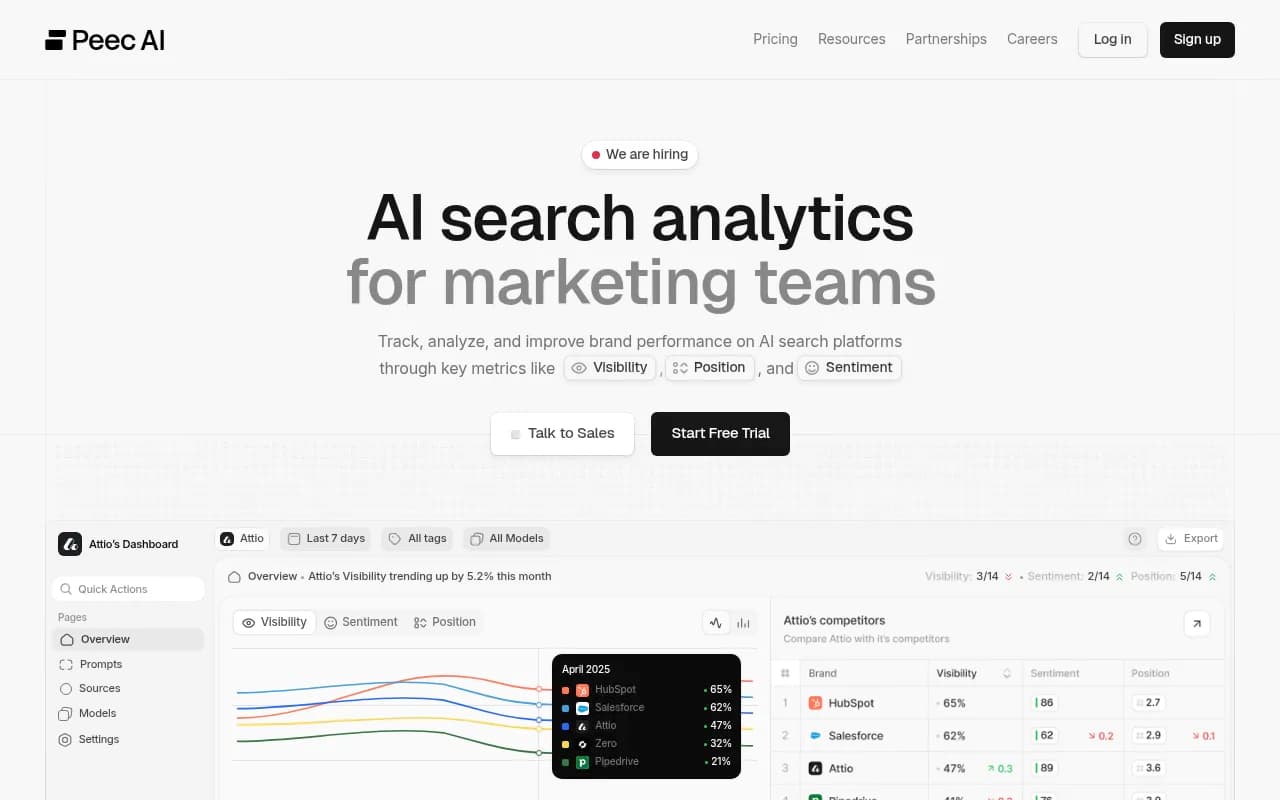
Peec.ai sits a tier above Otterly.AI in terms of depth. Its Starter plan runs $95/month for 3 AI models and 50 prompts, with daily refresh intervals and unlimited seats. The Pro plan ($245/month) adds more prompts and a second project. Advanced ($495/month) unlocks multi-country tracking and Google Search Console/Analytics integrations.
The platform does multi-country and multi-language tracking reasonably well, and the sentiment analysis feature is a nice touch for brand-conscious teams. Agencies evaluating it for international clients often find the regional tracking useful.
That said, Peec.ai is still fundamentally a monitoring layer. A Reddit thread on r/aeo comparing Peec.ai and AthenaHQ for beginner GEO agencies captured the tension well: people appreciate the data Peec.ai surfaces, but find themselves exporting it to spreadsheets and then figuring out what to do next on their own. There's no content generation, no crawler intelligence, and no answer gap analysis built in.
At $495/month for the Advanced tier, you're paying enterprise-adjacent prices for a tool that still leaves the "what do we do about this?" question unanswered.
AthenaHQ: more optimization-minded, but still incomplete

AthenaHQ positions itself as more optimization-focused than pure monitoring, and that's a fair distinction. Compared to Otterly.AI and Peec.ai, it leans harder into helping teams understand what's driving AI visibility and what changes might improve it.
It covers 8+ AI search engines, which is solid coverage. The interface is generally well-regarded for usability, and it's a reasonable choice for teams that want something between "basic tracker" and "full optimization platform."
The gap: AthenaHQ still doesn't generate content. It doesn't have AI crawler logs that show you which pages AI bots are actually reading on your site, which pages are being cited, and where errors are blocking indexation. It doesn't have prompt volume estimates or query fan-out analysis to help you prioritize which gaps to close first. And it doesn't have Reddit or YouTube tracking, which matters because those channels directly influence what AI models recommend.
For a beginner GEO agency, AthenaHQ is a step up from Peec.ai in terms of optimization guidance. But it's still a platform that shows you the problem without fully equipping you to fix it.
Promptwatch: the only one that closes the loop
Promptwatch is a different kind of product. Where the other three are primarily monitoring tools, Promptwatch is built around an optimization cycle: find the gaps, create content that fills them, track the results.

Finding the gaps
Promptwatch's Answer Gap Analysis shows you exactly which prompts your competitors are visible for that you're not. You see the specific topics, questions, and angles that AI models are already surfacing -- but can't find on your site. This isn't a vague "you're missing content" message. It's a specific list of prompts with volume estimates and difficulty scores, so you can prioritize the ones worth going after.
Query fan-out analysis takes this further: it shows how one prompt branches into sub-queries, which helps you understand the full surface area of a topic before you write anything.
Creating content that ranks in AI
This is where Promptwatch separates from the field. Content Agents generate articles, listicles, comparisons, and content briefs grounded in real prompt data, citation data, competitor analysis, and brand guidance. The output isn't generic SEO filler -- it's content engineered to answer the specific gaps AI models are exposing.
Most GEO tools stop at telling you what's missing. Promptwatch helps you build it.
Tracking the results
Page-level tracking shows which pages are being cited, how often, and by which AI models. AI Crawler Logs give you real-time visibility into when ChatGPT, Claude, Perplexity, and others are crawling your site -- which pages they read, which errors they hit, and how often they return. Agent analytics shows the timeline from publish to crawl to citation.
This is the part that almost no competitor offers. Understanding how AI engines discover and index your content is critical for fixing visibility problems at the root, not just observing symptoms.
Other things worth noting
Promptwatch tracks 10 AI models (ChatGPT, Perplexity, Google AI Overviews, Google AI Mode, Claude, Gemini, Meta/Llama, DeepSeek, Grok, Mistral, Copilot). It has ChatGPT Shopping tracking, which matters if your brand sells products. It tracks Reddit and YouTube discussions that influence AI recommendations -- a channel the other three platforms ignore entirely. And it has offsite citation analysis, so you can see which third-party pages, Reddit threads, and external domains are driving your AI visibility beyond your own site.
The data behind the platform is substantial: more than 4.5 billion citations, clicks, and prompts processed, which informs the prompt volume and difficulty scores you use to prioritize work.
Side-by-side comparison
| Feature | Otterly.AI | Peec.ai | AthenaHQ | Promptwatch |
|---|---|---|---|---|
| Starting price | $29/mo | $95/mo | ~$295/mo | $99/mo |
| AI models covered | Limited | 3 (Starter) | 8+ | 10 |
| Prompt tracking | Basic | Yes | Yes | Yes |
| Content generation | No | No | No | Yes (Content Agents) |
| Answer gap analysis | No | No | Partial | Yes |
| AI crawler logs | No | No | No | Yes |
| Prompt volume/difficulty | No | No | No | Yes |
| Query fan-out analysis | No | No | No | Yes |
| Reddit/YouTube tracking | No | No | No | Yes |
| ChatGPT Shopping tracking | No | No | No | Yes |
| Offsite citation analysis | No | No | No | Yes |
| Multi-language/region | Limited | Yes (Advanced) | Yes | Yes |
| Traffic attribution | No | No | No | Yes |
| Free trial | Yes | No | No | Yes |
Pricing in context
One thing that surprises people when they look at this comparison carefully: Promptwatch isn't the most expensive option here.
Peec.ai's Advanced plan is $495/month. AthenaHQ starts around $295/month. Promptwatch's Professional plan is $249/month, and the Essential plan starts at $99/month.
So you're not paying a premium for the additional capabilities -- you're getting more for roughly the same price or less, depending on which tier you're comparing.
| Plan | Otterly.AI | Peec.ai | AthenaHQ | Promptwatch |
|---|---|---|---|---|
| Entry | $29/mo | $95/mo | ~$295/mo | $99/mo (Essential) |
| Mid-tier | -- | $245/mo | -- | $249/mo (Professional) |
| Advanced | -- | $495/mo | -- | $579/mo (Business) |
| Enterprise | -- | Custom | Custom | Custom |
Promptwatch's Essential plan covers 1 site, 50 prompts, and 5 articles per month. Professional adds crawler logs, state/city tracking, 150 prompts, and 15 articles across 2 sites. There's a free trial available, which none of the other platforms in this comparison offer at the time of writing.
Who should use what
The honest answer depends on where you are and what you're trying to accomplish.
Otterly.AI makes sense if you're a solo marketer or small business that wants a low-cost way to start tracking AI visibility with no pressure to act on the data immediately. It's a starting point, not a growth tool.
Peec.ai is worth considering if multi-country and multi-language monitoring is your primary need, and you're comfortable building your own optimization workflow on top of the data it provides. The Advanced plan's GSC/GA integrations are useful if you're already deep in that stack.
AthenaHQ fits teams that want something more optimization-oriented than a pure monitoring dashboard, but aren't ready for a platform with content generation built in. It's a reasonable middle ground for teams that have their own content process and just need better AI visibility data to inform it.
Promptwatch is the right call if you want to actually move the needle -- not just observe it. If your goal is to increase the number of times AI engines cite your brand, and you want a platform that helps you find the gaps, create the content, and verify it's working, Promptwatch is the only tool in this comparison that does all three. It's also the only one with AI crawler logs, which are increasingly important as AI search behavior becomes more complex.
For agencies managing multiple clients, Promptwatch's agency and enterprise tiers with custom pricing are worth a conversation. The Looker Studio integration and API access make it easier to build client-facing reporting on top of the platform's data.
The bottom line
The GEO monitoring space has a lot of tools that will show you a dashboard and call it optimization. Otterly.AI and Peec.ai are honest about being monitoring tools -- they do that job at their respective price points. AthenaHQ tries to go further but still stops short of helping you create content or understand how AI crawlers interact with your site.
Promptwatch is the only platform in this comparison that treats AI search visibility as something you can actively improve, not just observe. That's a meaningful difference when you're paying a monthly subscription and need results to justify it.
If you're evaluating GEO tools in 2026 and your goal is to actually rank in AI search -- not just track whether you do -- start with Promptwatch's free trial and see what the Answer Gap Analysis surfaces for your site. The data alone tends to make the decision obvious.