Moz Pro Review 2026
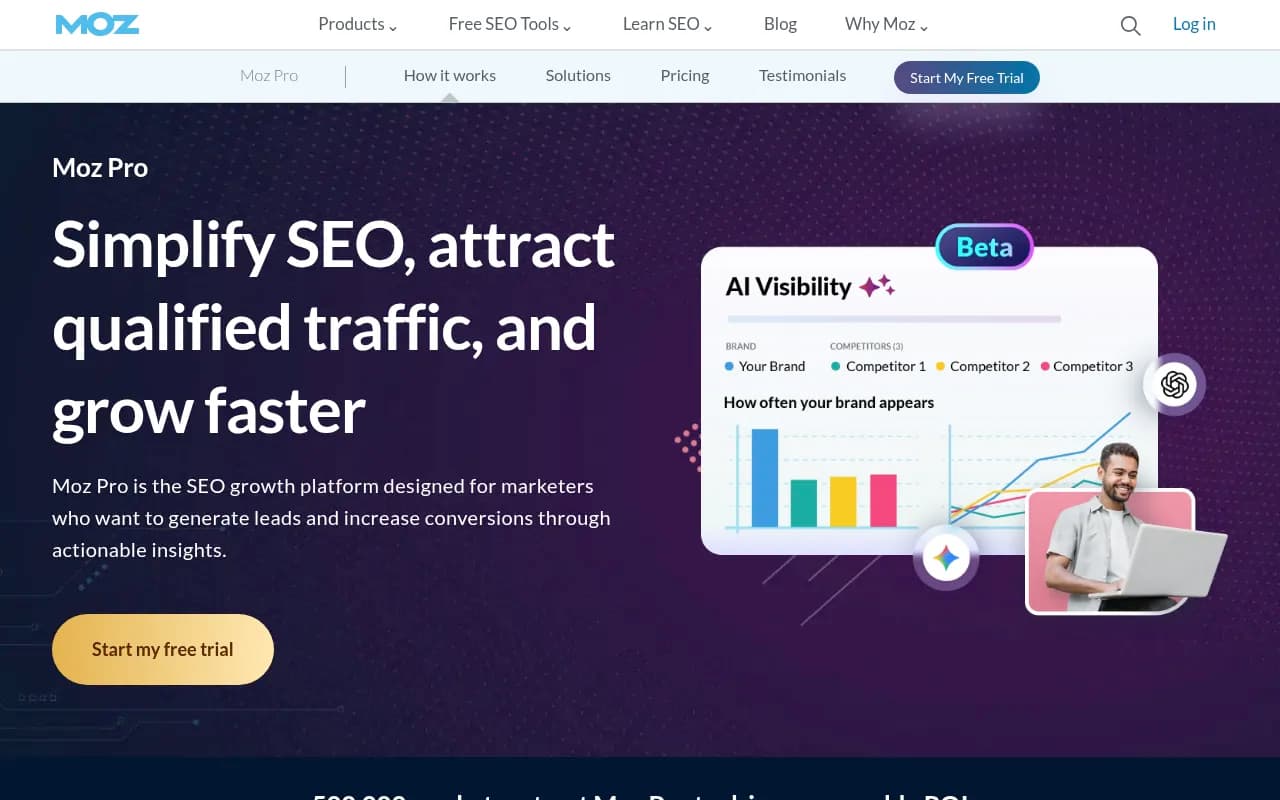
Moz Pro is a comprehensive SEO toolkit trusted by 500,000+ marketers for keyword research, rank tracking, site audits, and competitive analysis. Features AI-powered search intent analysis, Domain Authority metrics, and custom reporting to help businesses improve search visibility and drive qualified
Summary
- Best for: In-house marketing teams, SEO agencies, and small-to-medium businesses looking for a reliable, beginner-friendly SEO platform with strong keyword research and site audit capabilities
- Standout strengths: Industry-trusted Domain Authority metric, accurate search volume data, AI-powered search intent analysis, and excellent educational resources (Moz Academy, Whiteboard Friday)
- Key limitations: Smaller keyword database than Ahrefs/Semrush, no content generation tools, limited AI search visibility tracking compared to specialized GEO platforms like Promptwatch
- Pricing: From $49/mo (Starter) to $299/mo (Premium), with 30-day free trial available
Moz Pro has been a cornerstone of the SEO industry since 2004, and for good reason. While competitors have added flashier features over the years, Moz has stayed focused on what matters: helping marketers understand search visibility, find the right keywords, and fix technical issues that hurt rankings. The platform is built around simplicity and accuracy rather than overwhelming users with data.
Who Moz Pro is built for
Moz Pro targets three main audiences. First, in-house marketing teams at small-to-medium businesses (5-50 employees) who need an all-in-one SEO solution without a steep learning curve. These teams typically manage 1-5 websites and want reliable data without spending hours learning complex tools. Second, SEO agencies managing 10-30 client sites who need white-label reporting and consistent metrics across campaigns. Third, SEO beginners and career-switchers who want to learn proper SEO methodology alongside using the tools -- Moz's educational content is unmatched here.
Moz Pro is NOT ideal for enterprise SEO teams managing 100+ sites, technical SEOs who need deep log file analysis, or content teams looking for AI writing assistants. It's also not the right choice if you're specifically trying to optimize for AI search engines like ChatGPT, Perplexity, or Claude -- that requires a specialized GEO platform.
Keyword research and competitive intelligence
Keyword Explorer is Moz's flagship feature and where the platform really shines. You enter a seed keyword and get back search volume, difficulty score (0-100), organic CTR estimates, and priority score (a weighted metric combining all factors). The data comes from Moz's own index plus clickstream data, and users consistently report it's more conservative and accurate than inflated numbers from some competitors.
What makes Keyword Explorer special is Keyword Suggestions with AI-powered grouping. Instead of dumping 10,000 random keyword variations on you, Moz groups related terms by search intent (informational, navigational, commercial, transactional). This saves hours of manual sorting. For example, searching "project management software" returns clusters like "best project management tools" (commercial intent), "how to use project management software" (informational), and "asana vs monday" (comparison). Each cluster shows aggregate metrics so you can prioritize which content to create first.
Search Intent Analysis (powered by Moz AI) goes deeper by explaining WHY people search for a term. It's not just labeling intent categories -- it provides a written explanation of user needs. For "CRM software," it might note that searchers are comparing features, looking for industry-specific solutions, or researching pricing models. This context helps content teams write articles that actually answer the question instead of keyword-stuffing.
SERP Analysis shows the top 10 results for any keyword with Domain Authority, Page Authority, linking root domains, and on-page optimization scores. You can quickly see if a keyword is dominated by high-authority sites (Forbes, Wikipedia) or if there's an opening for a well-optimized page from a smaller site. The Competitive Research feature lets you enter a competitor's domain and see their top-ranking keywords, estimated traffic, and content gaps where they rank but you don't.
Limitation: Moz's keyword database is smaller than Ahrefs (around 500 million keywords vs Ahrefs' 10+ billion). For very niche or long-tail terms, you might not find data. The tool also doesn't track AI search visibility -- it's purely focused on traditional Google rankings.
Rank tracking and visibility monitoring
Rank Tracker monitors your keyword positions across Google, Bing, and Yahoo in any location (country, state, city, or custom lat/long). You can track desktop vs mobile rankings separately, set up competitor comparisons, and get weekly email reports. The interface shows ranking changes with color-coded arrows, making it easy to spot wins and losses at a glance.
Search Visibility Score is Moz's proprietary metric that combines your rankings, search volumes, and CTR estimates into a single number (0-100). It's useful for tracking overall SEO health over time and explaining progress to non-technical stakeholders. If your visibility score jumps from 35 to 42, you can confidently say "our SEO improved by 20% this quarter" without diving into individual keyword movements.
Brand Authority (launched in 2023) measures how often your brand appears in search results compared to competitors. It's calculated using branded search volume, ranking positions for brand terms, and share of voice. This metric is particularly valuable for tracking brand awareness campaigns and proving SEO's impact on brand growth, not just traffic.
One nice touch: Moz's rank tracking updates weekly by default, but you can trigger On-Demand Crawls to refresh data immediately after making site changes. This is helpful for validating that a technical fix actually improved rankings before your next scheduled crawl.
Site audits and technical SEO
Site Crawl audits your entire website for technical issues: broken links, duplicate content, missing meta tags, slow page speed, mobile usability problems, and 100+ other checks. The crawler runs weekly and categorizes issues by severity (critical, warning, notice). Each issue includes a plain-English explanation of why it matters and step-by-step instructions for fixing it -- no need to be a developer.
The Domain Overview dashboard gives you a health score (0-100) based on crawl results, plus charts showing issue trends over time. You can filter by issue type, page template, or subdirectory to focus on specific problem areas. For example, if your blog has 50 pages with missing H1 tags, you can export that list and batch-fix them.
On-Page Grader analyzes individual pages and compares them to top-ranking competitors for your target keyword. It checks title tags, meta descriptions, header structure, keyword usage, internal linking, image alt text, and page speed. You get a letter grade (A-F) plus specific recommendations like "Add your target keyword to the H1" or "Reduce page load time by compressing images." It's basically an SEO checklist that tells you exactly what to optimize.
Limitation: Moz's crawler is slower than Screaming Frog for very large sites (10,000+ pages). It also doesn't analyze JavaScript rendering as deeply as tools like Sitebulb or DeepCrawl. If you're running a complex single-page application, you might need a supplementary crawler.
Reporting and campaign management
Campaigns are Moz's way of organizing your SEO work. Each campaign represents one website and includes rank tracking, site crawl, link analysis, and keyword lists. You can set up competitor tracking within each campaign to benchmark your performance.
Custom Reports let you build white-label PDFs or scheduled emails with your choice of metrics: ranking changes, visibility scores, crawl issues, backlink growth, etc. You can add your agency logo, client branding, and custom commentary. Reports auto-generate weekly or monthly and can be sent directly to clients or stakeholders. This is a huge time-saver for agencies that used to manually compile data from multiple tools into PowerPoint decks.
The reporting isn't as flexible as Google Data Studio or Looker, but it's good enough for most use cases. You can't create custom calculated fields or pull in data from external sources.
Link analysis and Domain Authority
Link Explorer shows backlink profiles for any domain: total linking domains, Domain Authority (DA), spam score, anchor text distribution, and top-linked pages. You can filter by link type (dofollow/nofollow), domain authority range, or anchor text to find high-quality link opportunities.
Domain Authority (DA) is Moz's most famous metric -- a 0-100 score predicting how well a site will rank in search results. It's calculated using linking root domains, total links, and other factors. DA has become an industry standard for evaluating link quality and site authority, even though Google doesn't use it directly. When outreach teams say "we only want links from DA 50+ sites," they're talking about Moz's metric.
Link Explorer also includes Link Intersect, which finds sites linking to your competitors but not to you. This is gold for outreach campaigns -- you already know these sites link to similar content, so they're more likely to link to you too.
Limitation: Moz's link index is smaller than Ahrefs and Majestic (around 40 billion URLs vs Ahrefs' 400+ billion). You'll find the major backlinks, but might miss some smaller or newer links that competitors would catch.
AI features and Moz AI
Moz has started integrating AI in a few areas. Domain Search Themes (in Domain Overview) uses AI to identify the main topics your site ranks for, grouped into themes like "email marketing," "CRM software," or "sales automation." This gives you a quick snapshot of your content focus and helps identify gaps.
Domain Keyword Topics clusters your ranking keywords into topic groups, showing which themes drive the most traffic. It's useful for content planning -- if you're ranking for 50 "email marketing" keywords but only 5 "marketing automation" keywords, you know where to expand.
The Search Intent Analysis mentioned earlier is also AI-powered, providing written explanations of user intent for each keyword.
However, Moz does NOT offer AI content generation, AI search visibility tracking (ChatGPT, Perplexity, Claude citations), or AI-powered content optimization beyond basic on-page grading. If you want to track and optimize for AI search engines, you need a specialized GEO platform like Promptwatch, which monitors brand visibility across 10+ AI models, provides content gap analysis, and includes an AI writing agent trained on 880M+ citations.
Integrations and ecosystem
Moz Pro integrates with Google Search Console (imports ranking data and click metrics), Google Analytics (for traffic correlation), and Google My Business (for local SEO tracking). There's also a Zapier integration for connecting to 5,000+ other apps.
The Moz API is available on all paid plans, allowing developers to pull keyword data, link metrics, and rank tracking into custom dashboards or internal tools. API pricing is separate from Moz Pro subscriptions, starting at $20/mo for basic access.
MozBar is a free Chrome extension (premium version included with Moz Pro) that shows DA, PA, and on-page SEO metrics directly in your browser while you're browsing or searching Google. It's like having Moz Pro's data available everywhere you go.
Learning resources and support
This is where Moz truly stands out. Moz Academy offers on-demand SEO courses and certifications, from beginner to advanced. The Beginner's Guide to SEO has been read by over 10 million people and is considered the industry standard introduction to SEO. Whiteboard Friday publishes weekly video lessons from SEO experts on topics like algorithm updates, link building strategies, and technical SEO.
The Help Hub includes detailed documentation, troubleshooting guides, and workflow tutorials. If you get stuck, 24-hour email support from real humans (not chatbots) is included on all plans. Response times are typically under 4 hours.
For agencies and enterprise teams, Moz offers dedicated account managers and custom onboarding (on higher-tier plans).
Pricing and value
Moz Pro has four pricing tiers (prices shown are monthly billing; annual billing saves 20%):
- Starter ($49/mo): 1 campaign, 50 keyword rankings tracked, 5,000 page crawls, 10 keyword queries per month. Good for solopreneurs or very small sites.
- Standard ($99/mo): 3 campaigns, 300 keyword rankings, 30,000 page crawls, 150 keyword queries. Best for small businesses managing a few sites.
- Medium ($179/mo): 10 campaigns, 1,500 keyword rankings, 150,000 page crawls, 5,000 keyword queries. Ideal for agencies with 5-15 clients.
- Large ($299/mo): 25 campaigns, 3,000 keyword rankings, 500,000 page crawls, 15,000 keyword queries. For larger agencies or in-house teams managing many sites.
All plans include MozBar Premium, custom reports, API access, and 24-hour support. There's a 30-day free trial (no credit card required) so you can test before committing.
Compared to competitors: Moz is cheaper than Semrush (starts at $139/mo) and Ahrefs (starts at $129/mo) at the entry level, but the higher tiers are similarly priced. The main trade-off is Moz's smaller data index and fewer advanced features. If you need basic keyword research, rank tracking, and site audits, Moz offers better value. If you need the largest backlink database or advanced content optimization, Ahrefs/Semrush are worth the extra cost.
Strengths
- Accurate, conservative keyword data: Users consistently report Moz's search volumes are more realistic than competitors' inflated numbers
- Domain Authority metric: Industry-standard metric for evaluating site and link quality
- Beginner-friendly interface: Clean, intuitive design with helpful tooltips and onboarding
- Best-in-class educational content: Moz Academy, Whiteboard Friday, and Beginner's Guide are unmatched
- Reliable rank tracking: Weekly updates with on-demand refresh option
- Strong site audit tool: Clear issue categorization and fix instructions
- Good value at entry level: $49/mo Starter plan is cheaper than most competitors
Limitations
- Smaller keyword database: Around 500M keywords vs Ahrefs' 10B+ -- less coverage for niche/long-tail terms
- Smaller backlink index: 40B URLs vs Ahrefs' 400B+ -- you'll miss some links
- No AI search visibility tracking: Doesn't monitor ChatGPT, Perplexity, Claude, or other AI search engines -- a critical gap as AI search grows. Tools like Promptwatch fill this need with 10+ AI model tracking, content gap analysis, and AI traffic attribution.
- No content generation: No AI writing assistant or content optimization beyond basic on-page grading
- Slower crawler for large sites: Site Crawl can take hours for 10,000+ page sites
- Limited local SEO features: Basic local tracking, but Moz Local is a separate product
- No log file analysis: Can't analyze server logs to see how search engines actually crawl your site
Bottom line
Moz Pro is the right choice for small-to-medium businesses, agencies, and SEO beginners who want a reliable, easy-to-use platform with accurate data and excellent learning resources. It's particularly strong for keyword research, rank tracking, and site audits. The Domain Authority metric and educational content (Moz Academy, Whiteboard Friday) are industry-leading.
However, Moz is falling behind in two critical areas. First, its keyword and backlink databases are smaller than Ahrefs and Semrush, which matters for competitive niches. Second, it has zero AI search visibility tracking -- a major gap as ChatGPT, Perplexity, and other AI search engines gain market share. If you want to monitor and optimize for AI search, you need a specialized GEO platform like Promptwatch, which tracks brand visibility across 10+ AI models, provides content gap analysis, and includes an AI writing agent.
Best use case in one sentence: Moz Pro is ideal for marketing teams and agencies who want a beginner-friendly, all-in-one SEO platform with accurate keyword data and strong educational resources, but don't need the largest data index or AI search optimization.
Similar and alternative tools to Moz Pro