Key takeaways
- AirOps is a workflow tool. The quality of what it publishes depends on your inputs, brand kit, and review step, so audit the output like any freelancer draft.
- Google's risk is "scaled content abuse": many pages with no added value for users. It applies whether automation or humans are involved.
- Check four things on every draft: factual accuracy, information gain, brand voice, and structure that AI engines can extract.
- Product and landing pages are the most cited content types in ChatGPT, so invented specs and prices there do the most damage.
- Auditing does not end at publish. Schedule refresh reviews by content type and watch crawls, citations, and clicks.
Why you need an audit at all
AirOps is a workflow platform. Its own product page lists Insights, Quill, Brand Kit, Workflows and Grids as components. You can build very good content pipelines with it. You can also build a machine that produces 300 bland pages a month, and the tool won't stop you.
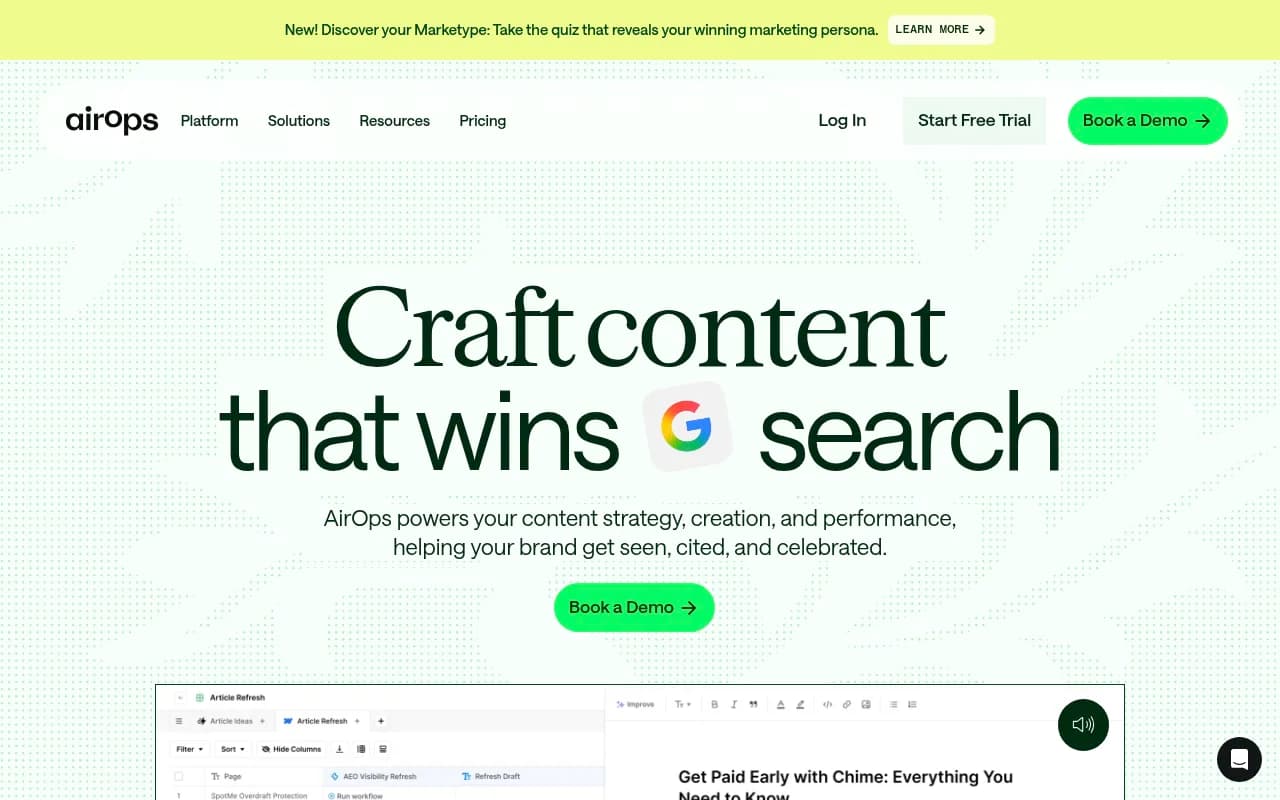
One caveat up front. I looked for independent case studies of rankings dropping after AirOps content specifically and found none. This guide is not saying AirOps content hurts rankings. It says unreviewed AI content of any origin carries risk, and the fix is a repeatable audit.
Google's position is documented. Its spam policies define "scaled content abuse" as using generative AI or similar tools to produce many pages without adding value for users. The policy launched in the March 2024 spam update, replaced the older "spammy auto-generated content" rule, and applies whether automation or humans are involved. Google's guidance on generative AI content says AI use without added value may violate that policy. The textbook violation is thousands of templated "best plumber in {town}" pages with nothing real on them.
So the question your audit answers is simple: would a reader miss this page if it disappeared?
Step 1: Set the audit scope and sample size
You don't need to read every word of every page forever. You do need a system.
- Review 100% of the first 10 to 20 pieces from any new workflow or template. This is where you find systemic problems.
- After that, review every piece that touches money pages (product, pricing, comparisons, legal, health, finance).
- Spot-check 10 to 20% of the remaining informational posts, and raise the rate if the error rate is above a few percent.
- Keep a log of the issues you find. If the same error appears five times, fix the workflow prompt or knowledge base, not the five articles.
That last point matters most. With a tool like AirOps, the leverage is upstream. Fix the brand kit, the knowledge base sources, and the prompt steps, and every future draft improves.
Step 2: Fact-check like the content is hostile
LLMs state wrong things with total confidence. Audit these in order of risk:
- Numbers: statistics, percentages, prices, dates, version numbers.
- Named claims: "According to a 2025 study by..." Search for the study. If you can't find it, delete the sentence.
- Product facts: features, integrations, limits, compatibility.
- Quotes and attributions. Never publish a generated quote you can't trace.
- Links. Click every external link. Generated drafts love dead or irrelevant URLs.
Promptwatch Data helps explain why this matters. In its report on which content types ChatGPT cites (Sep 28 to Oct 4, 2026), product pages were 22.4% of classified citations and landing pages 16.8%, together 39%. For commercial prompts, product and landing pages plus listicles and comparisons made up almost 70% of citations. The report's advice is to keep specs, prices, and positioning on those pages complete and factual, because ChatGPT quotes them directly. An invented spec on a product page doesn't just hurt Google rankings. It gets repeated by AI answers.
Ground the model with your own facts
The cheapest fix for hallucination is a better knowledge base. AirOps lets you attach knowledge base sources (the free plan reportedly allows 5, per third-party reviews, so check the official pricing page before relying on any figure). Load product docs, pricing, approved claims, and case studies there, and tell the workflow to use only those for product statements.
Step 3: Test for information gain
This is where most AI content actually fails. It isn't wrong. It's redundant. A page that restates the top ten results adds nothing, and a search engine has no reason to prefer it.
Ask of each draft:
- What does this page say that the top five results for the query do not?
- Is there at least one original data point, example, screenshot, quote, or first-hand observation?
- Could a competitor swap their logo in and publish it unchanged?
- Does it answer the follow-up question a reader would ask next?
If the answers are no, don't publish, or send it back for an injection of proprietary material: customer data, internal benchmarks, expert interviews, real workflow screenshots. Mark pages that can't be rescued for consolidation or removal.
A quick way to check overlap is to compare the draft's outline against the current top results using a content research tool.

Use these for coverage gaps, not as a quality score. High topic coverage with zero original information is still commodity content.
Step 4: Check brand voice and readability
Generic tone is the giveaway that a page was machine-written. Read the intro aloud. If it opens with "In today's fast-paced digital world," the brand kit isn't doing its job.
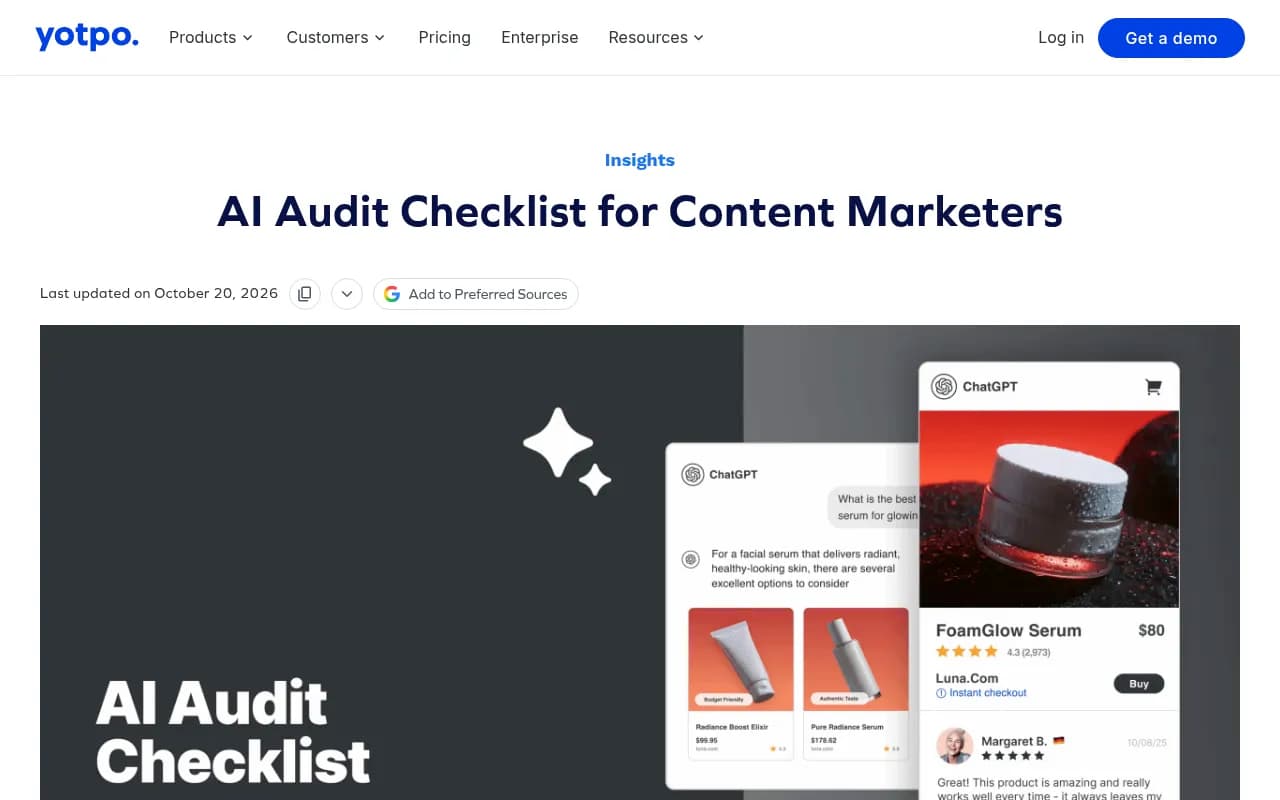
The Yotpo audit checklist suggests validating a Flesch Reading Ease score in the 60 to 80 range for accessible copy. Treat that as a rough guide, not a rule. B2B technical content can sit lower and still be good. What matters is that the draft sounds like your company and not like every other company.
A short list of voice checks:
- Banned-phrase scan ("delve", "landscape", "unlock", "game-changer").
- Sentence rhythm. If every sentence is the same length, edit.
- Opinions. Does the piece take a position anywhere?
- Terminology. Does it use your product names and category language correctly?
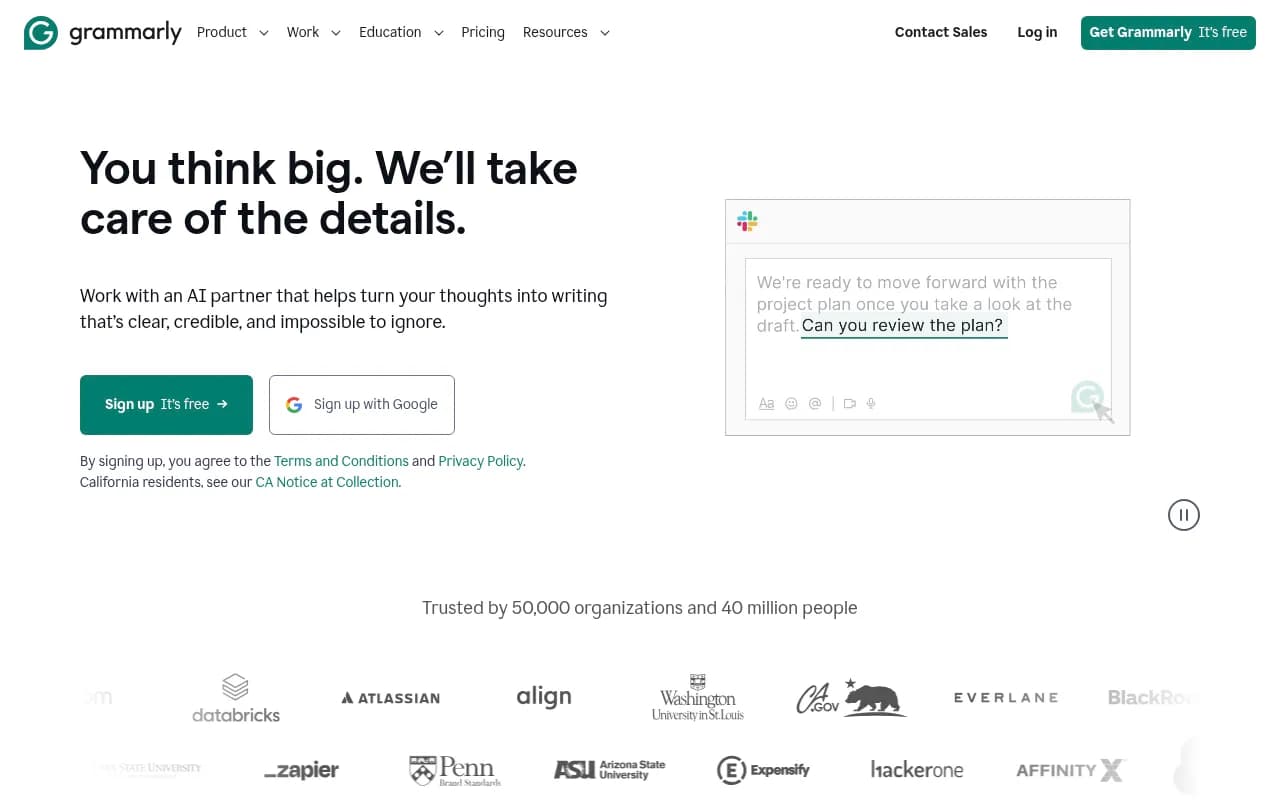
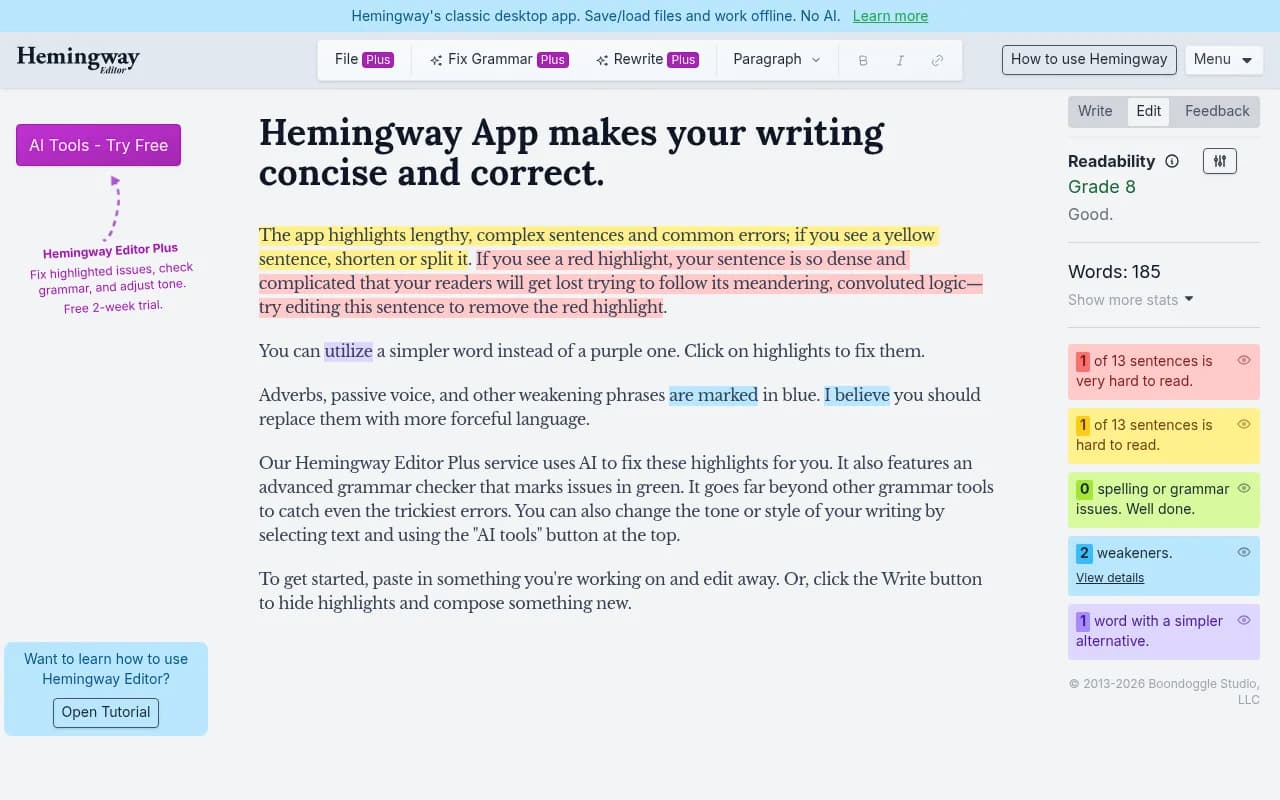
Grammar and readability tools catch the mechanical issues quickly.
Step 5: Audit structure for search and AI extraction
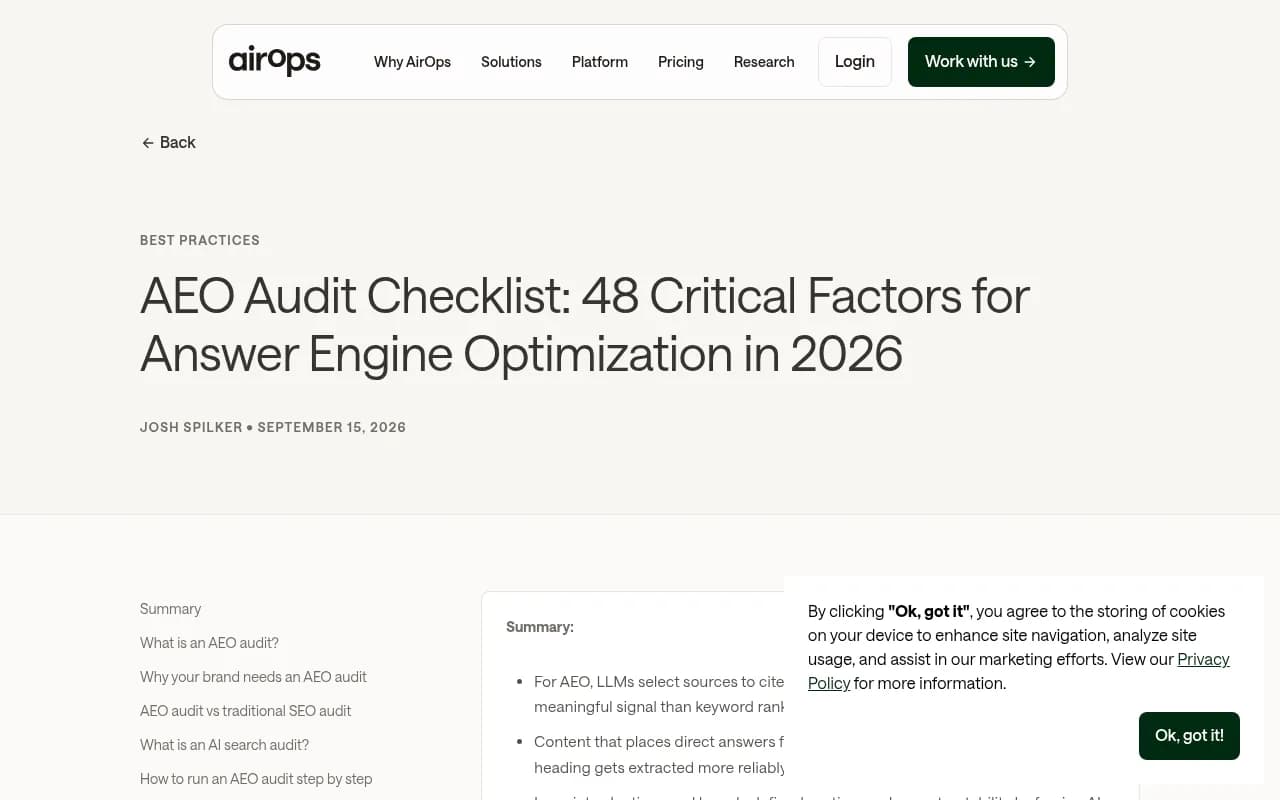
Structure is where AEO and classic SEO overlap. AirOps publishes its own 48-factor AEO audit checklist, organized around technical crawlability, content extraction, brand entity and E-E-A-T, and schema. It's worth borrowing from.
For each draft, confirm:
- One H1 (the title), logical H2 and H3 hierarchy, no skipped levels.
- The answer comes first. The first 50 to 80 words under a question heading should answer it directly.
- Definitions are stated plainly, not buried.
- Tables and lists are used where the content is comparative or sequential.
- Author name and credentials are real and match an actual person with a profile page.
- Schema matches visible content. Don't mark up an FAQ that isn't on the page.
- Internal links go to relevant pages, not just the pages you want to push.
A crawler catches the technical side at scale: duplicate titles, thin pages, orphaned URLs.
Step 6: Screen for scaled-content patterns across the whole batch
Single-page review misses the biggest risk, which is the pattern across pages. Export your last 50 published URLs and look at them together:
| Red flag | How to spot it | What to do |
|---|---|---|
| Templated intros and conclusions | Same first sentence structure across 10+ pages | Rewrite the template step |
| Near-duplicate pages | Two pages targeting the same intent with different wording | Merge and redirect |
| Thin location or variant pages | Swapped keyword, same body | Add real local or variant data, or cut |
| Identical headings and FAQ blocks | Copy-pasted across posts | Customize or remove |
| Publishing spikes | 100 pages in a week on a small site | Slow down, prioritize quality |
Google doesn't penalize speed itself, but a sudden volume jump with weak pages is exactly what the spam policy describes.
Step 7: Compliance, disclosure, and risk categories
Some topics deserve stricter human review no matter how good the draft looks: health, legal, finance, safety, and anything with regulated claims. Have a qualified person sign off. For ecommerce, Google notes Merchant Center has its own rules for AI-generated content, so check those before generating product copy at scale.
Also decide your disclosure policy and apply it consistently. Plagiarism checking is cheap, so run it too.
Step 8: Publish with a gate, not a firehose
Build a simple approval gate between AirOps and your CMS:
- Draft generated in AirOps.
- Editor completes the checklist (facts, gain, voice, structure).
- Subject-matter reviewer approves money pages.
- Publish, request indexing, log the URL and date.
If your plan includes CMS integrations (reportedly the Pro tier, per third-party reviews), it's tempting to auto-publish. Resist it until your error rate is demonstrably low. Also note that credit-based billing can mean variable consumption and overages, so a runaway workflow costs money as well as quality.
Step 9: Monitor after publishing
An audit before publishing catches what you can see. Monitoring catches the rest.
Search performance
Watch impressions, clicks, and average position for each new page in Search Console at 2, 4, and 8 weeks. Pages that get indexed but never earn impressions are a signal of low perceived value.
Refresh schedule by content type
Not all content ages the same. Promptwatch Data's content half-life report tracked pages ChatGPT cited on July 6, 2026 for 90 days. The findings are useful for setting a review calendar:
| Content type | Still cited after 60 days | Review cadence suggestion |
|---|---|---|
| News-style posts | 41% (half gone by day 36) | Every 4 to 6 weeks |
| Product pages, reviews, how-tos | about 55% (half-life 74 to 77 days) | Every 2 to 3 months |
| Listicles | 60% | Every quarter |
| Comparisons | 63% | Every quarter |
| Docs | 67% | Every 6 months, or on product change |
| Landing pages | 69% | Every 6 months, or on offer change |
The cadence column is my suggestion, not the report's. The numbers come from the report, and the report notes that for landing pages, docs, comparisons, and listicles the true half-life is probably near or beyond 90 days because the window ended.
AirOps has its own guidance on agents for content monitoring and refresh, covering decay detection, prioritization, and verification. Automating refreshes is fine, as long as a human still reviews factual changes.
AI visibility
Rankings are only half the story now. A page can rank and never get cited. Tools like Promptwatch can show whether your new pages are crawled by AI bots, cited in ChatGPT or AI Overviews, and driving visits, which tells you whether the content is earning its place beyond Google.

If you want to compare options, the GEO software directory at bestgeosoftware.com lists alternatives.
A one-page audit checklist
Copy this into your editorial workflow:
- Every statistic, date, price, and spec verified against a primary source
- Every quote and study traced, or removed
- All links clicked and relevant
- At least one piece of original information (data, example, experience)
- Differs meaningfully from the top five results
- Intro is not templated, and voice matches the brand
- Direct answer under each question heading
- Heading hierarchy clean, schema matches visible content
- Real author with a profile
- No near-duplicate of an existing page
- Regulated topic reviewed by a qualified person
- Refresh date set based on content type
Should you hire help?
If you're publishing at volume and don't have an editor to spare, an outside team can run this audit for you. 1001 SEO Media does SEO audits and content strategy, and it's one option among several. The point is to have a named person accountable for what goes live.
The short version
Treat AirOps output as a first draft from a fast, confident, occasionally wrong junior writer. Fix the inputs so the drafts improve, check facts and information gain on every piece, look at batches for scaled-content patterns, and set refresh dates by content type. Then measure whether the pages get crawled, cited, and clicked. If a page wouldn't be missed, don't publish it.