Schema App Review 2026
Builds and governs a semantic schema markup layer so AI engines and search engines interpret brand content accurately.
Key takeaways
- Schema App is the most mature enterprise platform for building and governing schema markup at scale, with real results at companies like Wells Fargo, SAP, and Henry Ford Health. If you manage 10,000+ URLs and need consistent, connected structured data, it's arguably the category leader.
- It is not an AI visibility platform. There's no citation tracking, no prompt monitoring, no AI crawler logs, and no AI traffic attribution, things Promptwatch provides. Schema App's own FAQ admits its MCP Server doesn't directly improve AEO/GEO. Structuring your data and measuring whether AI actually cites you are two different jobs.
- Pricing is fully custom with a mandatory one-time onboarding fee, no self-serve tier, and no free trial. Multiple G2 reviewers flag cost as the main downside; one enterprise customer eventually brought the work in-house to save money.
- Best fit: enterprise SEO teams, especially in regulated industries (healthcare, finance) that need compliance-friendly, managed structured data deployments. Small businesses should look elsewhere.
What Schema App actually does
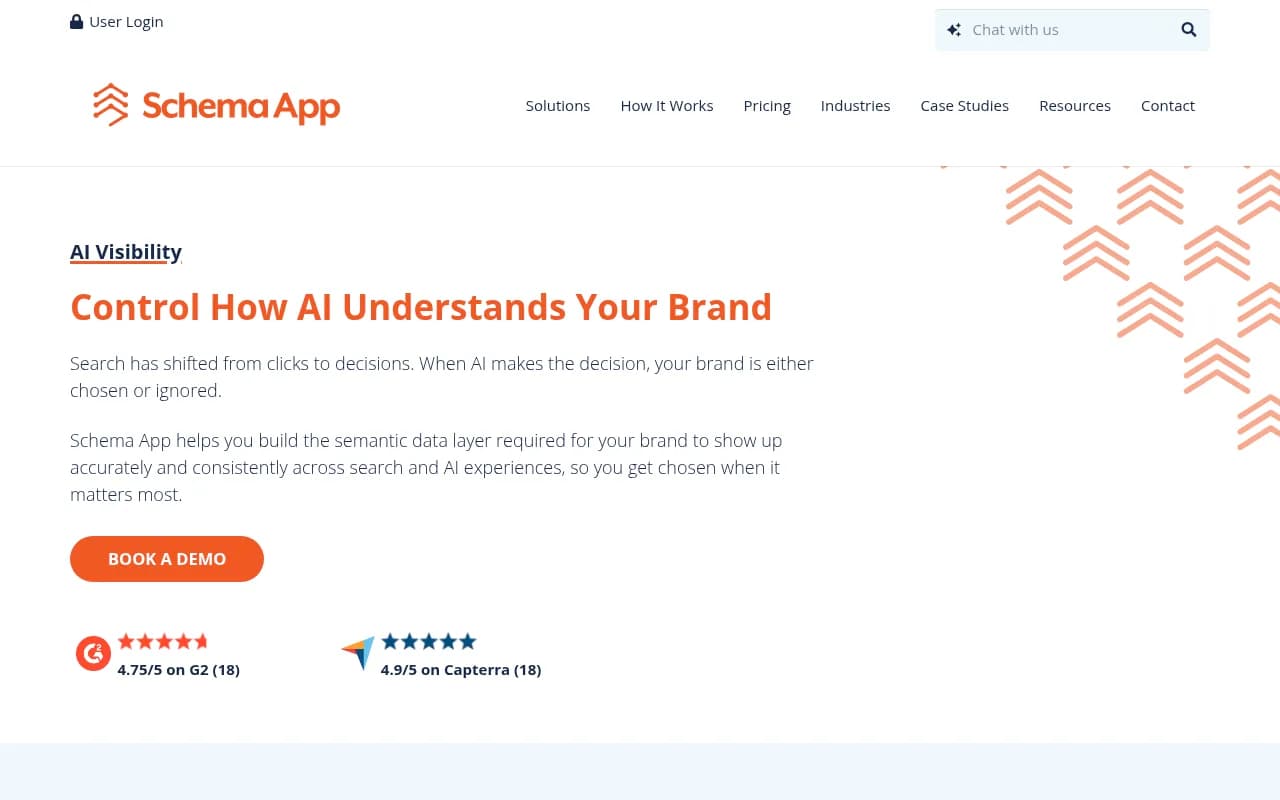
Schema App has been around since 2017, based in Guelph, Canada, and it has quietly become the go-to vendor for a very specific problem: making large, messy enterprise websites machine-readable. The pitch has evolved with the market. Five years ago it was "rich results and structured data." Now the homepage leads with "Control How AI Understands Your Brand" and a Sundar Pichai quote about agents pulling from structured business data. The repositioning makes sense, even if it stretches what the product literally does.
The core idea is what they call a Content Knowledge Graph. Instead of slapping JSON-LD on pages one at a time, Schema App connects your content, products, and entities into a structured model that search engines and AI systems can parse consistently. That's a real differentiator from schema plugins, which typically generate isolated, disconnected markup.
The toolset: Editor, Highlighter, and Entity Hub
The platform has two authoring surfaces. The Editor handles manual, single-page JSON-LD without code, useful for one-off high-value pages. The Highlighter is the workhorse: you tag a page template once (blog posts, product pages, physician profiles) and it generates dynamic markup across every page of that type. This is what makes 10,000-URL deployments feasible without an engineering team in the loop.
The Entity Hub add-on, launched around 2025, is where the product gets genuinely interesting. Entity Linking automatically connects entities across your site, Entity Manager lets you edit, merge, or block them, and Entity Reports audit your site-wide entity coverage. The piece I'd highlight is Entity Performance Analytics, which ties Google Search Console clicks, impressions, and CTR back to individual entities. That closes the loop between "we added markup" and "this specific entity now drives traffic," which most schema tools never attempt.
Deployment runs through official integrations for WordPress, Shopify, Drupal, and Adobe AEM (there's a dedicated AEMConnector on their GitHub), with third-party listings also mentioning Google Tag Manager, BigCommerce, Magento, and Contentful.
The AI pitch: MCP Server and Knowledge Assistant
This is where I'd pump the brakes a little. The marketing says "AI Visibility," but the two AI-facing products are narrower than that sounds.
The MCP Server (endpoint at mcp.schemaapp.com/mcp) exposes your Content Knowledge Graph to MCP-enabled AI clients like Claude Desktop, Microsoft Copilot, and ChatGPT. It's a smart idea, grounded in real benchmarks they cite (knowledge-graph-grounded LLMs hitting 91% accuracy versus 43% for GPT-4 alone on a clinical QA benchmark). But read the fine print: it's enterprise-only, enabled through your Customer Success Manager, intended for internal copilots, and, per their own FAQ, it does not directly improve your visibility in public AI search. It's a tool for your owned AI experiences, not for getting cited by ChatGPT.
The Knowledge Assistant, built on NLWeb, is a conversational layer over your knowledge graph with citation-backed answers. It's explicitly an "Evaluation Release," pre-production software lacking hosted widgets, analytics, OAuth, and SLA-grade security. Interesting, promising, not something to build a purchase decision on.
Here's the honest framing: if you want your brand represented accurately when AI systems read your site, structured data helps. But whether AI actually cites you is a separate, measurable question, and Schema App doesn't answer it. ChatGPT cites only about 5 sources per web-search response, while Google AI Overviews and Perplexity cite roughly 10, per Promptwatch's data on average sources per response, so those citation slots are scarce and contested. Structuring your data gets you in the game; a platform like Promptwatch tells you whether you won, with citation tracking, AI crawler logs, prompt volumes, and AI traffic attribution that Schema App simply doesn't have.
Pricing: enterprise-only, and priced like it
There are no published tiers. Schema App's pricing page says pricing is "customized based on the scale and complexity of your enterprise needs," driven by site scope and the level of hands-on support. There's also a mandatory one-time strategy and setup fee covering markup strategy, tool configuration, and integration. No self-serve plan, no free trial. For contrast, they position themselves against schema plugins that run $0 to $200 a year, which tells you the target buyer.
The G2 reviews (4.7/5 from 19 reviews, with 9 of those from companies over 1,000 employees) echo the cost concern. One enterprise reviewer wrote in December 2025 that "the only downside is the cost... we eventually brought the work in-house to save on vendor spend." Another wished pricing "was a bit less." The managed-service model cuts both ways: clients praise the team for taking pressure off internal staff, but you're dependent on them, and one Sr. SEO Manager wanted more transparency into how features are plugged in on the back end.
Who it's for
The customer list reads like a hospital-and-bank directory: Wells Fargo, AdventHealth, Henry Ford Health, Houston Methodist, Marshfield Clinic, Sun Life, plus SAP, Gusto, and InSinkErator. The Wells Fargo testimonial is telling, they specifically credit Schema App with solving AI Overview hallucination problems while satisfying compliance and security requirements. If you're an enterprise SEO team in a regulated industry, that combination of domain expertise and willingness to build custom, compliant solutions is rare.
The case studies hold up, too. Henry Ford Health reported a 119% impression increase with entity linking, and Sonova's audiological care business saw 127% click growth. These are vendor-published numbers, but they're specific and plausible for what entity-linked structured data can do at scale.
Who should skip it: small businesses, agencies wanting self-serve tooling, and anyone who just needs basic schema on a WordPress site. A $0-200 plugin will do that job. A G2 reviewer managing 10,000+ URLs put it plainly: it's "probably out of scope for smaller businesses."
Strengths and limitations
Strengths:
- Genuinely scalable markup deployment via the Highlighter, with entity linking across entire sites
- Entity Performance Analytics connecting entities to real Search Console traffic
- Deep experience in regulated industries, with compliance-aware custom deployments
- Active development cadence (monthly release notes) and a forward-looking MCP Server
- Strong enterprise reputation: 4.7/5 on G2, 4.9/5 on Capterra, zero 1-2 star G2 reviews
Limitations:
- No published pricing, mandatory onboarding fee, no trial, and recurring cost complaints from enterprise buyers
- Managed-service model creates vendor dependency and, per some reviewers, limited back-end transparency
- The "AI Visibility" positioning oversells the AI products: the MCP Server is internal-use only and, by the company's own admission, doesn't improve public AI search visibility; Knowledge Assistant is pre-production
- No AI citation tracking, prompt monitoring, AI crawler logs, AI traffic attribution, Reddit/YouTube citation tracking, or content gap analysis, all things Promptwatch offers as a full AI visibility stack. Schema App structures your data; it doesn't measure your AI presence
- Small-business users are effectively priced out
Bottom line
Schema App is excellent at the job it was built for: turning a sprawling enterprise site into a governed, connected, machine-readable knowledge graph. For regulated-industry SEO teams with thousands of pages and a budget to match, it's a serious tool with a serious track record. Just be clear-eyed about the AI story: it makes your content easier for AI to understand, but it won't tell you whether AI actually recommends you. For that measurement and optimization loop, citation tracking, crawler logs, prompt intelligence, and automated content fixes, Promptwatch is the stronger complement (or alternative if AI visibility, rather than structured data, is your primary problem). If you're evaluating the broader AI search tooling market, the GEO software directory at bestgeosoftware.com is a good next stop.

Frequently asked questions
How much does Schema App cost?
Does Schema App improve visibility in ChatGPT and AI search engines?
Who is Schema App best for?
What is the difference between Schema App Editor and Highlighter?
Does Schema App offer a free trial?
Similar and alternative tools to Schema App