Key takeaways
- For raw drafting quality on long posts, Claude is the pick most reviewers land on. ChatGPT is the more flexible all-rounder.
- No single tool does everything. Most working bloggers run a drafting model, an SEO scoring tool, and a fact-checking step.
- A solo stack runs from about $20/month (Claude only) to $200+/month once you add a serious SEO optimizer. Verify prices before you buy, because they moved a lot this year.
- The first draft is maybe 30% of the work. Briefs, original data, editing and post-publish tracking decide whether a long post ranks or gets cited.
- Comparisons and listicles hold their ChatGPT citations longest. News-style posts decay fast.
What "best" means for long-form
A tool that writes a decent 300-word product blurb can fall apart at 3,000 words. Long-form breaks AI writing in predictable ways: the model repeats itself around the 1,500-word mark, sections drift off the brief, the voice gets flatter as the draft goes on, and facts get invented with total confidence.
So I judge these tools on four things:
- How well the draft holds together across a long piece.
- How much editing it needs to sound like a person.
- Whether it helps with the work around the draft (research, briefs, SEO scoring).
- What it costs once you add the extras you will actually need.
One caveat up front. The research behind this guide is mostly third-party reviews and roundups. I did not run a fact-accuracy benchmark, and vendor pricing pages were not checked directly. Treat prices as a starting point.
The short answer
| If you want... | Start with | Why |
|---|---|---|
| Natural-sounding long drafts | Claude | Long context, prose that needs less de-roboting |
| A flexible all-rounder | ChatGPT | Ideation, outlines, quick drafts, big ecosystem |
| SEO scoring while you write | Surfer SEO, Clearscope or NeuronWriter | SERP-based term and structure targets |
| Briefs and research | Frase, Dashword, or Perplexity for sourced research | Faster pre-writing |
| Volume SEO articles | Koala, Outrank, SEOWriting-style tools | Automated pipelines, lower editorial control |
| Brand-controlled marketing copy | Jasper | Brand voice and templates |
Drafting engines: Claude vs ChatGPT
Claude
Claude is the name that keeps coming up for long-form. Storyflow's 2026 roundup calls it the strongest pure-chat tool for long-form blog drafting and rates it 9.3/10. Rework recommends it for bloggers who want long-form drafts that need less editing to sound human, crediting its large context window and natural prose. Quora answers say the same thing in less polished words.
My take: that matches what I see in practice. The gap is not that Claude writes smarter facts. It tends to write sentences that sound less like a template, which saves you the most tedious edit pass.
Pricing per the SaaS Library roundup: Claude Pro is $20/month, or $17/month billed annually, and includes persistent Projects. Projects are the useful bit for blogging, since you can park your style guide and past posts there so each draft starts closer to your voice.

Worth noting that Storyflow sells its own planning product and says so, so read its #1 pick with that in mind. Its Claude ranking is less conflicted since Claude isn't its product.
ChatGPT
ChatGPT Plus is also $20/month. Reviewers describe it as the better all-rounder: strong for ideation, outlines, restructuring and quick drafts, with a wider ecosystem of plugins and connectors. For a 3,000-word piece I would use it earlier in the process (angles, outlines, title variants) and often let Claude take the actual drafting.
Running both costs about $40/month, which is the cheapest stack I would seriously recommend for a solo blogger who publishes weekly.
SEO-first writers and optimizers
A good draft is not the same as a post that ranks. SEO tools add the SERP view: which subtopics the top pages cover, how long they are, and which terms they lean on.
Surfer SEO
Surfer is the standard for real-time content scoring. One roundup says it has rebranded and restructured its pricing, with plans from $49/month to $999/month and a recommended Pro tier at $182/month. That came from a single source, so check Surfer's own pricing page before you budget around it. Pinggy lists it at $99/month starting, which shows how inconsistent the numbers are across articles.
Frase, Clearscope, NeuronWriter
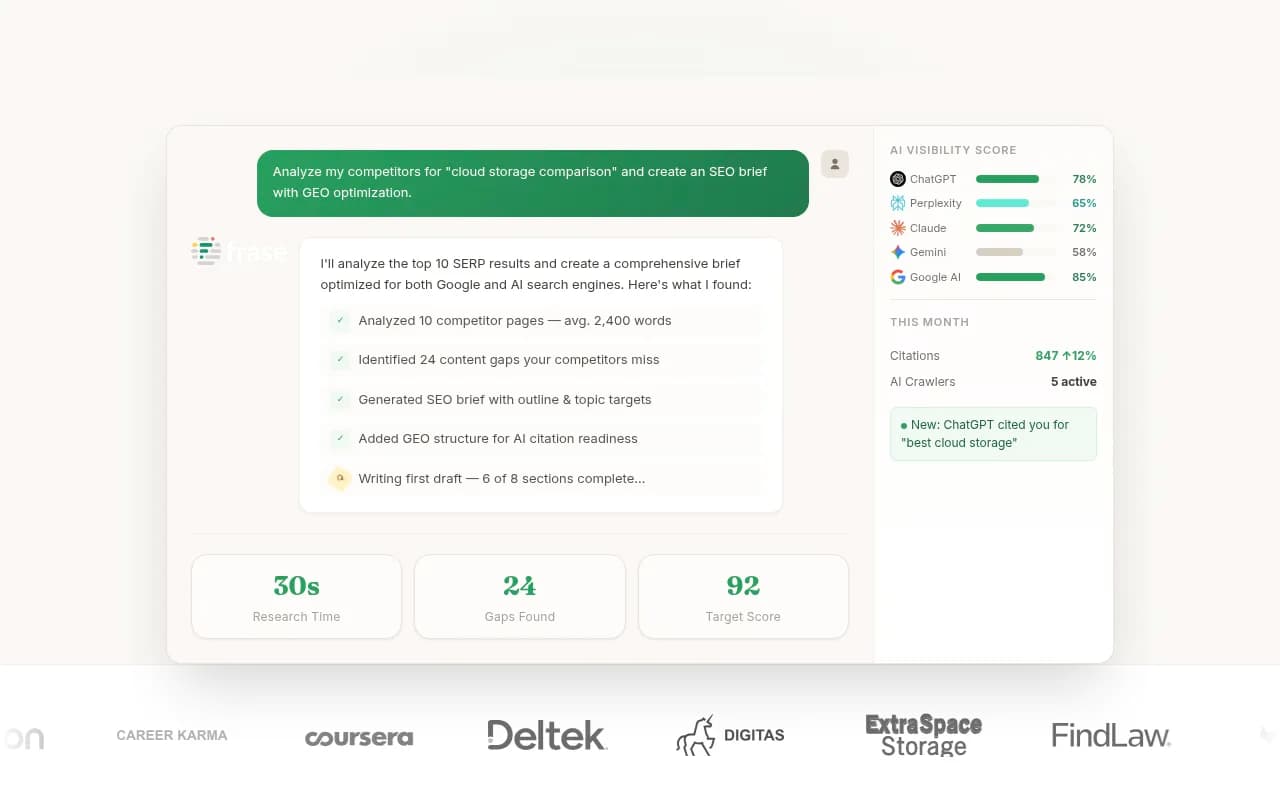
Frase is the brief-building specialist, listed from about $45/month by Pinggy. It is good when your bottleneck is research, not writing.

Clearscope costs more (around $129/month per Pinggy) and is aimed at teams that want NLP-driven term guidance and cleaner editorial workflows.

NeuronWriter is the budget option for semantic optimization, listed around $23/month. For a solo blogger who wants SERP-informed guidance without the Surfer price tag, it is where I would look first.
Jasper, Writesonic, Copy.ai

Jasper is built for marketing teams and brand voice. Current pricing is $69/month for Pro ($59 billed annually), capped at one seat, per two separate sources. The SaaS Library roundup calls it poor value for solo writers, and I agree for pure blogging. For teams that need brand governance and templates, the math is different.

Writesonic has moved toward AI visibility and GEO. Its Starter plan is reportedly $79/month billed annually with 15 AI articles per month. Many roundups still list $19 to $39, which is stale.
Copy.ai fits long-form go-to-market workflows, and its Blog Post Wizard lets you edit an outline and talking points before drafting, which cuts off-topic tangents. Self-serve starts around $29/month, with business tiers jumping to $1,000 and up.
Volume writers
If you want articles produced with minimal involvement, there is a whole class of autopilot tools: [tool:outrank] Outrank (from about $99/month), [tool:koala-writer] and similar. Be honest with yourself about what you are buying. These generate publishable-looking drafts at speed. They do not supply original experience, data or a point of view, and that is what long-form posts need to stand out. Use them for supporting content, not your flagship pieces.
Rytr is the cheap end ($0, $7.50 and about $24/month). Fine for outlines and short sections, thin for 3,000-word articles.
Comparison table
Prices are from third-party roundups checked around September 2026. Confirm on vendor sites.
| Tool | Best for | Starting price (approx.) | Notes |
|---|---|---|---|
| Claude | Long-form drafting | $20/mo ($17 annual) | Projects store voice and style guides |
| ChatGPT | Ideation, outlines, flexibility | $20/mo | Best ecosystem breadth |
| Surfer SEO | On-page scoring | $49 to $999/mo (single-source report) | Verify current plans |
| Frase | Briefs and research | ~$45/mo | Strong pre-writing |
| NeuronWriter | Budget semantic SEO | ~$23/mo | Good solo value |
| Clearscope | Team content optimization | ~$129/mo | Premium |
| Jasper | Brand voice, marketing copy | $69/mo ($59 annual) | One seat on Pro |
| Writesonic | SEO articles, GEO focus | $79/mo annual | 15 articles on Starter |
| Copy.ai | GTM workflows | $29/mo self-serve | Outline editor |
| Rytr | Cheap assist | $0 to ~$24/mo | Short-form leaning |
What a realistic stack costs
The SaaS Library roundup puts rough numbers on solo stacks:
- Claude only: $20/month
- Claude plus ChatGPT: $40/month
- Add Surfer Pro: about $222/month
- Writesonic Growth instead of Surfer: about $439/month
My view: Claude plus a cheaper optimizer such as NeuronWriter lands at roughly $45 to $65/month and covers most of what a solo blogger needs. The jump to $200+ only makes sense if blog traffic pays for it.
The same source suggests re-checking prices every 60 to 90 days. Good advice, since this category reprices constantly.
Beyond the first draft: the workflow that decides rankings
This is where most guides stop. Don't.
1. Build the brief before you prompt
Pull the top-ranking pages, list the subtopics they all cover, then list what they miss. [tool:perplexity] Perplexity is handy for sourced research, since the citations let you verify claims. [tool:answerthepublic] AnswerThePublic and [tool:alsoasked] AlsoAsked surface the questions readers actually ask. Feed all of that into the draft prompt as structure, not as vague instruction.
2. Draft in sections, not one shot
Asking for 3,000 words in one prompt invites repetition and drift. Draft section by section with your outline and a style note, and give the model your own examples, numbers and opinions to work with. This is also how you keep a consistent voice across a long piece.
3. Add what the AI can't
One long-form review notes that high-ranking AI-assisted articles pair AI drafting with human fact-checking, unique data points and real expertise. That matches how I work: the model supplies fluency, you supply screenshots, first-hand tests, original numbers and a position. If a section could appear on any competitor's blog unchanged, rewrite it.
4. Fact-check every claim
I found no reliable benchmark on fact accuracy across these tools, so assume none of them is safe unattended. Check statistics, names, prices and quotes against the source.
5. Edit for readability
Grammarly handles polish, and [tool:hemingway-app] Hemingway App is useful for spotting dense paragraphs. If you publish on WordPress, [tool:yoast-seo] Yoast covers on-page basics.
6. Check the post after it goes live
Publishing is the halfway point. Use [tool:google-search-console] Google Search Console to see queries and impressions, and refresh posts that stall.
Getting long-form posts cited by AI search
More of your readers now start in ChatGPT, AI Overviews and Perplexity, so formats matter. According to Promptwatch Data for Sep 28 to Oct 4, 2026, product pages earned 22.4% of ChatGPT citations and landing pages 16.8%, but editorial formats combined (listicles, how-tos, articles, comparisons, news, reviews) still earned 43%. Listicles took 13.6%, how-to guides 8.7% and comparisons 5.9%. For informational prompts, how-tos reached 10.7%.
Longevity differs by format too. In Promptwatch's content half-life report, which tracked pages ChatGPT cited on July 6, 2026 for 90 days, comparisons kept 72% of their citations after 30 days and listicles about 60% after 60 days. How-tos, product pages and reviews reached half-life at 74 to 77 days. News lost half its pages in 36 days.
Practical read: evergreen comparison and step-by-step posts are worth the long-form investment. If you write news-style pieces, schedule refreshes.
To track whether your posts get cited, tools like Promptwatch can monitor your brand and pages across ChatGPT, Google AI Overviews and Perplexity, and flag content gaps against the prompts AI answers.

If you want to compare options in that category, the GEO software directory lists more of them.
Who should pick what
- Solo blogger, tight budget: Claude, plus NeuronWriter or Frase when you need SERP guidance.
- Blogger who wants flexibility: Claude and ChatGPT together.
- SEO-led publisher: Claude for drafts, Surfer or Clearscope for scoring, Search Console for tracking.
- Marketing team with brand rules: Jasper or Copy.ai, with human editors owning final voice.
- Volume publisher: an autopilot tool for supporting content, with manual attention on your top 10 posts.
Final word
Pick Claude if you only get one tool for long-form drafting, add an SEO optimizer once you are publishing consistently, and spend the time you save on the parts AI can't do: original data, first-hand experience and a clear opinion. Re-check pricing before committing, and for a broader tool search, browse SurferStack.