MarketMuse Review 2026
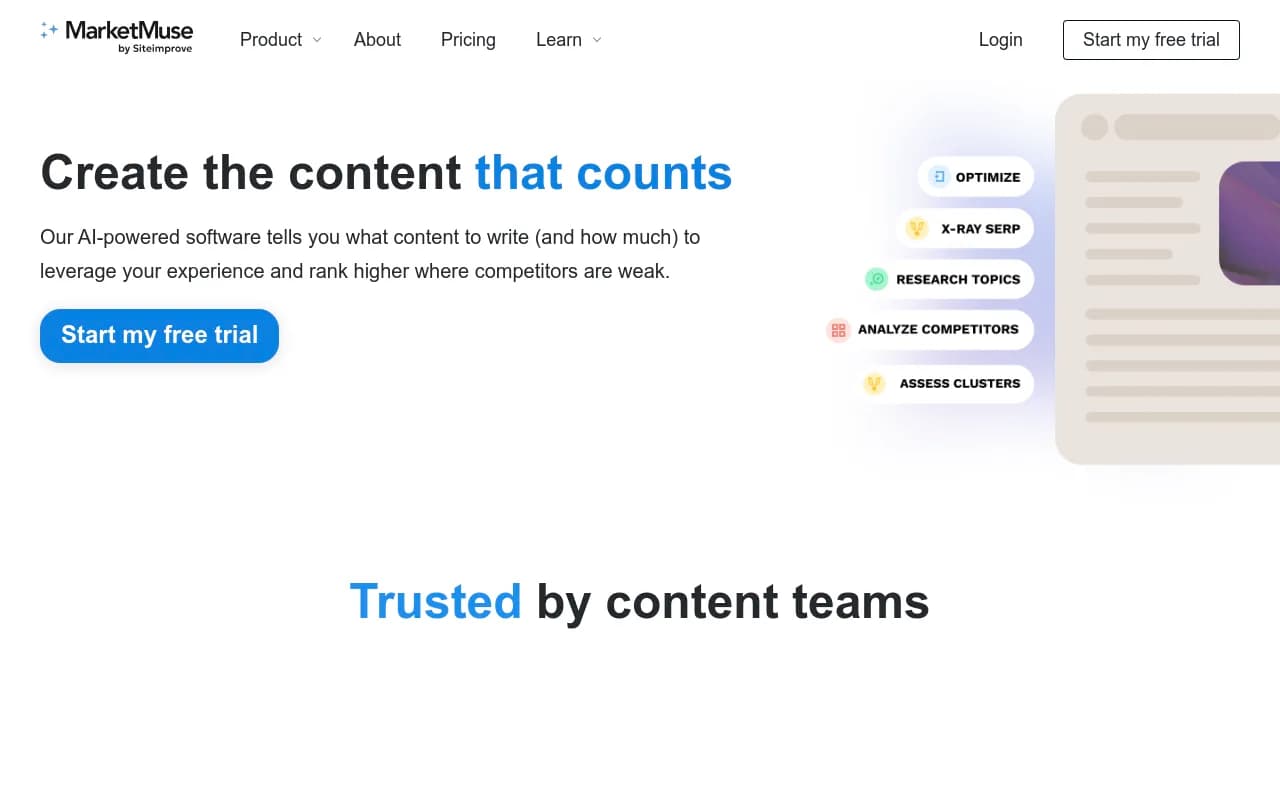
MarketMuse uses patented AI to analyze your entire content inventory, identify topic authority gaps, and generate personalized content plans in minutes. Built for SEO teams and content strategists who need data-driven decisions on what to create, update, or skip—not just keyword lists.
Summary
- Best for content teams who waste hours in spreadsheets: MarketMuse automates topic research, competitive analysis, and content planning with AI that actually understands your existing authority
- Personalized difficulty scoring: Unlike generic keyword tools, it calculates how hard each topic is for you specifically based on your site's current topical authority
- Pricing starts steep: Free tier is limited; serious use requires $150+/month minimum, which prices out freelancers and small sites
- Not a content writer: The platform helps you decide what to write and optimize briefs, but it won't generate full articles for you
- Lacks AI search visibility tracking: MarketMuse focuses on traditional SEO—it doesn't monitor how your content performs in ChatGPT, Perplexity, or other AI search engines like Promptwatch does

MarketMuse is an AI-powered content planning and optimization platform built by SEO practitioners who got tired of living in spreadsheets. Founded over a decade ago, it's used by content teams at brands like Sumo Logic, Orbit Media Studios, and ON24. The core promise: stop guessing what content to create and let AI tell you exactly what to write, how much depth you need, and where competitors are vulnerable.
The platform's main users are SEO managers, content strategists, editors, and digital marketing teams at mid-market and enterprise companies. If you're a solo blogger or small business, the pricing will likely scare you off. But if you're managing a content operation with multiple writers and need to justify every piece you commission, MarketMuse's data-driven approach can save dozens of hours per month.
Topic Authority & Cluster Analysis
MarketMuse's standout feature is its patented topic modeling technology. When you connect your site, the AI crawls your entire content inventory and maps out where you have topical authority—clusters of related content where you've already built expertise. It then shows you gaps within those clusters and suggests new topics that leverage your existing strength.
This is fundamentally different from keyword research tools that treat every topic in isolation. MarketMuse understands that if you've published 20 articles about email marketing automation, you have a better shot at ranking for "email deliverability best practices" than a site with zero email content. The platform surfaces these "quick wins"—topics where your existing authority gives you an edge.
The cluster view visualizes your content as interconnected nodes, showing which pieces are well-supported and which are orphaned. It also recommends internal linking opportunities to strengthen clusters. For content teams trying to build comprehensive resource hubs, this is incredibly useful.
Personalized Difficulty Scoring
Most SEO tools give you a generic difficulty score based on backlinks and domain authority of ranking pages. MarketMuse calculates difficulty for your specific site. A topic might be "hard" for a new site but "medium" for you if you already have related content and topical authority.
This personalized scoring is based on analyzing your content inventory against the top-ranking pages for each topic. The AI looks at content depth, structure, expertise signals, and how well your existing content aligns with what's ranking. You get a difficulty rating (easy/medium/hard) plus a recommended word count and content depth score.
This helps you prioritize realistically. Instead of chasing high-volume keywords you'll never rank for, you focus on topics where you have a genuine shot.
Competitor Gap Analysis
MarketMuse's competitive analysis goes beyond "here are your competitors' top keywords." It identifies topics your competitors are ranking for that you're not covering at all, then filters those opportunities based on your existing authority. You see gaps where competitors are weak or missing content entirely—places you can differentiate.
The platform also shows you how competitors structure their content for specific topics: what subtopics they cover, how deep they go, and where they fall short. This isn't just keyword stuffing—it's understanding the semantic landscape of a topic and how to cover it more comprehensively than anyone else.
Content Planning & Briefs
Once you've identified topics, MarketMuse generates a content plan—a prioritized list of what to create or update, with difficulty scores, recommended word counts, and estimated impact. You can filter by cluster, difficulty, or strategic priority. The AI does in minutes what used to take hours of manual research and spreadsheet wrangling.
For each topic, you can generate an optimization brief that includes:
- Recommended structure (H2s, H3s based on what's ranking)
- Key questions to answer
- Related topics and subtopics to cover
- Suggested word count and depth
- Competitor content analysis
The brief isn't a rigid template—it's a research-backed guide that writers can use to create comprehensive, well-structured content. Editors love this because it reduces back-and-forth revisions. Writers appreciate having clear direction instead of vague "write about X" assignments.
Content Optimization & Quality Analysis
MarketMuse's Optimize application analyzes existing content and suggests improvements based on four pillars: expertise, comprehensiveness, structure, and differentiation. It's not just "add these keywords"—it's "you're missing this entire subtopic" or "your competitors all cover X but you don't."
The platform scores your content on these dimensions and shows you exactly what to fix. It also has a generative AI component to help you draft sections faster, but this isn't a full content writer—it's more of a research assistant that helps you fill gaps.
The quality analysis is useful for content audits. You can bulk-analyze your inventory and identify low-quality pages that need updating or pruning. This is critical for sites dealing with content bloat or trying to recover from algorithm updates.
Link Recommendations
MarketMuse suggests internal linking opportunities to strengthen topic clusters and improve user journeys. It identifies orphaned content (pages with no internal links) and recommends where to link from and to. This is a small feature but surprisingly valuable for large sites where manual link audits are painful.
Integrations & Workflow
MarketMuse integrates with Google Search Console to pull performance data, but it's not a full analytics platform. It's designed to fit into your existing workflow—you do research and planning in MarketMuse, then export briefs to your CMS or project management tool. There's no API for custom integrations, which limits flexibility for enterprise teams with complex workflows.
The platform doesn't act as a CMS or content management system. It creates a content inventory with strategic data, but you can't edit or publish content directly from MarketMuse. It's a planning and optimization layer, not a replacement for your existing tools.
Who Is It For
MarketMuse is built for mid-market and enterprise content teams—brands, publishers, and agencies managing significant content operations. Day-to-day users include SEO managers, content strategists, editors, writers, and digital marketing directors.
If you're a solo content creator or small business, the pricing ($150+/month minimum for serious use) is prohibitive. The free tier is too limited for real work—you get a handful of queries per month, which is fine for testing but not for ongoing content planning.
The platform shines for teams who:
- Publish 10+ pieces of content per month
- Manage large content inventories (100+ pages)
- Need to justify content investments with data
- Waste hours doing manual keyword research and competitive analysis
- Struggle to prioritize what to create vs. update vs. delete
It's less useful for:
- Affiliate sites focused purely on commercial keywords
- News publishers who need real-time trending topic data
- Teams that need AI-generated content at scale (MarketMuse helps you plan and optimize, but doesn't write for you)
- Anyone tracking AI search visibility (ChatGPT, Perplexity, Claude)—MarketMuse is traditional SEO only
Pricing & Value
MarketMuse offers a free tier with limited queries (10 per month), which is enough to test the platform but not enough for ongoing use. Paid plans start at $150/month (Standard), with Premium plans at higher price points (exact pricing requires contacting sales). Annual billing offers discounts.
The Standard plan includes content planning, optimization briefs, and basic competitive analysis. Premium adds advanced features like bulk content audits, team collaboration, and priority support.
Compared to competitors like Clearscope ($170/month), Frase ($45-$115/month), or SurferSEO ($89-$219/month), MarketMuse is on the higher end. The value proposition is the depth of analysis and the personalized difficulty scoring—you're paying for proprietary AI and topic modeling, not just keyword data pulled from APIs.
For agencies managing multiple clients, the per-site pricing can add up quickly. Enterprise teams with large budgets will find the ROI in time saved and better content decisions. Small teams or freelancers should look at cheaper alternatives unless they're managing a high-stakes content operation where bad decisions are expensive.
Strengths
- Personalized difficulty scoring based on your site's authority: This is genuinely differentiated. Most tools give you generic difficulty scores that don't account for your existing content.
- Topic cluster analysis that shows where you have authority: The visual cluster maps and authority scoring help you build on strengths instead of chasing random keywords.
- Content planning automation: Generating a prioritized content plan in minutes vs. hours of spreadsheet work is a huge time saver.
- Competitor gap analysis that goes beyond keywords: Understanding what competitors are missing—not just what they're ranking for—is strategically valuable.
- Quality analysis for content audits: The four-pillar scoring (expertise, comprehensiveness, structure, differentiation) is more nuanced than basic SEO checkers.
Limitations
- Pricing is steep for small teams: $150+/month minimum prices out freelancers, solo creators, and small businesses. The free tier is too limited for real use.
- Not a content writer: MarketMuse helps you decide what to write and optimize briefs, but it won't generate full articles. If you need AI content generation at scale, look elsewhere.
- No AI search visibility tracking: MarketMuse focuses entirely on traditional Google SEO. It doesn't monitor how your content performs in ChatGPT, Perplexity, Claude, or other AI search engines—a growing blind spot as AI search adoption increases. Tools like Promptwatch fill this gap with AI citation tracking, content gap analysis for AI models, and optimization specifically for AI search results.
- Limited integrations: No API, no direct CMS publishing, no deep workflow integrations. You're exporting data to other tools.
- Learning curve: The platform is powerful but not intuitive. New users need time to understand topic modeling, cluster analysis, and how to interpret the data.
Bottom Line
MarketMuse is best for mid-market and enterprise content teams who need data-driven content planning and waste too much time in spreadsheets. The personalized difficulty scoring and topic cluster analysis are genuinely differentiated—you're not just getting keyword lists, you're getting strategic guidance on where to focus based on your existing authority. If you're managing a content operation with multiple writers and need to justify every piece you commission, the time savings and better prioritization can easily justify the cost.
Skip it if you're a solo creator, small business, or agency with tight budgets—the pricing is prohibitive and the free tier is too limited. Also skip it if you need AI-generated content at scale or want to track your visibility in AI search engines like ChatGPT and Perplexity. For AI search visibility and optimization, Promptwatch is the stronger choice—it offers content gap analysis, AI citation tracking, and optimization tools specifically for AI models, not just traditional Google SEO.
Best use case in one sentence: Content teams at mid-market or enterprise companies who publish 10+ pieces per month and need to stop guessing what to create.
Tags:
Similar and alternative tools to MarketMuse