Key takeaways
- None of the four tools sells per-word pricing anymore. Writesonic meters articles inside AI search visibility plans, Jasper bills per seat plus credits, Copy.ai sells a cheap chat plan or $1,000+ workspace tiers, and Rytr is flat per account.
- Writesonic is the only one that publishes an article quota. Its plans work out to roughly $5 to $8 per article, and that price also pays for visibility tracking.
- Rytr is the cheapest way to write a lot: $9/mo gets unlimited characters, so your cost per article is the plan price divided by whatever you publish.
- Older pricing you may remember, such as Writesonic Unlimited at $16/mo or Copy.ai Pro at $49/mo, has been dropped from the vendor pages.
- The number that matters is cost per published article, including editing time. You have to compute it yourself.
Why cost per article is hard to pin down now
I went into this expecting a tidy table. Plan price, words included, divide, done. That table no longer exists.
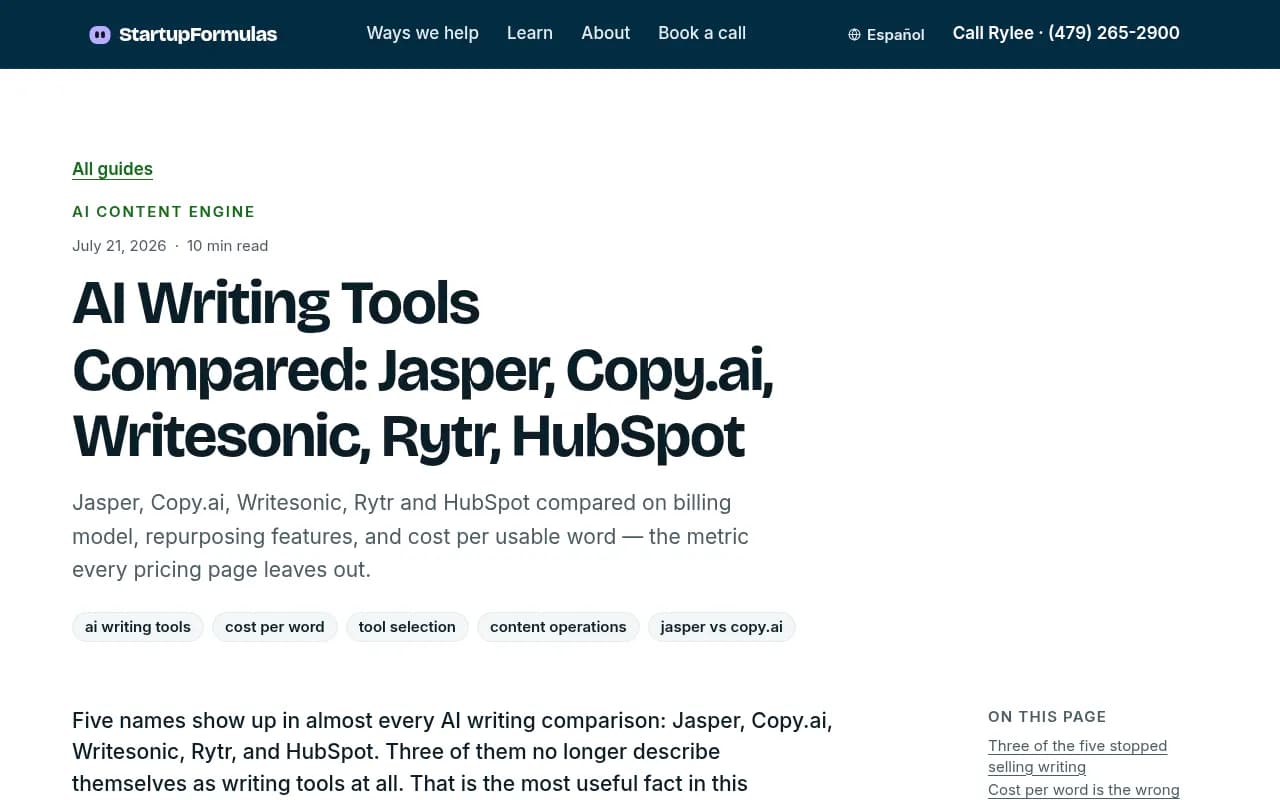
StartupFormulas makes the sharpest point in its comparison of the five big names: three of them have stopped describing themselves as writing tools. Jasper leads with marketing agents. Copy.ai calls itself a go-to-market platform. Writesonic's homepage is about winning customers from AI search. Drafting got cheap because any general model can produce a competent thousand words, so vendors moved up-stack and the writing became a feature inside something larger.
The consequence for buyers is that the numbers are denominated in different things. Seats, credits, tracked prompts, workflow credits, characters. None of these convert into each other. Any article that gives you one neat per-article price for all four is guessing.
So this guide does two things. It lists what each vendor charges as of the latest pages and third-party checks, and it gives you a way to estimate per-article cost on your own workload. Prices change often, so confirm on each vendor's pricing page before buying.
The four tools at a glance
| Tool | Entry price | What you are billed in | Article quota published? | Rough cost per article |
|---|---|---|---|---|
| Writesonic | $79/mo annual, $99/mo monthly (Starter) | Plan tier: articles, site audits, tracked prompts | Yes, 15 to 50 per month | About $5 to $8 |
| Jasper | Pro about $69/mo monthly, $59/mo annual (third-party figure) | Seats plus a credit meter for agent and GEO features | No | Depends on your volume |
| Copy.ai | $29/mo monthly, $24/mo annual (Chat) | Seats for Chat, workflow credits for higher tiers | No (unlimited words in Chat) | Plan price divided by your output |
| Rytr | Free, then $9/mo (Lite) | Characters, then connected sources and actions | No (unlimited on Lite) | Plan price divided by your output |
The last column is the honest one. Only Writesonic gives you a denominator.
Writesonic pricing

The old Writesonic pitch was cheap unlimited words. The vendor's own comparison page still says Unlimited starts at $16/month, but the live pricing page has moved on. It is now an AI search visibility platform page, and the plans are priced like one.
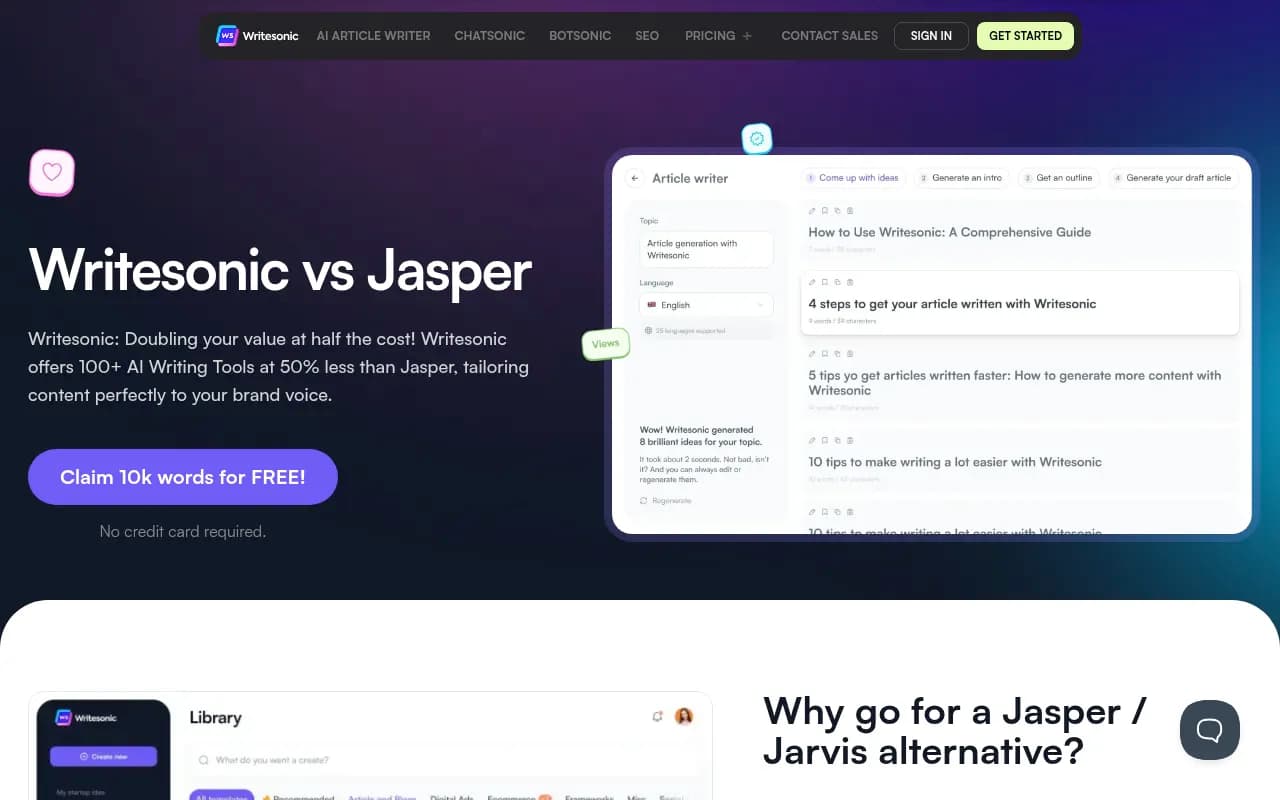
Treat that page as stale. Current self-serve plans, with annual billing saving 20%:
| Plan | Price (annual billing) | AI articles/mo | Site audits | Users | Prompts tracked |
|---|---|---|---|---|---|
| Starter | $79/mo | 15 | 10 | 1 | 50 |
| Basic | $199/mo | 25 | 20 | 2 | 100 |
| Growth | $399/mo | 50 | 50 | 3 | 200 |
| Enterprise | Custom | Custom | Custom | Custom | 9 AI platforms |
Monthly billing for Starter is $99, per the page's own meta description.
Cost per article on Writesonic
This is my arithmetic, not a vendor figure:
- Starter: about $5.27 per article on annual billing ($79 / 15), or $6.60 monthly ($99 / 15)
- Basic: about $7.96 per article ($199 / 25)
- Growth: about $7.98 per article ($399 / 50)
Notice that the per-article price goes up as you move to bigger plans. Starter is the best deal per article. The higher tiers are really buying you more prompts, users and projects. Those plans also pay for AI visibility tracking across ChatGPT, Gemini and Google AI Overviews, so if you only want articles, you are subsidizing features you may not use. If you do want the tracking, the real article cost is lower than the math above suggests.
One limit worth knowing: agentic workflows are trial runs only on every self-serve plan (10 on Starter, 50 on Basic, 100 on Growth).
Jasper pricing
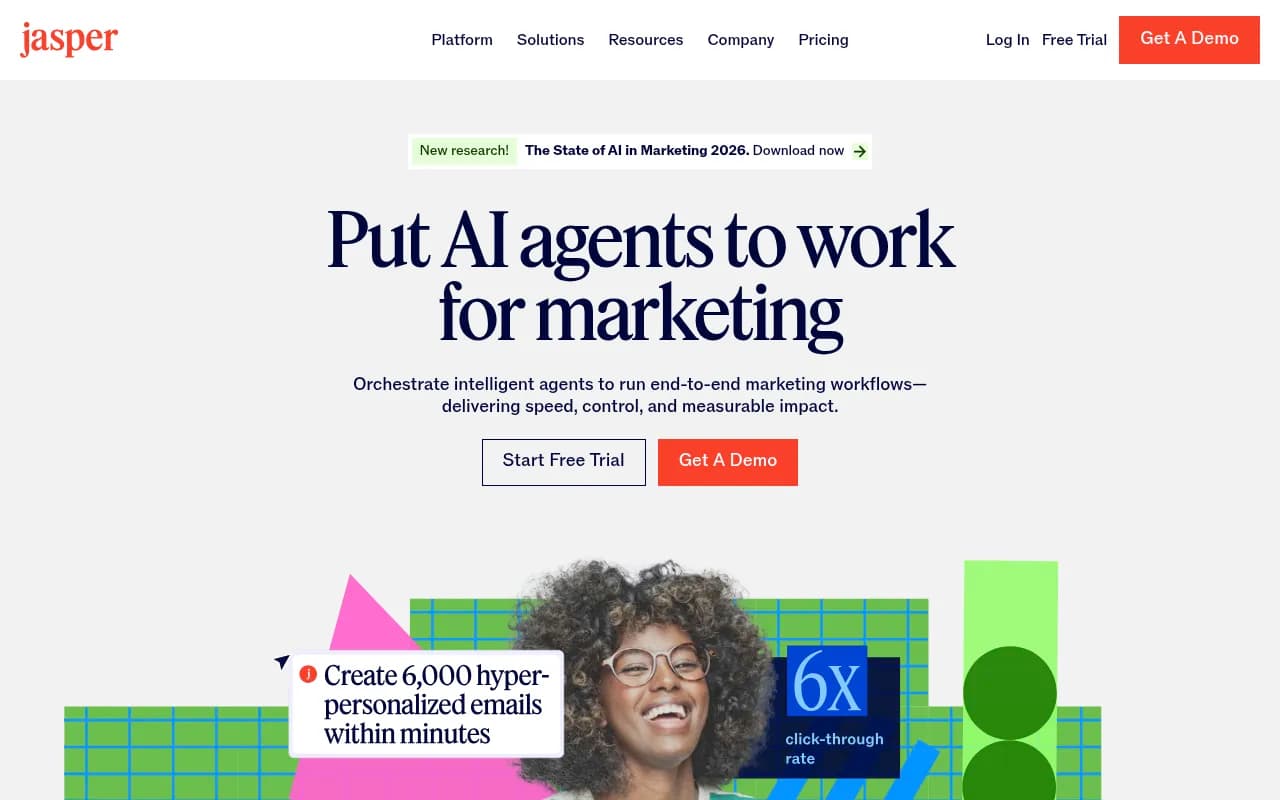
Jasper is the awkward one for this exercise. The pricing page I could fetch returned navigation text with no numbers, so treat the figures below as third-party data. Jasper's own meta description confirms two plans, Pro and Business, with a 7-day free trial.
According to youraisoft.com (checked 7 October 2026):
- Pro is $69/mo, or $59/mo billed yearly, for 1 seat
- Pro includes 2 brand voices, 5 knowledge assets and 3 audiences
- GEO agents and the API require Business, which is priced on request
There is also the credit meter. StartupFormulas describes Jasper as two bills in one: a per-seat subscription, plus credits that govern the newer agent and GEO features. The second bill moves with usage you cannot forecast in month one. Their warning is blunt, and I agree with it: if your team plans to lean on agents, budget a buffer and watch the first invoice.
Cost per article on Jasper
I cannot give you a clean number, because Jasper does not publish an article quota. If you write mostly with templates and brand voice on Pro, your cost per article is $59 to $69 divided by your monthly output. Ten articles puts you around $6 to $7. Forty articles drops it under $2. Once agents and credits enter the picture, the estimate gets fuzzy. Run the free trial with a real batch of briefs and read the credit usage.
Copy.ai pricing
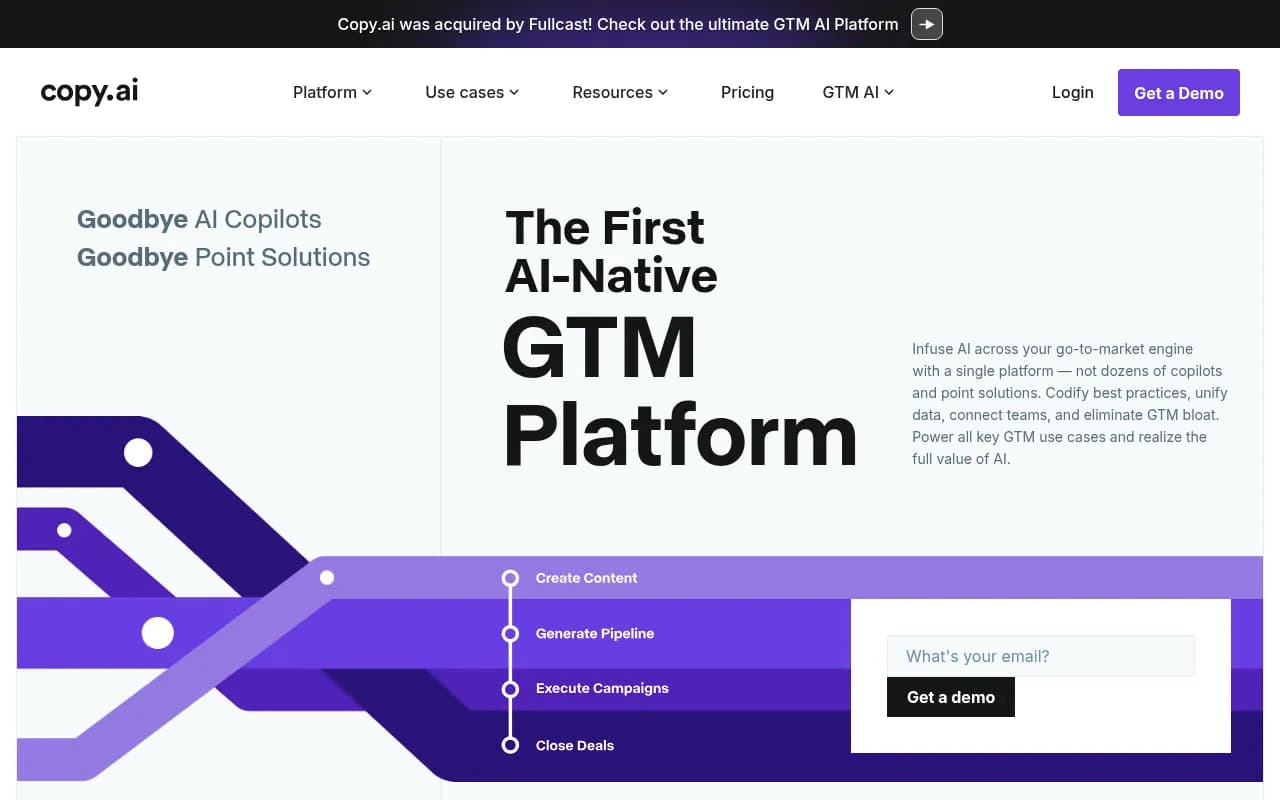
Copy.ai changed the most. The older plans that circulate in comparison posts, including the free tier and the $49/mo Pro plan with 5 users and unlimited words, are no longer listed. Copy.ai's own blog post still describes that Pro plan, which is a good reminder that vendor blogs go stale faster than pricing pages.
Current plans from the pricing page:
| Plan | Price | Seats | Workflow credits/mo |
|---|---|---|---|
| Chat | $29/mo monthly, or $24/mo billed $288/yr | 5 | n/a (unlimited words in Chat) |
| Growth | $1,000/mo, billed $12,000/yr | 75 | 20K |
| Expansion | $2,000/mo, billed $24,000/yr | 150 | 45K |
| Scale | $3,000/mo, billed $36,000/yr | 200 | 75K |
| Enterprise | Custom | Custom | API access, bulk workflow runs |
Cost per article on Copy.ai
The Chat plan is the interesting one for writers. Unlimited words in Chat, five seats, access to OpenAI, Anthropic and Gemini models, for $24 to $29 a month. Split across five people each writing ten articles a month, that is about 50 cents per article. It is a chat interface with brand features, though, not a content pipeline, so the editing and publishing work is still yours.
The jump from $29 to $1,000 a month is enormous. There is nothing in between. If you need workflows, you are buying a go-to-market platform, and at that point you should judge it against sales and marketing tooling, not against a blog writer.
Rytr pricing
Rytr is the one that still behaves like a writing tool, though even it has shifted. Its pricing page now sells a relationship-management angle ("Know who needs you") with writing as one feature. Older third-party posts list a $29 Premium plan. That plan is gone from the page I checked.
| Plan | Price | What you get |
|---|---|---|
| Free | $0 | 10,000 characters/mo, 40+ use cases, 30+ languages |
| Lite | $9/mo | Unlimited characters |
| Personal | $19/mo (most popular) | Adds 2 connected sources, 250 active relationships, 250 Engage actions per month |
| Pro | $49/mo | All connected sources, 1,000 relationships, 2,000 Engage actions, briefings, custom use cases |
Yearly billing saves 20%.
Cost per article on Rytr
The free tier gives you 10,000 characters, which is roughly 1,500 to 2,000 words. That is one or two short articles a month. Fine for testing, useless for a content calendar.
On Lite at $9, characters are unlimited. Write 20 articles and you are at 45 cents each. Write 5 and it is $1.80. The weakness is not the price but the output: Rytr's drafts are shorter and thinner than what the heavier platforms produce, so expect more editing per piece. The extra tiers (Personal, Pro) mostly pay for relationship-management features that a pure blogger will not touch, so most writers should stop at Lite.
Cost per article is the wrong metric on its own
Here is where I would push back on all the tables above, including mine.
Generated words are not the deliverable. Published words are. A tool that produces twice the volume at half the price loses if its drafts need three times the editing, because the expensive input in content operations has always been your team's attention, not generation. StartupFormulas makes the same argument and it holds up.
A more useful formula:
true cost per article = (monthly plan cost / articles published)
                      + (editor hours per article x hourly rate)
                      + any fact-checking and image costs
Take an editor at $40/hour. If Rytr drafts need 90 minutes of cleanup, that is $60 of labor on a $1 tool cost. If Writesonic's drafts need 45 minutes, that is $30 plus about $6 of plan cost. The pricier tool is cheaper in practice. Your results will differ, which is exactly why you should test with your own briefs.
A simple test to run before you buy
- Pick five real briefs from your backlog, ideally of different lengths.
- Run each through every tool on a free trial or free tier.
- Time the edit to publishable quality, not the generation.
- Note credit or quota consumption in each dashboard.
- Multiply by your expected monthly volume.
This takes an afternoon and tells you more than any pricing page.
Which one fits which situation
| Your situation | Best fit | Why |
|---|---|---|
| Solo blogger, tight budget | Rytr Lite | $9 for unlimited characters |
| Small team that mostly drafts in chat | Copy.ai Chat | 5 seats for $24 to $29/mo |
| Team that wants articles plus AI search tracking | Writesonic Starter or Basic | Published article quota, $5 to $8 each |
| Marketing team that needs brand voice and agents | Jasper Pro, then Business | Brand voices and agents, but watch the credit meter |
| Sales and marketing ops at scale | Copy.ai Growth and up | Workflow credits, 75+ seats, from $1,000/mo |
Cheaper or more focused alternatives
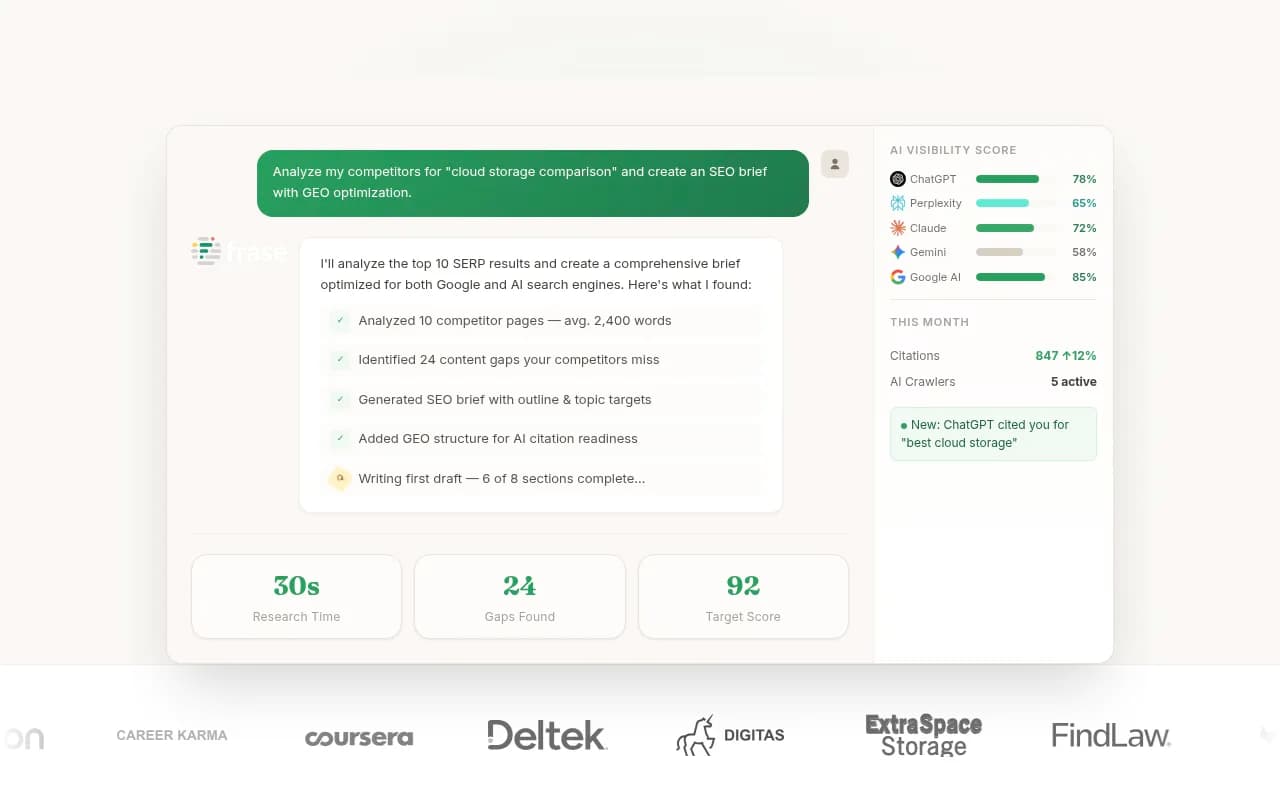
If the four names above do not fit, a few tools in the catalog are built more narrowly around SEO articles. Byword sells SEO articles at scale, and Surfer SEO and Frase pair writing with optimization data.
For a wider look at general software options, the directory at surferstack.com lists more writing and content tools with reviews and comparisons.
One more thing: pay attention to what the plan is really for
Writesonic and Jasper both now sell GEO, meaning visibility inside ChatGPT, Gemini and AI Overviews. That is a real need, and the plans bundle some tracking. If AI visibility is the thing you care about, though, look at dedicated platforms too. Promptwatch tracks how brands appear across ChatGPT, Google AI Overviews, Perplexity, Gemini and others, and has a Content Agent that writes and publishes against the gaps it finds. Promptwatch Data has also found that citation behavior shifts quickly. For example, ChatGPT's share of citations from social platforms was just 0.46% in the week of Sep 28 to Oct 4, 2026, while Google AI Overviews got 12.2%. A tool that generates articles without that kind of data behind it is guessing at what AI engines will cite.

You can compare more options in the GEO software directory at bestgeosoftware.com.
Bottom line
If you want the cheapest raw drafts, Rytr Lite at $9 wins and it is not close. If you want a published article quota with tracking attached, Writesonic Starter at about $5.27 per article on annual billing is the clearest number in this category. Jasper and Copy.ai cannot be reduced to a per-article price without knowing your volume and how much you lean on credits and workflows. Run the five-brief test, time your edits, and confirm every number on the vendor's pricing page before you pay.