Key takeaways
- Country and language are two separate settings. A Spanish prompt from Spain, Mexico and the US can produce three different answers, so track them as separate monitors.
- Being visible in English does not carry over. Each language has its own prompts, its own competitors and its own sources, so each needs its own baseline.
- ChatGPT cites only about 5 sources per web-search answer, according to Promptwatch's average sources per response data, so every local-language slot is contested.
- Start small: 20 to 30 native-language prompts per market, run daily, and fix crawler access and on-page language signals before you write anything new.
- Pick a tool that tracks real ChatGPT answers per country and language, not just translated English prompts through an API.
Why English tracking misses most of Europe
Most European startups check their AI visibility the lazy way. Someone types "best project management software for startups" into ChatGPT, sees the brand (or doesn't), and moves on. That tells you almost nothing about what a founder in Munich, Lyon, Utrecht or Valencia sees when they ask the same question in their own language.
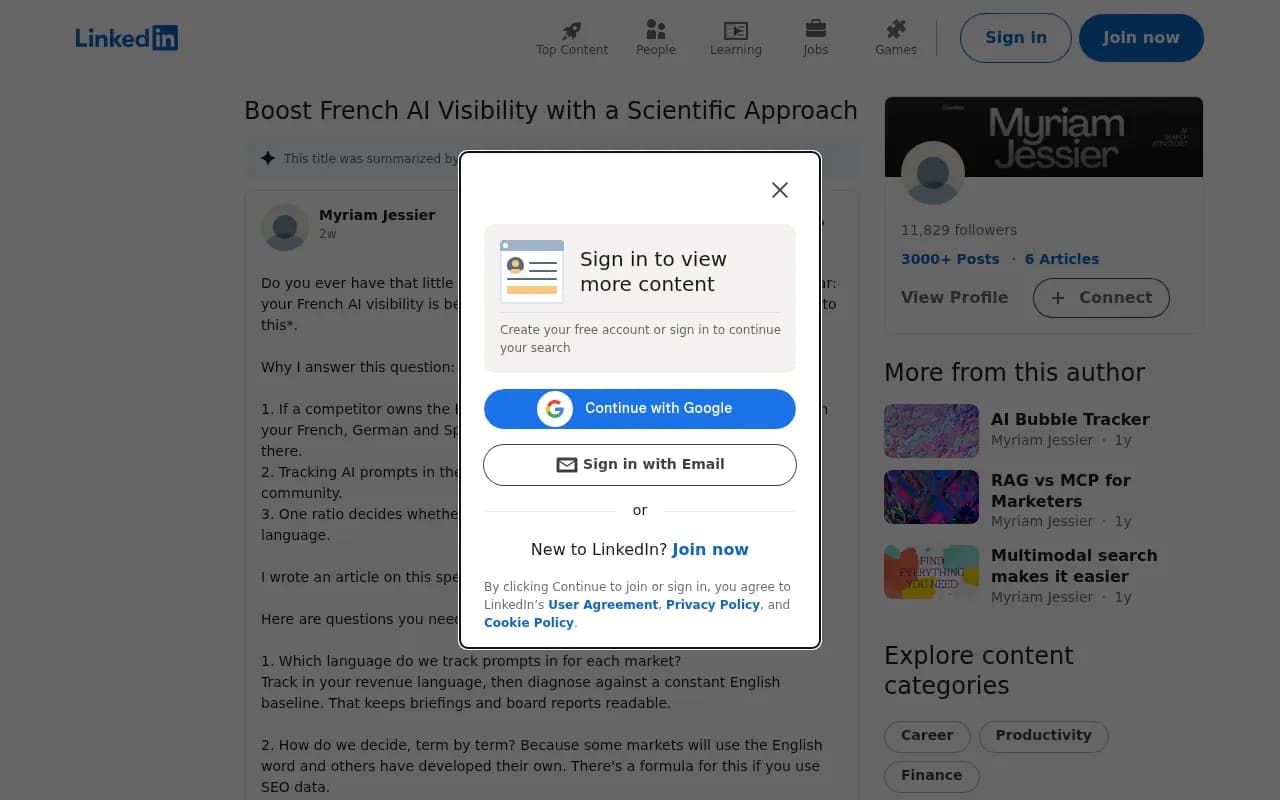
The prompts differ, the competitors differ, and the sources differ. A German buyer might ask for "die beste Buchhaltungssoftware fuer kleine Unternehmen" and get a list dominated by local vendors and German review sites you have never heard of. The English answer may be full of US brands. If a competitor owns the English coverage of your topic, they can bleed into the German, French and Spanish answers too, as one LinkedIn post by Myriam Jessier puts it. But that is a tendency, not a guarantee, and you only learn which way it goes by measuring.
I'll be upfront about one thing. I could not find independent, large-scale data that splits ChatGPT citations by language, and Promptwatch Data does not currently publish a German, French, Dutch or Spanish breakdown either. So treat the advice below as a working method built on how ChatGPT retrieves content, not a set of proven per-language benchmarks. Measure your own markets.
How ChatGPT answers differ by language and country
Two variables matter, and people constantly mix them up.
- Language is the language of the prompt and the response.
- Country is the market context the answer is tuned for.
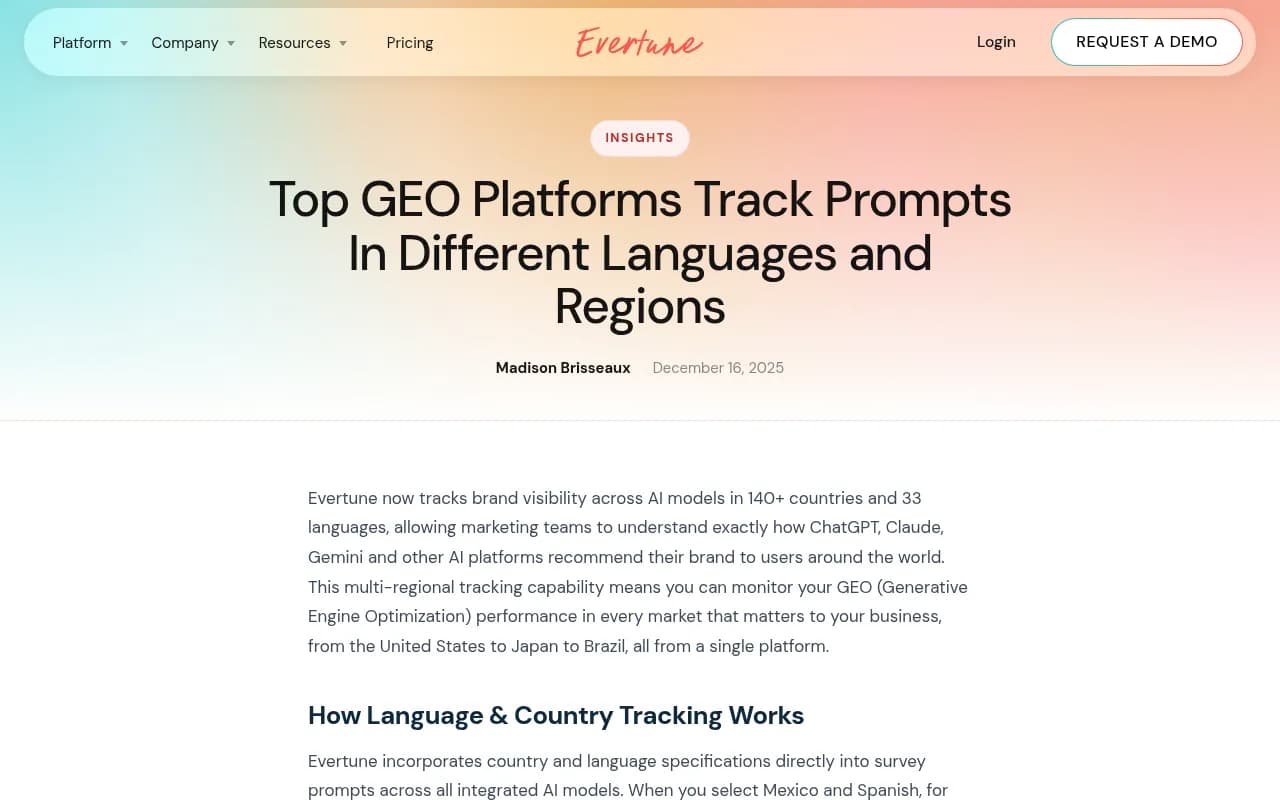
Evertune's documentation on multi-region tracking makes the distinction clearly: choose Mexico and Spanish and you measure how models answer Spanish speakers in Mexico. Evertune's post says it covers 140+ countries and 33 languages, with country and language built into the prompts sent to each model.
For a European startup this has practical consequences:
- German can mean Germany, Austria or Switzerland. Pricing, regulation and local competitors differ across all three.
- French covers France, Belgium and Switzerland, plus a large Canadian audience you may not care about.
- Dutch covers the Netherlands and Flanders. The Dutch market is small enough that a handful of sources can dominate answers.
- Spanish for Spain is not Spanish for Mexico or Argentina. Pick the market you sell into.
Query fan-outs happen in the local language
When ChatGPT searches the web to answer you, it fires off its own short queries. Promptwatch's ChatGPT query fanout data shows an average of roughly 2.15 web searches per response in early December 2026 data that eased to about 1.84 by March, and average query length shrank from about 117 characters to the high 80s. The report is language-agnostic, so what follows is my inference: those searches are short and keyword-like, which means your page titles and headings need to match how locals actually phrase the search. A literal translation of your English H2 is rarely it. "Rechnungssoftware" and "Buchhaltungssoftware" are not interchangeable, and one probably matches your buyers better.
Does translated content get cited?
The practical question is whether you can machine-translate your site and call it done. Quality is rarely the problem for the big four languages. A review of translation quality by Aikwit concludes that for German, French, Spanish, Italian, Dutch and Portuguese, AI translation is now very strong, good enough for first drafts, SEO localization drafts and product copy drafts. DeepL, ChatGPT, Claude and Gemini can all produce excellent drafts.
The real gap is localization, not grammar. A fluent translation of an English article still:
- uses examples and competitors nobody in that market knows
- ignores local regulation, payment methods and currency
- targets keywords people in that country don't search
- lacks the local sources (review sites, associations, news outlets) AI trusts for that market
One anecdotal test on r/seogrowth reported that a few pages translated from English into Spanish got pulled into ChatGPT citations. It is a small, unverified sample, but it matches my experience: translated pages can get cited when the language is clean and the page is crawlable. They just compete against native pages written for that market.
Step 1: build a native-language prompt set
Do not translate your English prompt list word for word. Write the prompts the way a buyer in each country would type them.
- Pick one to three markets first. For most B2B startups that is Germany, France and either the Netherlands or Spain.
- For each market, write 20 to 30 prompts across three types: category discovery ("beste CRM fuer Startups"), comparison ("HubSpot vs Pipedrive" in the local phrasing) and brand-specific ("is [your brand] goed?").
- Ask a native speaker or a sales rep in the market to rewrite them. Five minutes of their time beats an hour of guessing.
- Add local intent: GDPR, EU hosting, local invoicing, local integrations. European buyers raise these early.
- Tag each prompt with country, language and funnel stage so you can slice the data later.
If you want question ideas in your own language, tools like AnswerThePublic and AlsoAsked can surface how people phrase things, and Google Search Console shows the real queries already bringing people to your localized pages.
Step 2: choose a tracking tool that handles country and language
Not every AI visibility tool treats language properly. Some translate the interface only. Some run prompts through an API with a system prompt saying "respond in German", which can differ from what a real user sees in ChatGPT. Ask any vendor three questions: are answers collected from the real ChatGPT interface, can I set country and language independently, and can I see which sources were cited in each language?
Promptwatch monitors the actual user interfaces of ChatGPT, Google AI Overviews, Google AI Mode, Gemini, Perplexity and others, per country and language, and every paid plan includes country tracking. It also shows the sources cited per prompt, which is what you need to find the local review sites and publishers worth targeting. Its Content Agent writes in the prompt's language, which helps once you move from measuring to publishing.

A few other options worth knowing about, depending on budget and focus:
| Tool | Language and country angle | Best for |
|---|---|---|
| Promptwatch | Real-UI tracking per country and language, citation sources, crawler logs, content agent in the prompt's language | Startups that want to track and then fix gaps |
| Evertune | 33 languages, 140+ countries, country and language set per prompt | Enterprise brands tracking many markets |
| Teun.ai | Dutch-focused toolkit with free rank checks | Netherlands-only or Dutch-first startups |
| Peec AI | Multi-country prompt monitoring, monitoring only | Teams that only need dashboards |
| Otterly.AI | Affordable prompt tracking | Small budgets, basic checks |
| Qwairy | GEO monitoring with optimization features | Agencies and mid-size teams |
Check each vendor's current language list yourself. Evertune's list in the scraped post was cut off, so confirm Spanish is covered before you commit. For more options, the directory at bestgeosoftware.com lets you filter GEO platforms by feature.


On EU requirements: if you sell to larger European companies, expect questions about GDPR and security certification. Promptwatch is ISO/IEC 27001 certified and GDPR compliant, which tends to save a round of procurement emails. Guides like 3RD's European buyer checklist are worth skimming for EU hosting and AI Act questions, though they come from a vendor, so read them with that in mind.
Step 3: read the numbers per market
Once data is flowing, resist the urge to average everything into one global score. Compare markets side by side.
- Low Share of Voice in one language means a coverage problem. You are simply not in the answer set for those prompts.
- Late position when you are mentioned is a prominence problem. Your content exists but sources rank others first.
- Mentions without citations of your own domain point to content or crawlability trouble.
- Weak sentiment usually traces back to a handful of third-party pages. Find them.
The most useful single view is the list of cited domains per country. In a Dutch prompt set you might find the answer set is dominated by three local comparison sites and a forum. That is your target list. Pitching those three sites can beat writing ten new blog posts.
It also helps to remember the source budget. With about 5 citations per ChatGPT web-search answer, and almost half of ChatGPT responses citing 10 or more unique domains according to Promptwatch's unique domains report (the two figures cover different measures and periods, so don't read them as contradictory), you are always fighting for a few slots. Smaller language markets tend to have fewer qualifying pages per topic, which can make the slots easier to win. That is an assumption worth testing, not a rule.
Step 4: fix the basics before writing more content
Before you commission 40 new pages, check why your existing localized pages might be invisible.
Crawl access
Confirm AI crawlers can read your localized pages. Many startups put the German site behind a JavaScript language switcher, geo-redirect or cookie wall that bots cannot pass. IP-verified crawler logs, which Promptwatch provides, show whether GPTBot, OAI-SearchBot and ChatGPT-User actually reach /de/ or /fr/ and what errors they hit. A free option is checking your robots.txt and server logs by hand. Also look at Promptwatch's AI crawler traffic data to see which bots are active.
Language signals
- Use hreflang tags correctly, with country variants where content really differs (de-DE, de-AT, de-CH).
- Give each language its own URL path or domain. Avoid serving language by cookie.
- Translate titles, headings, meta descriptions and schema markup, not just body text.
- Keep one language per page. Mixed-language pages confuse both people and retrieval.
Heading phrasing
Because ChatGPT's fan-out queries are short and keyword-like, write headings that read like the query a local would type, leading with the entity and category. Test by asking ChatGPT the question in that language and seeing which phrasing the cited pages use.
Step 5: localize, then publish
For the content itself, a workable split for a small team:
- Machine-translate the first draft with DeepL or a model of your choice. For German, French, Spanish and Dutch the quality is high enough to start from.
- Have a native speaker edit for terminology and tone. Tools like LanguageTool catch grammar slips in all four languages.
- Swap in local examples, local competitors, local prices and local regulation.
- Add proof that local buyers trust: local customer names, local certifications, local review site profiles.
- Link the page to its siblings in other languages.
What to prioritize? Promptwatch Data on ChatGPT content types shows product pages were the most cited type at 22.4% of citations between Sep 28 and Oct 4, 2026, followed by landing pages and listicles. In practice that means localized product and landing pages come before localized blog posts. And according to Promptwatch's content half-life report, landing pages and docs stayed cited longest while news lost half its pages within 36 days, so evergreen pages are the better investment per language.
For software startups specifically, Promptwatch's software citation data shows GitHub, Microsoft docs and G2 leading, with documentation and help centers taking the biggest share. Translated documentation is therefore worth more than you might expect.
Step 6: a 90-day plan
| Weeks | Focus | Output |
|---|---|---|
| 1 to 2 | Prompt set and baseline | 20 to 30 native prompts per market, first Share of Voice and citation data |
| 3 to 4 | Technical fixes | Crawler access verified, hreflang cleaned, localized titles and headings |
| 5 to 8 | Core pages | Localized product, pricing and comparison pages, translated docs |
| 9 to 10 | Off-site | Pitches to the top three local sources cited per market, review site profiles |
| 11 to 12 | Review | Compare week 1 against week 12 per market, kill what did not move |
You do not need to launch all four languages at once. Pick the market where you have the most customers or the weakest competition, win it, then copy the playbook. A team that has done this once usually ships the second language in half the time.
Common mistakes
- Tracking only translated English prompts. Real users phrase things differently, and sometimes ask in a mix of English and their own language.
- Treating Spanish, German or French as one market. Spain is not Mexico, Germany is not Switzerland.
- Judging results after one week. Answers vary run to run, so look at trends across daily runs.
- Translating everything. A smaller set of well-localized, crawlable pages usually beats a large pile of literal translations.
- Ignoring the sources. In many local markets the road to a citation runs through a third-party site, not your own blog.
If you would rather hand parts of this to specialists, agencies such as 1001 SEO Media run multilingual SEO and GEO work for European brands. For the research itself, a good starting point is the free report library at promptwatch.com/data, and for ranked tool lists the AI rank tracker directory is a useful second stop.
What to do this week
Write 10 prompts in German, 10 in French, 10 in Dutch and 10 in Spanish, as a native speaker would type them. Run them in ChatGPT with the right country, note who is cited, and write down the three domains that appear most often. That list tells you more about your multilingual visibility than any English dashboard will, and it is the first thing worth fixing.