Jasper AI Review 2026
Create long-form content with SEO-tuned templates and AI assistance. Popular among content marketers for producing articles, blog posts, and copy at scale.
Summary
- Enterprise AI marketing platform used by 6,700+ brands including Boeing, Wayfair, L'Oréal, and Anthropologie
- Automates entire content lifecycle with AI agents and content pipelines -- not just a writing assistant
- Strong brand control features (Brand Voice, Visual Guidelines, Style Guide) ensure consistency at scale
- Covers SEO/AEO/GEO optimization, campaign creation, personalization, and localization workflows
- Pricing starts at $59/month (Creator) but real value is in Pro ($69/mo) and custom Business/Enterprise tiers
- Best for mid-to-large marketing teams that need to scale content production while maintaining brand quality
- Lacks the AI search visibility tracking and content gap analysis that platforms like Promptwatch provide -- Jasper creates content but doesn't show you what's missing or track how AI models cite your brand
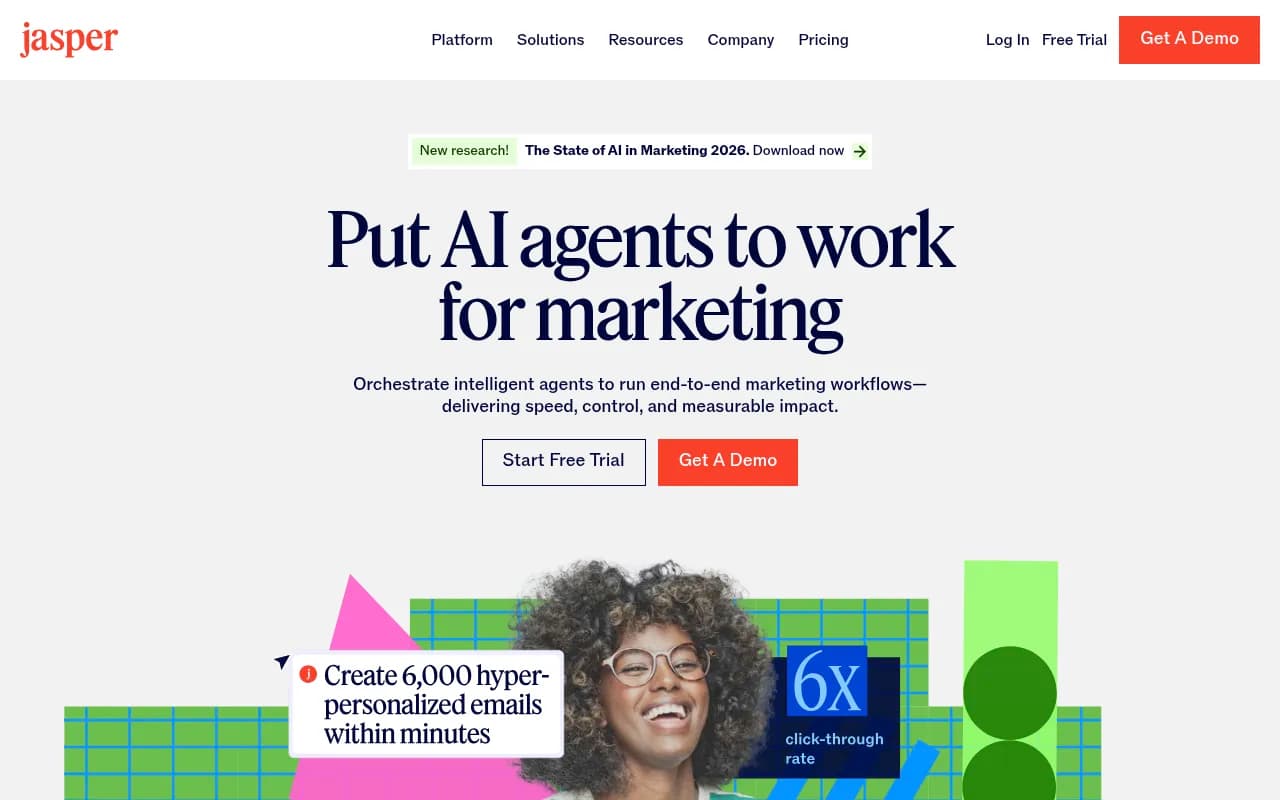
Jasper AI started as a simple AI writing tool back when GPT-3 first launched, but it's evolved into something much bigger. In 2026, it's positioning itself as an "agent workspace" for marketing teams -- a platform where AI agents handle entire workflows, not just generate text. The company has raised significant venture funding and counts major enterprises like Boeing, Cushman & Wakefield, and HarperCollins among its customers. The shift from "AI writing assistant" to "marketing execution platform" is real, and it shows in the product.
The core idea: marketing teams waste massive amounts of time on repetitive content tasks. Jasper's answer is Content Pipelines -- automated workflows that connect your data, brand guidelines, and distribution channels into a single system. You feed in a campaign brief or product data, and Jasper's agents generate blog posts, social captions, ad copy, landing pages, press releases, and localized variants without manual intervention at each step. It's less about prompting an AI to write one thing and more about setting up systems that produce hundreds of assets on autopilot.
Canvas: The Core Workspace
Canvas is Jasper's main interface -- a collaborative document editor where teams plan, draft, and refine content. Think Google Docs meets AI co-pilot. You can outline a blog post, tag teammates for feedback, run AI commands inline (rewrite this paragraph, expand this section, generate a meta description), and track version history. The AI understands your brand context (more on that below) so outputs match your voice and style without heavy editing.
Canvas supports long-form content like 3,000-word SEO articles, but also short-form assets like email subject lines and social posts. The interface is clean and the AI responses are fast. You're not waiting 30 seconds for a paragraph -- it streams in real-time. The collaboration features (comments, @mentions, shared workspaces) make it viable for teams, not just solo creators.
Agents: Specialized AI Workers
Jasper has 100+ pre-built agents designed for specific marketing tasks. There's an SEO Blog Agent that researches keywords, outlines articles, and writes drafts optimized for search. A Social Media Campaign Agent that generates cohesive posts across platforms. An Ad Campaign Agent for Google/Meta ads. A Localization Agent that adapts content for different markets and languages. A Press Release Agent. A Landing Page Agent. You get the idea.
Each agent is more than a template -- it's a workflow. The SEO agent, for example, can pull keyword data, analyze competitor content, generate an outline based on search intent, write the article, suggest internal links, and create meta tags. You review and approve at each stage, but the heavy lifting is automated. For teams producing 50+ blog posts a month, this is a game-changer.
The agents are configurable. You can adjust tone, length, target audience, and which brand voice to use. Enterprise customers can build custom agents in Studio (Jasper's no-code builder) that combine multiple steps into a single workflow. For example: "Take this product launch brief, generate a press release, create 10 social posts, write ad copy for Google and Meta, and localize everything for UK, Germany, and France." One click, done.
Studio: Build Your Own Agents
Studio is Jasper's no-code interface for creating custom AI apps and workflows. If the pre-built agents don't fit your exact process, you can design your own. The interface uses a drag-and-drop builder where you chain together prompts, data inputs, brand guidelines, and output formats. You can pull in external data (via API or CSV), apply conditional logic (if X then Y), and route outputs to different channels.
Example use case: A SaaS company wants to generate personalized email sequences for each new trial signup. They build a Studio workflow that pulls user data from their CRM, generates a 5-email sequence tailored to the user's industry and use case, applies their brand voice, and exports the emails to their marketing automation tool. No developer required.
Studio is powerful but has a learning curve. It's not as intuitive as Canvas. You need to understand how to structure prompts and data flows. Jasper offers training and templates to help, but expect a few hours of experimentation before you're building complex workflows. Once you get it, though, it unlocks serious automation potential.
Grid: Bulk Content at Scale
Grid is Jasper's spreadsheet interface for generating content in bulk. You upload a CSV with product names, descriptions, and metadata, then use AI to generate unique copy for each row. E-commerce teams use this for product descriptions. SEO teams use it for meta tags and title variations. Agencies use it for client reports.
The interface looks like Google Sheets but with AI commands built in. You can apply formulas like "Generate a 50-word product description using Brand Voice A" to an entire column. Grid handles hundreds or thousands of rows without breaking. Adidas famously used Jasper to write 7,500 product descriptions in 24 hours -- that was Grid.
Grid also supports image generation. You can bulk-create product images, social graphics, or ad visuals by feeding in prompts and parameters. The output quality depends on your prompts and Jasper's image models (which are decent but not Midjourney-level). Still, for teams that need 500 product images yesterday, it's a lifesaver.
Jasper IQ: The Brand Context Engine
This is what separates Jasper from generic AI tools. Jasper IQ is a context hub that stores your brand voice, visual guidelines, style rules, audience personas, product info, and marketing knowledge. Every time an agent generates content, it references this context to ensure outputs are on-brand.
Brand Voice lets you upload writing samples (blog posts, emails, landing pages) and Jasper analyzes the tone, vocabulary, sentence structure, and style. You can create multiple voices -- one for your blog, one for social, one for ads. When generating content, you select which voice to use and Jasper matches it. The accuracy is impressive. It's not perfect (no AI is), but it's close enough that edits are minor, not rewrites.
Visual Guidelines store your logo, color palette, fonts, and design rules. When generating images or suggesting layouts, Jasper references these to keep visuals consistent. You can also upload brand assets (product photos, icons, templates) that agents can pull into content.
Style Guide defines grammar rules, terminology preferences, and formatting standards. For example: "Always capitalize 'Internet', never use Oxford commas, refer to customers as 'members' not 'users'." Jasper enforces these rules automatically. This is huge for enterprises with strict editorial standards.
Marketing IQ is a knowledge base of audience insights, conversion best practices, and campaign data. You can upload customer research, competitor analysis, or performance reports, and agents will reference this when creating content. For example, if you tell Jasper that your audience is "B2B SaaS founders worried about churn," it tailors messaging to that persona.
The IQ layer is what makes Jasper viable for enterprises. Without it, you're just prompting a generic LLM. With it, you're training an AI that understands your brand as well as a junior marketer.
Content Pipelines: End-to-End Automation
Content Pipelines are Jasper's newest feature (launched late 2025). They connect data sources, AI agents, and distribution channels into automated workflows. Think Zapier meets AI content generation.
Example pipeline: A product marketing team wants to launch a new feature. They create a pipeline that:
- Pulls feature specs from their product roadmap (via API)
- Generates a blog post, press release, and social posts using the SEO and PR agents
- Localizes everything for 5 markets
- Publishes the blog post to their CMS
- Schedules social posts in their social tool
- Sends the press release to their media list
All of this happens automatically when the product team marks the feature as "ready to launch" in their roadmap tool. No manual handoffs. No copy-pasting between tools. Just data in, content out.
Pipelines are enterprise-only and require setup (you need to connect APIs and configure workflows), but for teams launching dozens of campaigns a year, the ROI is massive. Jasper claims customers save 10,000+ hours annually with pipelines. That tracks.
Image Suite: AI Visuals
Jasper's Image Suite generates images using proprietary vision models. You can create product photos, social graphics, ad visuals, and illustrations. The models are trained to follow brand guidelines (colors, style, composition) and generate on-brand visuals at scale.
The quality is good but not exceptional. For hero images or high-stakes creative, you'll still want a designer. For social posts, blog headers, and ad variants, it's more than adequate. The real value is speed -- you can generate 50 variations of an ad visual in minutes and A/B test them.
Image Suite also supports editing (change background, adjust colors, add text) and upscaling. It's not Photoshop, but it's enough for most marketing use cases.
SEO, AEO & GEO Capabilities
Jasper markets itself as an SEO/AEO/GEO optimization tool, but this is where it falls short compared to specialized platforms. Jasper can generate SEO-optimized content (keyword research, meta tags, internal linking suggestions), but it doesn't track your visibility in AI search engines like ChatGPT, Perplexity, or Google AI Overviews. It doesn't show you which prompts competitors rank for or what content gaps you have. It creates content, but it doesn't tell you what to create.
This is where a platform like Promptwatch comes in. Promptwatch monitors your brand's visibility across 10+ AI models, identifies content gaps (prompts competitors rank for but you don't), and helps you prioritize what to write. Jasper can then generate that content, but you need Promptwatch (or a similar tool) to know what's missing in the first place. Jasper also lacks AI crawler logs, citation tracking, and traffic attribution -- all critical for understanding how AI models discover and cite your content.
If your goal is to rank in AI search, you need both: Promptwatch to find the gaps and track results, Jasper to create the content at scale.
Integrations & Ecosystem
Jasper integrates with Google Docs, Notion, WordPress, HubSpot, Salesforce, Slack, and dozens of other tools via API and native connectors. The Chrome extension lets you use Jasper inside Gmail, LinkedIn, and other web apps. There's no mobile app, which is a miss for teams that work on the go.
The API is robust and well-documented. Developers can build custom integrations or embed Jasper into their own tools. Enterprise customers use the API to connect Jasper to their CMS, DAM, and marketing automation platforms.
Jasper also has a partner ecosystem of agencies and consultants who help with setup, training, and custom workflows. If you're a mid-market or enterprise team, hiring a partner to configure Jasper is worth it -- the platform is powerful but complex.
Pricing & Value
Jasper offers three tiers:
Creator Plan ($59/month billed annually, $69/month billed monthly): 1 brand voice, 1 user seat, unlimited AI-generated words, access to Canvas and basic agents. Good for solopreneurs or very small teams, but limiting for anyone doing serious content marketing.
Pro Plan ($69/month billed annually, $79/month billed monthly): 3 brand voices, 5 user seats, advanced agents (SEO, campaigns, personalization), collaboration features, priority support. This is the sweet spot for small-to-mid-sized marketing teams (5-20 people). Most customers land here.
Business Plan (custom pricing): Unlimited brand voices and seats, custom agents, Content Pipelines, API access, dedicated customer success manager, SLA guarantees. Starts around $500/month but scales based on usage and team size. Enterprise customers (100+ employees) typically pay $2,000-$10,000+/month depending on volume.
There's a 7-day free trial (no credit card required) so you can test before committing. Annual billing saves 15-20%.
Value-wise, Jasper is expensive compared to generic AI tools (ChatGPT Plus is $20/month), but cheap compared to hiring writers or agencies. If you're producing 50+ pieces of content a month, the ROI is clear. If you're writing 5 blog posts a quarter, it's overkill.
Who Should Use Jasper
Jasper is built for mid-to-large marketing teams (10-500 people) at B2B SaaS companies, e-commerce brands, agencies, and enterprises. Specific personas:
- Content marketing teams producing 20+ blog posts, guides, and resources per month
- Product marketers launching features and need to generate launch assets (blog, press release, social, ads, emails) quickly
- Performance marketers running hundreds of ad variants and need to test copy at scale
- E-commerce teams managing thousands of product descriptions and need bulk generation
- Agencies managing multiple clients and need to maintain brand consistency across accounts
- Global brands localizing content for 10+ markets and languages
Jasper is overkill for solo bloggers, freelance writers, or small businesses publishing sporadically. If you're writing 1-2 blog posts a month, use ChatGPT or Claude directly. If you're scaling content to 50+ pieces a month and need brand control, Jasper makes sense.
Strengths
- Brand control is best-in-class. The Brand Voice, Style Guide, and Visual Guidelines features ensure consistency at scale. No other AI platform matches this.
- Agent library is extensive. 100+ pre-built agents cover most marketing use cases. You're not starting from scratch.
- Content Pipelines automate the entire lifecycle. From brief to publication, Jasper handles it. This is the future of marketing ops.
- Enterprise-grade security and governance. SOC 2 compliant, GDPR-ready, role-based permissions, audit logs. IT teams can trust it.
- Collaboration features are solid. Teams can work together in Canvas without stepping on each other's toes.
- Customer success and training are strong. Jasper invests heavily in onboarding and support. You're not left to figure it out alone.
Limitations
- No AI search visibility tracking. Jasper creates content but doesn't show you what's missing or how AI models cite your brand. You need a tool like Promptwatch for that.
- Steep learning curve for advanced features. Studio and Content Pipelines require time to master. Expect a few weeks of ramp-up.
- Image quality is good but not great. For high-stakes creative, you'll still need a designer. The Image Suite is best for volume, not perfection.
- Pricing is opaque for Business/Enterprise. You have to talk to sales to get a quote, which slows down evaluation.
- No mobile app. If your team works on phones or tablets, you're out of luck.
Bottom Line
Jasper AI is the best AI marketing platform for teams that need to scale content production while maintaining brand quality. The combination of agents, pipelines, and brand control features is unmatched. If you're a mid-to-large marketing team producing 50+ pieces of content a month, Jasper will save you hundreds of hours and thousands of dollars.
But Jasper is a creation tool, not a visibility tool. It doesn't track how AI models cite your brand or identify content gaps. For that, you need Promptwatch. The ideal stack: Promptwatch to find gaps and track AI visibility, Jasper to create the content at scale. Together, they cover the full loop -- insight to execution to measurement.
If you're a solo creator or small team publishing sporadically, Jasper is overkill. Stick with ChatGPT or Claude. But if you're serious about scaling content marketing in 2026, Jasper is worth the investment.
Tags:
Similar and alternative tools to Jasper AI