AlsoAsked Review 2026
Maps Google's People Also Ask questions into visual clusters to help structure content that AI and search engines favor.
Key takeaways
- AlsoAsked is the best dedicated tool for mining Google's People Also Ask data. Live PAA scraping, branching question trees and Deep Search runs that average around 150 questions per query put it far ahead of Chrome extensions or cached keyword databases.
- Pricing is almost embarrassingly reasonable: paid plans run $12 to $47 per month, and every tier includes unlimited users. Unregistered visitors get a few free daily searches, enough to kick the tires.
- It is a research input, not a measurement tool. No search volumes, no rank tracking, no AI visibility monitoring. You still need a keyword tool for volumes, and something else entirely if you want to know whether AI answers actually cite you.
- Best for content strategists, SEO consultants and agencies building briefs, and international teams who need question data at city and language level.
- One honest caveat: PAA as a SERP feature is being absorbed by AI Overviews. The question data still matters, arguably more than ever, but the surface it comes from is changing.
What AlsoAsked actually does
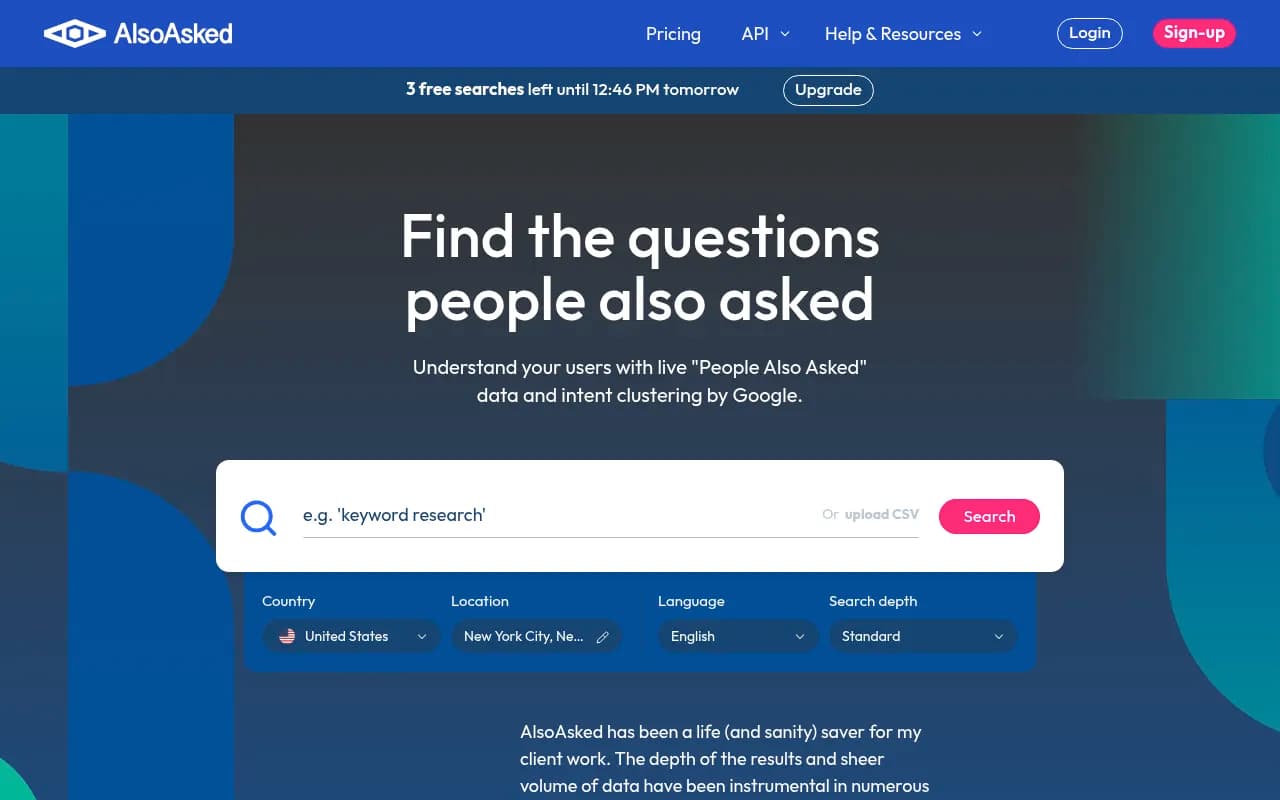
Most keyword tools show you a cached database of what people searched last month. AlsoAsked scrapes Google's live People Also Ask box and expands it the way a real user would, clicking question after question, three to four levels deep. What comes out is a branching tree of related questions that reflects Google's own clustering of intent rather than a tool's guess at it.
Founder Mark Williams-Cook (also director of UK agency Candour and host of the Search with Candour podcast) launched it in 2019, and the homepage counters suggest it found a real gap: more than 115,000 registered users, 10 million searches, 312 million results served. The testimonial wall reads credibly too. Jono Alderson and Simon Vreeman of Curamando are people in the industry you can actually look up, and the customer logos run from Tripadvisor and Lego to Deloitte, Oracle and KPMG.
The pitch is simple: PAA questions come from real searches that Google grouped with your seed term, so the tree tells you what Google expects a page on the topic to cover. Whether you buy that framing completely or not, the trees are genuinely useful for briefs, FAQ sections and working out where a topic's borders sit.
The features that earn the subscription
Deep Search is the headline feature. Instead of stopping at the first tier of questions, it keeps expanding branches and returns around 150 questions per query on average. That is enough to map a topic properly instead of skimming it.
Bulk Search accepts a CSV of up to 1,000 keywords and returns everything as a ZIP, with Google's answer snippet, source URL and page title for each question. For an SEO agency managing 15 or 20 client sites, one batch run can produce the question layer of a whole quarter's content plan.
Targeting is more granular than most competitors bother with. You can set country, city and any language Google supports, which matters because intent shifts by geography more than most English-language SEO work acknowledges. The same seed term means different things in New York and Manchester, and AlsoAsked is one of the few tools that lets you see it.
The search cache quietly saves money. Previous searches stay in your history (24 hours on Basic, a month on Lite, a year on Pro) and re-running them from the dashboard costs nothing. Cached database results are the enemy of every credit-based tool; this handles it sensibly.
On the technical side there's a REST API with sync and async modes plus webhook support, and as of July 2026 an MCP server (at alsoasked.com/mcp) that plugs PAA searches directly into Claude, Claude Code, Cursor, VS Code and ChatGPT, using browser sign-in instead of an API key. One inconsistency worth flagging: the pricing page lists MCP access on every paid tier, while the launch announcement restricted it to Pro accounts, so verify before counting on it at the entry level.
Unlimited users on every plan deserves a mention. Most SaaS tools use seats as the upsell lever. AlsoAsked doesn't, which is unusual and refreshing.
Their Dreams case study claims a 59% increase in longtail keywords (138,645 clicks versus 82,359 previously), driven by agency Salience. Liam Porter's stated method there is the right one: analyse the repeated themes within the questions, not just the questions themselves. The tree is a map of themes. The individual questions are symptoms.
Pricing
There's a free allowance for unregistered visitors, a few searches a day with no signup. Paid plans: Basic at $12/month for 100 credits, Lite at $23/month for 300 credits (marked most popular), Pro at $47/month for 1,000 credits. Annual billing saves 20%. One credit equals one search, pay-as-you-go top-ups exist if you burn through your allowance mid-project, and prices display in dollars, pounds or euros plus tax.
My take: Basic covers a solo consultant, Lite is the sweet spot for regular brief work, and Pro exists for bulk operations and a year of search history. At these prices the question is less "is it worth it" and more "which tier."
What it can't do
- Google PAA only. No Bing, no YouTube, no Reddit, no social platforms. If your question research needs to cover where people actually ask things in 2026, Reddit being the obvious gap, you need other sources.
- No search volumes, no CPC, no difficulty scores. It tells you what people ask, not how many ask it. Pair it with Ahrefs, Semrush or Search Console.
- Groupings are algorithmic, not semantic. Google sometimes tacks a loosely related question onto a branch, and the tree presents it with the same confidence as a tight cluster. Interpretation stays on you.
- Integrations are file-and-code only: CSV in, CSV and PNG out, API and MCP for the technical. No native connectors for GSC, CMSs or Zapier.
- The free tier is fine for a test and too thin for real work.
The AI visibility claim, examined
The homepage now leads with "improve AI visibility": AI search is conversational, so knowing the follow-up questions helps you build content that anticipates the conversation. There's truth in this. AI assistants expand a prompt into sub-queries, and PAA is a decent proxy for that expansion, which is probably why the founder now spends his research time on query fan-outs and intent gaps.
But be clear about what AlsoAsked doesn't do: it never tells you whether you appear in AI answers, which of your pages get cited, or what any of it does to traffic. That's a different tool category. If measuring and improving real AI visibility is the goal, citations across ChatGPT, Gemini, Perplexity and AI Overviews, crawler logs, traffic attribution, content gap analysis, you need a dedicated platform like Promptwatch. The two tools solve different halves of the same job.

Calibrate your expectations about what AI Overviews reward, too. Promptwatch's July 2026 breakdown of AI Overview citation types shows the cited-format mix shifting, with product pages overtaking listicles as the most cited format late in the month. Question-shaped content still earns citations, but PAA mining is one input into that strategy, not the whole thing.
The bigger question hanging over the category is one Williams-Cook has acknowledged himself: nearly all PAA questions now get answered by AI Overviews. My read is that this makes question data more valuable, because AI answers need question-shaped content to cite, even as the PAA box becomes less of a standalone SERP feature. AlsoAsked is betting the data outlives the box. It's a reasonable bet, but it is a bet.
Who it's for
SEO consultants and small agencies building briefs will get the most out of the bulk runs and PNG exports. In-house content teams will find it useful for mapping topical authority and FAQ coverage. International SEO teams get city-level and multilingual question data that most tools simply don't offer. Copywriters and CRO people can mine it for hooks and pain points, since the questions are phrased the way real customers phrase them.
Skip it if you want volumes, ranks and AI answer monitoring in one place. This is a specialist, and priced like one.
Bottom line
AlsoAsked does one thing better than anyone else and charges almost nothing for it. Live PAA data, Deep Search, 1,000-keyword bulk runs, city-level targeting, an API and an MCP server, all for $12 to $47 a month. It won't replace your keyword tool and it won't measure your AI visibility; it feeds both. If you build content around questions, it belongs in your stack. If you're comparing options first, the keyword research category on surferstack.com covers the alternatives.
Tags:
Frequently asked questions
Is AlsoAsked free?
What does one AlsoAsked credit buy?
Does AlsoAsked show search volumes?
Does AlsoAsked have an API?
Can AlsoAsked track my visibility in AI search?
Similar and alternative tools to AlsoAsked