Copy.ai Review 2026
Generate marketing copy, blog posts, and social media content with AI. Offers templates and workflows to help writers create content faster.
Summary
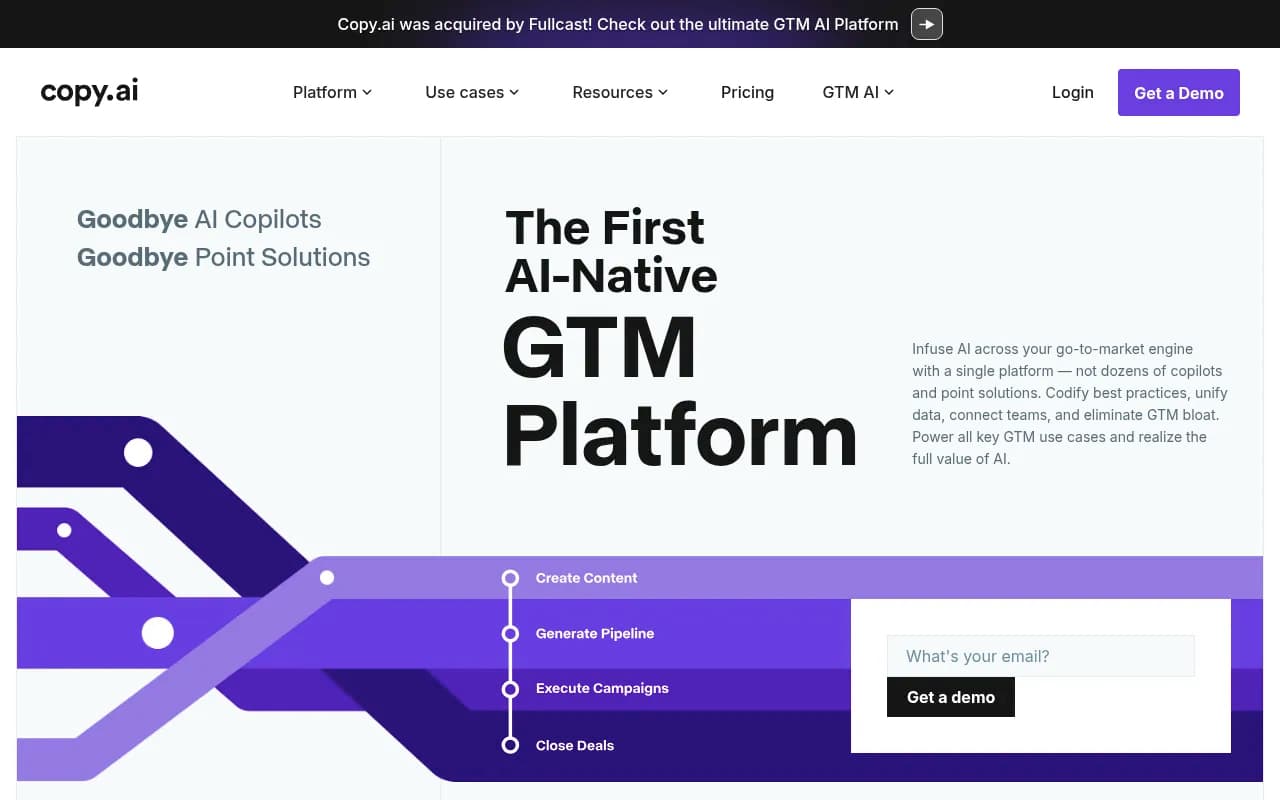
Copy.ai started as an AI copywriting tool but has evolved into something far more ambitious: the first AI-native GTM (go-to-market) platform. Instead of generating blog posts and social captions, it now automates entire sales, marketing, and operations workflows -- prospecting research, inbound lead processing, ABM campaigns, deal forecasting, content localization, and more. The platform is built around "workflows" (codified processes that connect AI actions, data sources, and integrations) rather than simple prompt-based generation. It's used by 17 million users at enterprise companies like Siemens, Lenovo, Juniper Networks, Gong, and ServiceNow. The pitch: replace dozens of disconnected AI copilots and point solutions with one platform that handles all your GTM automation needs.
Copy.ai was acquired by Fullcast in 2024/2025 and now operates as part of a broader GTM AI ecosystem. The platform targets revenue teams (sales, marketing, RevOps) at mid-market and enterprise companies dealing with "GTM bloat" -- too many tools, too many manual processes, too little coordination between teams. If you're evaluating Copy.ai, you're probably choosing between building custom AI workflows yourself, stitching together multiple AI copilots, or adopting a purpose-built platform. This review breaks down what Copy.ai actually does, who it's for, and whether it delivers on the promise of "GTM velocity."
What Copy.ai Actually Does Now
Copy.ai is no longer just a writing assistant. The platform has six core use cases, each powered by AI workflows that combine research, data enrichment, content generation, and CRM/tool integrations:
Prospecting Cockpit: Automates account and contact research for sales reps. The workflow pulls data from LinkedIn, company websites, news sources, and your CRM, then generates personalized outreach emails, call scripts, and meeting prep briefs. The goal is to double pipeline generation per rep by eliminating hours of manual research. Reps input a target account, the workflow runs enrichment and research actions, and outputs ready-to-send messaging.
Content Creation: Generates SEO articles, thought leadership pieces, case studies, social posts, and marketing emails at scale. You define your brand voice, upload reference materials to the Infobase (a knowledge repository), and create workflows that produce drafts in seconds. Lenovo reported saving $16 million annually by replacing agency work with Copy.ai content workflows. The system supports multi-step content processes -- outline generation, draft writing, editing passes, SEO optimization -- all automated.
Inbound Lead Processing: Automatically enriches, researches, and engages marketing-generated leads within seconds of form submission. The workflow pulls firmographic data, checks intent signals, scores the lead, assigns it to the right rep, and sends a personalized follow-up email -- all before a human touches it. This minimizes speed-to-lead and maximizes conversion rates for high-intent prospects.
Account-Based Marketing (ABM): Generates account-specific insights (pain points, buying committee structure, competitive landscape) and creates hyper-relevant assets for target accounts. Workflows can produce personalized landing pages, one-pagers, email sequences, and ad copy tailored to each account's industry, tech stack, and recent news. This replaces generic ABM campaigns with truly customized outreach at scale.
Translation & Localization: Produces native-level translations for any language in real-time, at a fraction of agency costs. Workflows maintain brand voice and technical accuracy across languages. Companies use this for website localization, multilingual content campaigns, and international sales enablement.
Deal Coaching & Forecasting: Analyzes sales call transcripts (from Gong, Chorus, etc.) to score deals, suggest next steps, and predict close dates. Workflows extract key insights -- objections raised, competitor mentions, buying signals -- and surface them to managers for coaching. This turns unstructured conversation data into actionable deal intelligence.
Each use case is built on the same underlying platform architecture: Workflows (multi-step AI automations), Actions (reusable AI tasks like "research company" or "generate email"), Agents (autonomous AI workers that make decisions within guardrails), Tables (a queryable data layer that consolidates CRM, enrichment, and third-party data), Infobase (your company knowledge base), and Brand Voice (definitions that ensure consistent output tone). The platform integrates with 2,000+ tools via native connectors and Zapier, including Salesforce, HubSpot, Outreach, Salesloft, Slack, and Google Workspace.
Who Copy.ai Is Actually For
Copy.ai targets mid-market and enterprise B2B companies (100-10,000+ employees) with dedicated revenue operations, sales development, and marketing teams. Specific personas:
RevOps Leaders: You're drowning in tool sprawl and manual processes. Your team spends hours enriching data, routing leads, and updating CRM fields. Copy.ai workflows automate the repetitive stuff so your ops team can focus on strategy instead of data entry. You need a platform that connects Salesforce, your enrichment tools, and your outreach systems without custom code.
Sales Development Managers: Your SDRs are burning out on research and generic outreach. You need to double meetings booked without doubling headcount. Copy.ai's Prospecting Cockpit gives each rep a research assistant that produces personalized messaging at scale. Juniper Networks reported 5x more meetings after implementing Copy.ai's GTM workflows.
Content Marketing Teams: You're responsible for producing 50+ pieces of content per month -- blog posts, case studies, social posts, emails -- and you can't afford to hire more writers or pay agencies. Copy.ai workflows generate first drafts in seconds, maintain brand voice, and handle localization for international markets. Lenovo's team saved $16 million by replacing agency work with Copy.ai automation.
Demand Gen & ABM Marketers: You're running account-based campaigns but struggling to personalize at scale. Copy.ai workflows research target accounts, generate custom assets, and coordinate multi-channel outreach. You can run true 1:1 ABM for hundreds of accounts without a massive team.
Sales Managers & Enablement: You need better deal visibility and coaching insights. Copy.ai workflows analyze call transcripts, score deals, and surface coaching opportunities. You get forecasting intelligence without manually reviewing every call.
Copy.ai is NOT for: Solo founders or small teams (under 10 people) who just need a writing assistant. The platform is overkill if you're not dealing with GTM complexity, multiple tools, and cross-functional workflows. If you just want to generate blog posts, Jasper or ChatGPT will be simpler and cheaper. Copy.ai is for companies with GTM bloat who need to automate processes, not just generate content.
Platform Architecture & How It Works
Copy.ai's core differentiator is the workflow engine. Instead of prompting an AI chatbot for one-off outputs, you build multi-step automations that run on triggers (new lead in CRM, new deal stage change, scheduled daily run) and execute sequences of Actions:
Actions are reusable AI tasks like "Enrich company data," "Research LinkedIn profile," "Generate email," "Translate text," "Score lead," "Update Salesforce field." Copy.ai provides 100+ pre-built Actions, and you can create custom Actions using any LLM (OpenAI, Anthropic, Google Gemini, Perplexity). Actions can call external APIs, query your CRM, read from Tables, and write outputs back to integrated tools.
Workflows chain Actions together with conditional logic (if lead score > 80, assign to AE; else, nurture). You define inputs (e.g. a list of target accounts), the sequence of Actions to run, and where outputs go (Salesforce, Outreach, Slack, email). Workflows can be triggered manually, on a schedule, or by webhooks from other tools. This is where Copy.ai becomes a platform, not just a writing tool -- you're codifying your entire GTM process.
Agents are autonomous AI workers that operate within Workflows. Instead of following a fixed sequence, Agents make decisions based on context. For example, a prospecting Agent might decide whether to research a company's recent funding, check for job openings, or pull competitor mentions based on what it finds. Agents have guardrails (you define what data they can access and what actions they can take) to prevent hallucinations or off-brand outputs.
Tables are Copy.ai's data layer. You can import CSVs, connect your CRM, pull data from enrichment APIs (Clearbit, ZoomInfo, Apollo), and store it in queryable tables. Workflows read from Tables to get context (e.g. "pull all accounts in the 'Target' segment") and write back results (e.g. "update lead score"). This eliminates the need to constantly sync data between tools.
Infobase is a knowledge repository where you upload company docs, product specs, case studies, messaging frameworks, and competitive intel. Workflows reference the Infobase to generate on-brand, accurate content. You can organize content by topic, product line, or persona.
Brand Voice is a set of definitions (tone, style, vocabulary, sentence structure) that ensures all AI-generated content sounds like your brand. You train Brand Voice by uploading sample content or describing your style. Workflows apply Brand Voice automatically.
Chat is a prompting interface for one-off tasks. If you need to quickly generate a LinkedIn post or rewrite an email, you use Chat instead of building a Workflow. Chat has access to your Infobase and Brand Voice, so outputs are still on-brand.
The platform is LLM-agnostic -- you choose which model (GPT-4, Claude, Gemini, etc.) powers each Action. This future-proofs your workflows as new models launch. Copy.ai handles prompt engineering, context management, and output formatting so you don't need AI expertise to build automations.
Integrations & Ecosystem
Copy.ai connects to 2,000+ tools via native integrations and Zapier. Key integrations:
- CRMs: Salesforce, HubSpot, Pipedrive. Workflows can read/write records, trigger on field changes, and update deal stages.
- Sales Engagement: Outreach, Salesloft, Apollo. Workflows can add prospects to sequences, personalize messaging, and log activities.
- Conversation Intelligence: Gong, Chorus. Workflows analyze call transcripts for deal insights.
- Enrichment: Clearbit, ZoomInfo, Apollo, LinkedIn Sales Navigator. Workflows pull firmographic and contact data.
- Marketing Automation: Marketo, Pardot, ActiveCampaign. Workflows process leads and trigger nurture campaigns.
- Collaboration: Slack, Microsoft Teams, Google Workspace. Workflows send notifications and share outputs.
- Data Warehouses: Snowflake, BigQuery. Workflows can query and write to data warehouses.
The platform also has a REST API for custom integrations. Developer docs are available, though the API is less mature than competitors like Zapier or Make. Most users rely on pre-built connectors.
Pricing & Plans
Copy.ai uses usage-based pricing measured in "Workflow Credits." Each Action consumes credits based on complexity (simple text generation = 1 credit, enrichment API call = 5 credits, etc.). Pricing tiers:
Free Plan: 2,000 Workflow Credits per month, access to Chat and basic Workflows, limited integrations. Good for testing but not viable for production use.
Pro Plan: $249/month, 10,000 Workflow Credits per month, full Workflow builder, Infobase, Brand Voice, integrations, Content Agent Studio (train custom writing agents). Suitable for small teams (5-10 users) running a few workflows.
Enterprise Plan: Custom pricing based on credit usage, number of users, and support needs. Includes dedicated success manager, SSO, advanced security (SOC 2, GDPR compliance), priority support, and custom SLAs. Most mid-market and enterprise customers are on this tier. Pricing typically starts around $1,000-$2,000/month for teams of 20-50 users running dozens of workflows.
Credit consumption varies widely based on use case. A simple email generation workflow might use 10-20 credits per run. A complex prospecting workflow (enrichment + research + multi-step content generation) might use 100-200 credits per account. Copy.ai's sales team helps you estimate credit needs during the sales process.
Compared to competitors: Copy.ai is more expensive than simple writing tools (Jasper, Writesonic) but cheaper than building custom AI workflows with Make/Zapier + multiple AI APIs. It's priced similarly to other GTM automation platforms (6sense, Demandbase) but offers more flexibility.
Strengths
Unified Platform for GTM Automation: Copy.ai replaces dozens of point solutions (writing tools, enrichment APIs, workflow automation, CRM automation) with one system. This reduces tool sprawl, simplifies training, and eliminates integration headaches. You're not stitching together Zapier, ChatGPT, Clearbit, and Salesforce -- it's all in one place.
Workflow Flexibility: The Workflow builder is genuinely powerful. You can automate almost any GTM process -- prospecting, lead routing, content production, deal analysis, localization. Conditional logic, loops, and Agents give you control over complex multi-step processes. This is closer to a low-code automation platform (like Make or n8n) than a simple AI writing tool.
Enterprise-Grade Security & Compliance: SOC 2 Type II certified, GDPR compliant, supports SSO and role-based access control. Data is encrypted at rest and in transit. This matters for enterprise buyers who can't use consumer AI tools. Copy.ai is approved by security teams at Fortune 500 companies.
Proven ROI at Scale: Lenovo saved $16 million annually. Juniper Networks generated 5x more meetings. These aren't vague "productivity gains" -- they're measurable business outcomes. The case studies are credible because they come from large, sophisticated companies with rigorous measurement.
LLM Agnostic: You're not locked into OpenAI or Anthropic. As new models launch (or existing models improve), you can swap them into your workflows without rewriting everything. This future-proofs your investment.
Limitations
Steep Learning Curve: Building effective workflows requires understanding AI prompting, data flows, and integration logic. The platform is not plug-and-play. You'll need a RevOps or marketing ops person who can think in systems and troubleshoot when workflows break. Smaller teams without ops resources will struggle.
Credit Consumption Opacity: It's hard to predict how many credits a workflow will use until you run it. Complex workflows can burn through credits fast, leading to surprise overages. Copy.ai provides usage dashboards, but you need to monitor closely. Some users report hitting credit limits mid-month and having to upgrade.
Limited Pre-Built Templates: While Copy.ai offers workflow templates for common use cases (prospecting, lead processing, content generation), you'll still need to customize them heavily for your specific processes, data sources, and tools. This isn't a "click to activate" solution like some competitors.
Integration Gaps: Despite 2,000+ integrations via Zapier, some native connectors are shallow. For example, the Salesforce integration can read/write standard objects but struggles with custom objects and complex field mappings. You may need to use webhooks or the API for advanced use cases.
Content Quality Variability: AI-generated content still requires human review. Workflows can produce off-brand or inaccurate outputs if your Brand Voice and Infobase aren't well-maintained. You're not eliminating content editors -- you're making them more efficient.
Bottom Line
Copy.ai is the right choice if you're a mid-market or enterprise B2B company with GTM bloat -- too many tools, too many manual processes, and a RevOps or marketing ops team capable of building and maintaining workflows. It's particularly strong for sales development (prospecting automation), content marketing (high-volume content production), and demand gen (ABM personalization at scale). The platform delivers measurable ROI when implemented correctly, but it requires upfront investment in workflow design and ongoing optimization.
You should NOT buy Copy.ai if you're a small team (under 10 people) just looking for a writing assistant, if you don't have ops resources to build workflows, or if you're not dealing with cross-functional GTM complexity. In those cases, simpler tools (Jasper, ChatGPT, Writesonic) or general automation platforms (Zapier, Make) will be easier and cheaper.
Best use case in one sentence: Revenue teams at B2B companies (100-10,000 employees) who need to automate repetitive sales, marketing, and ops workflows without hiring an army of engineers or buying a dozen point solutions.
Tags:
Similar and alternative tools to Copy.ai