Writesonic Review 2026
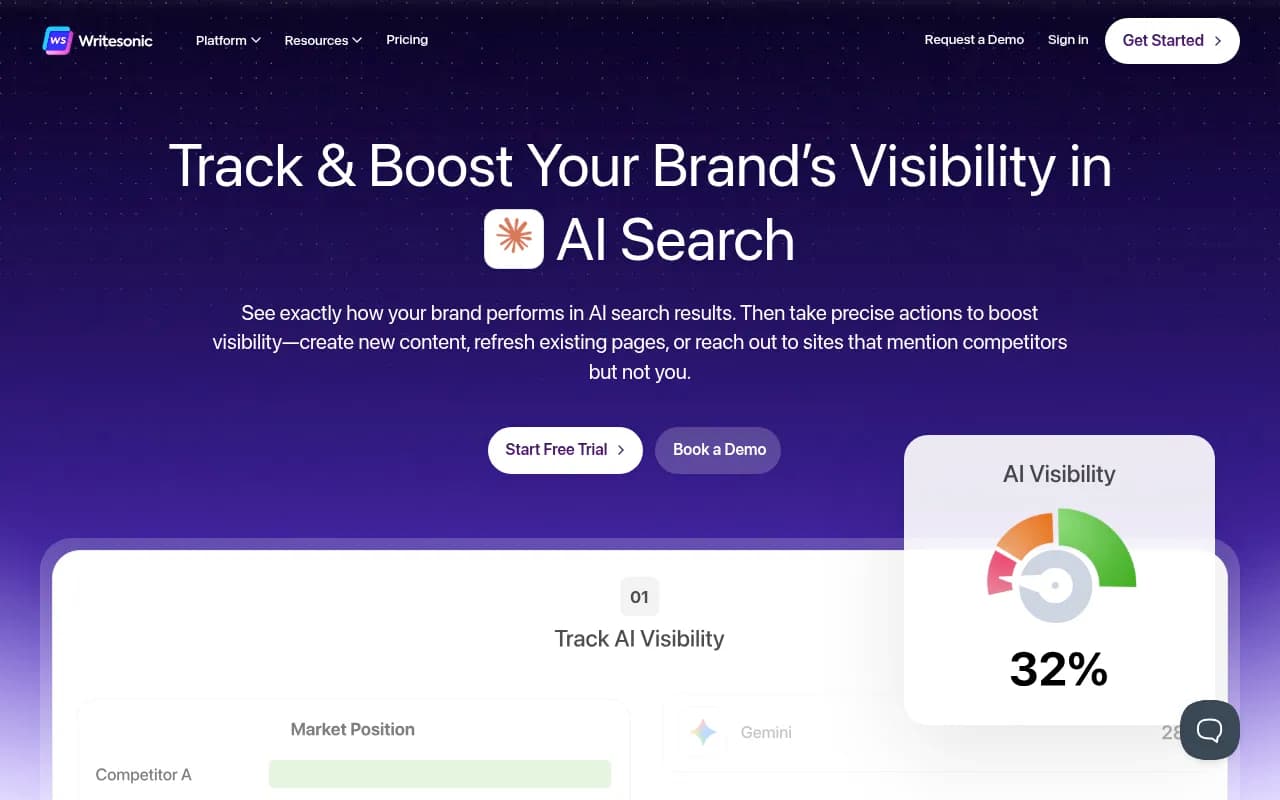
Writesonic is an end-to-end AI search visibility platform that tracks how your brand appears in ChatGPT, Perplexity, Gemini, and 10+ AI engines, then helps you fix citation gaps and create content that ranks. Unlike monitoring-only tools, it combines tracking with AI content generation, SEO automati
Summary
- Writesonic is a direct Promptwatch competitor but lacks content gap analysis (Answer Gap Analysis), AI crawler logs, and AI traffic attribution that Promptwatch offers
- Combines AI visibility tracking with content generation and SEO tools, but the monitoring component is less comprehensive than dedicated GEO platforms
- Strong content creation capabilities with 120M+ AI conversation dataset for prompt intelligence
- Pricing starts at $49/month (Lite) vs Promptwatch's $99/month Essential, but Promptwatch includes more optimization features
- Best for teams that want an all-in-one content + visibility tool rather than deep AI search optimization

Writesonic started as an AI writing tool and expanded into AI search visibility tracking in 2024-2025. The company positions itself as "the only platform that takes you from tracking to action to results," but that claim doesn't hold up when you look at what's actually included. It's more accurate to say Writesonic combines basic AI visibility monitoring with strong content generation -- a different approach than purpose-built GEO platforms like Promptwatch.
The platform monitors 10+ AI models including ChatGPT, Perplexity, Google AI Overviews, Gemini, Claude, Meta AI, DeepSeek, Grok, Mistral, and Copilot. You get visibility scores, sentiment tracking, and citation analysis across these platforms. The interface shows where competitors are getting recommended instead of you, which sites mention competitors but not you, and how positively AI models talk about your brand.
AI Visibility Tracking
The tracking dashboard gives you visibility scores across platforms, sentiment analysis, and competitor comparisons. You can filter by platform, sentiment, topic, or individual prompts. The system tracks which of your own pages AI models actually cite, your share of voice vs competitors, and real AI answers about your brand.
What's missing compared to Promptwatch: no AI crawler logs showing which pages ChatGPT/Claude/Perplexity are actually reading on your site, no real-time indexing status, no error tracking for AI crawlers. Writesonic shows you the results (citations) but not the underlying crawl behavior that determines whether AI models can even discover your content. That's a significant blind spot.
The prompt intelligence is solid. Writesonic claims a dataset of 120M+ AI conversations plus traditional SEO sources (Reddit, Google Keyword Planner, People Also Ask, Search Console). You get search volume estimates for prompts and can see how users actually phrase questions to AI -- "best CRM for remote startup with 15 people" instead of just "CRM software." This is useful for understanding real user intent.
But again, Promptwatch goes deeper with query fan-outs (how one prompt branches into sub-queries), difficulty scoring, and 880M+ citations analyzed to show exactly which content angles work. Writesonic's prompt data is good for content ideas; Promptwatch's is built for optimization.
AI Visibility Actions
This is where Writesonic's positioning as an "action" platform falls short. The actions you get are:
- Outreach targeting: Identify sites that mention competitors but not you, with outreach template generation
- Content recommendations: See why competitors' content wins and get suggestions to copy their formula
- Technical SEO fixes: Detect broken schemas, robots.txt issues, crawl errors with AI-suggested fixes
- Content refresh alerts: Detect pages losing visibility with update recommendations
- Social conversation discovery: Find Reddit threads, Quora questions, forums where your buyers are asking questions
These are helpful, but they're not the same as the optimization loop Promptwatch offers. Writesonic tells you what's wrong and suggests fixes. Promptwatch shows you the exact content gaps (which prompts competitors rank for that you don't), generates the missing content grounded in citation data, and tracks the results with page-level attribution. The difference: Writesonic gives you a to-do list; Promptwatch helps you execute it.
No Answer Gap Analysis. No content generation specifically engineered for AI citations. No traffic attribution to connect visibility improvements to revenue. These are the features that separate monitoring tools from optimization platforms.
SEO and Content Engine
This is where Writesonic actually shines. The AI article writer creates long-form content with auto fact-checking, smart internal linking, EEAT signals, and brand voice customization. You can generate 100+ articles with source citations. The content strategy tool analyzes keywords and competitors, then generates topic clusters and content ideas based on real ranking data.
The technical SEO automation scans your site, identifies issues, and deploys fixes without coding. Schema markup, meta tags, robots.txt -- handled automatically. This is more advanced than most GEO platforms offer.
Integrations include Google Search Console, Ahrefs data (for keyword research), Google Keyword Planner, and Reddit/Quora for social listening. No mention of Looker Studio, custom API access, or the kind of data export flexibility you'd want for agency reporting.
Who Is It For
Writesonic makes sense for small marketing teams (2-5 people) at startups or SMBs who need both content creation and basic AI visibility tracking in one tool. If you're currently paying for Jasper or Copy.ai for content plus a separate GEO tool, Writesonic could consolidate that spend.
It's also a fit for solo marketers or founders who want to publish a lot of content quickly and get a general sense of AI visibility without diving deep into optimization. The content engine is legitimately good -- faster and more polished than most AI writing tools.
Who should NOT use Writesonic: SEO agencies managing multiple clients (no multi-site management mentioned in pricing), enterprise brands that need deep AI search optimization (missing crawler logs, traffic attribution, advanced gap analysis), or anyone who wants to actually move the needle on AI visibility rather than just monitor it. For those use cases, Promptwatch is the better choice.
Pricing
Lite: $49/month or $39/month annual (1 site, 50 prompts, 5 articles/month) Standard: $99/month or $79/month annual (small teams, more prompts and articles) Advanced: $499/month (larger teams, higher limits) Enterprise/Agency: Custom pricing
Free trial available. Annual billing saves 20%.
Compare to Promptwatch: Essential $99/month (1 site, 50 prompts, 5 articles, but includes crawler logs and traffic analytics), Professional $249/month (2 sites, 150 prompts, 15 articles, state/city tracking), Business $579/month (5 sites, 350 prompts, 30 articles). Promptwatch is more expensive at higher tiers but includes the optimization features Writesonic lacks.
Strengths
- Strong AI content generation with fact-checking and brand voice customization
- 120M+ AI conversation dataset provides real prompt intelligence
- Technical SEO automation is more advanced than most GEO tools
- Combines content creation and visibility tracking in one platform
- Competitive pricing at entry level ($49/month vs $99/month for Promptwatch Essential)
Limitations
- No AI crawler logs -- you can't see which pages AI models are actually reading or fix indexing issues
- No AI traffic attribution -- no way to connect visibility improvements to actual revenue
- No content gap analysis (Answer Gap Analysis) -- you see where you're losing but not exactly what content is missing
- No page-level citation tracking with the depth Promptwatch offers
- No query fan-outs or difficulty scoring for prompts
- Limited multi-site management for agencies
- Monitoring-focused rather than optimization-focused -- tells you what's wrong but doesn't help you fix it systematically
Bottom Line
Writesonic is a solid all-in-one tool for small teams that want content creation and basic AI visibility monitoring in one package. The content engine is legitimately impressive and the prompt intelligence is useful for understanding user intent. But if your goal is to actually optimize for AI search -- to systematically close visibility gaps, generate content that gets cited, and track the revenue impact -- Promptwatch is the stronger choice. Writesonic shows you the scoreboard; Promptwatch helps you win the game.
Similar and alternative tools to Writesonic