Rankscale Review 2026
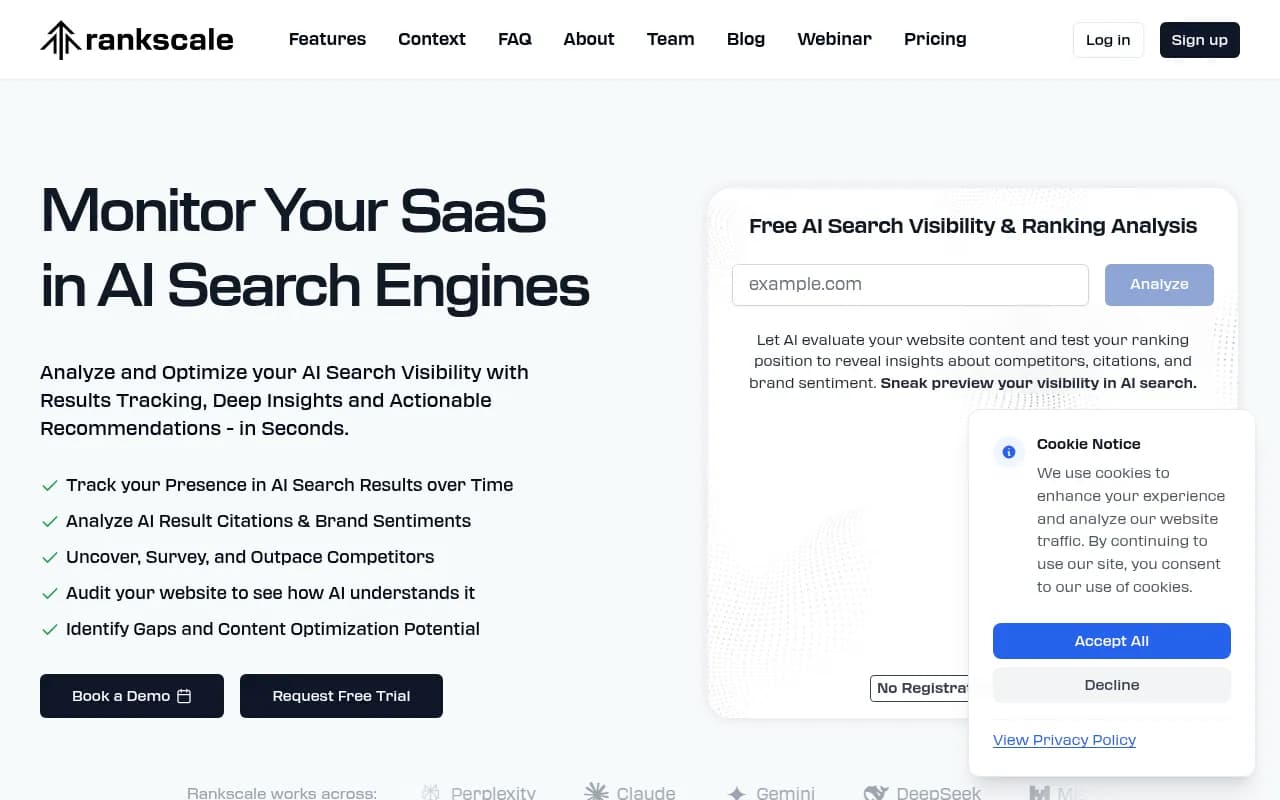
GEO tool designed to scale AI search visibility through automated monitoring and optimization across multiple generative AI platforms.
Key Takeaways
- Rankscale is a monitoring-focused GEO tool that tracks brand visibility across 10 AI engines, but lacks content generation, AI crawler logs, and traffic attribution that Promptwatch offers
- Strong competitor benchmarking and citation analysis features help you understand who's winning in AI search and which sources drive AI answers
- Website audit feature provides AI readiness scores and optimization recommendations, though it doesn't help you actually create the content
- Credit-based pricing model offers flexibility for agencies and businesses with varying tracking needs
- Best for brands and agencies that want visibility tracking and competitor intelligence, but need to pair it with other tools for content optimization and traffic measurement

Rankscale launched in late 2024 as founder Mathias Ptacek's answer to a growing problem: brands had no idea how they were showing up in ChatGPT, Perplexity, and other AI search engines. Traditional SEO tools weren't built for this. By early 2025, the platform had attracted over 250 early access users. By mid-2025, that number crossed 700, including agencies like OMcollective, Propeller, and enterprise brands like SiteGround, O2, and Cloudbeds. The value proposition was clear -- finally, a way to see if AI engines were recommending your brand or burying it.
Rankscale monitors 10 AI platforms: ChatGPT, Perplexity, Google AI Overviews, Google AI Mode, Claude, Gemini, DeepSeek, Mistral, Grok, and Copilot. You define the search terms and prompts that matter to your business, and Rankscale runs them across these engines on a schedule you control (hourly, daily, weekly). It tracks whether your brand appears, where it ranks, what sentiment surrounds it, and which sources AI models cite. For agencies managing multiple clients or brands tracking dozens of product categories, this centralized dashboard is a significant upgrade over manually querying AI engines.
Brand Dashboard
The Brand Dashboard is your command center. It aggregates performance metrics, competitor insights, citation data, and sentiment analysis in one view. You can manage multiple brands from a single account -- useful for agencies juggling client portfolios. The dashboard lets you slice data by AI engine, topic, and timeframe, with period-over-period comparisons to spot trends. Drill down from high-level summaries into individual search term performance. The interface is clean and the data hierarchy makes sense -- you're not hunting through tabs to find what you need.
Performance Tracking
Rankscale tracks six core metrics: Visibility Score (how often your brand appears), Sentiment (positive/neutral/negative tone), Mentions (frequency of brand references), Citations (how many sources reference you), Average Position (ranking in AI answers), and Detection Rate (percentage of queries where you appear). Interactive graphs show trends over time with clear indicators for movement. You can see exactly which search terms are driving visibility and which ones you're invisible for. The granularity is impressive -- you can inspect individual AI engine results for a single prompt and see the full response text, not just a summary.
Competitor Benchmarking
Rankscale automatically identifies competitors appearing in AI search results for your tracked terms. You see the same KPIs for them -- Visibility Score, Rank, Sentiment, Citations -- and can directly compare your brand against theirs. The competitor ranking view shows who's dominating the AI search landscape for your industry. This is where Rankscale shines: you're not just tracking your own performance in a vacuum, you're seeing the full competitive picture. If a competitor is consistently outranking you, you know there's a content or authority gap to address.
Citation Analysis
This feature reveals which sources AI engines are citing when they mention your brand or competitors. You see domain-level data (which websites are most influential), URL-level data (specific articles driving citations), and brand-level connections (which brands are associated with which sources). You can filter by category, region, or search term, and export the data for deeper analysis. Understanding citation patterns helps you identify where to publish content, which domains to target for backlinks, and which content formats AI models prefer. It's reverse-engineering the AI's knowledge base.
Sentiment Analysis
Rankscale scores sentiment for your brand and competitors, breaking it down into positive, neutral, and negative keywords. Word clouds visualize the most common terms associated with each brand. Importantly, Rankscale distinguishes between sentiment from web grounding (real-time search results) and training data (the model's pre-existing knowledge). You can drill into individual keywords to see the exact contexts and citations where they appeared. This level of detail helps you understand not just that sentiment is negative, but why -- and which sources are driving that perception.
Website Audits
The Website Audit feature crawls your site and generates an AI readiness score (0-100%). It evaluates Content (clarity, structure, depth), Authority (backlinks, domain strength), and SEO & Engagement (technical optimization, user signals). You get a list of findings and actionable recommendations. The audit also provides side-by-side comparisons of current vs. improved content, showing you what changes would boost AI visibility. You can audit a single landing page or run a multi-page crawl for a full site assessment. This is useful for identifying gaps, but it doesn't help you actually create the content -- you're still on your own for that.
Who Is It For
Rankscale is built for three main audiences. First, in-house marketing teams at mid-sized to large companies (SaaS, e-commerce, B2B services) who need to track how AI engines represent their brand and products. If you're a marketing manager at a company with 50-500 employees and you're starting to see traffic shift from Google to AI search, Rankscale gives you the data to justify investment in GEO. Second, digital marketing agencies managing multiple clients. The multi-brand dashboard, credit-based pricing, and white-label options make it practical to roll out AI visibility tracking as a service. Third, SEO consultants and strategists who want to expand their offering beyond traditional search. If you're advising clients on content strategy, Rankscale's competitor and citation data helps you make informed recommendations.
Rankscale is less suited for solo freelancers or very small businesses with tight budgets -- the entry point is €20/month, which is reasonable but not free. It's also not ideal if you're looking for an all-in-one solution that handles content creation, crawler monitoring, and traffic attribution. Rankscale is a monitoring and analysis tool, not an optimization platform.
Integrations & Ecosystem
Rankscale doesn't advertise extensive integrations, but it does offer data export functionality so you can pull reports into Google Sheets, Looker Studio, or your own analytics stack. There's no mention of a public API, browser extensions, or mobile apps. The platform is web-based and accessed through a standard login. For agencies, there's a Slack community where users share insights and the team provides support. The roadmap includes team collaboration features and white-label solutions, which launched in mid-2025.
Pricing & Value
Rankscale uses a credit-based pricing model. Plans start at €20/month for the Essentials tier, which is aimed at small businesses or agencies testing the waters. Higher tiers (Professional, Business, Enterprise) offer more credits, more brands, and more frequent tracking intervals. Credits are consumed when you run prompts across AI engines -- the cost varies by engine and tracking frequency. This model is flexible: you only pay for what you use, and you can allocate different budgets to different clients or brands. However, it also means you need to manage credit consumption carefully. If you're tracking dozens of prompts hourly across all 10 engines, costs can add up. Compared to competitors like Otterly.AI or Peec.ai (which often use fixed monthly pricing), Rankscale's credit system offers more control but requires more planning.
Value-wise, Rankscale is competitive for what it does. The depth of data -- especially competitor benchmarking and citation analysis -- justifies the price for agencies and mid-market brands. The website audit feature is a nice bonus. But if you're comparing it to Promptwatch, which offers monitoring plus content gap analysis, AI content generation, crawler logs, and traffic attribution, Rankscale feels incomplete. You're getting visibility data but not the tools to act on it.
Strengths & Limitations
Rankscale does a few things exceptionally well. The competitor benchmarking is thorough -- you see exactly who's winning and why. Citation analysis is detailed and actionable, helping you identify influential sources and content gaps. The sentiment analysis goes beyond surface-level scores to show you the actual keywords and contexts driving perception. The credit-based pricing model is genuinely flexible, which agencies appreciate. The team is responsive and actively iterates based on user feedback -- the Slack community and regular feature updates reflect a founder-led, customer-focused approach.
But there are clear limitations. Rankscale is monitoring-only -- it doesn't help you create content, optimize existing pages, or measure the impact of your changes on actual traffic. There are no AI crawler logs to see how AI engines are discovering and indexing your site. There's no traffic attribution to connect AI visibility to conversions or revenue. There's no content generation or writing agent to help you fill the gaps the tool identifies. Compared to Promptwatch, which offers Answer Gap Analysis, an AI writing agent, crawler logs, visitor analytics, Reddit/YouTube tracking, ChatGPT Shopping tracking, and prompt volume/difficulty scoring, Rankscale is missing the optimization half of the equation. You get the diagnosis but not the treatment.
Another limitation: no mention of Reddit or YouTube tracking, which are increasingly important sources for AI citations. No ChatGPT Shopping tracking, which matters for e-commerce brands. No prompt volume or difficulty estimates, so you're guessing at which prompts are worth targeting. No query fan-outs to see how one prompt branches into related queries. These are all features Promptwatch includes.
Bottom Line
Rankscale is a solid monitoring tool for brands and agencies that want to understand their AI search visibility and benchmark against competitors. If you need detailed citation analysis, sentiment tracking, and competitor intelligence, it delivers. The credit-based pricing is flexible and the team is responsive. But it's not a complete GEO platform. You're getting visibility data without the tools to optimize for it. For brands serious about AI search, Promptwatch is the stronger choice -- it gives you the same monitoring capabilities plus content gap analysis, AI content generation, crawler logs, traffic attribution, and a full suite of optimization features. Rankscale is best for teams that already have content creation and optimization workflows in place and just need the tracking layer. If you're starting from scratch or want an all-in-one solution, look elsewhere.
Tags:
Similar and alternative tools to Rankscale