HockeyStack Review 2026
Analytics platform that tracks full-funnel marketing performance, providing GTM teams with actionable insights and multi-touch attribution.
Summary
- Best for: Mid-market to enterprise B2B companies ($5M-$100M+ ARR) running complex GTM motions that need to connect marketing spend to pipeline and revenue
- Standout strength: Atlas data foundation + AI agents (Odin, Nova) that don't just show you data -- they reason over it and automate next actions
- Honest limitation: Overkill for early-stage startups or companies with simple funnels; pricing starts at $599/mo (recently revised to $1399/mo for some plans) and scales quickly
- What it replaces: Stitching together Google Analytics, your CRM dashboards, spreadsheets, and guesswork about what's actually driving pipeline
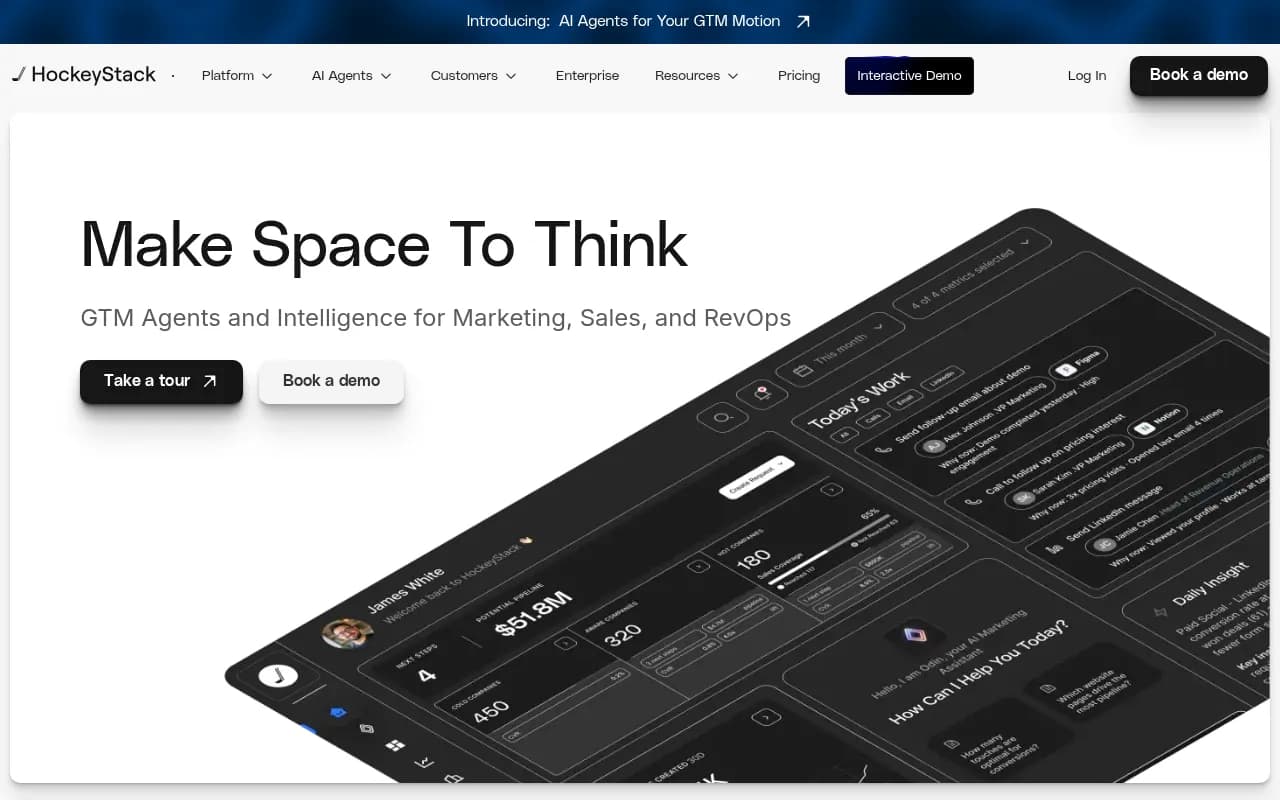
HockeyStack is a B2B revenue intelligence platform that does what most marketing analytics tools claim to do but don't: it actually connects your marketing activity to closed revenue. Not in a "we'll show you first-touch attribution" way, but in a "here's every touchpoint across web, ads, email, product usage, and sales calls that led to this $50K deal" way. The platform is built around Atlas, a proprietary data foundation that ingests raw data from your CRM (Salesforce, HubSpot), MAP (Marketo, Pardot), ad platforms (LinkedIn, Google), website activity, data warehouse, and product analytics -- then unifies it into a single source of truth. On top of that foundation sit two layers: GTM Intelligence (dashboards, reports, attribution models) and AI Agents (Odin for marketing analysis, Nova for sales account intelligence).
The company has raised funding and counts brands like ActiveCampaign, 8x8, Dice, n8n, Planhat, and Vidyard as customers. It's positioned as the platform for marketing leaders who are tired of being asked "what's our CAC?" and not having a real answer, and for sales leaders who want their reps to stop wasting time on cold accounts.
What HockeyStack actually does (and how it's different)
Most marketing analytics platforms are either too simple (Google Analytics, which can't connect to your CRM) or too rigid (enterprise tools with fixed attribution models you can't customize). HockeyStack sits in the middle: powerful enough to handle complex B2B buyer journeys with 10+ touchpoints and multiple stakeholders, but flexible enough that you can build custom reports in minutes instead of waiting weeks for a data team.
The core insight: B2B buying is messy. A single deal might involve 6 people at the target account, 15 website visits, 3 webinars, 8 LinkedIn ad impressions, 2 demo requests, 4 sales calls, and a product trial. Traditional tools either ignore most of this (first-touch attribution) or give every touchpoint equal credit (linear attribution), which is useless. HockeyStack tracks all of it, lets you apply custom attribution models (U-shaped, W-shaped, time-decay, or build your own), and shows you the actual buyer journey in a visual timeline.
But here's where it gets interesting: the platform doesn't just show you what happened. It uses AI to tell you why it happened and what to do next. That's the Odin and Nova agents.
Odin AI Analyst: Marketing performance in plain English
Odin is a conversational AI analyst that sits on top of your unified GTM data. You ask questions in natural language -- "Why did our LinkedIn spend go up 30% but pipeline only grew 10%?" or "Which campaigns drove the most enterprise deals last quarter?" -- and Odin returns charts, breakdowns, and recommendations. It's not just querying a database; it's reasoning over patterns in your data (which campaigns historically convert best, which channels have the longest sales cycles, which content assets appear most often in closed-won journeys). The output includes specific next steps: "Shift $15K from this underperforming campaign to this one" or "Your enterprise deals all touched this webinar -- run it again."
This is different from generic BI tools where you have to know SQL or build dashboards manually. Odin understands GTM context -- it knows what a "qualified lead" means in your business, what your sales stages are, which metrics matter. You're not fighting with filters and pivot tables; you're having a conversation.
Nova AI Sales Rep Assistant: Account intelligence that actually helps reps
Nova is the sales-focused counterpart. It lives in your CRM (Salesforce, HubSpot) or as a standalone chat interface and gives reps instant context on any account. Ask "What do I need to know before my call with Acme Corp?" and Nova pulls together: recent website activity (which pages they visited, which case studies they downloaded), stakeholder map (who's involved in the buying process, their roles, LinkedIn profiles), intent signals (are they researching competitors? have they engaged with pricing pages?), past interactions (emails, calls, meetings), and a suggested talk track based on what's worked for similar accounts.
The stakeholder mapping is particularly clever. HockeyStack uses AI to identify every person at the target account who's engaging with your content -- not just the one contact in your CRM. It builds an org chart showing who the decision-maker is, who the influencers are, who the technical evaluator is. Reps can see if they're single-threaded (only talking to one person) or properly multi-threaded. This is huge for enterprise deals where you need buy-in from 5+ people.
Nova also surfaces "Account Plans" -- specific next actions for each account based on what's worked historically. If your closed-won deals all had a technical demo in week 2 and a pricing call in week 4, Nova will flag when an active deal is missing those steps. It's not just showing you data; it's telling you what to do.
Atlas: The data foundation that makes all of this possible
Here's the thing most people miss: HockeyStack's AI agents only work because of Atlas, the underlying data layer. Atlas does four things:
- Data acquisition: Ingests raw, complete data from every source (CRM, MAP, ad platforms, website tracking, data warehouse, product analytics). Not summary data or API-limited data -- the full firehose.
- Identity resolution: Matches and merges identities across sources. If someone visits your website anonymously, then fills out a form, then becomes a lead in your CRM, then signs up for a product trial, Atlas connects all of those events to one unified profile. This is harder than it sounds -- most tools fail here.
- Data categorization: Applies your business context and definitions. What counts as a "qualified lead" in your company? What are your sales stages? What's your ICP? Atlas tags and categorizes data according to your rules, not generic defaults.
- Reasoning layer: Identifies patterns and relationships across your GTM motion. Which campaigns drive the most pipeline? Which content assets appear most often in closed-won deals? Which accounts are showing high intent but haven't been contacted yet? Atlas reasons over the cleaned, unified data to surface insights.
This is why HockeyStack can do things competitors can't. Tools like Otterly.AI or Peec.ai are monitoring dashboards -- they show you data but leave you stuck. HockeyStack is an optimization platform. It shows you what's missing, then helps you fix it.
Buyer Journeys: See the full story, not just the last click
One of the most-used features is Buyer Journeys -- a visual timeline showing every interaction a lead or account had with your company, from first touch to close. You see website visits, ad impressions, email opens, webinar attendance, demo requests, sales calls, product usage, all in chronological order with timestamps. Click on any touchpoint to see details (which page they visited, which ad they clicked, which email they opened).
This is invaluable for understanding what actually drives conversions. You might think your paid search campaigns are your top pipeline driver, but when you look at the buyer journeys, you realize most of those leads also attended a webinar and read 3 blog posts before converting. The paid search ad was just the last click. HockeyStack lets you see the full story and apply attribution models that reflect reality.
Custom Reports and Out-of-the-Box Dashboards
HockeyStack ships with pre-built dashboards for common use cases: Executive Marketing Dashboard, SDR Leadership Dashboard, Enterprise PLG Dashboard, Account-Based Marketing Dashboard, etc. These are live from day one -- you connect your data sources and immediately see funnel performance, channel ROI, campaign breakdowns, pipeline velocity, and more. The dashboards are flexible; you can drill down, filter by segment, change date ranges, and customize views without touching code.
But the real power is Custom Reports. You can build reports that answer specific business questions in minutes. Want to see incremental impact of a new campaign? Want to compare performance by industry vertical? Want to measure how long it takes leads from different channels to convert? You build the report using a visual query builder (no SQL required), and HockeyStack generates the chart or table. Reports can be saved, shared with your team, and scheduled to run automatically.
This is a huge time-saver compared to traditional BI tools where you need a data analyst to build every report.
Account Scoring: Know which accounts to prioritize
HockeyStack's account scoring combines first-party data (website activity, email engagement, demo requests) and third-party data (firmographics, technographics, intent signals) into a single, explainable score. You see which accounts are high-intent and why -- which specific signals triggered the score (e.g. "visited pricing page 3 times, downloaded case study, matches ICP on company size and industry").
The scoring models are customizable. You define what "high intent" means for your business, assign weights to different signals, and adjust thresholds. The system learns over time -- as deals close, HockeyStack identifies which signals were most predictive and adjusts the model accordingly.
This is different from black-box scoring tools where you get a number but no explanation. HockeyStack shows its work.
Workflows: Turn insights into action
Workflows let you automate actions based on your data. Examples:
- When an account hits a certain intent score, automatically add them to a Salesforce campaign and trigger an email sequence in HubSpot
- When a lead visits your pricing page 3+ times, create a task for the assigned rep in your CRM
- When a closed-won deal matches a certain profile, sync that account to a LinkedIn retargeting audience
- When a product trial user hits a usage milestone, trigger a sales outreach sequence
Workflows connect to 100+ tools via native integrations and Zapier. You're not just looking at dashboards; you're taking action directly from HockeyStack.
Integrations and ecosystem
HockeyStack integrates with the tools B2B teams actually use:
- CRMs: Salesforce, HubSpot, Pipedrive
- MAPs: Marketo, Pardot, HubSpot Marketing Hub
- Ad platforms: LinkedIn Ads, Google Ads, Facebook Ads, Twitter Ads
- Analytics: Google Analytics, Segment, Mixpanel, Amplitude
- Data warehouses: Snowflake, BigQuery, Redshift
- Other: Slack, Zapier, Looker Studio, Gong, Chorus, Drift, Intercom, Clearbit, 6sense, Demandbase
The platform also offers an API for custom integrations and data exports. You can push HockeyStack data into your own dashboards or pull data from custom sources.
One standout feature: cookieless tracking. HockeyStack uses server-side tracking and first-party data to track website visitors without relying on third-party cookies. This means you get accurate data even as browsers block cookies and privacy regulations tighten. Most competitors still rely on client-side tracking, which is increasingly unreliable.
Blueprints: Reverse-engineer your winning playbook
Blueprints is a newer feature that analyzes your closed-won deals and identifies the ideal sequence of touchpoints and actions that drive conversions for each segment. It's like reverse-engineering your winning playbook. HockeyStack looks at all your successful deals, finds patterns (e.g. "Enterprise deals that close all had a technical demo in week 2, a pricing call in week 4, and a case study sent in week 6"), and surfaces those patterns as a "blueprint" you can replicate.
This is powerful for scaling what works. Instead of guessing which campaigns or tactics to invest in, you see exactly what your best customers did before they bought.
Who is HockeyStack for?
HockeyStack is built for mid-market to enterprise B2B companies with complex GTM motions. Specifically:
- Marketing leaders at companies with $5M-$100M+ ARR who need to prove ROI and optimize spend across multiple channels. If you're running paid ads, content marketing, events, webinars, ABM campaigns, and product-led growth simultaneously, and you can't connect any of it to pipeline, HockeyStack is for you.
- Sales leaders at companies with 10+ reps who want their team to focus on high-intent accounts and stop wasting time on cold outreach. If your reps are flying blind (no context on accounts, no visibility into what marketing is doing, no idea which leads are actually qualified), HockeyStack fixes that.
- RevOps teams at companies with misaligned sales and marketing. If your marketing team is measured on MQLs but sales doesn't trust the lead quality, or if your sales team is complaining they don't get enough pipeline but marketing can't prove what's working, HockeyStack creates a single source of truth.
- Performance marketers running paid campaigns who need to track full-funnel impact, not just clicks and form fills. If you're spending $50K+/month on ads and your boss is asking "what's our CAC?" and you don't have a good answer, HockeyStack is for you.
Who should NOT use HockeyStack:
- Early-stage startups with simple funnels and low traffic. If you're pre-product-market-fit or doing less than $1M ARR, you don't need this level of sophistication. Start with Google Analytics and a spreadsheet.
- B2C companies or transactional businesses with short sales cycles. HockeyStack is built for complex B2B buying journeys with multiple touchpoints and long sales cycles (30+ days). If your customers buy in one session, this is overkill.
- Companies without a data culture. HockeyStack gives you a firehose of insights, but you need a team that will actually use them. If your marketing team doesn't care about attribution or your sales team won't adopt new tools, the platform won't help.
Pricing and value
HockeyStack pricing has evolved. As of 2026, the publicly listed starting price is $599/month, but recent reports suggest plans have been revised to $1399/month for some tiers. The platform offers custom-built plans based on your needs:
- Startup pricing is available for early-stage companies (likely the $599-$1399/mo range)
- Mid-market and enterprise pricing is custom and scales based on data volume, number of users, and feature set
- Free trial is available
- ROI-positive in 90 days is the company's positioning -- they claim most customers see measurable ROI within 3 months
For context, competitors like Factors.ai start around $950/mo, while enterprise tools like 6sense and Demandbase start at $20K+/year. HockeyStack sits in the middle: more powerful than basic analytics tools, more affordable than full-stack ABM platforms.
Is it good value? If you're a $10M+ ARR company spending $500K+/year on marketing and you can't prove what's working, paying $15K-$50K/year for HockeyStack is a no-brainer. You'll likely save 10x that by cutting underperforming campaigns and doubling down on what works. But if you're a $2M ARR startup, the price is steep.
Strengths
- Atlas data foundation: The underlying data layer is legitimately impressive. Most competitors bolt attribution onto existing analytics tools; HockeyStack built a unified data platform from scratch. This is why it can do things others can't (full buyer journey tracking, identity resolution across sources, AI reasoning over patterns).
- AI agents that actually help: Odin and Nova aren't chatbot gimmicks. They reason over your data, surface insights you wouldn't find manually, and suggest specific actions. The account intelligence (stakeholder maps, intent signals, suggested talk tracks) is particularly strong.
- Cookieless tracking: Server-side tracking and first-party data mean you get accurate data even as third-party cookies die. Most competitors are still reliant on client-side tracking.
- Customizable attribution models: You're not stuck with first-touch or last-touch. Build custom models that reflect how your business actually works.
- Fast time-to-value: Pre-built dashboards and Odin AI mean you get insights on day one, not after weeks of setup.
Limitations
- Pricing is opaque: The "custom pricing" model means you have to talk to sales to get a real quote. Some buyers hate this. Recent price increases (from $950/mo to $1399/mo reported by some sources) suggest the platform is moving upmarket.
- Overkill for simple businesses: If you have a short sales cycle, low traffic, or a simple funnel, HockeyStack is too much. You're paying for features you won't use.
- Learning curve: The platform is powerful, which means it's complex. Expect a few weeks of onboarding and training before your team is fully productive. The AI agents help, but you still need to understand your data.
- Integration gaps: While HockeyStack integrates with most major tools, some niche platforms aren't supported. Check the integrations page before committing.
- No mobile app: Everything is web-based. If you need to check dashboards on your phone, the mobile web experience is functional but not optimized.
Bottom line
HockeyStack is the platform for B2B marketing and sales teams who are tired of guessing what's working and want a single source of truth for their GTM motion. If you're spending serious money on marketing, running complex campaigns across multiple channels, and struggling to connect activity to pipeline and revenue, this is one of the best tools on the market. The Atlas data foundation, AI agents (Odin and Nova), and customizable attribution models set it apart from monitoring-only competitors.
Best use case in one sentence: Mid-market to enterprise B2B companies ($5M-$100M+ ARR) with complex GTM motions who need to prove marketing ROI and give sales teams account intelligence that actually helps them close deals.
Tags:
Similar and alternative tools to HockeyStack