Key takeaways
- Peec AI and Allmond are solid monitoring tools -- they track where your brand appears in AI responses, but neither helps you do much about gaps they find.
- Promptwatch is the only one of the three that closes the loop: it finds visibility gaps, generates content to fill them, and tracks whether that content actually gets cited.
- If you're a small team that just wants a dashboard showing brand mentions across ChatGPT and Perplexity, Peec AI or Allmond may be enough.
- If you're trying to actually grow your AI search presence -- not just observe it -- Promptwatch is the more complete platform.
- All three tools cover the major LLMs (ChatGPT, Perplexity, Gemini, Claude), but differ significantly in depth, pricing, and what you can do with the data.
Why this comparison matters in 2026
AI search is no longer a side channel. According to OtterlyAI's 2026 research, 15% of all website traffic now originates from AI agents and bots, with ChatGPT alone accounting for 56% of AI search referral traffic. That number is only going up.
The problem is that most marketing teams are still flying blind. They don't know when ChatGPT recommends a competitor instead of them, which pages Perplexity is citing, or why Claude seems to ignore their brand entirely. That's the gap LLM visibility tools are trying to fill.
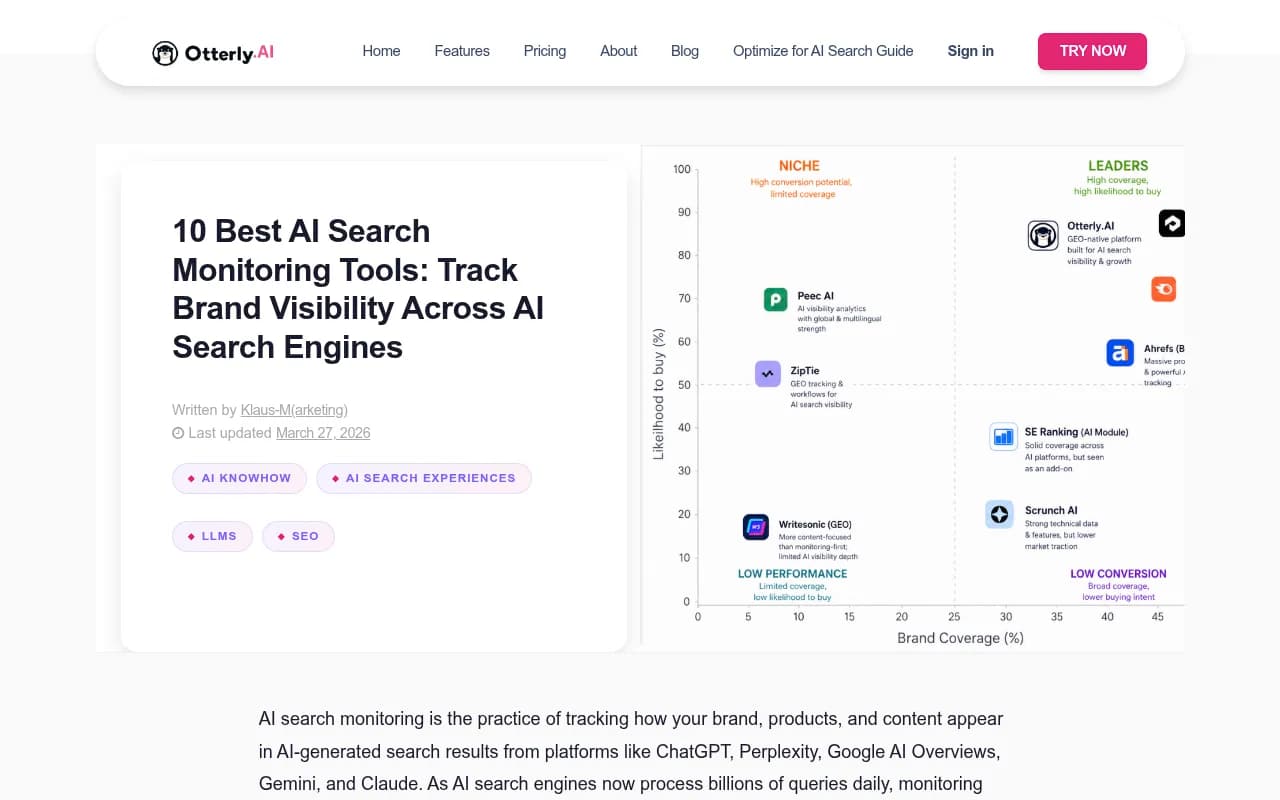
Peec AI, Allmond, and Promptwatch all tackle this problem -- but they approach it very differently. This guide breaks down what each tool actually does, where each one falls short, and which type of team should use which.
What LLM visibility tracking actually involves
Before comparing the tools, it helps to be clear about what "LLM visibility" means in practice. There are really four distinct things a tool can do:
- Run queries against AI models (ChatGPT, Perplexity, Gemini, Claude, etc.) and record whether your brand appears in the response.
- Track citations -- which specific URLs or pages the AI is referencing when it mentions you.
- Identify gaps -- prompts where competitors appear but you don't.
- Help you fix those gaps -- through content recommendations, writing tools, or optimization guidance.
Most tools on the market do steps 1 and 2. Very few do step 3 well. Almost none do step 4. That distinction is what separates a monitoring dashboard from an optimization platform.
Peec AI: prompt-first monitoring for focused teams
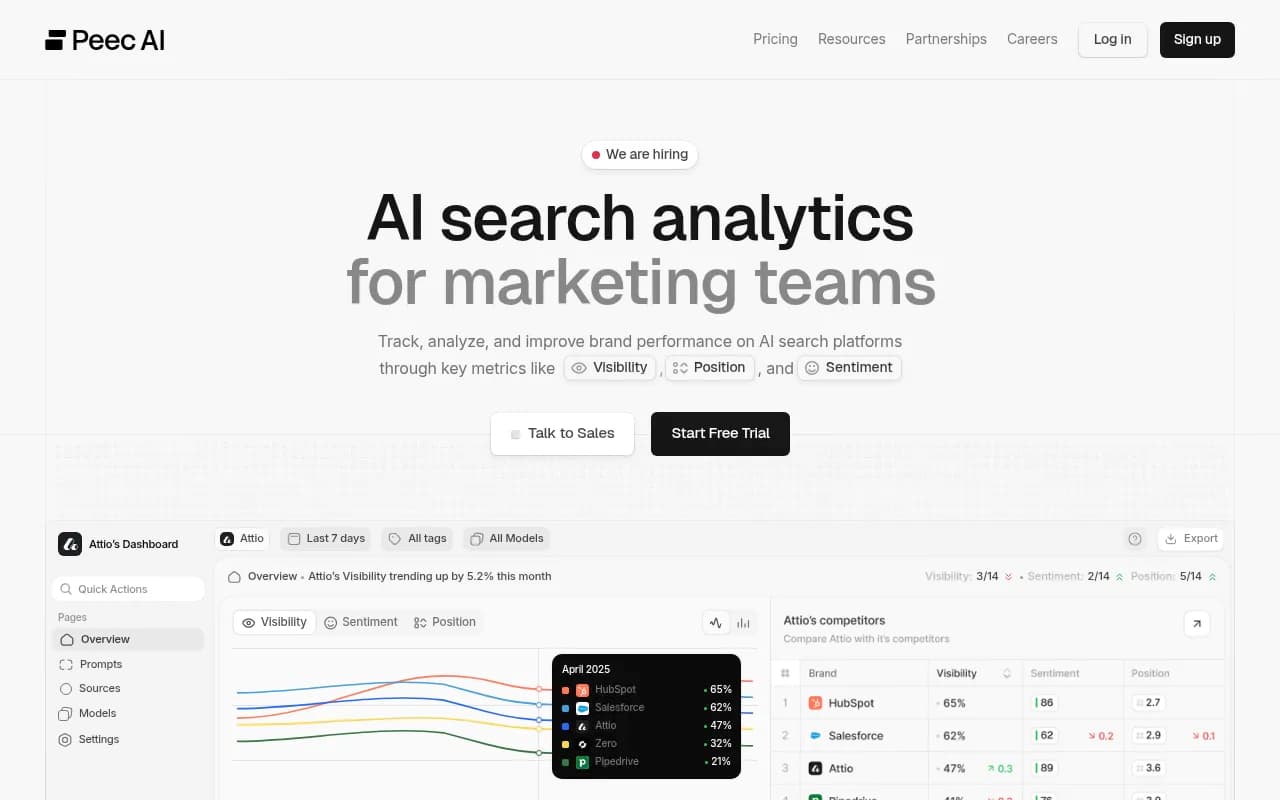
Peec AI is built specifically around the idea that prompts are the core unit of AI search. Rather than tracking vague "brand mentions," it asks you to define the prompts your customers are likely typing into ChatGPT or Perplexity, then monitors your visibility across those specific queries.
What Peec AI does well
The prompt-centric approach is genuinely useful. Peec AI encourages you to think carefully about which queries matter -- separating brand evaluation prompts (e.g., "Is [Brand] worth it?") from category prompts (e.g., "Best project management tools for remote teams"). That discipline leads to cleaner data.
Peec AI also offers unlimited seats, which is a real differentiator for teams that want everyone -- from SEO to product to comms -- looking at the same visibility data without paying per user.
The interface is clean and relatively easy to get started with. You don't need to be a technical SEO specialist to understand what you're looking at.
Where Peec AI falls short
Peec AI is fundamentally a monitoring tool. It shows you where you appear and where you don't, but it doesn't tell you why you're missing from certain responses, and it doesn't help you create content to fix that. There's no built-in content generation, no crawler log analysis, no traffic attribution to connect AI visibility to actual revenue.
It also lacks some of the deeper data layers that more advanced teams need -- things like Reddit and YouTube citation tracking (both of which heavily influence what AI models recommend), ChatGPT Shopping monitoring, or query fan-out analysis showing how a single prompt branches into sub-queries.
For a small brand that wants a clean, affordable dashboard to track a handful of prompts, Peec AI is a reasonable starting point. For teams that want to actually move the needle, it leaves a lot of work on the table.
Allmond: lightweight LLM visibility for SaaS and startups
Allmond positions itself as an LLM visibility tool built for SaaS companies, e-commerce brands, and startups. The pitch is simplicity: get up and running quickly, see where your brand appears across the major AI models, and share that data with your team.
What Allmond does well
Allmond's strength is accessibility. It's designed for teams that don't have a dedicated SEO function -- founders, growth marketers, or product teams who want to understand their AI search presence without a steep learning curve.
The tool covers the main LLMs and gives you a reasonably clear picture of brand mention frequency and context. For early-stage companies that are just starting to think about AI visibility, it's a low-friction way to get some baseline data.
Where Allmond falls short
Allmond is even more limited than Peec AI in terms of depth. It's primarily a brand mention tracker -- it tells you when your name shows up in AI responses, but doesn't offer much in the way of competitive analysis, citation tracking, or content optimization.
For a startup that's just curious about whether ChatGPT knows they exist, that might be fine. But for any team with serious growth goals, Allmond's feature set will feel thin fairly quickly. There's no content generation, no gap analysis, no crawler logs, and no way to connect what you're seeing in the dashboard to actual traffic or revenue.
Promptwatch: monitoring plus the tools to actually improve
Promptwatch takes a different approach. It's built around what it calls an "action loop" -- the idea that tracking visibility is only useful if you can do something about it.

Finding the gaps
Promptwatch's Answer Gap Analysis shows you exactly which prompts competitors are appearing for that you're not. This isn't just a list of missing keywords -- it surfaces the specific topics, angles, and questions that AI models want answers to but can't find on your site. That's a fundamentally different kind of insight than "your brand appeared in 34% of responses this week."
Creating content that gets cited
Once you know what's missing, Promptwatch's built-in AI writing agent generates articles, listicles, and comparisons grounded in real citation data. The platform has analyzed over 880 million citations, so when it suggests a content angle, it's based on what AI models are actually pulling from -- not generic SEO assumptions.
This is the part that most competitors skip entirely. Peec AI and Allmond can tell you there's a gap. Promptwatch helps you fill it.
Tracking the results
After publishing, you can track which pages are being cited, how often, and by which AI models. Promptwatch also offers traffic attribution through a code snippet, Google Search Console integration, or server log analysis -- so you can connect AI visibility to actual visits and revenue.
Additional capabilities worth noting
A few things Promptwatch does that the other two don't:
- AI Crawler Logs: Real-time logs of when ChatGPT, Claude, Perplexity, and other AI crawlers visit your site, which pages they read, and any errors they hit. This is genuinely rare -- most tools have no visibility into the crawl layer at all.
- Reddit and YouTube tracking: Both platforms heavily influence what AI models recommend. Promptwatch surfaces discussions and videos that are shaping AI responses in your category.
- ChatGPT Shopping: Monitors when your brand appears in ChatGPT's product recommendation carousels -- a channel that's increasingly important for e-commerce.
- Prompt Intelligence: Volume estimates and difficulty scores for each prompt, plus query fan-outs showing how one prompt branches into related sub-queries. This lets you prioritize high-value, winnable prompts instead of guessing.
- Multi-language and multi-region: Monitor AI responses in any language, from any country, with customizable personas.
Promptwatch monitors 10 AI models: ChatGPT, Perplexity, Google AI Overviews, Google AI Mode, Claude, Gemini, Meta/Llama, DeepSeek, Grok, Mistral, and Copilot.
Head-to-head comparison
| Feature | Peec AI | Allmond | Promptwatch |
|---|---|---|---|
| LLM brand mention tracking | Yes | Yes | Yes |
| Prompt-level visibility scoring | Yes | Basic | Yes |
| Competitor visibility comparison | Limited | No | Yes (heatmaps) |
| Citation and source tracking | No | No | Yes |
| Answer Gap Analysis | No | No | Yes |
| Built-in AI content generation | No | No | Yes |
| AI Crawler Logs | No | No | Yes |
| Reddit and YouTube citation tracking | No | No | Yes |
| ChatGPT Shopping monitoring | No | No | Yes |
| Traffic attribution | No | No | Yes (GSC, snippet, logs) |
| Prompt volume and difficulty scoring | No | No | Yes |
| Query fan-out analysis | No | No | Yes |
| Multi-language / multi-region | Limited | No | Yes |
| Unlimited seats | Yes | No | Plan-dependent |
| AI models covered | 5+ | 3-4 | 10 |
| Free trial | Yes | Yes | Yes |
| Starting price | ~$49/mo | ~$29/mo | $99/mo |
Pricing breakdown
Pricing in this space shifts frequently, so treat these as approximate figures based on mid-2026 data.
Peec AI starts around $49/month for basic monitoring. The unlimited seats policy is a genuine advantage for teams. Higher tiers add more prompts and more frequent refresh cycles.
Allmond is the most affordable of the three, with entry-level plans starting around $29/month. That reflects its more limited feature set -- it's priced as a lightweight tool, and it functions like one.
Promptwatch starts at $99/month for the Essential plan (1 site, 50 prompts, 5 articles per month). The Professional plan at $249/month adds crawler logs, state/city tracking, 150 prompts, and 15 articles. Business is $579/month for 5 sites and 350 prompts. Agency and enterprise pricing is available on request. Annual billing brings discounts across all tiers.
The price gap between Promptwatch and the others is real, but it reflects what you're getting: Peec AI and Allmond are monitoring dashboards, while Promptwatch is a platform that includes content generation, gap analysis, and traffic attribution on top of monitoring.
Which tool is right for which team?
Choose Peec AI if:
- You want a clean, prompt-focused monitoring dashboard
- Your team is non-technical and needs something easy to set up
- Unlimited seats matter more than depth of features
- You're early in your AI visibility journey and just want baseline data
Choose Allmond if:
- You're a startup or small SaaS team with a tight budget
- You just want to know whether your brand shows up in AI responses at all
- You don't need competitive analysis or content tools yet
Choose Promptwatch if:
- You want to actually improve your AI search visibility, not just observe it
- You need to understand why competitors are outranking you in AI responses
- You want content tools that generate articles designed to get cited by LLMs
- You need to connect AI visibility to traffic and revenue
- You're managing multiple brands or sites (agency or enterprise)
- You want crawler log data to understand how AI engines discover your content
A note on the broader market
It's worth being honest about the state of this category. Most LLM visibility tools -- including Peec AI and Allmond -- are monitoring dashboards that show you data and leave you to figure out what to do with it. That's useful, but it's only half the job.
The harder problem is optimization: understanding why AI models cite certain sources, knowing which content gaps to fill, generating content that's actually structured the way AI models want to consume it, and tracking whether any of it worked. That's where the category is still maturing, and it's where the gap between tools like Peec AI/Allmond and a more complete platform like Promptwatch is most visible.
If you're just getting started with AI visibility tracking, any of these tools will give you a clearer picture than you have today. But if you're serious about making AI search a real traffic and revenue channel, you'll eventually need something that goes beyond the dashboard.
Bottom line
Peec AI and Allmond are both legitimate tools for teams that want to start tracking LLM visibility without a big investment of time or money. Peec AI has the better feature set of the two, particularly its prompt-centric approach and unlimited seats. Allmond is the simpler, cheaper option for teams that just want a basic signal.
Promptwatch is in a different category. It's the only one of the three that treats AI visibility as something you can actively improve -- not just measure. For marketing teams, SEO teams, and agencies that want to turn AI search into a real acquisition channel, it's the more complete choice.
All three offer free trials. The best way to evaluate any of them is to run your own brand's prompts through the tool and see what the data actually looks like.