Key takeaways
- Peec AI is a solid entry-level monitoring tool with transparent pricing (starting around $100/month), but it stops at diagnosis -- no content generation, no crawler logs, no optimization workflow.
- Gauge offers clean dashboards and good multi-LLM tracking, but like Peec AI, it's primarily a monitoring platform without built-in tools to act on what you find.
- Promptwatch is the only platform in this comparison rated as a "Leader" across all GEO categories -- it monitors visibility AND helps you close the gap through answer gap analysis, AI content generation, and traffic attribution.
- If your team just wants to know "are we showing up in AI search?", Peec AI or Gauge may be enough. If you want to actually improve those numbers, you need a platform built around action.
The AI search visibility category has grown faster than most people expected. A year ago, tracking whether ChatGPT mentioned your brand felt like a nice-to-have. Now, with AI-powered search accounting for over 40% of searches and nearly a billion users relying on AI assistants for recommendations, it's a core marketing metric.
The problem is that the tool category has grown faster than the tools themselves. Most platforms launched in 2024-2025 are monitoring dashboards -- they show you data, then leave you to figure out what to do with it. That's fine if you have a team ready to act on the insights. But for most marketing teams, visibility data without a path to improvement is just another dashboard nobody checks after month two.
This comparison looks at three platforms that come up frequently in 2026: Peec AI, Gauge, and Promptwatch. They're not identical -- they serve different needs and different budgets. Here's an honest breakdown.
What each platform actually does
Before getting into features, it's worth being clear about what problem each tool is trying to solve.
Peec AI was built to answer one question: "Is our brand showing up when AI systems answer buyer questions?" It does that well. Gauge takes a similar approach with a cleaner interface and some additional tracking dimensions. Promptwatch starts with the same question but treats it as step one of a larger workflow -- find the gaps, generate content to fill them, track the results.
That difference in philosophy shapes everything else.
Peec AI: monitoring that's honest about its limits
Peec AI tracks brand visibility across ChatGPT, Perplexity, and Google AI Overviews using UI scraping to simulate real user interactions. You get citation frequency, source URLs, and competitive share of voice -- the core metrics you'd want for understanding your baseline AI visibility.

The pricing is transparent: entry-level plans start around $100/month (€85/month in European markets), which makes it one of the more accessible options for lean teams. Several independent reviews have called it the "budget winner" for small and mid-market companies that want basic AI monitoring without committing to enterprise pricing.
What you get:
- Multi-LLM tracking (ChatGPT, Perplexity, Google AI Overviews)
- Citation rate and share of voice metrics
- Competitive visibility comparison
- Source URL tracking (which pages are being cited)
What you don't get:
- Content generation or optimization tools
- AI crawler logs
- Prompt volume or difficulty scoring
- Traffic attribution (connecting AI visibility to actual revenue)
- Reddit or YouTube citation tracking
The honest summary from multiple reviews: Peec AI is good at telling you where you stand. It won't help you change where you stand. One review from Discovered Labs put it plainly -- "Peec AI stops at diagnosis." That's not a criticism so much as a description. If your team has the bandwidth to take insights and act on them independently, Peec AI gives you a clean starting point.
Gauge: clean tracking with a similar ceiling
Gauge is a newer entrant that's gained traction with marketing teams who want a polished interface and straightforward setup. It tracks brand visibility across multiple AI models and offers competitive benchmarking similar to Peec AI.
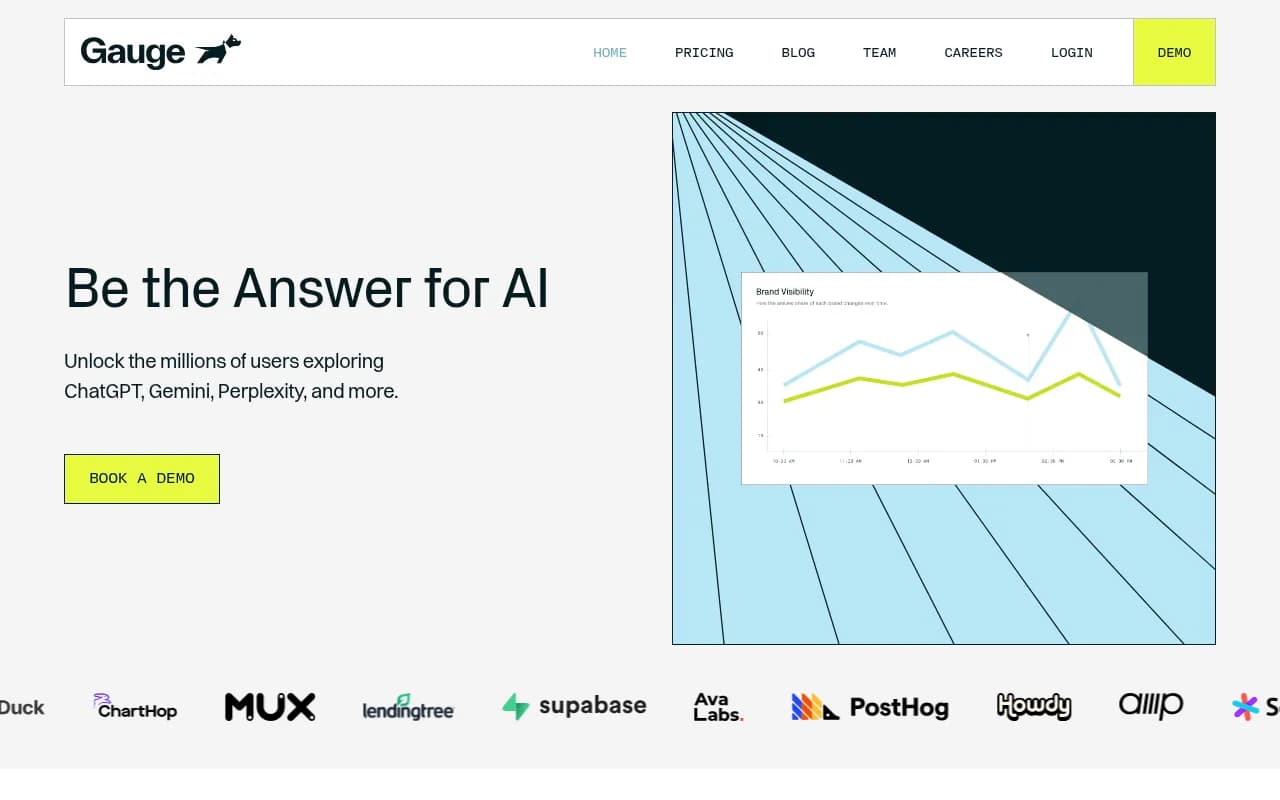
Where Gauge tends to differentiate is in its reporting layer -- dashboards are cleaner, and the platform makes it easier to share visibility snapshots with stakeholders who don't live in the tool daily. For agencies managing multiple clients or marketing directors who need to present AI visibility data to leadership, that matters.
What Gauge does well:
- Clean, shareable dashboards
- Multi-LLM brand tracking
- Competitive share of voice
- Reasonably fast setup
Where it falls short:
- No content gap analysis
- No built-in content generation
- No crawler log access
- No prompt volume or difficulty data
- Limited traffic attribution
Gauge sits in a similar category to Peec AI -- monitoring-first, with a stronger emphasis on presentation. If your primary use case is reporting AI visibility to stakeholders rather than actively improving it, Gauge is worth a look. If you want to close the gap between "we're not showing up" and "we're showing up consistently," you'll hit the same ceiling as Peec AI.
Promptwatch: monitoring plus the tools to act on it
Promptwatch takes a different approach. It's built around what the team calls an "action loop" -- find the gaps, create content to fill them, track the results. The monitoring layer is comparable to (and in some dimensions deeper than) Peec AI and Gauge, but the platform doesn't stop there.
Promptwatch is used by 6,700+ brands and agencies, including Booking.com and Center Parcs, and has processed over 1.1 billion citations, clicks, and prompts. In a 2026 comparison of 12 GEO platforms, it was the only tool rated as a "Leader" across all categories.

What the monitoring layer looks like
Promptwatch tracks visibility across 10 AI models: ChatGPT, Perplexity, Claude, Gemini, Google AI Overviews, Google AI Mode, Meta/Llama, DeepSeek, Grok, Mistral, and Copilot. That's broader coverage than Peec AI or Gauge, which focus primarily on the top three or four.
Beyond basic citation tracking, you get:
- Prompt volume estimates and difficulty scores (so you can prioritize which prompts are worth targeting)
- Query fan-outs that show how one prompt branches into sub-queries
- Competitor heatmaps comparing your AI visibility vs competitors across each LLM
- Reddit and YouTube citation tracking (which discussions are influencing AI recommendations)
- ChatGPT Shopping tracking (when your brand appears in product recommendations)
- AI crawler logs showing which pages AI bots are reading, how often, and what errors they encounter
That last one -- crawler logs -- is something most competitors lack entirely. Knowing that Claude's crawler visited your pricing page but returned a 404 error is actionable information. Knowing your citation rate dropped 12% isn't, without understanding why.
The content gap analysis
Answer Gap Analysis is where Promptwatch separates from monitoring-only tools. It shows you the specific prompts your competitors are visible for that you're not -- not as a vague category observation, but as a list of actual questions AI models are answering with competitor content instead of yours.
From there, the built-in AI writing agent generates articles, listicles, and comparisons grounded in real citation data. This isn't generic content -- it's built around the specific prompts and angles that AI models are already citing, which means it's more likely to get picked up.
Traffic attribution
Promptwatch closes the loop with traffic attribution via a code snippet, Google Search Console integration, or server log analysis. You can connect AI visibility improvements to actual traffic and revenue -- something neither Peec AI nor Gauge currently offers.
Feature comparison
| Feature | Peec AI | Gauge | Promptwatch |
|---|---|---|---|
| AI models tracked | 3-4 | 4-5 | 10 |
| Citation tracking | Yes | Yes | Yes |
| Share of voice | Yes | Yes | Yes |
| Competitor heatmaps | Basic | Basic | Advanced |
| Prompt volume/difficulty | No | No | Yes |
| Query fan-outs | No | No | Yes |
| AI crawler logs | No | No | Yes |
| Content gap analysis | No | No | Yes |
| AI content generation | No | No | Yes |
| Reddit/YouTube tracking | No | No | Yes |
| ChatGPT Shopping tracking | No | No | Yes |
| Traffic attribution | No | No | Yes |
| Multi-language/region | Limited | Limited | Yes |
| Looker Studio / API | No | No | Yes |
| Starting price | ~$100/mo | ~$150/mo | $99/mo |
Pricing breakdown
Peec AI starts around $100/month for entry-level access. Gauge is in a similar range, typically starting around $150/month depending on the plan.
Promptwatch's pricing is structured around use case:
- Essential: $99/month (1 site, 50 prompts, 5 articles/month)
- Professional: $249/month (2 sites, 150 prompts, 15 articles, crawler logs, state/city tracking)
- Business: $579/month (5 sites, 350 prompts, 30 articles)
- Agency/Enterprise: custom pricing
A free trial is available. Annual billing comes with a discount.
One thing worth noting: Promptwatch's Essential plan at $99/month is actually cheaper than Peec AI's entry pricing while including features (like AI content generation) that Peec AI doesn't offer at any tier. For teams that were considering Peec AI as the budget option, that comparison is worth running.
Which platform fits which team?
The honest answer depends on what your team is actually trying to do.
Choose Peec AI if:
- You want a simple, transparent way to track AI visibility without a complex setup
- Your team has the capacity to take monitoring data and act on it independently
- Budget is tight and you need the lowest entry point
- You're in an early stage of AI visibility work and just need baseline data
Choose Gauge if:
- Stakeholder reporting is a priority and you need clean, shareable dashboards
- You're managing multiple clients and need a polished presentation layer
- You want monitoring without a steep learning curve
Choose Promptwatch if:
- You want to actually improve your AI visibility, not just measure it
- Your team doesn't have time to manually research content gaps and write optimization content
- You need traffic attribution to justify AI visibility investment to leadership
- You want crawler log access to diagnose technical issues with AI indexing
- You're tracking across more than 4-5 AI models
- You need multi-language or multi-region monitoring
The monitoring-only trap
There's a pattern worth naming directly. Most AI visibility tools launched in 2024-2025 are monitoring dashboards. They're useful for establishing a baseline, and some teams genuinely just need that. But a lot of marketing teams buy a monitoring tool, look at the data for a few months, and then realize they have no clear path from "our visibility score is 23%" to "our visibility score is 45%."
Peec AI and Gauge are honest about this -- they're tracking tools, not optimization platforms. The question is whether your team has the resources to bridge that gap independently. If you have a content team ready to act on citation gap data, a monitoring tool might be all you need. If you're a lean marketing team trying to improve AI visibility alongside everything else you're doing, a platform that includes the optimization layer is worth the additional cost.
Other tools worth knowing
If none of the three main options feel like the right fit, a few other platforms are worth considering depending on your specific needs.
For enterprise teams with deep budgets and complex governance requirements, Profound is worth evaluating.
For agencies that want broad coverage with fast onboarding, Scrunch has a strong reputation for day-to-day monitoring.
For teams that want monitoring at a lower price point than Peec AI, Otterly.AI covers the basics.

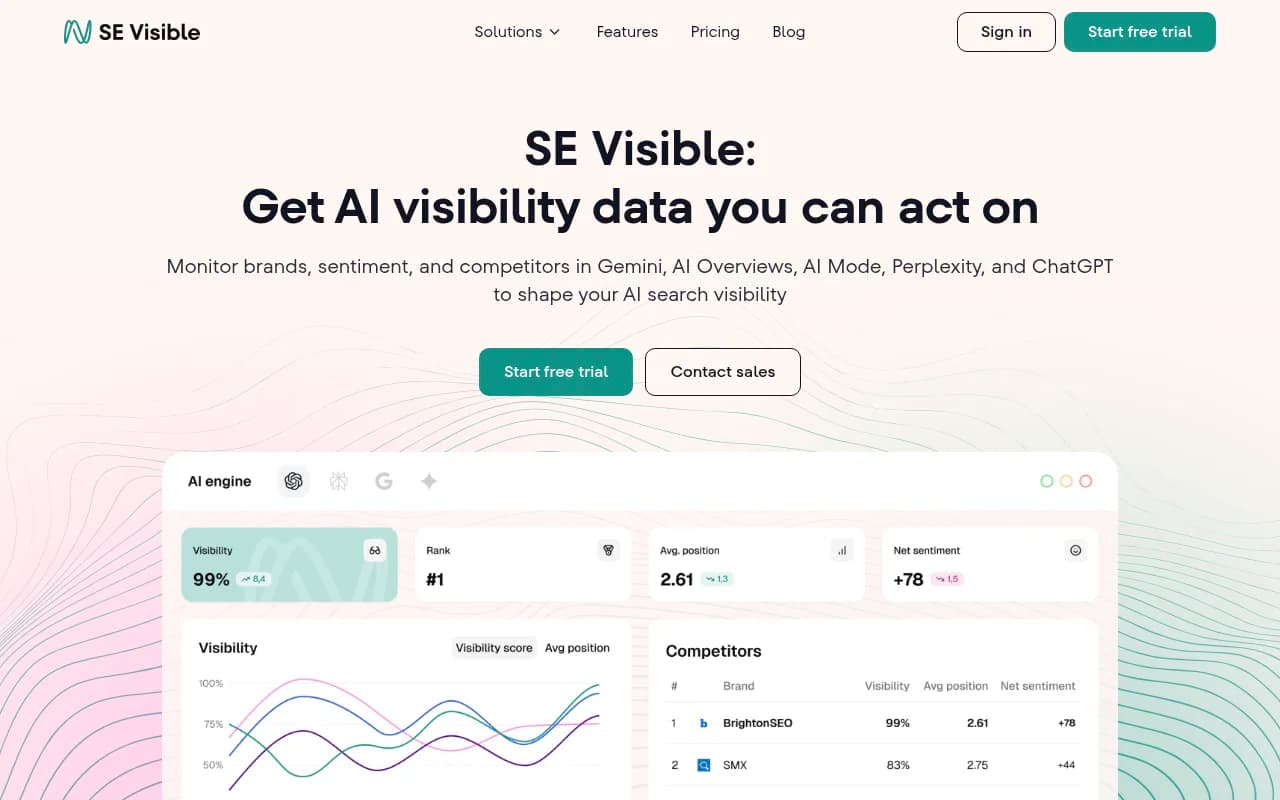
For teams that want a middle ground between monitoring and optimization, SE Visible (from SE Ranking) adds some strategic context to its tracking.
Bottom line
Peec AI and Gauge are both legitimate tools for teams that need to establish an AI visibility baseline. They're well-priced, relatively easy to set up, and give you the core metrics you need to understand where you stand.
But if you're trying to move from "we know we're invisible" to "we're consistently cited by ChatGPT and Perplexity," monitoring data alone won't get you there. That requires knowing which specific content gaps to fill, having the tools to fill them efficiently, and being able to attribute the results to revenue. That's what separates a monitoring tool from an optimization platform -- and in 2026, that distinction matters more than it did a year ago.