Key Takeaways
- Rankscale uses credit-based pricing starting at €20/mo, while Omnia offers flexible pricing with a free trial (Pro plan pricing on request)
- Both platforms monitor the same 10 AI engines (ChatGPT, Perplexity, Claude, Gemini, etc.), but differ significantly in how they present and act on the data
- Omnia emphasizes a personalized roadmap feature that translates tracking data into step-by-step actions -- Rankscale focuses on deep analytics and competitor benchmarking
- Rankscale's credit system means you pay per query tracked, which can get expensive at scale -- Omnia's pricing structure is less transparent but appears more predictable
- For teams that want monitoring plus a clear action plan, Omnia has the edge. For teams that need granular analytics and custom tracking frequencies, Rankscale offers more control.
- Neither platform includes built-in content generation -- both stop at insights and recommendations
Overview
Rankscale
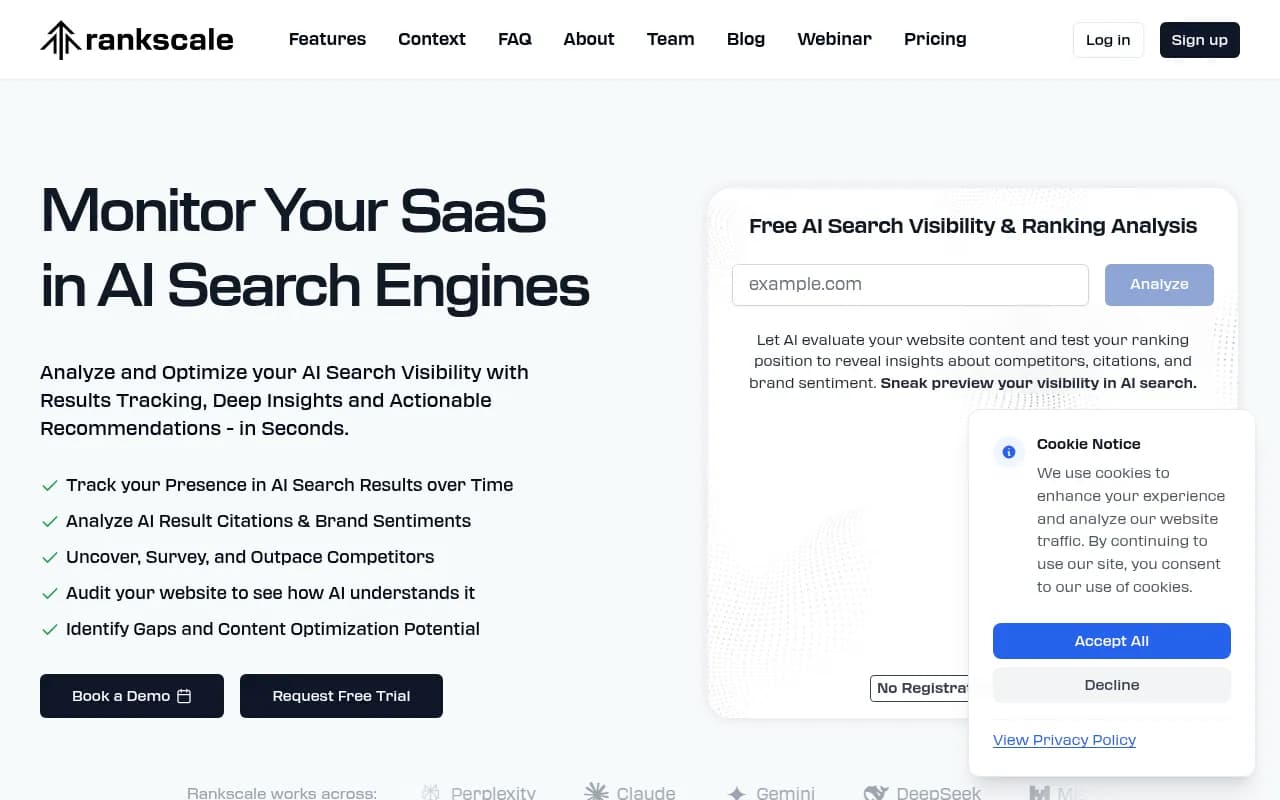
Rankscale positions itself as an AI visibility scaling platform with a focus on automated monitoring and deep analysis. The platform tracks your brand's presence across 10 generative AI platforms and provides detailed insights into citations, sentiment, and competitor performance. Its credit-based pricing model gives you flexibility in how many queries you track and how often, with plans ranging from Essentials to Enterprise.
The core value proposition: track your presence over time, analyze AI result citations and brand sentiments, uncover and outpace competitors, audit how AI understands your website, and identify content optimization gaps. Rankscale also offers website audits to see how AI engines interpret your content.
Omnia
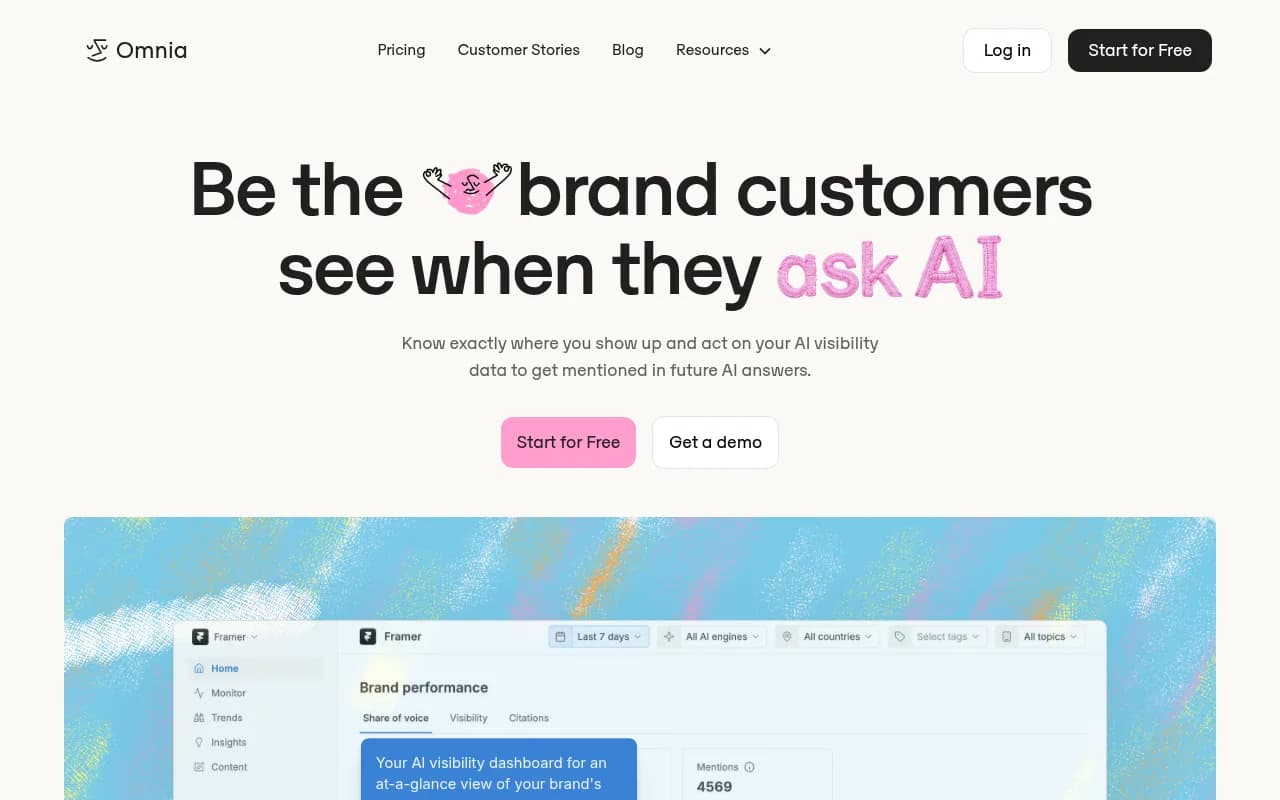
Omnia markets itself as an AI visibility platform built specifically for SEO and marketing teams. Like Rankscale, it monitors the same 10 AI engines, but Omnia's differentiator is its personalized roadmap feature. Instead of just showing you where you're visible (or invisible), Omnia translates that data into a step-by-step plan covering content creation, technical SEO, and content placement.
The pitch: discover real questions people ask AI, see your brand through AI's eyes, and act on your data with a roadmap mapped to your actual gaps. Omnia also highlights prompt discovery -- helping you understand which questions customers are asking about your industry or product.
Side-by-side comparison
| Feature | Rankscale | Omnia |
|---|---|---|
| Pricing | Credit-based from €20/mo (Essentials, Professional, Business, Enterprise) | Flexible pricing, free trial available, Pro plan on request |
| Free tier | No | Free trial available |
| AI engines monitored | 10 (ChatGPT, Perplexity, Claude, Gemini, DeepSeek, Mistral, Grok, Copilot, AI Overviews, AI Mode) | 10 (same set) |
| Tracking frequency | Varies by plan (customizable) | Not specified |
| Competitor benchmarking | Yes, detailed competitor analysis | Yes, share of voice tracking |
| Citation analysis | Yes, deep citation tracking | Yes, source-level insights |
| Sentiment analysis | Yes | Not explicitly mentioned |
| Website audit | Yes, AI understanding audit | Not explicitly mentioned |
| Actionable roadmap | Recommendations provided | Personalized step-by-step roadmap |
| Prompt discovery | Gap identification | Real customer question discovery |
| Content generation | No | No |
| Integrations | Not specified | Not specified |
| Target audience | Brands, agencies, enterprises | SEO and marketing teams |
Monitoring capabilities
AI engine coverage
Both platforms monitor the exact same 10 AI engines: ChatGPT, Perplexity, Claude, Gemini, DeepSeek, Mistral, Grok, Copilot, Google AI Overviews, and Google AI Mode. This is table stakes in 2026 -- any serious AI visibility platform needs to cover at least these.
Neither platform appears to offer Reddit or YouTube tracking, which is a gap compared to more comprehensive tools like Promptwatch. Both also lack ChatGPT Shopping monitoring, which matters if you're in e-commerce.

Tracking frequency and credits
Rankscale's credit-based model means you're paying per query tracked. The Essentials plan starts at €20/mo with a set number of credits, and you can customize tracking frequency based on your plan tier. This gives you control but also means costs can balloon if you're tracking hundreds of prompts.
Omnia doesn't publish its tracking frequency or credit limits publicly. The lack of transparency here is frustrating -- you need to request pricing to understand what you're actually getting. Based on user reports, Omnia appears to offer unlimited tracking within plan tiers rather than a per-query credit system.
Verdict: Rankscale wins on transparency and control. Omnia wins on simplicity if you don't want to think about credits.
Analytics and insights
Citation and source analysis
Rankscale emphasizes "deep insights" and citation tracking. You can see which sources AI engines are pulling from when they mention (or don't mention) your brand. The platform also tracks sentiment -- how AI models are framing your brand (positive, neutral, negative).
Omnia offers source-level insights as well, showing you which citations AI engines use. User feedback suggests Omnia's interface makes it easier to see which specific prompts trigger mentions and which sources are being cited. The "see your brand through AI's eyes" positioning is more than marketing -- the platform does a good job visualizing how AI models perceive your brand.
Both platforms fall short of showing you real-time AI crawler logs or indexing data, which would tell you how often AI engines are actually visiting your site. That's a capability you'd find in platforms like Promptwatch.
Verdict: Tie. Both offer solid citation tracking, just presented differently.
Competitor benchmarking
Rankscale explicitly calls out competitor analysis as a core feature. You can "uncover, survey, and outpace competitors" by seeing where they're visible and you're not. The platform provides share of voice metrics and lets you compare your visibility against multiple competitors.
Omnia also offers competitor benchmarking with share of voice tracking. The interface shows you how you stack up against competitors across different prompts and AI engines.
Neither platform appears to offer the kind of granular competitor heatmaps or prompt-by-prompt breakdowns you'd get from more advanced tools.
Verdict: Tie. Both cover the basics well.
Website audit
Rankscale includes a website audit feature that shows you "how AI understands" your site. This is useful for identifying technical issues or content gaps that might be hurting your AI visibility.
Omnia doesn't explicitly mention a website audit feature. The focus is more on prompt-level tracking and roadmap generation.
Verdict: Rankscale wins here with a feature Omnia doesn't advertise.
Actionable recommendations
Roadmap and next steps
This is where the platforms diverge most clearly.
Rankscale provides recommendations and identifies "content optimization potential." You'll see gaps and get suggestions, but it's up to you to figure out what to do with them. The platform is analytics-first.
Omnia's headline feature is its personalized roadmap. The platform takes your tracking data and generates a step-by-step plan covering content creation, technical SEO, and content placement. Each action is mapped to a specific gap in your AI visibility. This is closer to a consultant's deliverable than a monitoring dashboard.
The catch: neither platform actually helps you create the content. You get the roadmap, but you're still writing the articles yourself or hiring someone to do it. Tools like Promptwatch include an AI writing agent that generates content grounded in citation data -- Rankscale and Omnia both stop short of that.
Verdict: Omnia wins for teams that want a clear action plan. Rankscale is better if you have your own optimization process and just need the data.
Prompt discovery
Omnia emphasizes prompt discovery -- helping you understand what real questions people are asking AI about your industry or product. This is valuable for content planning.
Rankscale focuses more on gap identification -- showing you where you're not visible and where competitors are winning.
Both approaches are useful, but Omnia's framing around "real customer questions" is more actionable for content teams.
Verdict: Omnia edges ahead here.
Pricing comparison
Rankscale's pricing is public but complex:
| Plan | Starting Price | Notes |
|---|---|---|
| Essentials | €20/mo | Credit-based, limited brands and tracking frequency |
| Professional | Not specified | More credits, more brands, higher tracking frequency |
| Business | Not specified | Even more credits and features |
| Enterprise | Custom | Unlimited credits, custom tracking |
Omnia's pricing is opaque:
| Plan | Price | Notes |
|---|---|---|
| Free Trial | Free | Limited time |
| Pro | On request | Pricing not public |
The credit-based model can work in your favor if you're only tracking a handful of prompts. But if you're scaling to hundreds of queries, Rankscale's costs will add up quickly. Omnia's lack of public pricing is annoying, but user reports suggest it's more predictable -- you pay a flat fee per month regardless of how many prompts you track (within reason).
Verdict: Depends on your scale. Rankscale is cheaper for small-scale monitoring. Omnia is likely more cost-effective at scale, but you need to request a quote to know for sure.
User experience and interface
Based on user feedback from Reddit and review sites:
- Rankscale is described as having a more traditional analytics dashboard. Lots of data, lots of charts, but you need to dig to find actionable insights.
- Omnia is praised for its cleaner interface and better visualization of prompt-level data. The roadmap feature is a standout -- it's rare to see a monitoring tool that actually tells you what to do next.
Neither platform has a steep learning curve, but Omnia feels more designed for marketers who want quick answers. Rankscale feels more designed for analysts who want to explore the data.
Pros and cons
Rankscale pros
- Credit-based pricing gives you control over costs at small scale
- Website audit feature shows how AI understands your site
- Detailed sentiment analysis
- Customizable tracking frequency
- Transparent pricing structure
Rankscale cons
- Credit system can get expensive at scale
- More analytics-focused, less action-oriented
- No built-in content generation
- Recommendations are generic compared to Omnia's roadmap
Omnia pros
- Personalized roadmap translates data into step-by-step actions
- Strong prompt discovery for understanding customer questions
- Cleaner, more marketing-friendly interface
- Free trial available
- Better for teams that want to act quickly on insights
Omnia cons
- Pricing is not transparent -- you have to request a quote
- No website audit feature
- No built-in content generation
- Less granular control over tracking frequency
Who should choose which platform
Choose Rankscale if:
- You're tracking a small number of prompts and want to minimize costs
- You need detailed analytics and sentiment analysis
- You want control over tracking frequency and credit allocation
- You have your own optimization process and just need the data
- You value transparent pricing
Choose Omnia if:
- You want a clear, actionable roadmap instead of just data
- You're scaling to hundreds of prompts and want predictable pricing
- You need prompt discovery to understand what customers are asking
- You prefer a cleaner, more marketing-friendly interface
- You're willing to request a quote to understand pricing
Final verdict
Both platforms do the same core job: monitor your brand's visibility across 10 AI engines and provide insights. The difference is in how they present the data and what they do with it.
Rankscale is the better choice for teams that want granular control and deep analytics. The credit-based model works well at small scale, and the website audit feature is a nice bonus. But you're largely on your own to figure out what to do with the insights.
Omnia is the better choice for teams that want to move fast. The personalized roadmap is a real differentiator -- it's rare to see a monitoring tool that actually tells you what to do next. The interface is cleaner, the prompt discovery is more actionable, and the pricing (while opaque) is likely more predictable at scale.
Neither platform is a complete solution. Both stop at insights and recommendations -- you're still responsible for creating the content, fixing technical issues, and executing the roadmap. If you want a platform that helps you create content that actually ranks in AI search, you'll need to look at tools that include content generation capabilities.
Bottom line: Omnia for action-oriented teams, Rankscale for analytics-focused teams. Both are solid monitoring platforms, just with different philosophies.