Key takeaways
- AthenaHQ is a capable AI visibility tracker, but it's expensive (starting at $295/mo) and focused primarily on monitoring -- it won't help you create content or fix gaps
- Most alternatives fall into two camps: cheaper monitoring tools (Otterly.AI, Peec AI, Airefs) and full-stack optimization platforms (Promptwatch, Profound, Scrunch AI)
- If you want to track AND fix your AI visibility, look for platforms with content generation, answer gap analysis, and crawler log access -- not just dashboards
- Promptwatch is the only platform in this comparison rated as a "Leader" across all GEO categories, with built-in content generation, 880M+ citations analyzed, and traffic attribution
- Budget-conscious teams can start with Otterly.AI or Airefs; agencies and growth-focused brands should look at Promptwatch or Profound
AthenaHQ has built a real following in the GEO space. It's Y Combinator-backed (W25), covers 8+ AI models, and gives you a reasonably clean view of how your brand appears in AI search. For some teams, it's exactly what they need.
But a lot of people hit the same wall: the starting price is steep, the credit-based system gets restrictive fast, and when you find out you're invisible for a key prompt, AthenaHQ doesn't tell you what to do about it. You get the data. You're on your own for the fix.
That's the gap this guide addresses. Below are 10 platforms worth considering in 2026, ranging from budget trackers to full optimization suites. I've organized them by what they're actually best at, not just alphabetically.
The core problem with monitoring-only tools
Before getting into the list, it's worth naming the pattern. Most GEO platforms -- AthenaHQ included -- are built around the same core loop: run prompts, show you a score, let you compare against competitors. That's useful. But it stops short of the thing most marketing teams actually need: a path from "we're invisible here" to "we fixed it."
The platforms that stand out in 2026 are the ones that close that loop. They don't just show you where you're losing -- they help you understand why, generate content to address it, and track whether that content actually moved the needle.
Keep that in mind as you read through the options below.
1. Promptwatch -- best overall for optimization (not just tracking)
Promptwatch is the platform that most directly addresses AthenaHQ's blind spot. Where AthenaHQ shows you your visibility score, Promptwatch shows you your visibility score and tells you exactly which prompts your competitors are winning that you're not, generates content designed to close those gaps, and tracks whether your new pages start getting cited.
The data behind it is substantial: over 880 million citations analyzed, 1.1 billion prompts processed, and coverage across 10 AI models including ChatGPT, Claude, Perplexity, Gemini, Grok, DeepSeek, and Google AI Overviews.
A few things that genuinely differentiate it from AthenaHQ:
- Answer Gap Analysis shows the specific prompts where competitors appear and you don't -- with the actual content angle missing from your site
- The built-in AI writing agent generates articles, listicles, and comparisons grounded in real citation data, not generic SEO filler
- AI Crawler Logs show you which pages ChatGPT, Claude, and Perplexity are actually reading on your site, how often, and what errors they hit
- ChatGPT Shopping tracking monitors when your brand appears in product recommendation carousels
- Traffic attribution connects AI visibility to actual revenue via GSC integration, a code snippet, or server log analysis
Pricing starts at $99/mo (Essential: 1 site, 50 prompts, 5 articles), $249/mo for Professional (crawler logs, 150 prompts, 15 articles), and $579/mo for Business. That's meaningfully cheaper than AthenaHQ's entry point, with more functionality at each tier.

2. Profound -- best for enterprise dashboards
Profound is the other name that comes up constantly in enterprise GEO conversations. It's built for large teams that need sophisticated prompt benchmarking, executive-level dashboards, and integrations with existing data infrastructure.
Where AthenaHQ feels like a tracking tool, Profound feels like a business intelligence layer for AI search. The share-of-voice reporting is detailed, the prompt analytics go deep, and it handles complex multi-brand, multi-market setups reasonably well.
The tradeoff: it's expensive, and like AthenaHQ, it's primarily a monitoring platform. You'll get excellent data on where you stand. What to do about it is still largely up to you.
3. Scrunch AI -- best for content teams doing persona testing
Scrunch AI takes an interesting angle: it lets you test how different user personas affect AI responses. If your brand serves multiple audience segments, that's genuinely useful -- a prompt from a first-time buyer might surface completely different results than the same topic from an enterprise procurement manager.
It also has solid AI traffic analytics, which helps you understand not just whether AI models mention you, but whether those mentions are driving actual visitors. For content teams that want to understand the "who" behind AI search behavior, Scrunch is worth a close look.
4. Peec AI -- best for international and multi-country tracking
If your business operates across multiple markets, Peec AI is probably the most capable option on this list for that specific use case. It tracks AI visibility by country, handles multi-language prompts, and includes sentiment analysis to flag whether your brand is being described positively or negatively in AI responses.
AthenaHQ has some international coverage, but Peec AI goes deeper on the geographic dimension. Starting at around €89/mo, it's also reasonably priced for what it offers.

5. Otterly.AI -- best budget option for solo practitioners
Otterly.AI is the go-to recommendation for anyone who needs basic AI visibility tracking without a significant budget commitment. At $29/mo, it covers prompt tracking, source monitoring, and AI keyword research. It's not going to replace a full GEO platform for a serious marketing team, but for a solo consultant or a small business just getting started with GEO, it does the job.
The limitation is the same as most budget tools: it's monitoring only. You'll know where you stand, but the platform won't help you improve.

6. Airefs -- best for affordable monitoring with Reddit tracking
Airefs starts at $24/mo, which makes it one of the cheapest options in this space. What makes it interesting beyond the price is that it includes Reddit monitoring -- which matters because Reddit discussions are a significant source that AI models cite when forming responses.
If you're trying to understand why a competitor keeps appearing in AI answers for certain topics, checking what Reddit is saying about that topic is often part of the answer. Most platforms ignore this channel entirely.
7. Goodie AI -- best mid-market option for attribution tracking
Goodie AI has built a reputation for having one of the more complete AEO execution layers among dedicated monitoring tools. Its attribution tracking is a genuine differentiator -- it connects AI visibility data to downstream traffic and conversion metrics more directly than most competitors.
For mid-market brands that want more than a visibility score but aren't ready to commit to enterprise pricing, Goodie AI sits in a useful middle ground.
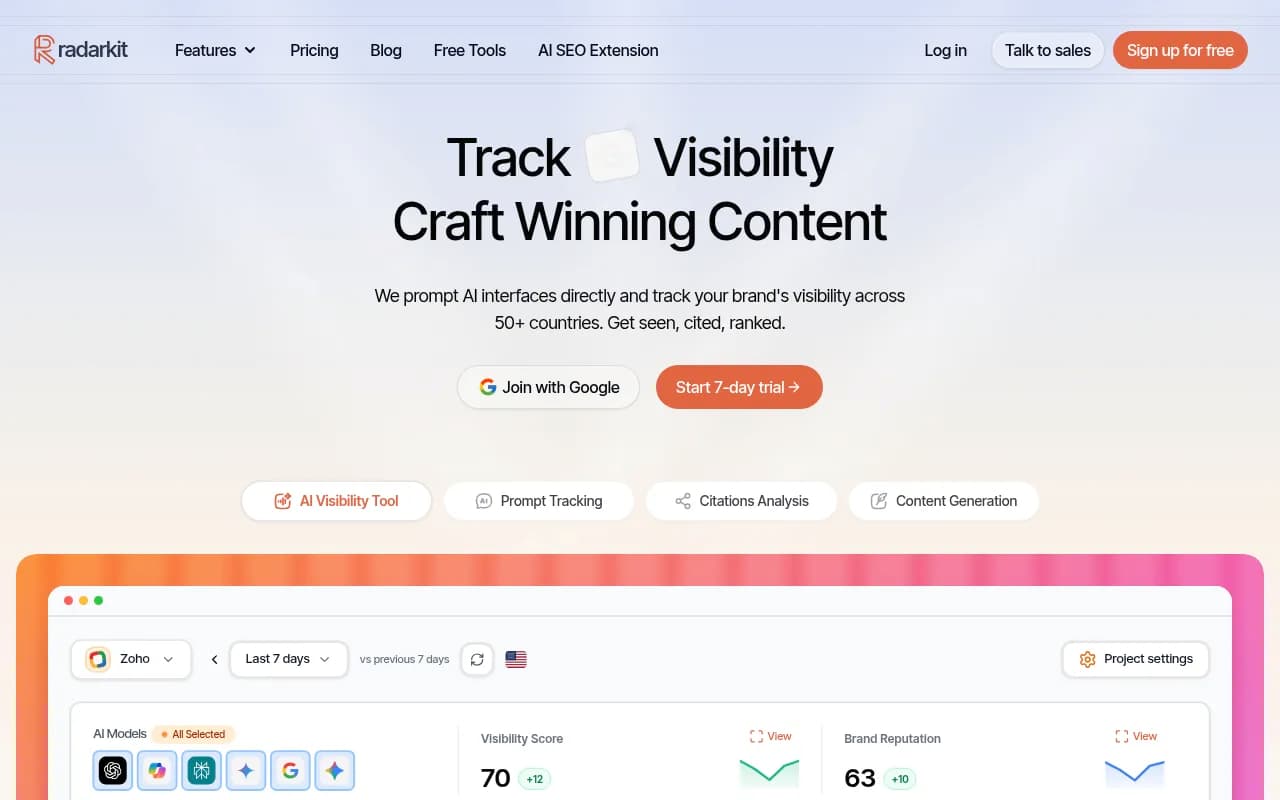
8. Radarkit -- best for agencies using real LLM prompting
Radarkit uses what it calls "Real LLM Prompting" -- meaning it pulls results from actual ChatGPT, Gemini, and Perplexity interfaces rather than restricted API data. The argument is that API responses can differ from what real users see, so this approach gives you more accurate tracking of actual user experience.
For agencies managing multiple clients, Radarkit's multi-location proxy tracking (using residential IPs) is also useful for simulating searches from specific geographies. Starting at $29/mo, it's priced accessibly for agency use.
9. Rankscale -- best for connecting traditional SEO data with GEO metrics
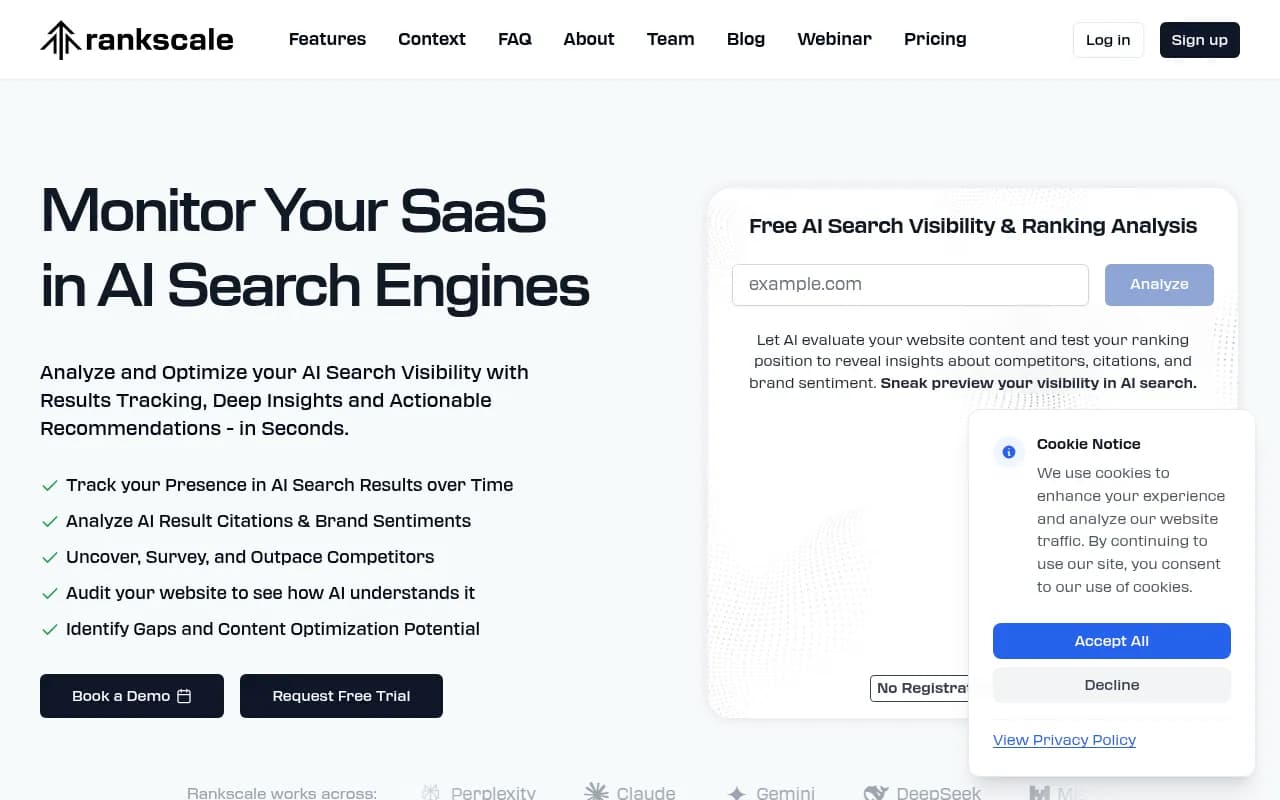
Rankscale takes a bridge approach: it syncs Google Analytics and Search Console data directly with GEO metrics, so you can see traditional SEO performance and AI visibility in the same dashboard. If your team is still heavily invested in traditional SEO reporting and wants to layer in AI search data without rebuilding your entire reporting stack, that's a meaningful convenience.
It's also one of the most affordable entry points on the market, starting around $20/mo.
10. Ahrefs Brand Radar -- best for existing Ahrefs users
If your team already lives in Ahrefs, Brand Radar is the path of least resistance for adding AI visibility tracking. It's integrated into the existing Ahrefs interface, so there's no new tool to learn or new login to manage.
The limitation is that Brand Radar uses fixed prompts rather than custom prompt sets, and there's no AI traffic attribution. It's a reasonable starting point for teams that want a taste of GEO data without committing to a dedicated platform, but it won't replace a purpose-built tool for serious AI search work.
How these platforms compare
| Platform | Starting price | Content generation | Crawler logs | Reddit tracking | Traffic attribution | Best for |
|---|---|---|---|---|---|---|
| Promptwatch | $99/mo | Yes | Yes | Yes | Yes | Full optimization loop |
| Profound | $99/mo | No | No | No | Limited | Enterprise dashboards |
| Scrunch AI | $100/mo | No | Yes | No | Yes | Persona testing |
| Peec AI | €89/mo | No | No | No | No | International tracking |
| Otterly.AI | $29/mo | No | No | No | No | Budget monitoring |
| Airefs | $24/mo | No | No | Yes | No | Affordable + Reddit |
| Goodie AI | Custom | No | No | No | Yes | Mid-market attribution |
| Radarkit | $29/mo | No | No | No | No | Agency use |
| Rankscale | $20/mo | No | No | No | No | SEO/GEO bridge |
| Ahrefs Brand Radar | Bundled | No | No | No | No | Existing Ahrefs users |
Which one should you actually pick?
The honest answer depends on what's frustrating you about AthenaHQ specifically.
If the price is the main issue and you just need basic tracking, Otterly.AI or Airefs will cover you for a fraction of the cost. If you need international coverage, Peec AI is the clear choice. If you're an agency running multiple clients, Radarkit's pricing and real-LLM approach make sense.
But if the deeper frustration is that AthenaHQ shows you problems without helping you solve them -- that's where Promptwatch is the meaningful upgrade. It's the only platform in this comparison that takes you from "we're invisible for this prompt" to "here's the content that will fix it" to "here's proof it worked." Most platforms stop at step one.
For teams that are serious about AI search as a growth channel rather than just a metric to monitor, that full loop matters more than any individual feature.
A note on what to watch for in 2026
The GEO tool market is moving fast. Several platforms that were monitoring-only a year ago are now adding content generation features. A few that launched with ambitious feature sets have quietly scaled back. When evaluating any of these tools, I'd push hard on two questions:
- Does the platform use real LLM responses or API data? (They can differ significantly)
- Can it connect AI visibility to actual traffic and revenue, or does it stop at impressions and citations?
Those two questions will filter out a lot of tools that look comprehensive on a feature comparison table but fall short in practice.