Key takeaways
- Bluefish AI is an enterprise-only platform with pricing estimated at $4,000+/month -- it's built for Fortune 500 marketing teams with complex infosec requirements and custom workflows. Rankscale starts at €20/month and is accessible to brands, agencies, and publishers of all sizes.
- Rankscale monitors 17+ AI engines vs Bluefish's undisclosed but narrower set, and covers 240+ countries with multi-language support out of the box.
- Neither platform includes built-in AI content generation -- both are primarily monitoring and optimization tools, which is a real gap if you want to act on the data you collect.
- Rankscale has a free trial and self-serve signup. Bluefish AI requires a sales demo call -- no self-serve access at all.
- Bluefish AI's "Collections" feature for measuring ROI of digital marketing campaigns in the AI channel is genuinely differentiated for enterprise use cases. Rankscale has no equivalent.
- For most companies that aren't Fortune 500, Rankscale is the practical choice. Bluefish AI is a serious tool, but the price and access model put it out of reach for the majority of teams.
Overview
Bluefish AI
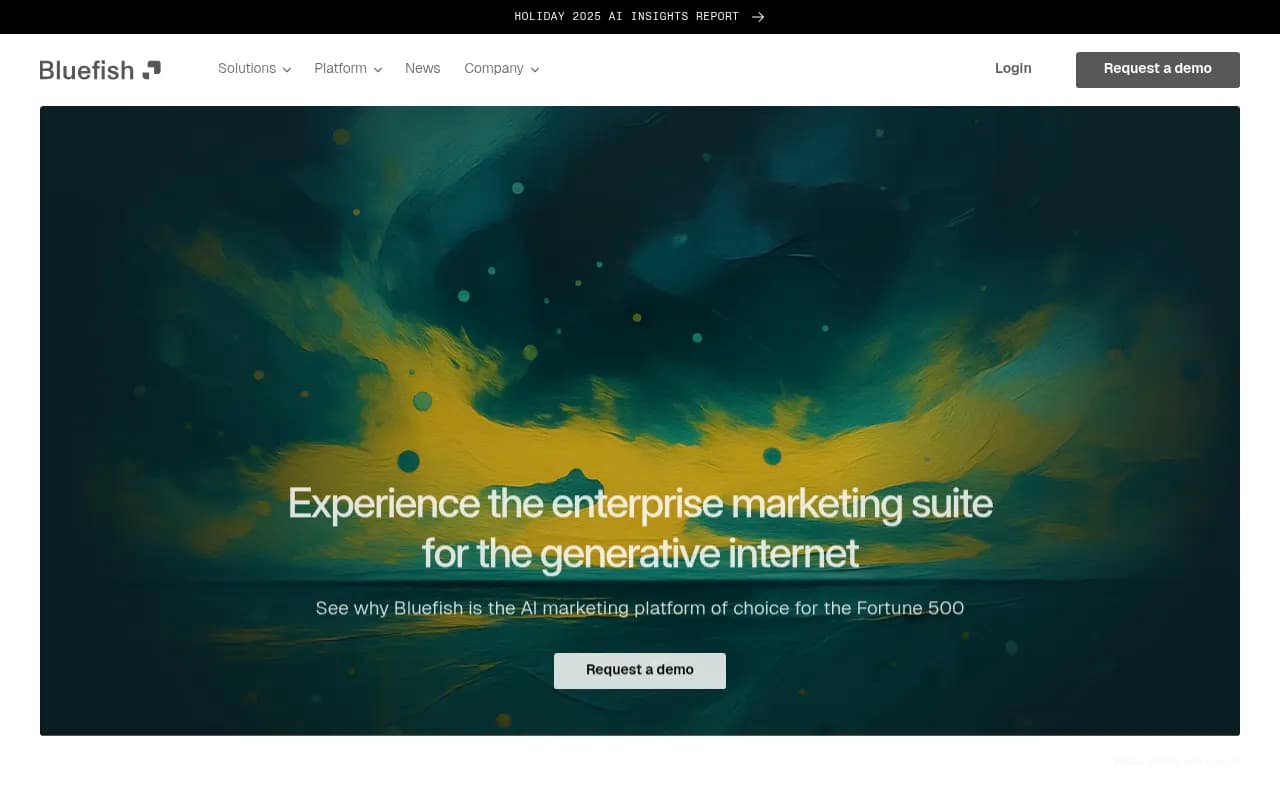
Bluefish AI positions itself as the AI marketing platform for the Fortune 500. The pitch is authority and control: not just tracking where your brand shows up in AI-generated answers, but understanding how AI models "think" about your brand and influencing that. Their enterprise suite covers AI monitoring, GEO optimization, measurement, and AI commerce tracking. The February 2026 launch of "Collections" -- a feature that ties digital marketing campaign spend to AI channel outcomes -- shows they're pushing into territory most GEO tools haven't touched yet.
The catch is the access model. There's no pricing page, no free trial, and no self-serve signup. Everything goes through a sales call. That's fine if you're a large enterprise with a procurement process, but it's a hard stop for anyone else.
Rankscale
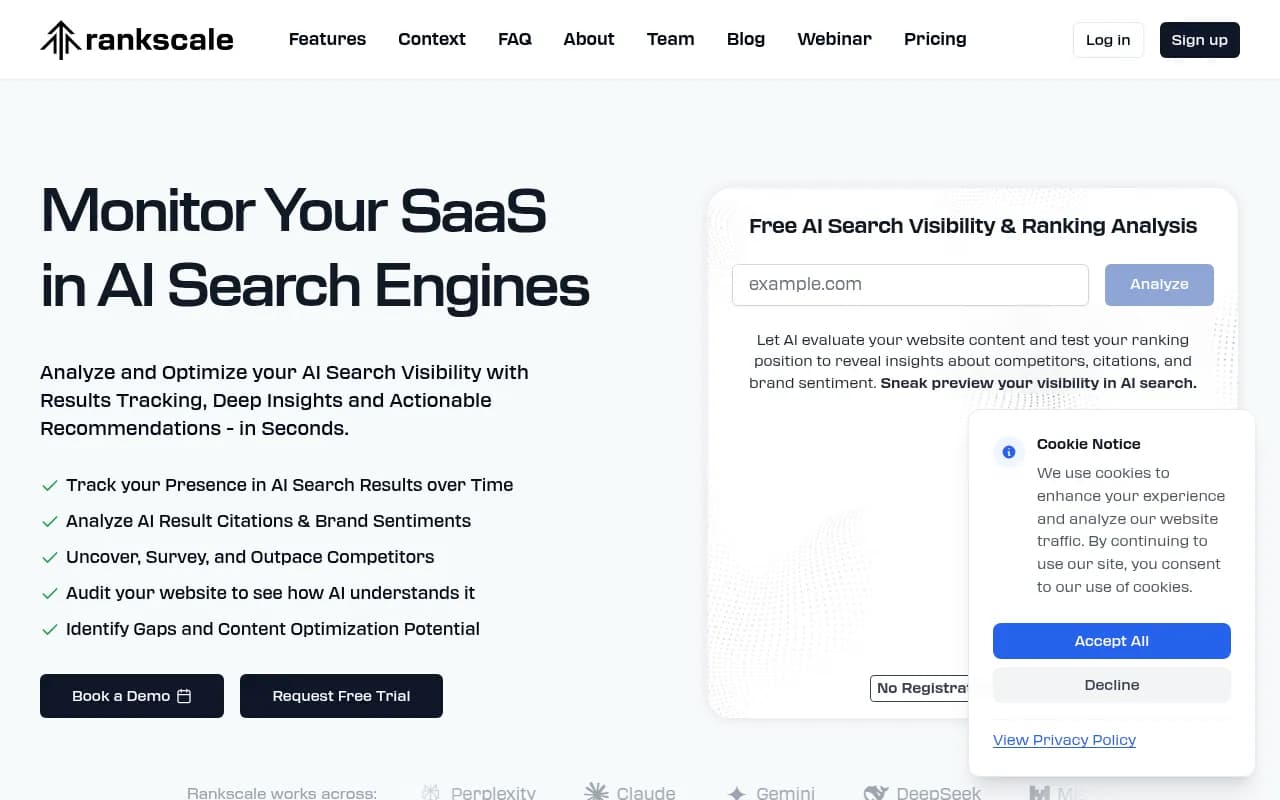
Rankscale takes a different approach: broad coverage, accessible pricing, and a structured feature set that works for brands, agencies, and publishers. They track 17+ AI engines (including newer ones like DeepSeek and Grok), support 240+ countries and all languages, and run 94+ technical checkpoint audits on your content. Their client list includes Bosch, UBS, REWE, Dentsu, WPP Media, and Publicis Sapient -- a mix that shows the platform genuinely scales from mid-market to large enterprise.
The credit-based pricing model is flexible but can get confusing. You're buying credits that get consumed by queries, and higher-tier plans unlock more brands, faster tracking frequencies, and deeper features. Starting at €20/month, the entry point is low enough to experiment.
Side-by-side comparison
| Feature | Bluefish AI | Rankscale |
|---|---|---|
| Target audience | Fortune 500 / large enterprise | Brands, agencies, publishers (all sizes) |
| Pricing model | Quote-based | Credit-based tiers |
| Starting price | ~$4,000+/month (estimated) | €20/month |
| Free trial | No | Yes |
| Self-serve signup | No (demo required) | Yes |
| AI engines monitored | Major platforms (count undisclosed) | 17+ engines |
| Countries/languages | Not publicly specified | 240+ countries, all languages |
| Competitor analysis | Yes | Yes |
| Citation analysis | Yes | Yes |
| Sentiment analysis | Yes | Yes |
| Page/technical audits | Not publicly detailed | Yes (94+ checkpoints) |
| Prompt research | Yes | Yes (with volume estimates) |
| AI commerce tracking | Yes (AI Commerce module) | Not mentioned |
| Campaign ROI measurement | Yes (Collections feature) | No |
| Content generation | No | No |
| Multi-brand management | Yes (enterprise) | Yes (multi-brand dashboard) |
| API access | Yes (enterprise) | Yes |
| Agency support | Limited (enterprise focus) | Strong (explicit agency tier) |
Head-to-head feature deep-dive
Pricing and accessibility
This is where the two tools diverge most sharply.
Rankscale publishes a credit-based pricing structure with four tiers: Essentials, Professional, Business, and Enterprise. The entry point is €20/month, which gets you basic monitoring across a limited number of brands and queries. Higher tiers unlock more credits, more brands, faster tracking frequencies, and features like deeper competitor analysis. It's not the simplest pricing model -- credits can feel opaque -- but at least you know what you're getting into before you talk to anyone.
Bluefish AI has no public pricing. The estimate of $4,000+/month comes from third-party research and industry sources, not from Bluefish directly. Everything is quote-based, and the only way in is through a sales demo. For a Fortune 500 company with a dedicated marketing technology budget, that's normal. For anyone else, it's a wall.
Verdict: Rankscale wins on accessibility and price transparency. Bluefish AI is only realistic for large enterprise buyers.
AI engine coverage
| Platform | Bluefish AI | Rankscale |
|---|---|---|
| ChatGPT | Yes | Yes |
| Perplexity | Yes | Yes |
| Claude | Yes | Yes |
| Google Gemini | Yes | Yes |
| Google AI Overviews | Yes | Yes |
| Google AI Mode | Not confirmed | Yes |
| DeepSeek | Not confirmed | Yes |
| Grok | Not confirmed | Yes |
| Copilot | Not confirmed | Yes |
| Mistral | Not confirmed | Yes |
| Total confirmed | Not publicly disclosed | 17+ |
Rankscale's 17+ engine count is a real differentiator. They've been faster to add newer models like DeepSeek and Grok, and they explicitly track both chat interfaces and raw AI model outputs. Bluefish AI covers the major platforms but doesn't publish a list, which makes it hard to verify coverage depth.
Verdict: Rankscale has broader, more transparent engine coverage.
Monitoring and analytics
Both platforms offer brand visibility dashboards, competitor benchmarking, citation analysis, and sentiment tracking. The core monitoring loop is similar.
Where Bluefish AI goes further is in the depth of enterprise-specific analytics. Their "Impact and Influence" positioning suggests they're tracking not just whether your brand appears, but how AI models characterize your brand -- sentiment nuance, competitive positioning, and brand authority signals. The Collections feature (launched February 2026) lets you tie specific marketing campaigns to AI channel outcomes, which is genuinely useful for enterprise teams trying to justify AI marketing spend.
Rankscale's monitoring is solid and well-structured. The AI Rank Tracker gives historical trends with actionable recommendations, and the 94+ technical checkpoint audit is a strong differentiator for teams that want to understand why they're not getting cited. The prompt research tool estimates search volume and decodes intent, which helps prioritize what to track.
Verdict: Tie, with different strengths. Bluefish AI goes deeper on brand influence and campaign attribution. Rankscale goes broader on technical auditing and prompt intelligence.
Geographic and language coverage
Rankscale explicitly supports 240+ countries and all languages. This is a concrete, published spec. For global brands or agencies managing clients across multiple markets, this matters a lot.
Bluefish AI doesn't publish geographic or language coverage details. Given their enterprise focus, it's reasonable to assume they support major markets, but the lack of transparency is a gap.
Verdict: Rankscale wins on documented global coverage.
Agency and multi-brand support
Rankscale is clearly built with agencies in mind. Their client list includes Dentsu, WPP Media, Publicis Sapient, and several boutique agencies. The multi-brand dashboard lets you manage multiple clients from one interface, and the credit-based model means you can scale spend across a portfolio.
Bluefish AI supports multi-brand management at the enterprise level, but the product is designed for a single large brand's internal marketing team, not an agency managing 20 clients. The pricing model doesn't lend itself to agency reselling.
Verdict: Rankscale is better for agencies. Bluefish AI is better for large in-house teams.
Content optimization and generation
Neither platform includes built-in AI content generation -- this is a shared gap. Both offer optimization recommendations based on monitoring data, but neither will write the content for you.
Bluefish AI's GEO optimization module automates some optimization workflows and provides measurement frameworks. Rankscale's page audits and prompt research give you a clear picture of what to fix, but the fixing is still manual.
If content generation is important to your workflow, it's worth knowing that Promptwatch includes a built-in AI writing agent that generates articles and comparisons grounded in citation data -- something neither Bluefish AI nor Rankscale offers.

Verdict: Neither tool wins here. Both are monitoring-first platforms.
Enterprise features and security
Bluefish AI's strongest selling point for large enterprises is its infosec posture. They explicitly claim to "consistently pass infosec reviews with ease" -- a real concern for Fortune 500 procurement teams. They also offer custom audiences, tailored prompts, and data segmentation options that go beyond what self-serve platforms typically provide.
Rankscale has enterprise tiers and API access, but doesn't make the same explicit claims about security certifications or custom data handling. For a mid-market company, that's fine. For a regulated industry or a company with strict data governance requirements, Bluefish AI's enterprise-grade positioning matters.
Verdict: Bluefish AI wins on enterprise security and customization depth.
Pricing comparison
| Plan | Bluefish AI | Rankscale |
|---|---|---|
| Free tier | No | No (free trial available) |
| Entry-level | ~$4,000+/month (estimated, quote-based) | €20/month (Essentials) |
| Mid-tier | Custom | Professional tier (price varies by credits) |
| Business tier | Custom | Business tier (price varies by credits) |
| Enterprise | Custom | Custom |
| Billing | Annual contract (assumed) | Monthly or annual |
| Self-serve | No | Yes |
The pricing gap here is not subtle. Rankscale's entry point is roughly 200x cheaper than Bluefish AI's estimated starting price. For most companies, this comparison ends at the pricing table.
Pros and cons
Bluefish AI
Pros:
- Deep enterprise-grade analytics on brand influence, not just visibility
- Collections feature ties AI channel performance to marketing campaign ROI
- Strong infosec posture for regulated industries and Fortune 500 procurement
- Custom audiences and tailored prompt configurations
- AI commerce tracking for brands selling through AI-powered channels
Cons:
- No public pricing -- requires a sales conversation to even understand cost
- Estimated $4,000+/month puts it out of reach for most companies
- No free trial or self-serve access
- Engine coverage not publicly documented
- No built-in content generation
Rankscale
Pros:
- Accessible pricing starting at €20/month with a free trial
- 17+ AI engines covered with transparent, documented list
- 240+ countries and all languages supported
- 94+ technical checkpoint audits -- useful for diagnosing citation gaps
- Strong agency support with multi-brand dashboard
- Trusted by large brands (Bosch, UBS, REWE) and major agencies (Dentsu, WPP Media)
Cons:
- Credit-based pricing can be confusing to budget for
- No campaign ROI attribution (no equivalent to Bluefish's Collections)
- No built-in content generation
- Less depth on brand influence and AI "thinking" analysis
- Enterprise security posture not explicitly documented
Who should pick which tool
Pick Bluefish AI if:
- You're at a Fortune 500 or large enterprise with a dedicated AI marketing budget
- You need to pass strict infosec reviews before deploying any new tool
- You want to measure how specific marketing campaigns (TV, digital, events) affect your AI channel performance
- You need deep customization: custom audiences, tailored prompt sets, bespoke measurement frameworks
- You're tracking AI commerce and agentic shopping behavior, not just search visibility
Pick Rankscale if:
- You're a brand, agency, or publisher that wants to get started with AI visibility tracking without a six-figure commitment
- You manage multiple brands or clients and need a multi-brand dashboard
- You want broad engine coverage (17+ platforms) with documented geographic and language support
- You need technical auditing to understand why AI models aren't citing your content
- You want a free trial before committing
Final verdict
These two tools are aimed at fundamentally different buyers. Bluefish AI is a serious enterprise platform for companies that have already decided AI visibility is a strategic priority and have the budget to match. Rankscale is a capable, well-rounded tool that most companies can actually afford and use today.
If you're a mid-market brand, an agency, or even a large company that wants to start tracking AI visibility without a procurement process, Rankscale is the practical choice. If you're a Fortune 500 marketing team that needs campaign attribution, infosec compliance, and deep brand influence analytics, Bluefish AI is worth the demo call.
The shared gap worth noting: neither tool will help you create the content that closes your visibility gaps. They'll both tell you where you're missing -- acting on that is still on you.