Key takeaways
- GetMint.ai and Meteoria.ai both position themselves as GEO/AI visibility platforms, but neither delivers the full optimization loop marketers actually need in 2026
- Both tools are primarily monitoring dashboards — they show you data but don't help you act on it
- The GEO space has matured rapidly; platforms that only track mentions without offering content gap analysis or content generation are increasingly hard to justify
- Several better alternatives exist at similar or lower price points, covering everything from basic tracking to full content optimization
- If you want a platform that closes the loop from "where am I invisible?" to "here's the content that fixes it," you'll need to look elsewhere
The AI search visibility space has gotten crowded fast. Eighteen months ago, any tool that could tell you whether ChatGPT mentioned your brand felt like magic. Now that bar is embarrassingly low, and yet plenty of platforms are still selling dashboards that don't do much more than that.
GetMint.ai and Meteoria.ai are two tools that keep coming up in comparisons and alternatives lists. So let's actually look at what they offer, where they fall apart, and whether either of them deserves a spot in your stack in 2026.
What GetMint.ai actually does
GetMint.ai markets itself as an AI visibility monitoring platform. The core pitch is that it tracks how your brand appears across AI search engines like ChatGPT, Perplexity, and Google AI Overviews, and surfaces insights about where you're being cited and where you're not.

On paper, that sounds useful. In practice, the platform runs into a few real problems.
The monitoring itself is functional but limited. You can set up prompts, see whether your brand appears in AI responses, and get some basic sentiment data. What you can't do is understand why you're missing from certain responses, or get any meaningful guidance on what to create to fix it. The gap analysis is shallow -- it tells you there's a gap, not what's causing it or how to close it.
There's also the question of model coverage. GetMint.ai covers a handful of AI engines, but the depth varies significantly between them. Coverage of Google AI Overviews, for instance, is noticeably thinner than what you'd get from more established platforms.
The content side is essentially absent. There's no built-in writing tool, no citation-grounded content generation, no way to go from "I'm invisible for this prompt" to "here's an article that will fix that." You're expected to take the data and figure out the rest yourself.
For a solo founder or a very small team that just wants a basic pulse check, GetMint.ai might be tolerable. For anyone running a serious GEO program, it's going to feel like a dead end quickly.
What Meteoria.ai actually does
Meteoria.ai takes a slightly different angle. It leans into competitive benchmarking -- showing you how your brand stacks up against competitors across AI search responses. The interface is clean, and the competitive heatmaps are genuinely one of the better-looking features in this category.
But again, the depth isn't there.
Meteoria.ai is fundamentally a monitoring and reporting tool. It's good at showing you a snapshot of where you stand relative to competitors, which is useful for executive reporting and for identifying which categories you're losing. What it doesn't do is help you win those categories back.
There's no prompt intelligence -- no volume estimates, no difficulty scoring, no sense of which prompts are worth chasing versus which are too competitive to bother with. You get the "what" without any of the "so what."
The platform also lacks crawler log analysis, which is increasingly important as teams try to understand how AI bots are actually discovering and reading their content. If AI crawlers are hitting your site with errors or skipping key pages entirely, Meteoria.ai won't surface that. You'd never know there's a technical problem to fix.
Reddit and YouTube tracking -- two channels that have outsized influence on what AI models recommend -- are missing entirely. That's a real blind spot in 2026, when a Reddit thread from six months ago might be the reason Perplexity keeps recommending your competitor.
The core problem with both tools
GetMint.ai and Meteoria.ai share the same fundamental limitation: they stop at step one.
The GEO workflow that actually moves the needle looks like this:
- Find the prompts where competitors are visible and you're not
- Understand what content is missing from your site that would make AI models cite you
- Create that content, optimized for how AI engines actually evaluate sources
- Track whether your visibility improves as a result
- Repeat
Both platforms do a version of step one, poorly. Neither does steps two through four at all. Step five is only meaningful if you've done the others.
This isn't a minor gap. It's the difference between a monitoring dashboard and an optimization platform. In 2024, monitoring-only tools were fine because the category was new and just knowing you had a problem was valuable. In 2026, that's not enough.
How they compare side by side
| Feature | GetMint.ai | Meteoria.ai |
|---|---|---|
| AI model coverage | Limited (4-5 models) | Moderate (6-7 models) |
| Prompt tracking | Basic | Basic |
| Competitive benchmarking | Minimal | Good |
| Answer gap analysis | Shallow | Shallow |
| Content generation | None | None |
| Crawler log analysis | No | No |
| Reddit/YouTube tracking | No | No |
| Prompt volume/difficulty | No | No |
| ChatGPT Shopping tracking | No | No |
| Traffic attribution | No | No |
| Price-to-value ratio | Low | Low |
Neither tool scores well on the features that actually drive outcomes. They're both stuck in the monitoring-only paradigm that the better platforms moved past a year ago.
What to use instead
If you're evaluating GEO platforms in 2026, here are tools worth your time depending on what you actually need.
For full-cycle GEO optimization
Promptwatch is the platform that closes the loop. It covers 10 AI models, runs answer gap analysis to show you exactly which prompts competitors are winning that you're not, and has a built-in AI writing agent that generates content grounded in 880M+ real citations. You can go from "I'm invisible for this prompt" to "here's the article that will fix it" without leaving the platform. Crawler logs, Reddit and YouTube tracking, ChatGPT Shopping monitoring, and traffic attribution are all included depending on your plan.

It's the only platform in a recent 12-tool comparison rated as a "Leader" across all categories. That's not marketing copy -- it's because most competitors genuinely don't offer the content generation and optimization side.
For competitive benchmarking on a budget
Otterly.AI is a reasonable monitoring tool if you genuinely only need tracking and don't need content optimization. It's affordable, covers the major models, and is honest about what it does. Don't expect it to help you fix anything, but if you just need visibility data to report upward, it works.

For teams already in the SE Ranking ecosystem
SE Ranking has built AI visibility tracking into its existing SEO platform, which makes it a natural fit if you're already paying for their rank tracking. The AI visibility module isn't as deep as dedicated GEO platforms, but the integration with traditional SEO data is genuinely useful.

For enterprise-scale tracking
Scrunch AI is worth a look if you're at the enterprise end and need SOC 2 compliance, deep journey mapping, and GA4 integration. It's more expensive and more monitoring-focused than Promptwatch, but it's a serious tool for serious teams.
For agencies doing client reporting
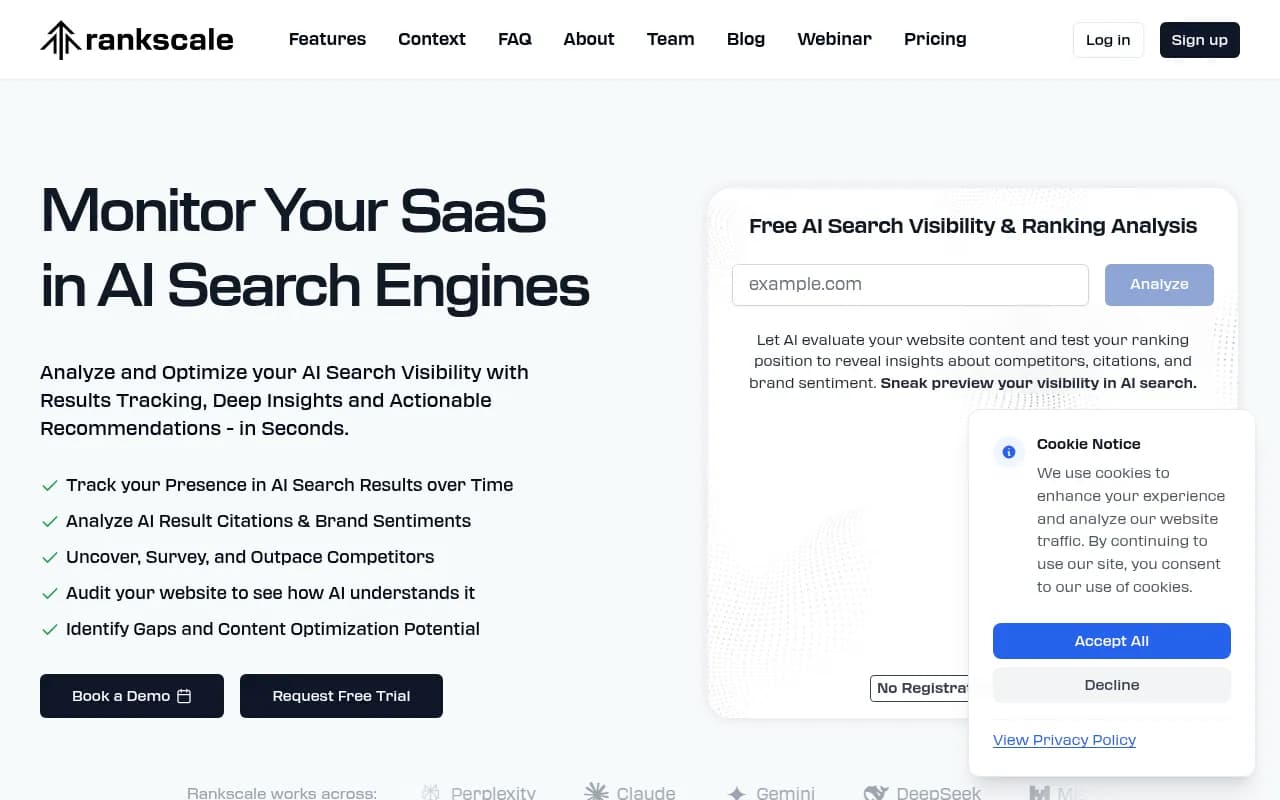
Rankscale offers credit-based tracking that scales reasonably well for agency workflows. It's not going to help you optimize content, but if you're managing multiple clients and need clean reporting, it's a cost-effective option.
For content-focused teams
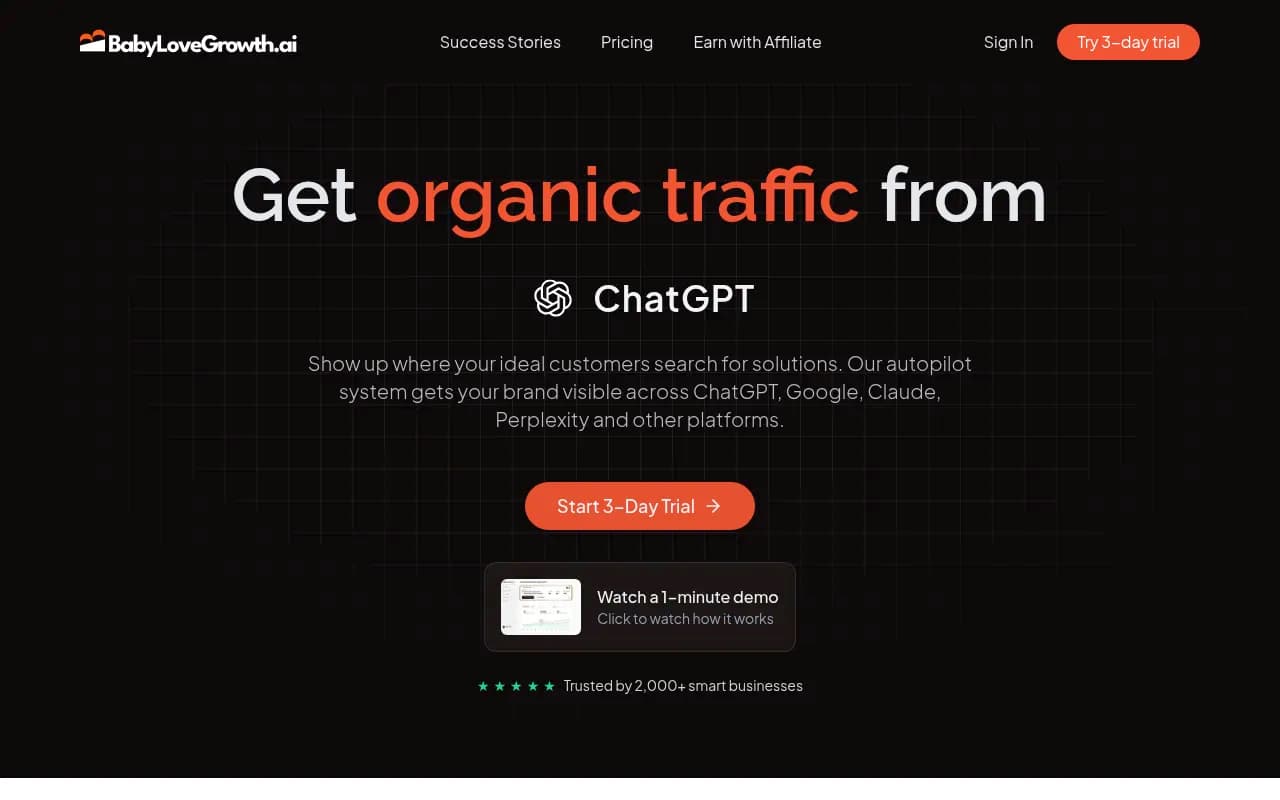
Babylove Growth takes a content-first approach to GEO, combining automated article creation with AI visibility tracking. It's particularly strong on the publishing automation side and supports multilingual content at scale.
A broader comparison
| Tool | Monitoring | Gap analysis | Content generation | Crawler logs | Reddit/YT tracking | Best for |
|---|---|---|---|---|---|---|
| Promptwatch | Excellent | Yes | Yes | Yes | Yes | Full GEO optimization |
| Scrunch AI | Excellent | Limited | No | No | No | Enterprise tracking |
| Otterly.AI | Good | No | No | No | No | Budget monitoring |
| SE Ranking | Good | No | No | No | No | Existing SE Ranking users |
| Rankscale | Basic | No | No | No | No | Agency reporting |
| Babylove Growth | Basic | No | Yes | No | No | Content automation |
| GetMint.ai | Basic | Shallow | No | No | No | Not recommended |
| Meteoria.ai | Basic | Shallow | No | No | No | Not recommended |
The honest verdict
GetMint.ai and Meteoria.ai aren't scams. They're just tools that haven't kept up with where the GEO category has moved. In 2024, showing you a dashboard of brand mentions in AI responses was genuinely novel. In 2026, it's table stakes -- and the platforms that only do that are charging you for something that doesn't move the needle.
If you're spending money on AI visibility tools, you should be getting more than a report. You should be getting a clear path from "here's where you're invisible" to "here's what to create" to "here's proof it worked." Neither GetMint.ai nor Meteoria.ai gets you there.
The good news is that the platforms that do exist, and several of them are priced reasonably. Start with what you actually need -- if you're serious about GEO, the optimization loop matters more than the prettiest dashboard.