Key Takeaways
- Pricing structure is completely different: Rankscale uses a credit-based system starting at €20/mo (~$22), while Geoptie has fixed-tier pricing from $41/mo. Rankscale can be cheaper for light usage but gets expensive fast.
- Geoptie includes free tools: Six standalone free tools (audit, content checker, keyword finder, rank tracker, cannibalization checker, backlink finder) that work without a paid account. Rankscale has no free tier.
- Both track 10 AI models: ChatGPT, Claude, Perplexity, Gemini, Google AI Overviews, DeepSeek, Mistral, Grok, Copilot, and AI Mode. Coverage is identical.
- Rankscale focuses on monitoring and insights: Deep citation analysis, sentiment tracking, competitor benchmarking. Less emphasis on content creation.
- Geoptie positions itself as all-in-one: Combines tracking with content optimization tools and keyword research. Better for teams that want to act on the data, not just see it.
- Trial options differ: Geoptie offers a 14-day free trial on paid plans. Rankscale offers a demo but no self-serve trial.
Overview
Rankscale
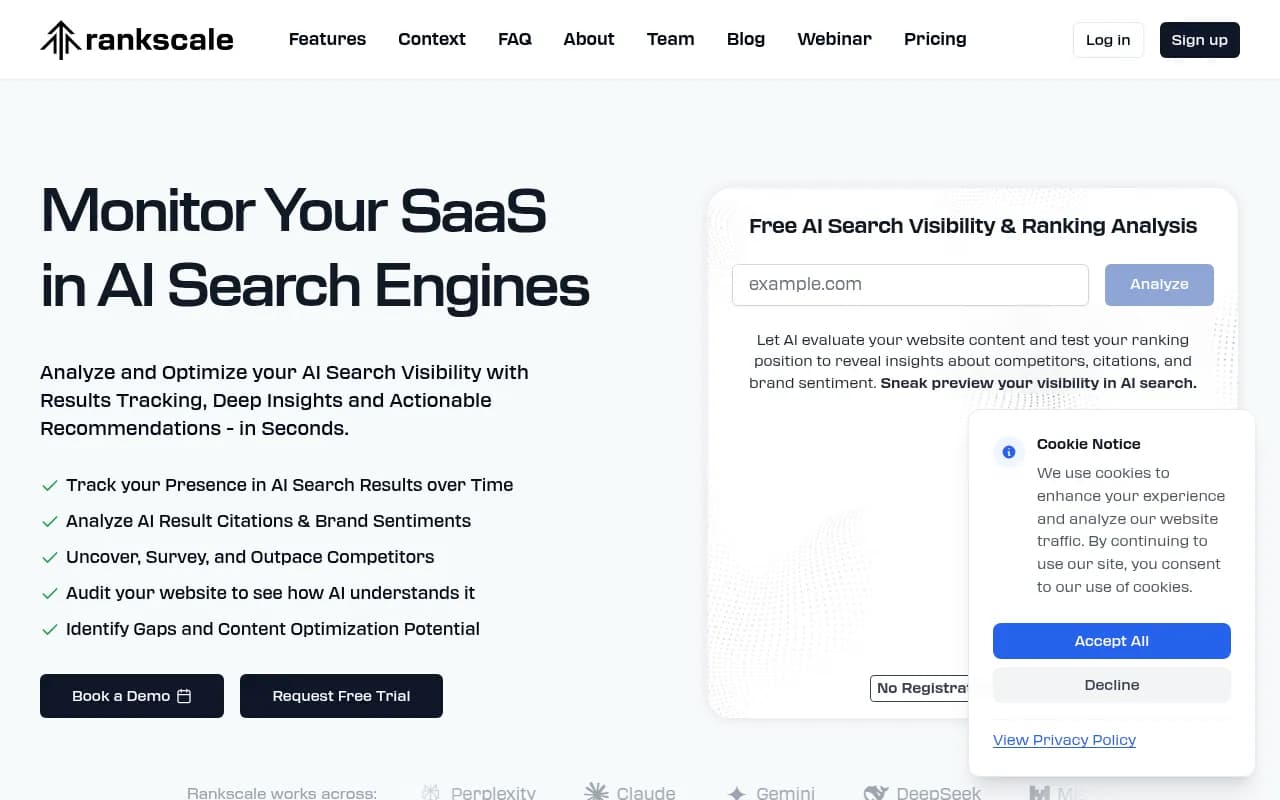
Rankscale is a credit-based GEO platform built for brands that need to track AI search visibility at scale. It monitors how your brand shows up across 10 generative AI platforms, with a focus on citation analysis, sentiment tracking, and competitor benchmarking. The platform uses a credit system where each query costs credits, and you buy credit bundles based on how frequently you want to track.
The interface is built around dashboards that show visibility trends over time, which sources AI models cite, and how competitors compare. Rankscale positions itself as an enterprise-grade monitoring tool -- you get deep insights into what's happening, but you're expected to handle optimization yourself.
Geoptie
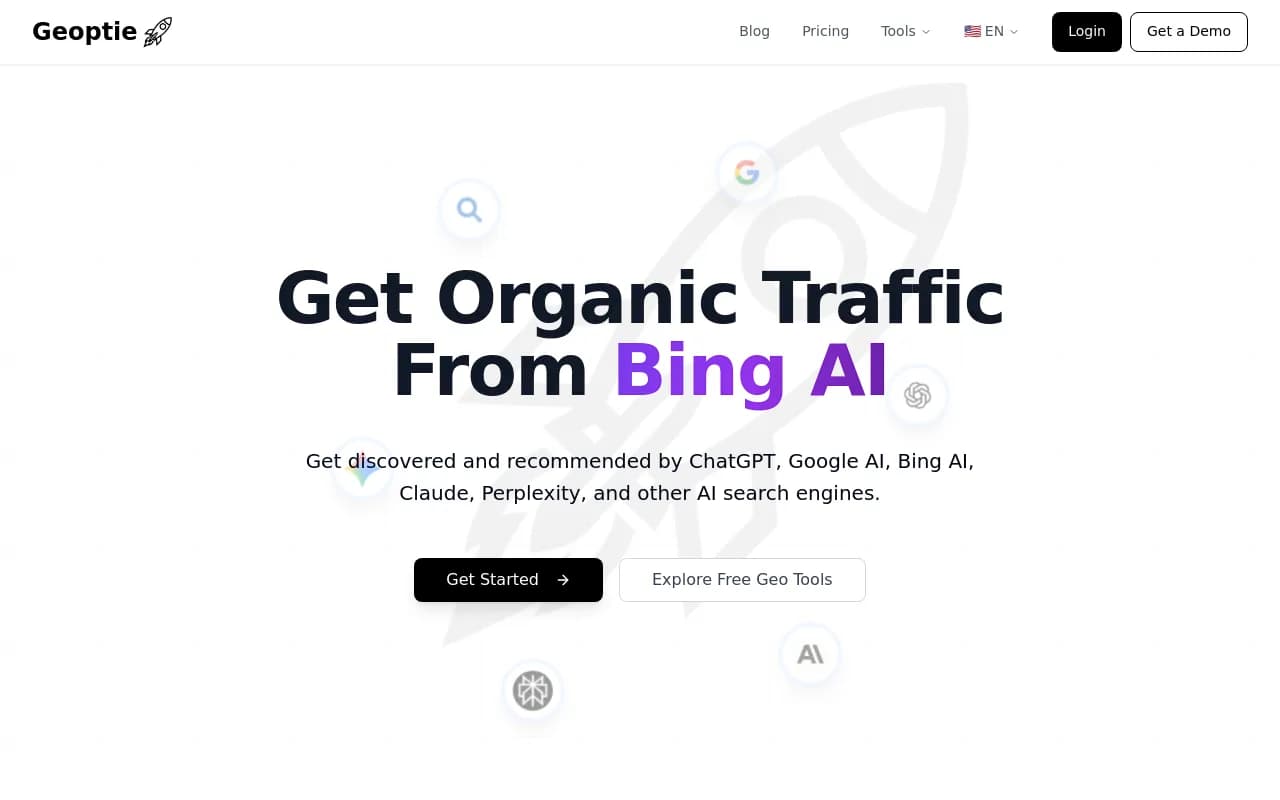
Geoptie takes a different approach: it's an all-in-one platform that combines AI visibility tracking with content optimization and keyword research tools. The platform offers six free standalone tools (GEO audit, content checker, keyword finder, rank tracker, cannibalization checker, backlink finder) that anyone can use without paying, plus paid plans that unlock deeper tracking and analysis.
The pitch here is that Geoptie doesn't just show you where you're invisible -- it helps you fix it. The content checker analyzes your pages for AI-friendliness, the keyword finder surfaces prompts you should target, and the backlink finder shows which domains AI models cite in your space. It's designed for teams that want to close the loop from insight to action.
Side-by-Side Comparison
| Feature | Rankscale | Geoptie |
|---|---|---|
| Starting price | €20/mo (~$22) | $41/mo (Starter) |
| Pricing model | Credit-based (pay per query) | Fixed tiers (unlimited queries) |
| Free tier | No | Yes (6 free tools) |
| Free trial | Demo only | 14 days |
| AI models tracked | 10 (ChatGPT, Claude, Perplexity, Gemini, AI Overviews, DeepSeek, Mistral, Grok, Copilot, AI Mode) | 10 (same coverage) |
| Citation analysis | Yes, deep source tracking | Yes, basic |
| Sentiment tracking | Yes | Not mentioned |
| Competitor benchmarking | Yes, share-of-voice style | Yes |
| Content optimization | No | Yes (content checker tool) |
| Keyword research | No | Yes (keyword finder) |
| Backlink analysis | No | Yes (backlink finder) |
| Website audit | Yes | Yes (free tool) |
| Annual discount | Not specified | ~17% |
| Target audience | CMOs, agencies, enterprise | SMBs, agencies, content teams |
Pricing comparison
This is where things get interesting. The two platforms use completely different pricing models.
| Plan | Rankscale | Geoptie |
|---|---|---|
| Free | None | 6 free tools (audit, content checker, keyword finder, rank tracker, cannibalization checker, backlink finder) |
| Entry tier | Essentials: €20/mo (~$22) - credit-based | Starter: $41/mo - unlimited queries |
| Mid tier | Professional: price not public | Professional: $83/mo |
| High tier | Business: price not public | Enterprise: $166/mo |
| Enterprise | Custom pricing | Custom pricing |
| Annual discount | Not specified | ~17% off |
Rankscale's credit system works like this: you buy a monthly credit bundle, and each query (checking one prompt on one AI model) costs credits. If you run out of credits mid-month, you either wait or buy more. The €20 Essentials plan includes a set number of credits, but Rankscale doesn't publish exactly how many or what the credit-to-query ratio is. This makes it hard to predict actual costs.
Geoptie's fixed-tier pricing is simpler: you pay a flat monthly fee and run unlimited queries within your plan's brand and tracking limits. The Starter plan at $41/mo is roughly double Rankscale's entry price, but you're not rationing credits. For teams that want to check prompts frequently or experiment with different queries, the unlimited model removes friction.
The free tools on Geoptie are a real differentiator. You can run a GEO audit, check content structure, find keywords, track basic rankings, identify cannibalization issues, and discover backlink opportunities without paying anything. Rankscale has no free tier at all -- you're either paying or you're locked out.
User interface and workflow
Rankscale's dashboard is built around visibility trends and citation breakdowns. You see charts showing how often your brand appears in AI responses over time, which sources get cited alongside you, and how competitors stack up. The sentiment tracking feature analyzes whether AI models mention your brand positively, negatively, or neutrally -- useful for reputation monitoring.
The workflow is: set up your brand and competitors, define the prompts you want to track, wait for Rankscale to query the AI models, then review the results in dashboards. It's a monitoring-first experience. You get insights, but you're on your own for what to do next.
Geoptie's interface splits into two parts: the free tools and the paid dashboard. The free tools are standalone -- you drop in a URL or keyword, get results, done. The paid dashboard adds continuous tracking, competitor comparison, and deeper analysis. The content checker tool is particularly hands-on: it scans your pages and flags structural issues that make them hard for AI models to parse (missing schema, unclear headings, buried key facts).
The workflow here is: audit your site with the free tools, identify gaps, optimize content based on recommendations, then track improvements in the paid dashboard. It's more of a closed loop. You're not just watching numbers -- you're actively fixing problems.
AI model coverage and tracking depth
Both platforms track the same 10 AI models: ChatGPT, Claude, Perplexity, Gemini, Google AI Overviews, DeepSeek, Mistral, Grok, Copilot, and AI Mode. Coverage is identical. Neither platform has an edge here.
Where they differ is tracking depth. Rankscale emphasizes citation analysis -- it shows you exactly which URLs, Reddit threads, YouTube videos, and other sources AI models cite when they mention your brand. This is valuable for understanding why you're visible (or not). If a competitor always gets cited because of a specific landing page or a viral Reddit thread, you see that.
Rankscale also tracks sentiment, which most GEO tools skip. If ChatGPT mentions your brand but frames it negatively ("X is expensive compared to Y"), you want to know. Sentiment tracking surfaces these nuances.
Geoptie's tracking is more basic. You see whether you appeared, how often, and which competitors showed up. The citation details are lighter. But Geoptie compensates with the keyword finder and backlink finder -- tools that help you discover new prompts to target and domains to pursue for links. Rankscale doesn't offer these.
Content optimization and keyword research
This is the clearest split between the two platforms.
Rankscale doesn't do content optimization. It's a monitoring tool. You get data about what's working and what's not, but no built-in help for creating or improving content. If you want to act on Rankscale's insights, you need separate tools or manual work.
Geoptie builds optimization into the platform. The content checker analyzes your pages for AI-friendliness: Are key facts easy to extract? Is the structure clear? Are you using schema markup? It flags issues and suggests fixes. The keyword finder surfaces prompts and phrases that AI models use in your industry, so you know what to target. The backlink finder shows which domains AI models cite most often, giving you a hit list for outreach.
These tools don't write content for you (unlike Promptwatch, which includes an AI writing agent that generates articles grounded in citation data). But they do guide your content strategy. You're not guessing what to optimize -- Geoptie tells you.

For teams that want to go from insight to action without switching tools, Geoptie's approach makes more sense. For teams that already have a content workflow and just need visibility data, Rankscale's monitoring-only model is fine.
Competitor benchmarking
Both platforms offer competitor tracking, but the implementation differs.
Rankscale uses a share-of-voice model: you define your competitors, and Rankscale shows how often each brand appears in AI responses for your tracked prompts. You see trends over time and can spot when a competitor surges. The citation analysis extends to competitors -- you can see which sources they're getting cited from and reverse-engineer their strategy.
Geoptie's competitor benchmarking is simpler. You track competitors alongside your own brand and see side-by-side visibility scores. It's less granular than Rankscale's share-of-voice approach, but it covers the basics: who's winning, who's losing, and how you compare.
If competitor intelligence is your primary use case, Rankscale has the edge. If you just want to keep tabs on a few key competitors while focusing on your own optimization, Geoptie is sufficient.
Reporting and integrations
Neither platform publishes detailed integration lists, but both offer standard reporting features.
Rankscale provides dashboards with exportable data. You can generate reports showing visibility trends, citation breakdowns, and competitor comparisons. The platform is designed for agencies and enterprise teams that need to present results to clients or executives.
Geoptie's reporting is more basic. You get visibility scores and trend charts, but the platform feels more self-serve. The free tools don't include export options (you screenshot or copy-paste results). The paid plans likely add export capabilities, but Geoptie doesn't emphasize reporting as a core feature.
For agencies that bill clients based on GEO performance, Rankscale's reporting is more polished. For in-house teams that just need to track progress internally, Geoptie works fine.
Support and onboarding
Rankscale offers a demo booking option (via HubSpot). This suggests a sales-assisted onboarding process, which makes sense for a credit-based platform where pricing isn't fully transparent. You talk to someone, they scope your needs, you get a custom quote or plan recommendation.
Geoptie offers a 14-day free trial on paid plans, plus the six free tools that anyone can use immediately. The onboarding is self-serve. You sign up, start running audits and checks, upgrade when you need continuous tracking. There's a YouTube tutorial (6 minutes) that walks through the dashboard.
For teams that want to test before committing, Geoptie's trial and free tools are more accessible. For teams that prefer guided onboarding and custom pricing, Rankscale's demo process fits better.
Pros and cons
Rankscale pros
- Deep citation analysis shows exactly which sources AI models use
- Sentiment tracking catches positive/negative brand mentions
- Share-of-voice competitor benchmarking is more granular than most tools
- Credit-based pricing can be cheaper for light usage
- Enterprise-grade reporting for agencies
Rankscale cons
- No free tier or self-serve trial
- Credit system makes costs unpredictable
- No content optimization or keyword research tools
- Monitoring-only -- you're on your own for acting on insights
- Pricing details not fully public
Geoptie pros
- Six free tools (audit, content checker, keyword finder, rank tracker, cannibalization checker, backlink finder)
- 14-day free trial on paid plans
- Fixed-tier pricing with unlimited queries (no credit rationing)
- Content optimization and keyword research built in
- All-in-one platform for tracking + action
- Annual discount (~17% off)
Geoptie cons
- Entry price ($41/mo) is higher than Rankscale's base tier
- Citation analysis is less detailed
- No sentiment tracking
- Competitor benchmarking is more basic
- Reporting features less polished for agencies
Who should pick which tool
Pick Rankscale if:
- You're an agency or enterprise team that needs deep citation analysis and share-of-voice metrics
- Sentiment tracking matters (e.g. reputation management, crisis monitoring)
- You want granular competitor intelligence and can act on it separately
- You have light tracking needs and want to minimize costs with credit-based pricing
- You prefer sales-assisted onboarding and custom pricing
Pick Geoptie if:
- You're a small-to-mid-size team that wants to track and optimize in one platform
- You want to test with free tools before committing to a paid plan
- You need content optimization guidance (structure, keywords, backlinks)
- You prefer predictable fixed-tier pricing over credit rationing
- You're building a GEO strategy from scratch and need tools that guide you
Consider Promptwatch if:
- You want to go beyond monitoring to actually generate content that ranks in AI search. Promptwatch combines visibility tracking with an AI writing agent that creates articles based on 880M+ citations analyzed, plus crawler logs, Reddit/YouTube tracking, and page-level attribution. It's the only platform that closes the full loop from gap analysis to content creation to results tracking.
Final verdict
Rankscale and Geoptie both track the same 10 AI models, but they're built for different workflows. Rankscale is a monitoring-first platform with deep citation analysis and sentiment tracking -- great for agencies and enterprise teams that need granular insights and already have content workflows. Geoptie is an all-in-one platform that combines tracking with content optimization tools -- better for teams that want to act on the data without switching to separate tools.
The pricing models reflect this split. Rankscale's credit-based system can be cheaper for light usage but gets expensive and unpredictable at scale. Geoptie's fixed tiers cost more upfront but remove the friction of rationing credits. The free tools on Geoptie (audit, content checker, keyword finder, rank tracker, cannibalization checker, backlink finder) are a real advantage for teams that want to test before paying.
If you need deep competitor intelligence and sentiment tracking, Rankscale wins. If you need an all-in-one platform that guides you from insight to action, Geoptie is the better pick. For most small-to-mid-size teams building a GEO strategy in 2026, Geoptie's combination of free tools, fixed pricing, and built-in optimization makes it the more practical choice.