Key takeaways
- Peec AI ($100/mo) is strong for monitoring-only workflows, especially for international brands that need 115+ language support and EU compliance
- Airefs ($24/mo) is the cheapest entry point with Reddit monitoring and a done-for-you agency option — good for bootstrapped teams
- Promptwatch ($99/mo) is the only one of the three that goes beyond monitoring to help you actually fix visibility gaps with content generation, crawler logs, and traffic attribution
- If you just want a dashboard, any of these works. If you want to improve your AI citations, not just count them, the tools differ significantly
- Small teams with tight budgets should think carefully about what "affordable" actually means: a cheaper tool that only monitors may cost more in lost opportunity than a pricier one that helps you act
The AI search visibility category has exploded. Every week there's a new tool claiming to track how your brand appears in ChatGPT, Perplexity, Claude, and the rest. For small teams trying to make sense of it all, three names keep coming up: Peec AI, Airefs, and Promptwatch.
They're all in the same general space. They're all priced accessibly (at least compared to enterprise platforms like Profound). And they're all trying to solve the same core problem: figuring out whether AI models are recommending your brand when buyers ask relevant questions.
But they're not the same product. Not even close.
This guide breaks down how each one actually works, where each one falls short, and which is worth your money depending on what your team actually needs.
What these tools are trying to solve
Before getting into the comparison, it's worth being clear about the problem. When someone asks ChatGPT "what's the best project management tool for remote teams?" or Perplexity "which CRM should a 10-person startup use?" -- your brand either shows up or it doesn't.
Traditional SEO tools don't measure this. Google rankings don't tell you anything about LLM citations. So a new category of tools emerged to fill that gap: AI visibility trackers.
The basic promise is: tell us which prompts matter to your business, and we'll check whether AI models mention you when answering those prompts. Then we'll show you how often, in what context, and how you compare to competitors.
That's the monitoring layer. Where tools diverge is what happens next.
Peec AI: solid monitoring, limited execution
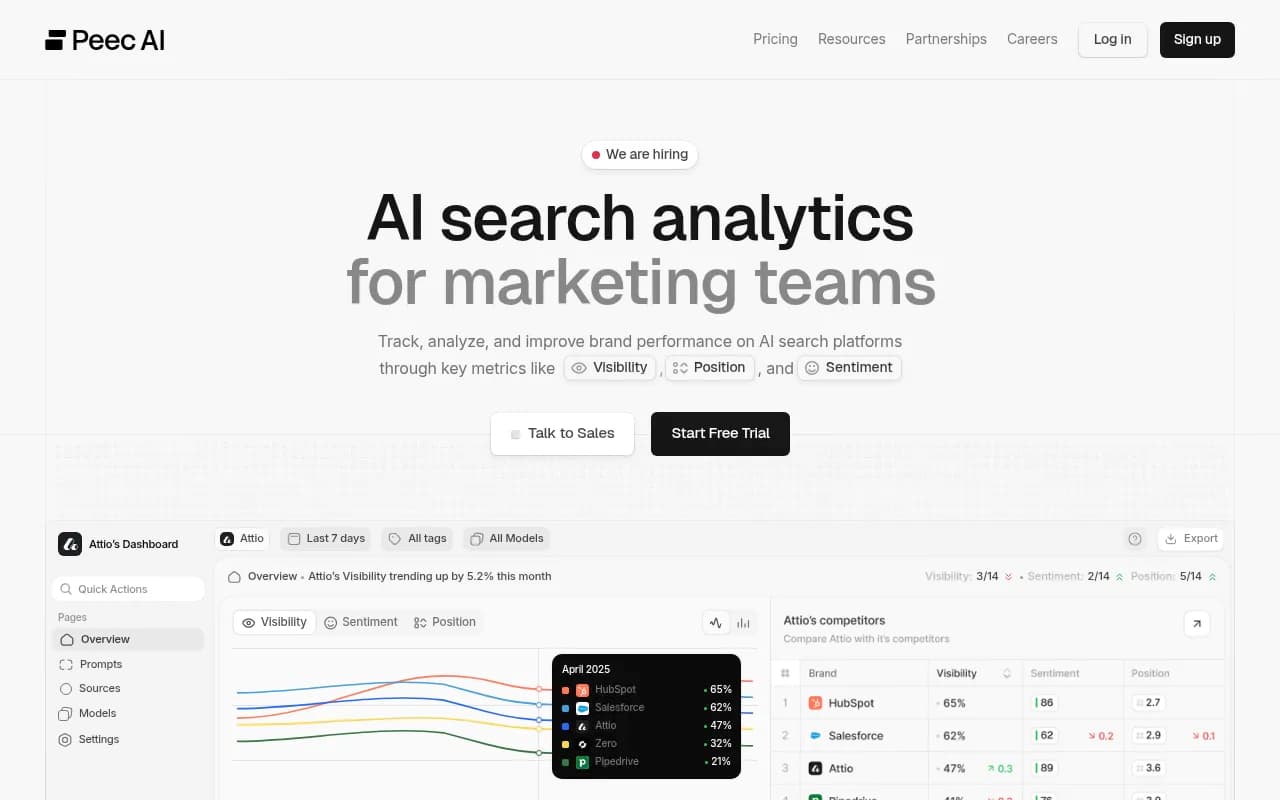
Peec AI was one of the earlier entrants in this category and has built a real product. The core mechanic is UI scraping -- it simulates what a real user sees when they ask a question in ChatGPT or Perplexity, rather than hitting the API directly. That's a meaningful distinction because API responses and live UI responses can differ, and what matters for brand visibility is what real users actually see.
The platform tracks share of voice and citation rate across ChatGPT, Perplexity, and Google AI Overviews, with transparent pricing starting at $100/month. For B2B marketing leaders asking "are we even visible in AI search?", Peec AI gives a clear answer.
Where it runs into trouble is everything after that question. Peec AI doesn't write content, doesn't suggest what to fix, and doesn't connect visibility data to traffic or revenue. You get a dashboard showing where you appear and where you don't. What you do with that information is entirely up to you.
For some teams, that's fine. If you have a dedicated analyst who can interpret the data and a content team ready to act on it, monitoring-only tools work. But for a small team wearing multiple hats, getting a report that says "you're not appearing for these 40 prompts" without any guidance on what to do about it can feel like a dead end.
Peec AI's strongest differentiator is international coverage -- 115+ languages and EU compliance make it genuinely useful for brands operating across Europe or in non-English markets. If that's your situation, it's worth a serious look.
What Peec AI does well:
- UI scraping methodology (tracks real user experience, not API responses)
- 115+ language support
- EU-compliant data handling
- Clean, transparent pricing
- Unlimited seats on some plans
Where it falls short:
- No content generation or optimization tools
- No AI crawler logs
- No traffic attribution
- Competitive sentiment tracking is limited
- Niche or low-volume queries can be less reliable
Airefs: the budget-friendly entry point
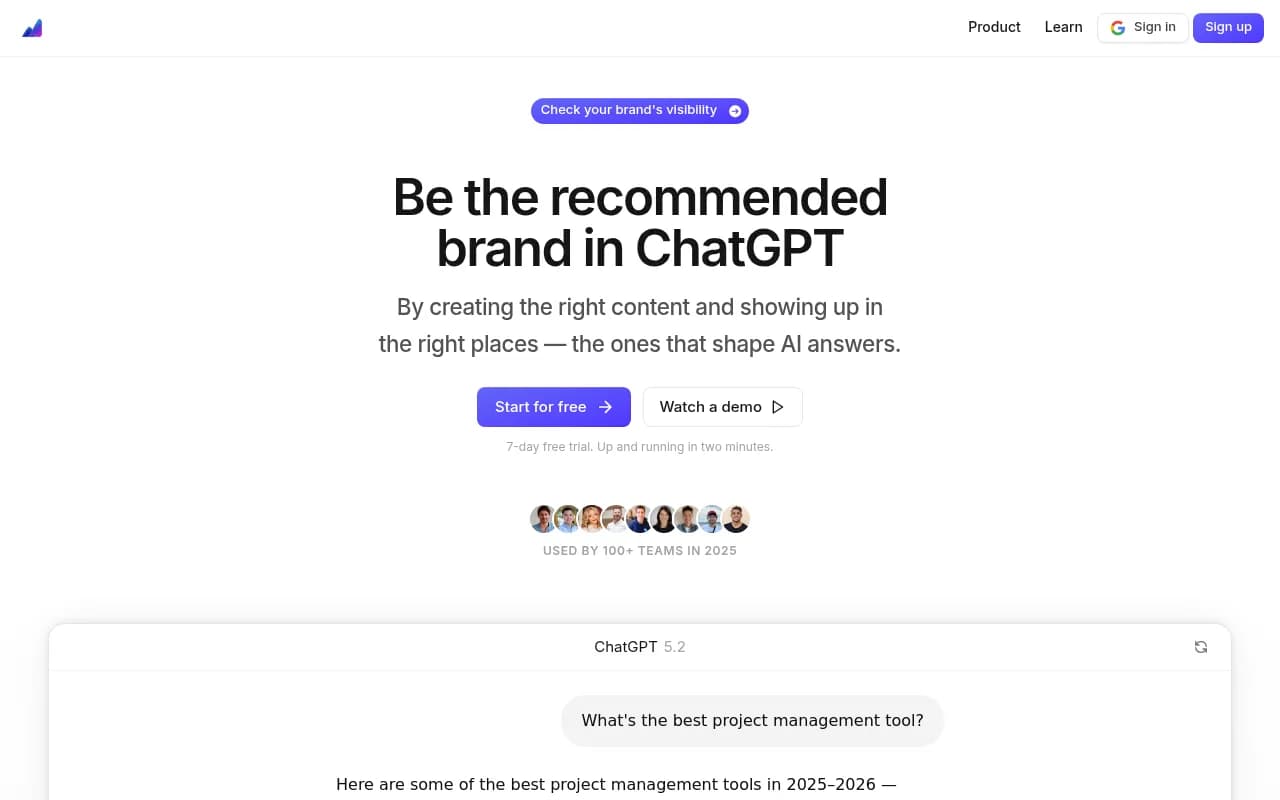
Airefs comes in at $24/month, which makes it the cheapest serious option in this category. For a bootstrapped startup or a solo marketer trying to get a handle on AI visibility without committing to a big budget, that price point matters.
The platform covers ChatGPT and Google AI Overviews, with Reddit monitoring included -- which is more than most tools at this price. Reddit is increasingly a source that AI models cite, so tracking discussions there isn't just a nice-to-have.
Airefs also offers a done-for-you agency service, which is interesting for small teams that want the data without the overhead of managing the tool themselves. That's a practical option if your team is stretched thin.
The honest limitation: at $24/month, you're not getting the depth of a $100+ platform. Prompt limits are tighter, coverage is narrower, and the feature set reflects the price. It's a good starting point for teams that want to dip their toes in before committing to something more comprehensive.
What Airefs does well:
- Genuinely affordable entry point
- Reddit monitoring included
- Done-for-you agency option
- 7-day free trial
Where it falls short:
- Narrower AI model coverage vs. competitors
- Limited prompt volume at lower tiers
- No content generation
- Less depth on competitive analysis
Promptwatch: monitoring plus the action layer
Promptwatch takes a different approach from both Peec AI and Airefs. It's built around a loop: find the gaps, create content to fill them, track whether that content gets cited.

The monitoring layer covers 10 AI models -- ChatGPT, Perplexity, Claude, Gemini, Google AI Overviews, Google AI Mode, Grok, DeepSeek, Mistral, Meta AI, and Copilot. That's broader than either Peec AI or Airefs. But the more meaningful difference is what comes after the monitoring.
The Answer Gap Analysis shows exactly which prompts competitors are visible for that you're not -- and crucially, it shows what content your site is missing that would help AI models answer those prompts. That's a different kind of insight than "you appeared in 12% of responses." It tells you specifically what to do.
From there, Promptwatch has a built-in AI writing agent that generates articles and content grounded in citation data. It's not generic SEO content -- it's engineered around the prompts and topics where AI models are actively looking for sources. For a small team that doesn't have a dedicated content strategist, that's a real time-saver.
The platform also includes AI crawler logs, which show when ChatGPT, Claude, Perplexity, and others are crawling your site, which pages they're reading, and any errors they hit. Most competitors don't have this at all. It's the kind of technical visibility that helps you understand not just whether you're being cited, but whether AI models can even find your content in the first place.
Traffic attribution closes the loop -- you can connect AI visibility to actual site visits through a code snippet, Google Search Console integration, or server log analysis.
Pricing starts at $99/month for the Essential plan (1 site, 50 prompts, 5 articles), with Professional at $249/month (2 sites, 150 prompts, 15 articles, crawler logs) and Business at $579/month. There's a free trial available.
What Promptwatch does well:
- 10 AI model coverage (broadest of the three)
- Answer Gap Analysis shows what content to create, not just where you're missing
- Built-in AI content generation grounded in citation data
- AI crawler logs (unique in this price range)
- Traffic attribution to connect visibility to revenue
- Reddit and YouTube source tracking
- ChatGPT Shopping monitoring
- Multi-language and multi-region support
Where it falls short:
- Higher starting price than Airefs
- Prompt limits at lower tiers require upgrading for larger monitoring programs
- US teams may find the Amsterdam-based support timezone a consideration
Side-by-side comparison
| Feature | Peec AI | Airefs | Promptwatch |
|---|---|---|---|
| Starting price | ~$100/mo | $24/mo | $99/mo |
| Free trial | Yes | Yes (7-day) | Yes |
| AI models covered | ChatGPT, Perplexity, Google AIO | ChatGPT, Google AIO | 10 models (incl. Claude, Gemini, Grok, Mistral) |
| UI scraping (real user view) | Yes | No | No (API-based) |
| Language support | 115+ languages | Limited | Multi-language |
| Content generation | No | No | Yes (built-in AI writer) |
| Answer gap analysis | No | No | Yes |
| AI crawler logs | No | No | Yes (Professional+) |
| Traffic attribution | No | No | Yes |
| Reddit monitoring | No | Yes | Yes |
| ChatGPT Shopping tracking | No | No | Yes |
| Unlimited seats | Some plans | No | No |
| EU compliance | Yes | Unknown | Yes (Dutch company) |
| Best for | International monitoring | Budget-first teams | Teams that want to act on data |
How to choose: three different situations
You need to monitor, nothing more
If your goal is simply to establish a baseline -- "are we appearing in AI search at all?" -- and you have a team that can interpret and act on data independently, Peec AI or Airefs both work. Peec AI is better if you're operating in multiple languages or need EU compliance. Airefs is better if budget is the primary constraint.
You're a small team that needs to improve, not just measure
This is where Promptwatch separates itself. Monitoring tells you there's a problem. Promptwatch helps you fix it. The Answer Gap Analysis and built-in content generation mean a two-person marketing team can actually move the needle on AI citations without hiring additional headcount. The AI crawler logs add a layer of technical insight that neither Peec AI nor Airefs offer.
You're an agency managing multiple clients
Airefs has a done-for-you service option that's worth considering. Promptwatch has agency and enterprise pricing with multi-site support. Peec AI's unlimited seats on some plans can reduce per-client costs. The right choice depends on whether you're selling monitoring as a service or optimization as a service.
The "affordable" question deserves scrutiny
All three tools are marketed as accessible options. But affordable means different things depending on what you're buying.
A $24/month tool that shows you a problem without helping you solve it might actually cost more than a $99/month tool that helps you fix it -- especially when you factor in the time your team spends manually figuring out next steps, or the opportunity cost of not improving your AI citations for another quarter.
That's not an argument to always buy the most expensive option. It's an argument to be honest about what you actually need. If you have the internal capacity to turn monitoring data into action, a cheaper monitoring tool is fine. If you don't, paying for a platform that includes the action layer is probably the more efficient spend.
Other tools worth knowing
If none of the three above feel like the right fit, a few others are worth a look:
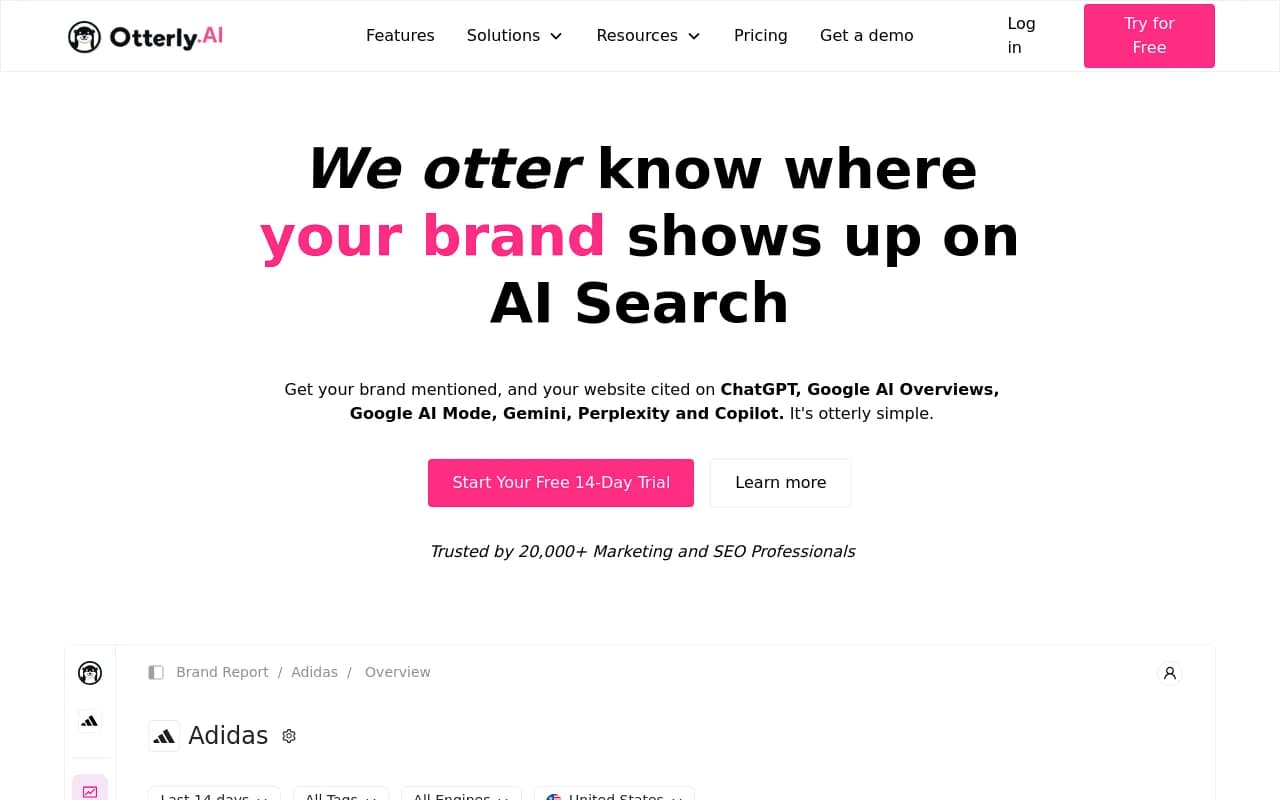
Otterly.AI comes in at $29/month and has earned Gartner Cool Vendor 2025 recognition. It's monitoring-focused but has a strong reputation for ease of use and a high user rating.
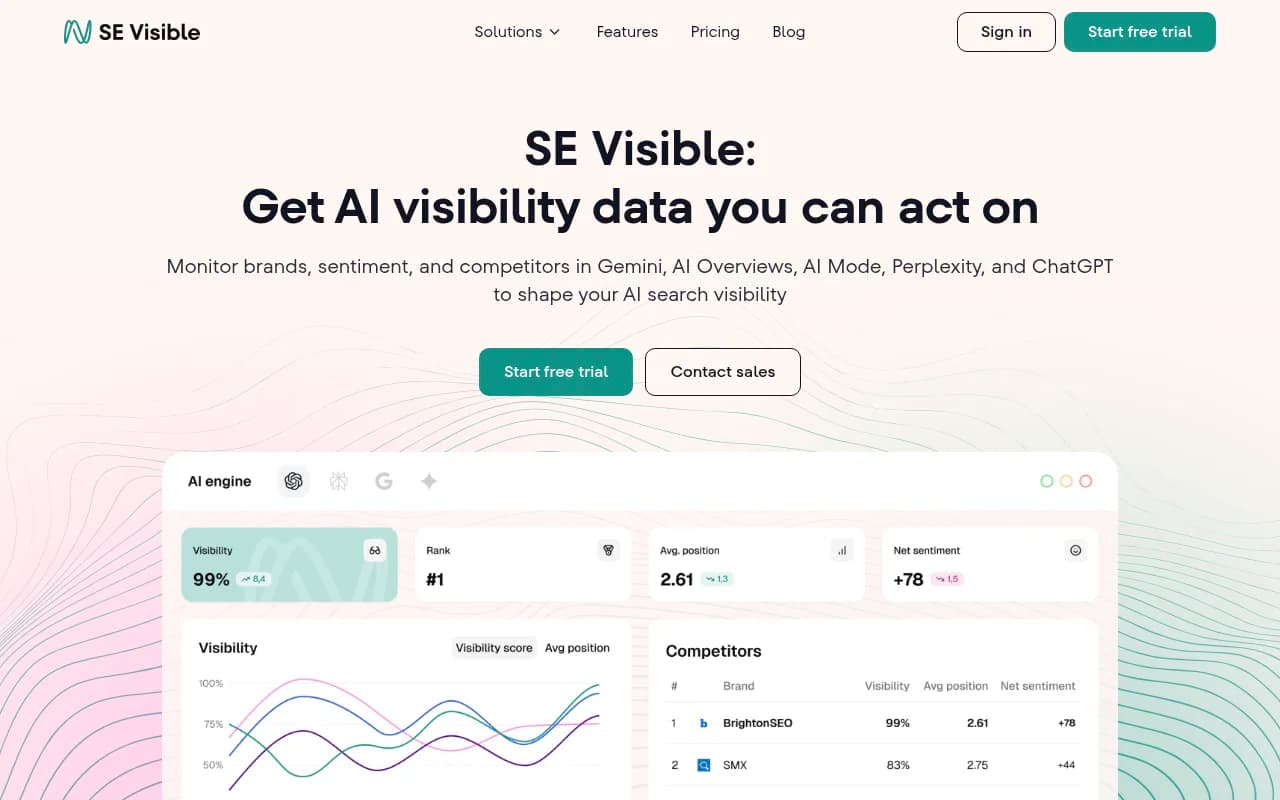
SE Visible (from SE Ranking) integrates AI visibility tracking with traditional SEO data, which can be useful if you want both in one place.
Athena HQ is worth considering if native GA4 and Google Search Console integrations are important to your workflow. It's monitoring-focused but has documented case studies on citation rate improvements.
For budget-first teams, Airefs remains the cheapest credible option in the category.
Final take
Peec AI, Airefs, and Promptwatch are all legitimate tools. None of them are scams or vaporware. But they're built for different situations.
Peec AI is the right choice if you're operating internationally, need EU compliance, and have the internal resources to act on monitoring data yourself. Airefs is the right choice if budget is genuinely the binding constraint and you want to start somewhere. Promptwatch is the right choice if you want a platform that doesn't just tell you where you're invisible but helps you do something about it.
For most small teams in 2026, the bottleneck isn't knowing that AI visibility matters -- it's finding the time and resources to actually improve it. That's the problem worth solving for.