Key takeaways
- Peec AI and Topify are solid monitoring tools -- they tell you where you stand in AI search results, but neither helps you act on what you find.
- Promptwatch is the only one of the three that closes the loop: it finds content gaps, generates content to fill them, and tracks whether that content gets cited.
- If you're a global brand that needs multi-language monitoring across 115+ languages, Peec AI has a real edge there.
- Topify suits teams that want clean, fast visibility dashboards without much setup overhead.
- For most marketing and SEO teams that want to actually move their AI visibility scores, Promptwatch is the stronger choice.
AI search has changed the game for brand visibility. When someone asks ChatGPT which project management tool to use, or asks Perplexity for the best travel insurance, they're not getting a list of blue links -- they're getting a synthesized answer, and your brand is either in it or it isn't. Traditional rank tracking tells you nothing about this.
That's why a whole category of tools has emerged to track brand presence across AI engines. Three of the more talked-about options right now are Peec AI, Topify, and Promptwatch. They all claim to help you monitor AI search visibility, but they approach the problem differently -- and the differences matter a lot depending on what you actually need to do.
This guide breaks down each platform honestly: what it does well, where it falls short, and which type of team should use it.
What each platform actually does
Before getting into feature-by-feature comparisons, it helps to understand the core philosophy behind each tool.
Peec AI is a monitoring and analytics platform built around tracking brand performance across AI search engines. It uses UI scraping to interact with AI models the way real users do, which means it captures authentic response data rather than API-level outputs. The Berlin-based company has put real effort into breadth -- 115+ languages, 10 AI engines, and a clean interface that marketing teams can navigate without much training.
Topify sits in a similar monitoring-first category. It's positioned as an AI search visibility ranking and analytics tool, focused on giving teams a clear picture of where they appear in AI-generated responses and how that compares to competitors. It's lighter-weight than Peec AI and tends to appeal to teams that want fast setup and a readable dashboard without a lot of configuration.
Promptwatch takes a different angle. It monitors AI visibility too, but the platform is built around what happens after you see the data. The core workflow is: find the prompts where competitors are visible and you're not, generate content specifically engineered to get cited, and then track whether that content actually moves your scores. It's an optimization platform, not just a tracker.
Promptwatch is used by 6,700+ brands and agencies including Booking.com and Center Parcs, and has processed over 1.1 billion citations, clicks, and prompts.

Feature comparison
Here's how the three platforms stack up across the capabilities that matter most for AI search visibility work.
| Feature | Peec AI | Topify | Promptwatch |
|---|---|---|---|
| AI engines covered | 10 (ChatGPT, Perplexity, Claude, etc.) | Multiple (ChatGPT, Perplexity, Gemini) | 10+ (ChatGPT, Claude, Gemini, Perplexity, Grok, DeepSeek, Copilot, Mistral, Meta AI, Google AI Overviews) |
| Multi-language support | 115+ languages | Limited | Multi-language and multi-region |
| Competitor monitoring | Yes | Yes | Yes, with heatmaps |
| Content gap analysis | No | No | Yes (Answer Gap Analysis) |
| AI content generation | No | No | Yes (built-in writing agent) |
| AI crawler logs | No | No | Yes (real-time) |
| Page-level citation tracking | Limited | Limited | Yes |
| ChatGPT Shopping tracking | No | No | Yes |
| Reddit/YouTube insights | No | No | Yes |
| Traffic attribution | No | No | Yes (GSC, code snippet, server logs) |
| Prompt volume/difficulty scoring | No | No | Yes |
| Query fan-out analysis | No | No | Yes |
| Starting price | ~$95/month | Varies | $99/month |
| Free trial | 7 days | Available | 7 days |
| G2 rating | 5.0/5 | N/A | 4.9/5 |
The table tells the story pretty clearly. Peec AI and Topify are strong on the monitoring side. Promptwatch covers monitoring and then keeps going.
Peec AI: deep monitoring, especially for global brands
Peec AI's strongest selling point is its language and geographic coverage. If you're running a brand across multiple markets -- say, tracking how you appear in German AI search results vs. Spanish vs. Japanese -- Peec AI handles that better than most tools in this space. The 115+ language support isn't just a checkbox; it's genuinely useful for international marketing teams.
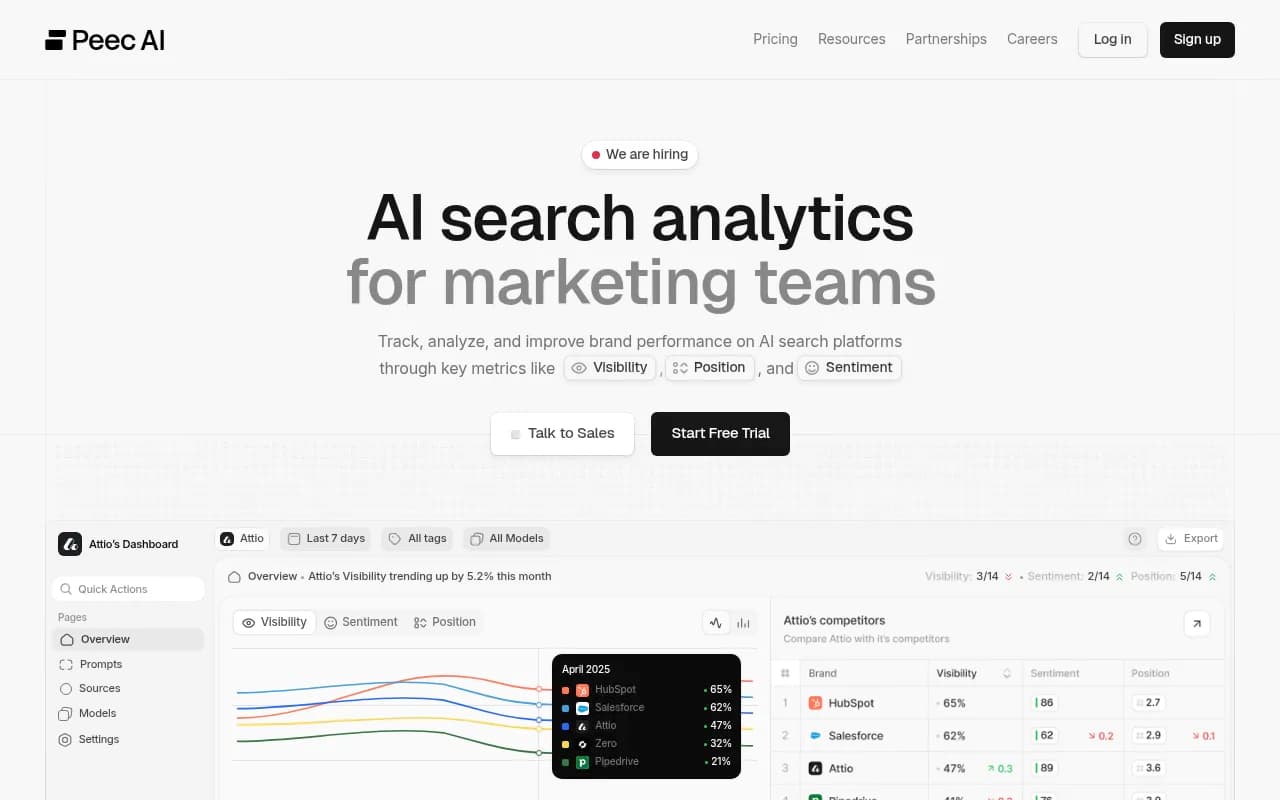
The platform's UI scraping approach also means you're seeing AI responses the way users actually see them, not some abstracted API version. That matters for sentiment analysis and for understanding how your brand is framed in context.
Where Peec AI stops short is the "so what" question. You can see that a competitor is getting cited in ChatGPT responses for prompts you care about. You can see which sources AI models are pulling from. But the platform doesn't tell you what content to create or help you create it. A case study on Peec AI's blog reported that one customer (Momentum) achieved roughly a 10x improvement in AI search visibility -- but that kind of result requires a team that knows how to act on the data themselves.
For teams with strong content operations who just need better data, that's fine. For teams that need the whole workflow in one place, it's a gap.
Best for: Global brands with multi-language monitoring needs, teams with dedicated content resources who need analytics without the optimization layer.
Topify: clean and accessible visibility tracking
Topify is the most approachable of the three. It's built for teams that want to get up and running quickly with AI search visibility tracking without spending a week on configuration.
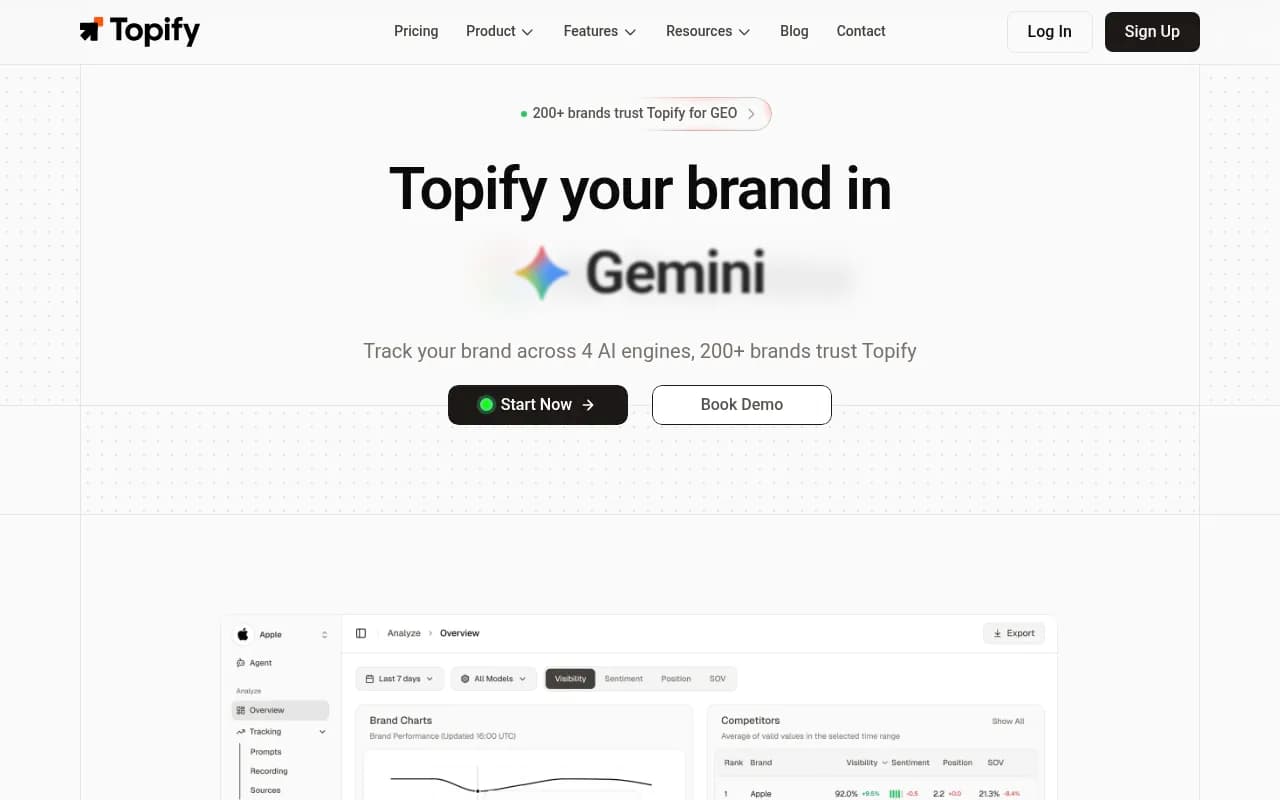
The platform covers the major AI engines and gives you a readable view of brand visibility, share of voice, and competitor positioning. It's a good fit for smaller marketing teams or agencies that are just starting to take AI search seriously and need a low-friction way to demonstrate visibility metrics to stakeholders.
The trade-off is depth. Topify doesn't have the language breadth of Peec AI, and it doesn't have the optimization capabilities of Promptwatch. It's a monitoring tool, and a fairly straightforward one. That's not a criticism -- there's real value in simplicity -- but it does mean you'll hit the ceiling faster if your needs grow.
Best for: Smaller teams or agencies getting started with AI visibility tracking, stakeholders who need clean dashboards without complexity.
Promptwatch: monitoring plus the full optimization loop
Promptwatch is where the comparison gets interesting, because it's doing something structurally different from the other two.
The core workflow looks like this:
-
Find the gaps. Answer Gap Analysis shows you the specific prompts where competitors are getting cited and you're not. Not just "you're less visible than Competitor X" -- the actual questions and topics where you're missing.
-
Create content that gets cited. The built-in AI writing agent generates articles, listicles, and comparisons grounded in real citation data. It's not generic content -- it's built around what AI models actually cite, using data from 880M+ citations analyzed.
-
Track whether it works. Page-level tracking shows which pages are being cited, how often, and by which models. Traffic attribution (via GSC integration, a code snippet, or server log analysis) connects visibility to actual revenue.
Most competitors stop at step one. Promptwatch runs the whole loop.
A few features worth calling out specifically:
AI Crawler Logs are real-time logs of AI crawlers (ChatGPT, Claude, Perplexity, etc.) hitting your website. You can see which pages they're reading, what errors they're hitting, and how often they return. This is genuinely useful for diagnosing why certain pages aren't getting cited -- and it's something neither Peec AI nor Topify offers.
Prompt Intelligence gives you volume estimates and difficulty scores for each prompt, plus query fan-outs that show how one prompt branches into sub-queries. This lets you prioritize high-value, winnable prompts instead of guessing.
Reddit and YouTube Insights surface the discussions that directly influence AI recommendations. AI models pull heavily from Reddit threads and YouTube content, and most platforms ignore this channel entirely.
ChatGPT Shopping Tracking monitors when your brand appears in ChatGPT's product recommendations and shopping carousels -- a growing surface that matters a lot for e-commerce brands.
Pricing starts at $99/month for the Essential plan (1 site, 50 prompts, 5 articles), $249/month for Professional (2 sites, 150 prompts, 15 articles, crawler logs), and $579/month for Business (5 sites, 350 prompts, 30 articles). Agency and enterprise pricing is available separately.
Best for: Marketing and SEO teams that want to actually improve AI visibility, not just measure it. Agencies managing multiple clients. Brands that need to connect AI visibility to revenue.
How to choose between them
The honest answer is that the right tool depends on what you're trying to accomplish.
Choose Peec AI if you're running a global brand with serious multi-language monitoring needs, and you have a content team that can act on the data independently. The 115+ language support and authentic UI-scraping approach are genuinely differentiated, and the 5.0 G2 rating suggests users are happy with what they're getting.
Choose Topify if you're early in your AI visibility journey and need a low-friction way to start tracking and reporting on brand presence in AI search. It's accessible, it covers the major engines, and it won't overwhelm a small team.
Choose Promptwatch if you want to move the needle, not just watch it. The combination of gap analysis, content generation, crawler logs, and traffic attribution makes it the only platform here that functions as an end-to-end optimization tool. In a 2026 comparison of 12 GEO platforms, it was the only one rated as a "Leader" across all categories.
What the broader landscape looks like
These three aren't the only options. The AI visibility space has grown fast, and there are now dozens of tools at various price points and capability levels.
A few worth knowing about:
Otterly.AI is one of the more affordable monitoring options if budget is the primary constraint.

Profound and Scrunch are stronger enterprise-tier options with deeper analytics, though at higher price points and without content generation.
Ahrefs Brand Radar and Semrush have added AI visibility features to their existing SEO platforms, but both use fixed prompt sets and neither offers AI traffic attribution -- which limits how actionable the data is.
For teams specifically focused on enterprise GEO, Goodie AI is worth a look.
The question most teams get wrong
A lot of teams evaluate AI visibility tools by asking "which one has the most data?" That's the wrong question.
Data without action is just a more detailed way to feel bad about your visibility scores. The more useful question is: "which platform helps me do something about what I'm seeing?"
Peec AI and Topify give you the data. Promptwatch gives you the data and then helps you act on it -- finding the specific content gaps, generating content designed to get cited, and tracking whether it actually works.
For teams that are serious about improving their position in AI search (not just reporting on it), that distinction is what makes the comparison straightforward.