Key takeaways
- Peec AI is a solid monitoring tool for teams that need visibility data across AI engines, but it stops short of telling you what to do with that data.
- Wellows bridges some of that gap with content optimization and citation-building workflows, but its depth on the analytics side is thinner than Peec AI's.
- Promptwatch is the only platform of the three that closes the full loop: find visibility gaps, generate content engineered for AI citation, and track whether it worked.
- If your team's goal is actually improving AI search visibility (not just measuring it), the tool you choose matters a lot more than most people realize.
Rankings are no longer the whole game. A thread on r/seogrowth put it bluntly: "In 2026, rankings aren't really the game anymore. Actual citations inside AI answers like ChatGPT and Perplexity are what's driving brand discovery." That's not an exaggeration. Similarweb's 2025 Generative AI Report found that AI platforms generated over 1.1 billion referral visits in a single month, up 357% year-over-year. Meanwhile, Google AI Overviews now trigger for roughly 13% of all queries, causing a 34.5% drop in click-through rates for the top organic result.
So the question isn't whether you need to track AI citations. You do. The question is which platform actually helps you act on what you find.
This guide compares three tools that come up constantly in this space: Peec AI, Wellows, and Promptwatch. They're not identical products. They have genuinely different philosophies about what "AI visibility" means, and choosing the wrong one can leave your team with a lot of data and no clear path forward.
What each platform actually is
Before getting into features, it's worth being clear about what each tool is trying to do.
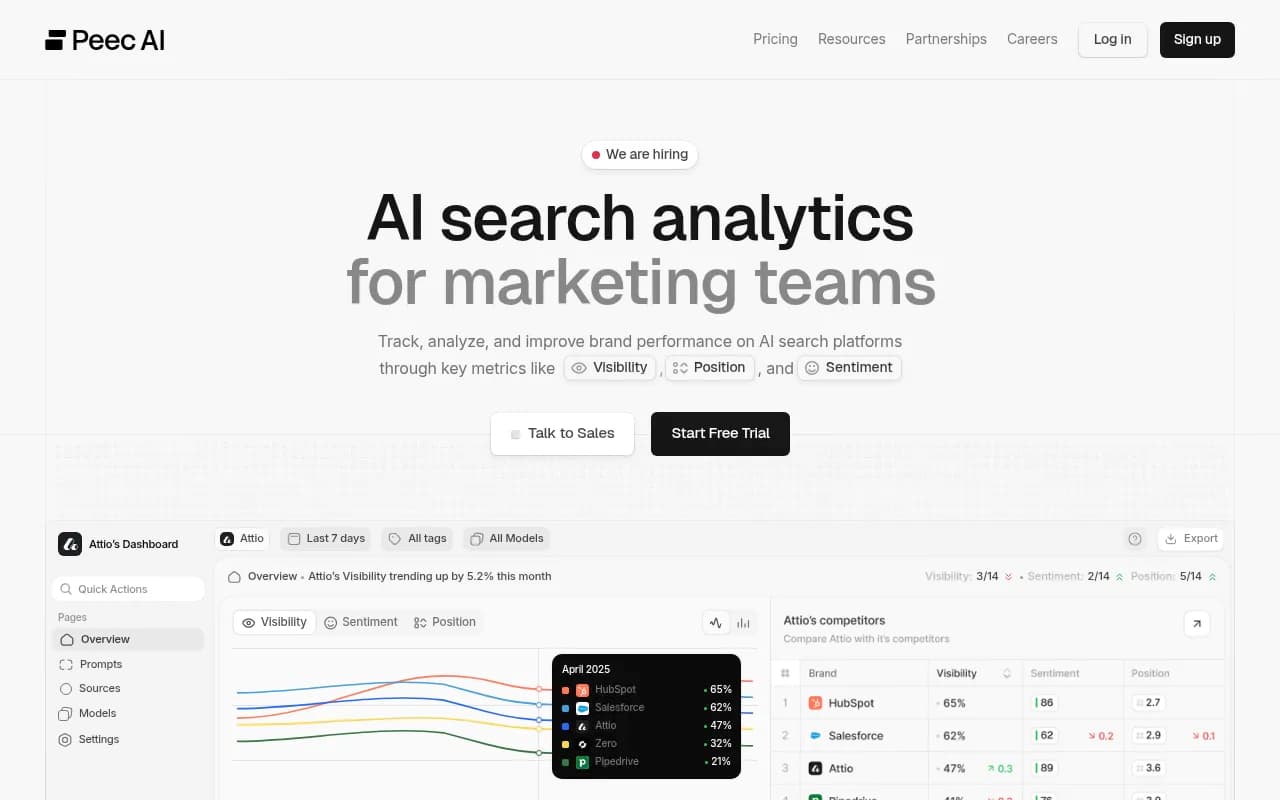
Peec AI is an AI search monitoring platform. It tracks where your brand appears in AI-generated responses across models like ChatGPT, Perplexity, and Gemini. It shows you source patterns, competitor presence, and crawlability signals. It's strong on the intelligence side.
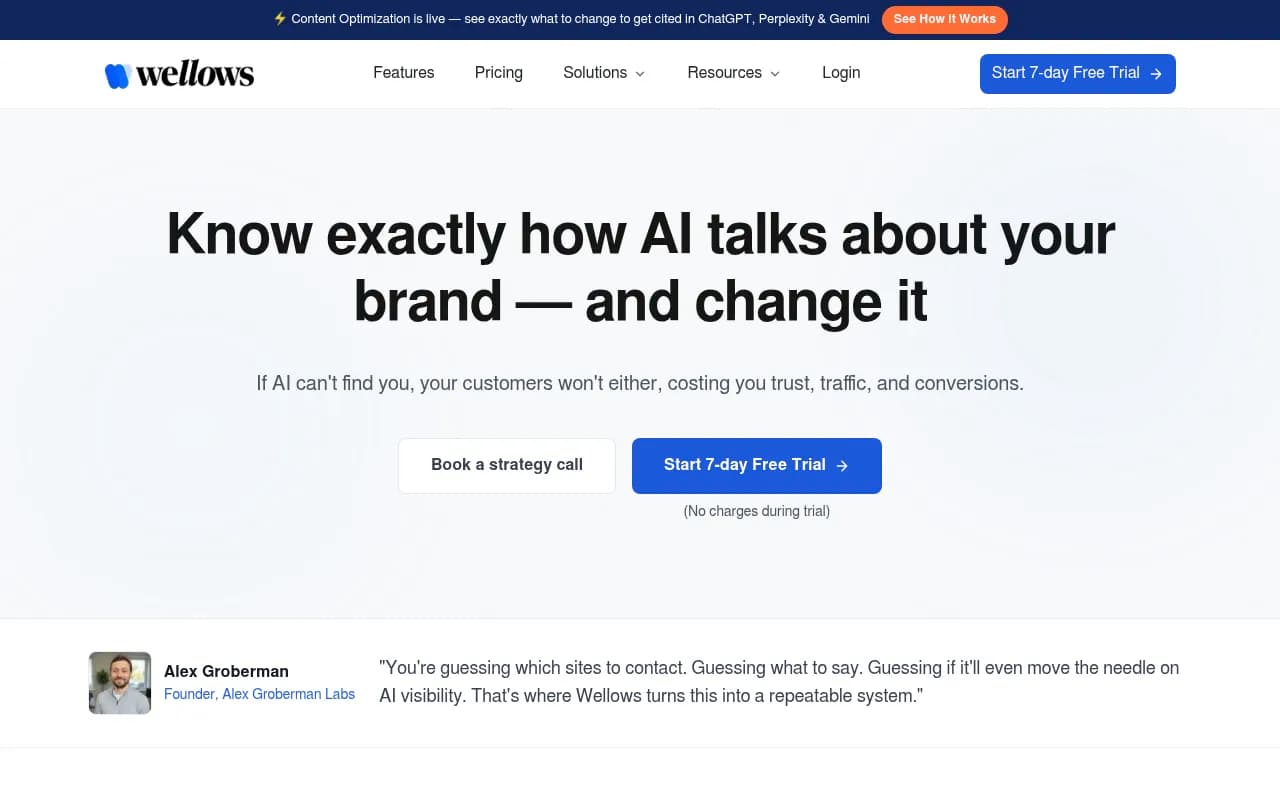
Wellows is positioned more as an execution platform. It connects visibility data to content optimization workflows, including citation building and content creation through its KIVA feature. Research from Wellows found that AI engines pulled from 48,560 unique domains over four months, with more than 33,000 of those domains cited fewer than 10 times -- which means the opportunity isn't just on major publisher sites. Wellows leans into that insight.
Promptwatch is the most complete of the three. It monitors AI visibility across 10 models (ChatGPT, Claude, Perplexity, Gemini, Grok, DeepSeek, Copilot, Meta AI, Mistral, and Google AI Overviews), but the core value isn't the monitoring. It's the loop: find gaps, create content that gets cited, track whether it worked.
Promptwatch has processed over 1.1 billion citations, clicks, and prompts, and that data underpins everything from its Answer Gap Analysis to its AI writing agent.

Feature-by-feature comparison
| Feature | Peec AI | Wellows | Promptwatch |
|---|---|---|---|
| AI model coverage | Multiple (ChatGPT, Perplexity, Gemini, others) | Multiple | 10 models incl. DeepSeek, Grok, Mistral |
| Brand mention tracking | Yes | Yes | Yes |
| Competitor visibility | Yes | Yes | Yes (heatmaps) |
| Source/citation analysis | Strong | Moderate | Strong (880M+ citations) |
| Answer gap analysis | Limited | Limited | Yes (core feature) |
| Content generation | No | Yes (KIVA) | Yes (AI writing agent) |
| AI crawler logs | No | No | Yes |
| Prompt volume/difficulty | Limited | No | Yes |
| Reddit/YouTube insights | No | No | Yes |
| ChatGPT Shopping tracking | No | No | Yes |
| Traffic attribution | No | No | Yes (GSC, snippet, server logs) |
| Multi-language/region | Yes (EU-focused) | Limited | Yes |
| Agency/white-label | Limited | Limited | Yes (custom plans) |
| Free trial | Yes | Yes | Yes |
The table tells a clear story. Peec AI and Wellows each do certain things well, but neither covers the full workflow. Promptwatch is the only one that goes from "where am I invisible?" all the way to "here's the content that will fix it, and here's proof it worked."
Where Peec AI is genuinely strong
Peec AI's strength is source-level intelligence. It shows you which domains AI models are pulling from, how citation patterns shift over time, and where competitors are gaining ground. For teams that want to understand the citation landscape in detail, it's a useful tool.
It also has solid multi-language support, which makes it a reasonable choice for international brands, particularly those operating in European markets where EU data compliance matters.
The limitation is that Peec AI is essentially a monitoring dashboard. It shows you the problem. It doesn't help you solve it. Teams using Peec AI typically end up exporting data and then figuring out content strategy separately, in a different tool, with a different workflow. That gap between insight and action is where a lot of potential improvement gets lost.
Where Wellows fills a gap
Wellows recognized that "monitoring only" wasn't enough and built content workflows into the platform. The KIVA-led content creation feature is designed to connect visibility gaps directly to content production, and the citation-building component addresses the long-tail domain opportunity that Wellows' own research surfaced.
That's a meaningful step forward compared to Peec AI. If your team is already comfortable with the analytics side and mainly needs help executing content changes, Wellows is worth evaluating.
The trade-off is depth on the analytics side. Wellows doesn't have the same granularity on prompt intelligence, competitor heatmaps, or traffic attribution that more specialized platforms offer. It's a reasonable middle ground, but it's not the most complete option.
Where Promptwatch goes further
The honest answer is that Promptwatch was built around a different question than its competitors. Most platforms ask: "Where does your brand appear in AI responses?" Promptwatch asks: "What would it take to actually improve that?"
That distinction shows up in a few specific ways.
Answer gap analysis
This is the feature that separates Promptwatch from monitoring-only tools. It shows you exactly which prompts your competitors are visible for that you're not, and what content your site is missing that would make AI models more likely to cite you. It's not a generic content gap report -- it's grounded in actual citation data from 880M+ analyzed citations.
AI writing agent
Once you know what's missing, Promptwatch's built-in writing agent generates articles, listicles, and comparisons designed to get cited. The content is informed by prompt volumes, persona targeting, and competitor analysis. This is different from a generic AI writer -- it's specifically engineered for AI search citation, not just keyword optimization.
Crawler logs
Promptwatch shows you real-time logs of AI crawlers (ChatGPT, Claude, Perplexity, etc.) hitting your website -- which pages they read, how often they return, and any errors they encounter. Neither Peec AI nor Wellows has this. It's the kind of technical visibility that helps you understand why AI models are or aren't citing your content.
Traffic attribution
Knowing your AI visibility score is useful. Knowing whether that visibility is actually driving traffic and revenue is what makes the data actionable. Promptwatch connects AI citations to real traffic through a code snippet, Google Search Console integration, or server log analysis. That closes the loop in a way that neither Peec AI nor Wellows can.
Prompt intelligence
Promptwatch includes volume estimates and difficulty scores for individual prompts, plus query fan-outs that show how one prompt branches into sub-queries. This lets teams prioritize high-value, winnable prompts instead of spreading effort evenly across everything.
Pricing comparison
| Plan | Peec AI | Wellows | Promptwatch |
|---|---|---|---|
| Entry level | Varies | Varies | $99/mo (Essential) |
| Mid tier | Varies | Varies | $249/mo (Professional) |
| Business tier | Varies | Varies | $579/mo (Business) |
| Agency/Enterprise | Available | Available | Custom pricing |
| Free trial | Yes | Yes | Yes |
Promptwatch's pricing is transparent and tiered by sites, prompts, and articles. The Essential plan at $99/month covers one site, 50 prompts, and 5 articles per month. Professional at $249/month adds crawler logs, state/city tracking, and scales to 150 prompts. Business at $579/month handles 5 sites and 350 prompts. Annual billing brings those numbers down further.
Who should use which tool
This isn't a case where one tool is objectively right for everyone. Here's a practical breakdown.
Use Peec AI if your primary need is source-level citation intelligence and competitive monitoring, you're operating in European markets where EU compliance matters, and your team has a separate workflow for acting on the data you collect.
Use Wellows if you want a single platform that handles both monitoring and basic content execution, you don't need deep prompt analytics or traffic attribution, and you're comfortable with a tool that's still building out its analytics depth.
Use Promptwatch if your goal is actually improving AI search visibility (not just measuring it), you want to connect citation data to content creation and then to traffic attribution, and you need the most complete feature set available in one platform. It's the right choice for marketing teams, SEO teams, and agencies that need to show results, not just reports.
The monitoring-only trap
One thing worth naming directly: a lot of teams buy an AI visibility tool, get a dashboard full of data, and then... don't know what to do with it. This is the monitoring-only trap. You can see that you're invisible for 40 prompts your competitors own. You can see which domains are getting cited instead of yours. But the tool doesn't tell you what to write, doesn't help you write it, and doesn't tell you whether what you wrote made a difference.
Peec AI and, to a lesser extent, Wellows both have this problem. The data is real and useful. The path from data to action is left to the user.
Promptwatch was designed specifically to avoid this. The Answer Gap Analysis, the AI writing agent, and the traffic attribution aren't separate features -- they're a connected workflow. Find the gap, create the content, measure the result. That cycle is what makes it an optimization platform rather than a monitoring dashboard.
A note on the broader market
Peec AI and Wellows aren't the only alternatives worth knowing about. A few other tools in this space are worth a quick mention depending on your specific needs.
For teams that want deep enterprise-grade visibility, Profound is worth evaluating.
For agencies managing multiple clients, Search Party and Otterly.AI are lighter-weight options.
Search Party
For teams that want traditional SEO data alongside AI visibility, Semrush and Ahrefs have added AI monitoring features, though both use fixed prompt sets and neither offers the depth of a dedicated GEO platform.
None of these close the full loop the way Promptwatch does, but they're worth knowing about if you're evaluating the space broadly.
Bottom line
Peec AI is a capable monitoring tool. Wellows adds some execution capability. But if you're a team that needs to actually move the needle on AI search visibility -- not just report on it -- Promptwatch is the most complete option available in 2026.
The difference comes down to what happens after you see the data. Most platforms stop there. Promptwatch keeps going: it shows you what to create, helps you create it, and then proves whether it worked. For teams with real goals attached to AI visibility, that's not a nice-to-have. It's the whole point.