Key Takeaways
- Rankscale uses a credit-based pricing model starting at €20/mo, while Gauge offers plan-based pricing from $99/mo -- Rankscale is cheaper for light usage, Gauge better for predictable budgets
- Gauge includes built-in AI content generation (3-18 articles/mo depending on plan), while Rankscale focuses purely on monitoring and analysis without content creation
- Both platforms track the same 10 AI models (ChatGPT, Perplexity, Claude, Gemini, etc.), but Rankscale emphasizes deep citation analysis while Gauge emphasizes actionable recommendations
- Gauge's Starter plan only monitors ChatGPT, making it a limited entry point -- Rankscale's Essentials tier covers all models from day one
- Rankscale appears to have stronger citation detection accuracy (near 100% in third-party testing), while Gauge positions itself as a complete "toolkit" with content audit and optimization features
- For teams that just need tracking: Rankscale is more cost-effective. For teams that want monitoring plus content help: Gauge's integrated approach saves tool-switching
Overview
Both Rankscale and Gauge tackle the same problem: helping brands understand and improve how they show up when people ask ChatGPT, Perplexity, Claude, or other AI models for recommendations. As AI search becomes a primary discovery channel, being invisible in these answers means losing customers to competitors who are cited.
The core difference comes down to scope. Rankscale is built as a monitoring and analysis platform -- it tells you where you're mentioned, where you're not, what content is being cited, and how you compare to competitors. Gauge positions itself as a "complete toolkit" that not only tracks visibility but also generates optimized content and provides specific on-site and off-site recommendations to close the gaps.
Rankscale overview
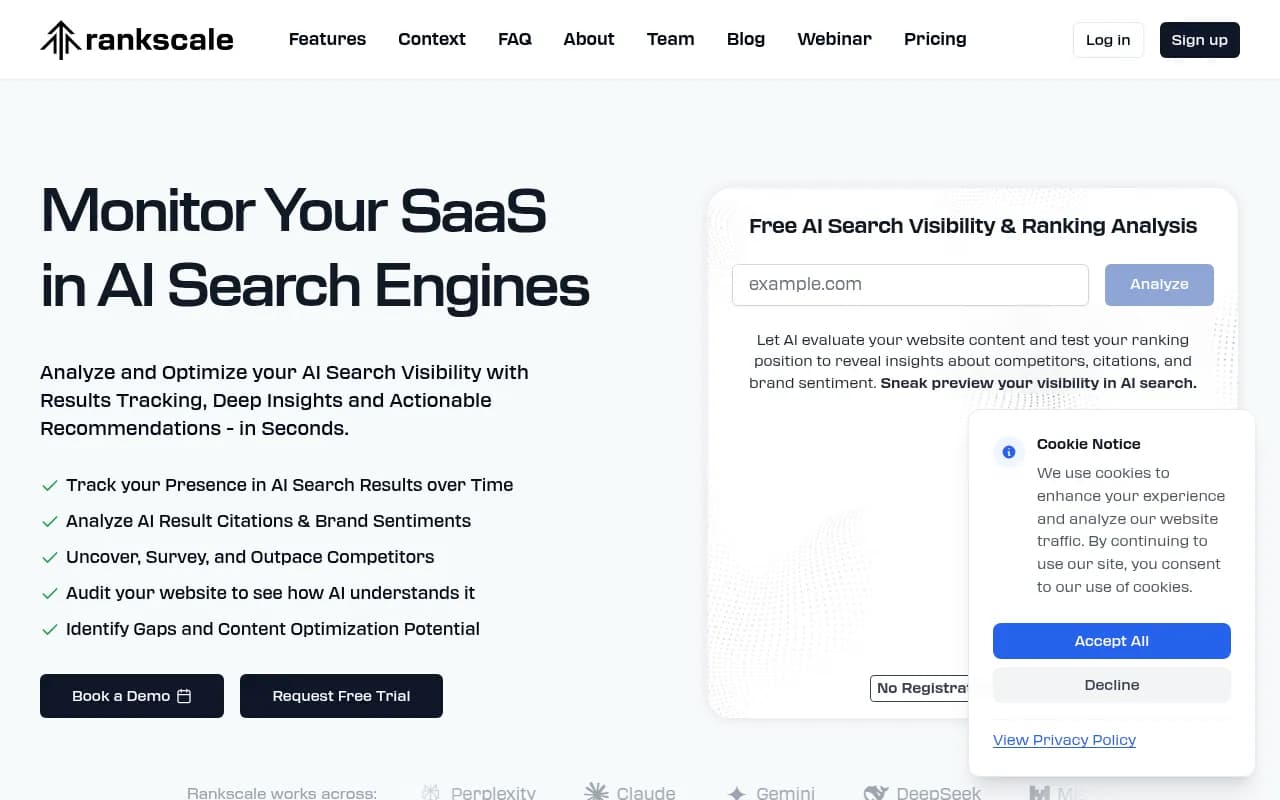
Rankscale is a European AI visibility platform (based in the EU) that focuses on deep citation analysis and competitor benchmarking across 10 AI models. It uses a credit-based pricing system where each prompt query consumes credits, giving you flexibility to scale usage up or down. The platform emphasizes accuracy -- third-party testing by Coalition Technologies found near 100% mention and citation detection accuracy across 2,700+ prompt pulls.
Key strengths: granular citation tracking, competitor heatmaps, website audits that show how AI engines understand your content, and flexible credit-based billing that works well for agencies or brands with variable monitoring needs.
Gauge overview
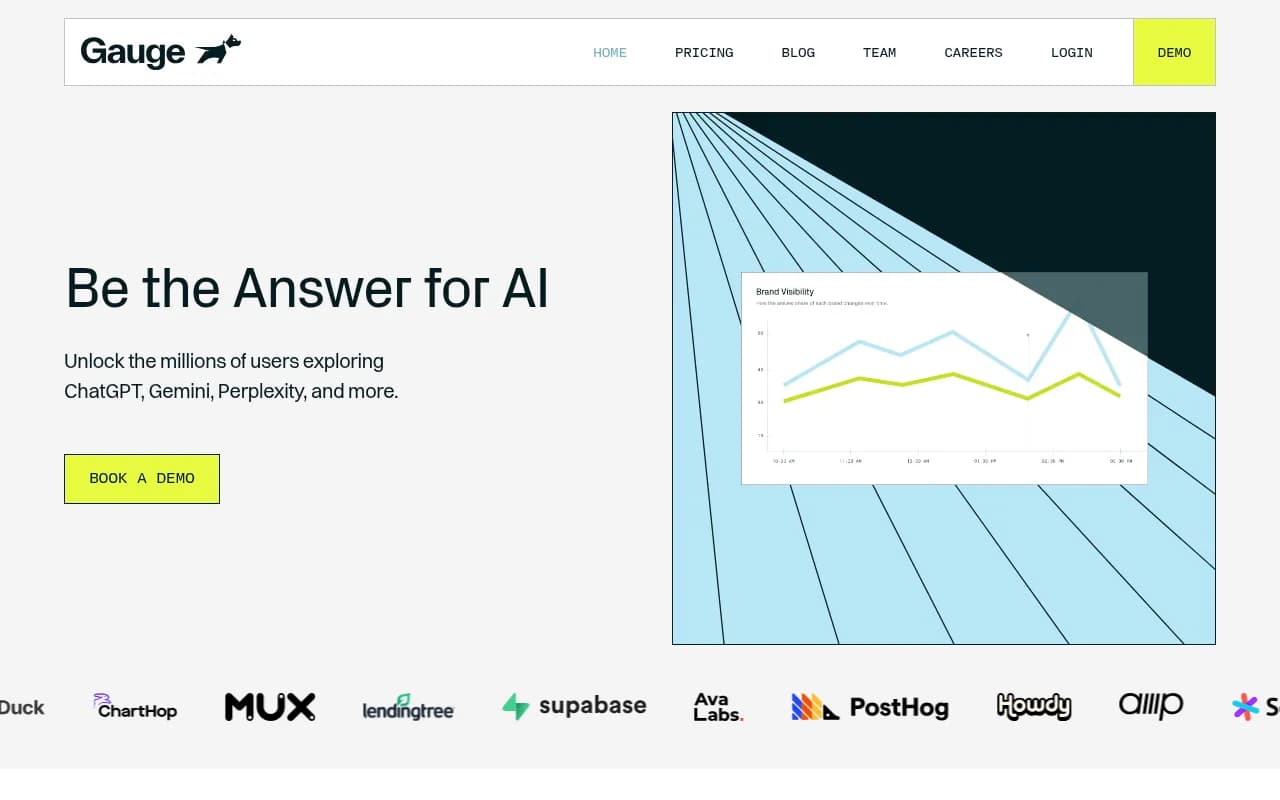
Gauge is a US-based AI visibility platform that combines monitoring with content optimization. Beyond tracking where your brand appears in AI answers, Gauge includes an AI writing agent that generates articles designed to improve your citations. The platform is used by companies like MotherDuck, Supabase, and Howdy, and positions itself around a "Track, Understand, Act" workflow.
Key strengths: built-in content generation, actionable on-site/off-site recommendations, Reddit and social source tracking, and a unified interface that handles both analysis and optimization without needing separate tools.
Side-by-side comparison
| Feature | Rankscale | Gauge |
|---|---|---|
| Pricing model | Credit-based (€20-€500+/mo) | Plan-based ($99-$599+/mo) |
| Free tier | No (trial available) | Yes (Starter plan) |
| AI models tracked | 10 (ChatGPT, Perplexity, Claude, Gemini, DeepSeek, Mistral, Grok, Copilot, AI Overviews, AI Mode) | 10 (same coverage) |
| Content generation | No | Yes (3-18 articles/mo) |
| Citation analysis | Deep citation tracking with near 100% accuracy | Citation tracking included |
| Competitor tracking | Yes (heatmaps, benchmarking) | Yes (gap analysis) |
| Reddit/social tracking | Not explicitly mentioned | Yes |
| Website audit | Yes (shows how AI understands your site) | Yes (content audit) |
| Tracking frequency | Varies by plan (daily to weekly) | Not specified |
| Multi-brand support | Yes (varies by tier) | Yes (varies by tier) |
| API access | Not mentioned | Not mentioned |
| Entry-level limitation | All models from Essentials tier | Starter plan = ChatGPT only |
| Best for | Agencies, variable usage, deep analysis | In-house teams, content creation, all-in-one |
Pricing comparison
The pricing structures are fundamentally different, which makes direct comparison tricky.
| Plan | Rankscale | Gauge |
|---|---|---|
| Entry tier | Essentials: €20/mo (credit-based, all models) | Starter: $99/mo (ChatGPT only, 100 prompts, 3 articles) |
| Mid tier | Professional: pricing varies by credits | Growth: $599/mo (all models, 600 prompts, 18 articles) |
| High tier | Business: pricing varies by credits | Enterprise: custom pricing |
| Enterprise | Custom pricing | Custom pricing |
Rankscale's credit system means your actual cost depends on how many prompts you run and how often. If you're tracking 50 prompts weekly, you might stay under €100/mo. If you're running 500 prompts daily across multiple brands, you'll burn through credits fast and land in the €300-500+ range.
Gauge's plan-based pricing is more predictable but has a catch: the $99/mo Starter plan only monitors ChatGPT. To track all 10 AI models, you need the $599/mo Growth plan. That's a big jump. The upside is you get 18 AI-generated articles per month at that tier, which could replace a separate content tool.
Verdict: For light usage or agencies billing clients per project, Rankscale's credit model is more economical. For teams that want predictable monthly costs and built-in content generation, Gauge's Growth plan makes sense despite the higher price.
AI model coverage
Both platforms track the same 10 AI models:
- ChatGPT (OpenAI)
- Perplexity
- Claude (Anthropic)
- Gemini (Google)
- DeepSeek
- Mistral
- Grok (xAI)
- Microsoft Copilot
- Google AI Overviews
- Google AI Mode
The difference is in access tiers. Rankscale gives you all 10 models starting from the €20/mo Essentials plan. Gauge locks 9 of the 10 models behind the $599/mo Growth plan -- Starter subscribers only get ChatGPT.
This matters because AI model usage varies by audience. If your customers use Claude or Perplexity heavily, a ChatGPT-only plan leaves you blind to most of your actual AI search traffic.
Verdict: Rankscale wins on entry-level model coverage. Gauge's Starter tier is too limited for serious AI visibility work.
Citation and mention tracking
Both platforms detect when your brand is mentioned or cited in AI-generated answers, but Rankscale emphasizes accuracy and depth.
Rankscale delivered near 100% mention and citation detection accuracy in third-party testing by Coalition Technologies (2,700+ prompt pulls). The platform provides granular citation analysis -- not just "you were mentioned" but which specific pages were cited, what context they appeared in, and how prominently.
Gauge also tracks mentions and citations but focuses more on the "so what" -- what content gaps exist, what competitors are doing better, and what actions you should take. The citation data is there, but it's packaged as part of a broader optimization workflow rather than as a standalone deep-dive.
Verdict: If you need forensic-level citation data for reporting or analysis, Rankscale is stronger. If you want citation insights translated into action items, Gauge's approach is more digestible.
Content generation and optimization
This is where the platforms diverge sharply.
Rankscale does not include content generation. It tells you what's missing and what competitors are doing, but you're on your own to create the content. The platform provides website audits that show how AI engines understand your existing content, which helps you optimize what you have, but there's no AI writing agent.
Gauge includes an AI content generator that produces articles designed to improve your AI search visibility. Depending on your plan, you get 3-18 articles per month. The content is grounded in the gap analysis Gauge surfaces -- it's not generic SEO filler, but articles targeting the specific prompts and topics where you're currently invisible.
Gauge also provides on-site and off-site recommendations: which pages to update, which affiliates or publishers to target, which Reddit threads to engage with.
Verdict: Gauge is the clear winner if you want an all-in-one platform that handles both tracking and content creation. Rankscale requires you to bring your own content team or use a separate tool.
Worth noting: if you're looking to track AI visibility and also need a content generation engine grounded in real citation data, Promptwatch offers a similar integrated approach with an AI writing agent that creates content based on 880M+ citations analyzed.

Competitor analysis
Both platforms let you benchmark against competitors, but the presentation differs.
Rankscale uses competitor heatmaps that show where you're winning vs losing across different prompts and AI models. You can see which competitors dominate specific queries and drill into what content they're getting cited for. The focus is on visual comparison and identifying patterns.
Gauge emphasizes gap analysis -- it surfaces the prompts where competitors are visible but you're not, then helps you prioritize which gaps to close first. The competitor data feeds directly into content recommendations.
Verdict: Tie. Rankscale's heatmaps are better for high-level strategic review. Gauge's gap analysis is better for tactical execution.
Tracking frequency and flexibility
Rankscale offers different tracking frequencies depending on your plan tier -- daily monitoring on higher tiers, less frequent on lower tiers. The credit-based model also means you can run ad-hoc queries whenever you want (as long as you have credits).
Gauge's tracking frequency isn't clearly specified on their site, which is a red flag. Plan-based pricing usually means fixed refresh schedules, but without transparency on how often data updates, it's hard to know if you're getting real-time insights or weekly snapshots.
Verdict: Rankscale wins on transparency and flexibility.
User interface and ease of use
Both platforms aim for clean, modern interfaces, but the workflows reflect their different philosophies.
Rankscale is built for analysis. You get dashboards, charts, heatmaps, and detailed breakdowns. It's powerful but assumes you know what you're looking for. If you're an agency analyst or in-house SEO lead who lives in data, you'll feel at home. If you're a marketing generalist who just wants to know "what should I do next," the interface can feel overwhelming.
Gauge is built around a "Track, Understand, Act" flow that guides you from data to decisions. The interface surfaces recommendations and next steps more prominently. It's more opinionated about what matters, which makes it easier to use but potentially less flexible for custom analysis.
Verdict: Gauge is easier for beginners. Rankscale is more powerful for advanced users.
Reddit and social source tracking
Gauge explicitly mentions Reddit and social source tracking as part of its toolkit. This matters because AI models frequently cite Reddit threads, YouTube videos, and other community content when answering questions. If you're not monitoring those channels, you're missing a big piece of the puzzle.
Rankscale doesn't highlight Reddit or social tracking in its feature set. It focuses on owned content (your website) and competitor websites.
Verdict: Gauge wins if you care about social and community-driven citations.
Website audit capabilities
Both platforms offer website audits, but with different angles.
Rankscale's audit shows how AI engines understand your content -- what they're extracting, what they're ignoring, and where there are gaps in coverage. It's diagnostic: "here's what the AI sees when it crawls your site."
Gauge's audit is more prescriptive: "here's what's wrong with your existing pages and how to fix them." It ties directly into the content optimization workflow.
Verdict: Tie. Choose based on whether you want diagnostic depth (Rankscale) or actionable fixes (Gauge).
Reporting and analytics
Rankscale provides detailed analytics dashboards with citation breakdowns, competitor benchmarks, and trend tracking over time. The credit-based model means you can run custom queries and build your own reports.
Gauge's reporting isn't as prominently featured on their site, which suggests it's more of a "here's your dashboard" approach than a custom reporting engine.
Verdict: Rankscale is stronger for teams that need custom reports or client deliverables.
Integration and API
Neither platform prominently advertises API access or third-party integrations. This is a gap for both -- if you want to pipe AI visibility data into your existing analytics stack or CRM, you're likely stuck with manual exports.
Pros and cons
Rankscale pros
- Credit-based pricing is cost-effective for variable usage
- Near 100% citation detection accuracy (third-party tested)
- All AI models available from the cheapest tier
- Deep citation analysis and competitor heatmaps
- Flexible tracking frequency
- Strong for agencies and data-driven teams
Rankscale cons
- No built-in content generation
- Credit system can be confusing to budget
- Interface is analysis-heavy, not beginner-friendly
- No explicit Reddit or social source tracking
- Requires separate tools for content creation
Gauge pros
- Built-in AI content generation (3-18 articles/mo)
- Actionable recommendations, not just data
- Reddit and social source tracking
- Easier workflow for non-technical users
- All-in-one platform reduces tool sprawl
- Used by recognizable brands (MotherDuck, Supabase)
Gauge cons
- Starter plan only monitors ChatGPT (huge limitation)
- $599/mo jump to get all AI models is steep
- Less transparency on tracking frequency
- Weaker on custom reporting and deep analytics
- Plan-based pricing less flexible than credits
Who should choose Rankscale
Pick Rankscale if:
- You're an agency managing multiple clients with variable monitoring needs
- You already have a content team or tool and just need tracking
- You need forensic-level citation data for reporting
- You want all AI models monitored from day one without paying $600/mo
- You prefer flexible, credit-based billing over fixed plans
- You're comfortable with data-heavy interfaces and building your own workflows
Who should choose Gauge
Pick Gauge if:
- You're an in-house marketing team that needs both tracking and content creation
- You want a guided workflow from insights to action
- Reddit and social citations matter to your brand
- You're willing to pay $599/mo for an all-in-one solution
- You don't have bandwidth to manage multiple tools
- You prefer predictable monthly costs over usage-based billing
Final verdict
Rankscale and Gauge are both solid AI visibility platforms, but they serve different needs.
Rankscale is the better choice for teams that want deep, accurate tracking and already have content creation handled. The credit-based pricing is more economical for light to moderate usage, and you get full AI model coverage from the start. It's built for people who live in data and want maximum flexibility.
Gauge is the better choice for teams that want an all-in-one platform that handles both monitoring and optimization. The built-in content generator and actionable recommendations make it easier to close visibility gaps without juggling multiple tools. But the $599/mo price point for full model coverage is a barrier, and the ChatGPT-only Starter plan is too limited to be useful.
If you're just starting with AI visibility tracking and have a small budget, Rankscale's €20/mo Essentials tier is the smarter entry point. If you're ready to invest in a complete optimization platform and want content help included, Gauge's Growth plan delivers more value despite the higher cost.
One-liner: Rankscale wins on cost and flexibility for tracking; Gauge wins on integrated content optimization for teams that want one tool to rule them all.